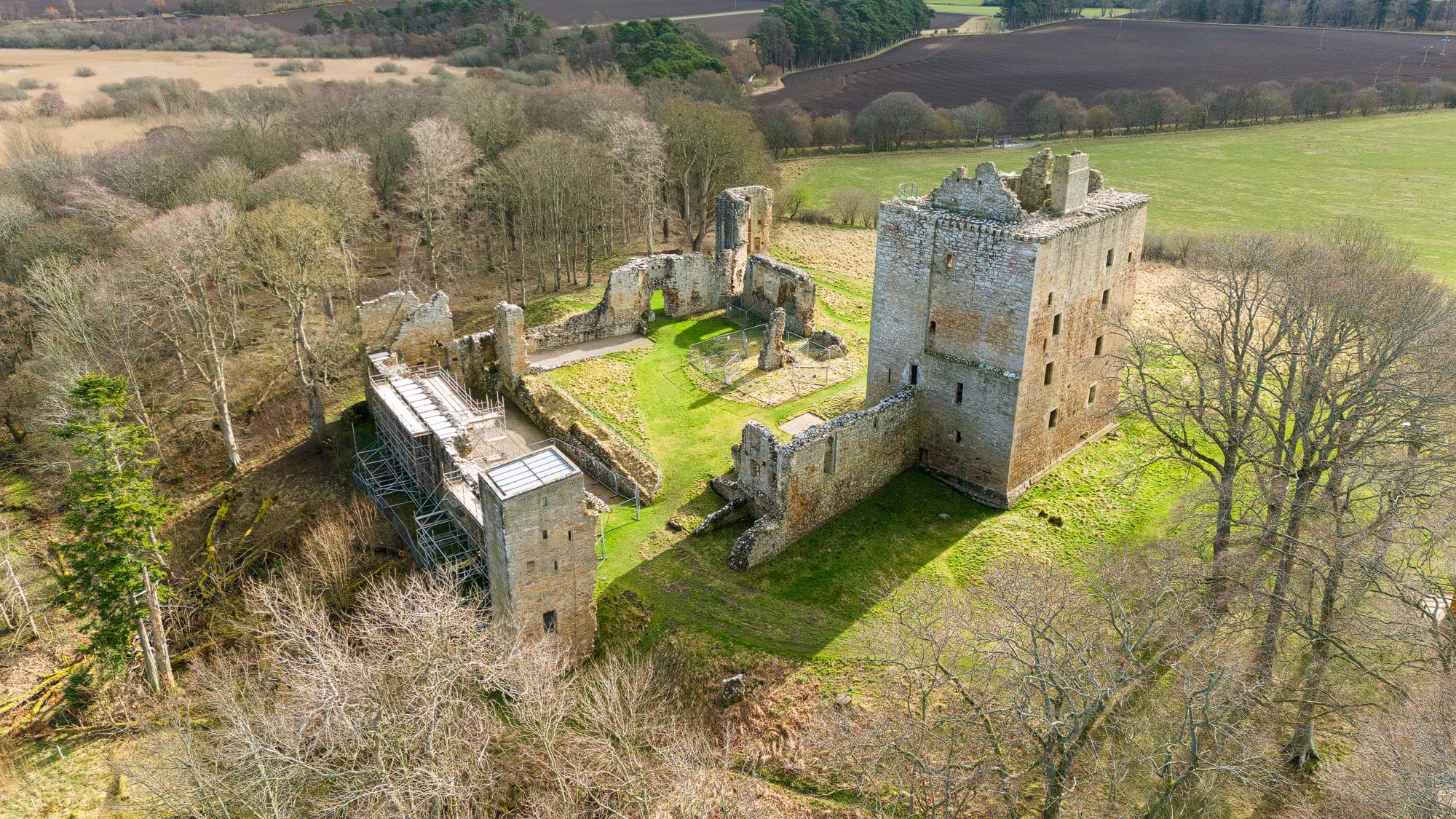
Home to the bishops of Moray for over 500 years, Spynie Palace is an outstanding ruin to visit in North Moray, between Elgin and Lossiemouth. I had been here before as a child and loved the place, but it had been at least 30 years since my last visit, so I thought taking my own young family here would be fun.

Our visit to Spynie Palace
My family and I visited Spynie Palace in mid-March on a lovely sunny Sunday morning. The site was closed for the winter season (from the 1st of October to the 28th of March), but it was still open to visitors. However, all of the facilities are closed.
This included the main car park, which was closed with a bar crossing the entrance. We opted to park at the nearby passing place, which was fairly big, so we thought it would be OK for a quick visit. From the closed car park, we made our way down the short path and arrived at the impressive ruin of Spynie Palace.


The path leads up to the ticket office, a modern wooden building, where you would purchase your ticket during the open season.

David's Tower
David's Tower dominates the ruin with its sheer size and rectangular shape. For a 500-year-old building, it's in fantastic shape. Its impressive dimensions are 19 m by 13.5 m and 22 m in height! The coats of arms of the three bishops responsible for building works at Spynie can be seen carved on the south wall:
-
Bishop David Stewart
-
Bishop Patrick Hepburn
-
Bishop William Tulloch
The royal arms of Scotland can also be seen.


As we visited in the closed season, the tower was inaccessible to us; it would have been great to see inside, particularly the vaulted basement, so we will likely be back this summer to explore the interior.
We made our way around the entire site, which included:
-
The East Gate
-
The South Range
-
The Little Tower
-
The Water Tower
-
The Great Hall
-
The Curtain Wall
Many areas were off-limits for repairs, but it's great to see Historic Scotland taking care of this impressive ruin. All of the external areas were still visible but had scaffolding.
The site contains informational boards about the ruin; one has an artist's impression showing that Loch Spynie once came up to the palace walls.


History of Spynie Palace
Spynie Palace, located in Moray, Scotland, served as the residence of the bishops of Moray for over five centuries, from its establishment in the late 12th century until 1682. Initially positioned beside Spynie Loch, the palace was at the heart of a thriving settlement, which has since disappeared along with the loch itself. The site now features the ruins of what is the largest surviving medieval bishop's house in Scotland.
The origins of the Bishopric of Moray date back to the 1120s, with the bishops initially having no fixed residence and moving between various locations. Formal settlement at Spynie was authorized by Pope Innocent III in 1206. Bishop Brice established the cathedral church around 1207, and the episcopal palace remained there even after Elgin Cathedral was built in Elgin in 1224. The first structures were likely wooden, with stone buildings appearing in the 13th century.

Bishop David Stewart
Significant development at Spynie occurred throughout the medieval period. By the 14th century, stone buildings replaced earlier wooden ones, with a notable construction being David's Tower in the late 15th century. This tower, one of the largest in Scotland, was commissioned by Bishop David Stewart and completed by his successors. Along with other constructions over the years, it showcases the architectural evolution and importance of the palace.
It remained an Episcopal residence until 1682 when the Crown annexed it. The last significant developments were undertaken by Bishop Patrick Hepburn, who anticipated troubles ahead.
Throughout its history, Spynie Palace witnessed numerous historical events, including sieges and involvement in the Rough Wooing. Bishop William Hay refused to take an oath of allegiance to King William and Queen Mary and was expelled from Spynie; he was the last bishop.
The palace eventually fell into decay, leading to its plundering for building materials until the early 19th century. Restoration efforts in the late 20th century stabilized the structure, and it was opened to the public by Historic Scotland in 1994.
Spynie Palace's history reflects its importance as a religious, political, and residential site in Scotland's medieval landscape, offering insight into the ecclesiastical and social dynamics of the time.

FAQs on Spynie Palace
Can I visit Spynie Palace during the out-of-season?
Yes, the ruin can be visited out of season for free, but the building interiors are locked. So you cannot enter David's Tower or speak to any staff about the ruin. The toilets are also closed.
How to get to Spynie Palace
Spynie Palace is easily accessed by travelling north out of Elgin towards Lossiemouth on the A941. Around halfway between the towns, you will see a right turn to Spynie Palace.
There is a large car park here for visitors in the open season. Out of season, you will have to be a little more creative with your parking, but there is a large passing place nearby that could act as a quick parking space in a pinch.
Driving by car is the easiest way to get to Spynie Palace, but catching a bus from Elgin to Lossiemouth is also feasible.


How much does it cost to visit Spynie Palace?
Costs are as follows:
Adult (16-64yrs) - £7.50
Concession (65yrs+ and unemployed) - £6.00
Child (7-15yrs) - £4.50
Family (one adult, two children) - £15.00
Family (two adults, two children) - £21.50
Family (two adults, three children) - £25.50
Visiting out of season is free, but many areas are closed.
Who owns Spynie Palace?
Historic Environment Scotland is the current caretaker of Spynie Palace.
What wildlife can be seen at Spynie Palace?
We saw many birds around the castle ruin. The area seems well-known for barn owls and pine martens.
What other attractions are near Spynie Palace?
If you're in the mood for another impressive ruin, Duffus Castle is a short drive from Spynie Palace. Lossiemouth, with its beautiful beaches, lighthouse, bridge, and ice cream shop, is nearby. Elgin Cathedral is another fine ruin just a 5/10 minute drive south into Elgin.
Moray has no shortage of castles to visit; please see my guide to castles in Moray for more information.


Videos of our visit to Spynie Palace
Here is a quick drone video flying around the ruin:
Key information on Spynie Palace
-
Spynie Palace was home to the bishops of Moray for 500 years.
-
The external parts of the palace can be visited out of season.
-
The open season is between the 29th of March to the 30th of September.
-
The site is ruined today but still has a couple of interior areas.
-
Many fine details are still visible on the ruin; the east gate is particularly impressive.
-
Dogs are not allowed within the roofed areas.


Conclusion
Spynie Palace is often overlooked by tourists, but it's one of the most impressive medieval ruins in Scotland and well worth your time and money. We loved our little Easter visit to the palace and opted to head next to the beautiful Roseisle Beach.


Leave a comment below