
The Second Reformer: Scotland's Most Powerful Churchman After John Knox
In the turbulent decades of the seventeenth century, when the future of Scotland's Kirk hung in the balance against the impositions of an English king, one man rose above the fray as the foremost defender of Presbyterian faith. Alexander Henderson - theologian, diplomat, Moderator, and Covenanter - shaped the religious and political landscape of not just Scotland, but the whole of Britain. Described by his contemporaries as "incomparably the ablest man of us all, for all things," Henderson is remembered as the second great reformer of the Scottish Church, surpassed in stature only by John Knox himself.
Early Life and Education
Alexander Henderson was born in 1583 in Guthrie, in the parish of Creich in northern Fife - a region whose rolling farmland and quiet kirks gave little hint of the storms to come. Of his family origins, history records little with certainty, though tradition holds that he was a cadet of the Hendersons of Fordel, a suggestion lent weight by the fact that he was later buried in that family's lair at Greyfriars Kirkyard in Edinburgh.
Henderson entered St Salvator's College at the University of St Andrews in 1599 and graduated with his master's degree in 1603, a year that also saw him appointed as a Regent - a teaching fellow - at St Andrews, where he instructed students in logic and rhetoric. His early career placed him firmly within the establishment of the Church of Scotland as it existed under episcopal governance, and he was initially regarded as a supporter of that system.
A Conversion That Changed History
In 1612, Henderson was appointed minister at St Athernase Church in Leuchars, a handsome Romanesque building near the East Neuk of Fife that still stands today. His arrival was far from smooth - parishioners, alarmed by his perceived Episcopalian sympathies and unorthodox approach, reportedly barred the doors of the church against him. It was during this difficult period that Henderson underwent what would prove to be one of the most consequential personal transformations in Scottish history.
Slipping away to hear the celebrated minister Robert Bruce preach nearby, Henderson was struck to his core by Bruce's text from the Gospel of John: "He that entereth not in by the door, but climbeth some other way, the same is a thief and a robber." Contemporaries recorded that the fear of God came upon him. He emerged from the shadows, and in his own words became a repentant man. His conversion to Presbyterian principles was genuine and complete. He reconciled with his parishioners, settled into the life of a country minister, and presided over his Fife parish in relative peace for the next twenty-five years - years that would prove to be the calm before a very great storm.
The Prayer Book Riot and the National Covenant
By the 1630s, King Charles I had resolved to impose an Anglican-style prayer book and episcopal church government upon Scotland, a policy that provoked outrage across the kingdom. Henderson refused to procure copies of the new prayer book for his parish, was summoned to Edinburgh to account for his defiance, and there made a bold and spirited defence that won him national recognition as a leader of ecclesiastical resistance.
The flashpoint came on Sunday 23 July 1637, when the attempt to use the new prayer book in St Giles' Cathedral in Edinburgh sparked a full riot - tradition records that a market trader named Jenny Geddes hurled her stool at the Dean's head as he read from the hated text. The mood across Scotland was one of fury.
Henderson's response was to work quickly and brilliantly. Together with Archibald Johnston of Wariston, he drafted the document that became the National Covenant, basing it on an older covenant from 1581. On 28 February 1638, the Covenant was laid open for signing in Greyfriars Kirk in Edinburgh, and the great and the humble alike queued to put their names to it - some, by legend, signing in their own blood. The document declared the commitment of the Scottish people to the "true reformed religion" and rejected the King's innovations. In London, it was read as an act of open rebellion.
Moderator and Architect of Reform
Henderson's role in the months that followed was extraordinary. In November 1638, the first General Assembly of the Church of Scotland since 1618 opened in Glasgow with Henderson presiding as Moderator - a position to which he was appointed by acclaim. Over the course of the Assembly, he guided proceedings that abolished episcopacy in Scotland, deposed all the bishops appointed by the King, and excommunicated several of them as "vassals of tyranny." In London, these decisions were regarded as treasonous.
As the Bishops' Wars unfolded - two armed conflicts between Scotland and the Crown in 1639 and 1640 - Henderson was in the thick of the negotiations that followed Scotland's extraordinary military success, including the Treaty of Ripon, which saw Northumberland and County Durham temporarily ceded to Scottish control. In January 1639, he left Leuchars to become minister of St Giles' in Edinburgh, placing himself at the very heart of Scottish ecclesiastical life.
In 1640, Henderson was appointed Rector of Edinburgh University, and those who have studied his impact there regard it in the highest terms. The historian Grant wrote that Henderson "was the ablest educationist and the man of clearest insight of all who had to do with the college since its foundation." It is a measure of the man that even amid the chaos of war, covenanting, and diplomacy, he found time to reshape the university.
The Solemn League and Covenant
When England descended into civil war between the King and Parliament in 1642, Henderson was at the centre of Scotland's response. He led the majority of Scots to side with the English Parliament against Charles I - a momentous decision with consequences that would echo for decades. In 1643, acting for the third time as Moderator of the General Assembly, he unveiled the Solemn League and Covenant, a document intended to extend Presbyterian principles of church government across the whole of Britain.
Approved by the English Parliament, the Covenant brought Scotland into the Civil War on Parliament's side and secured the Scots a place at the Westminster Assembly of Divines - the body tasked with reconstituting church rule across the British Isles. Henderson served as a commissioner to that Assembly, and his principal achievement there was the drafting of the Directory for Public Worship, which replaced the hated prayer book as the guide to Reformed worship in England and Scotland alike.
He also authored significant works of polemic and theology during this period, including The Bishops' Doom (1638), Instructions for a Defensive Arms (1638), and The Government and Order of the Church of Scotland (1641). These tracts made the Presbyterian case with a clarity and force that earned Henderson his enduring reputation as the "Second Reformer."
A Final Mission and a Quiet Death
In the spring of 1646, as Charles I threw himself upon the mercy of the Scottish army besieging Newark, Henderson - by now gravely ill - was summoned to Newcastle by the King himself. Charles regarded Henderson as the most formidable mind in the Presbyterian camp and believed, perhaps naively, that the two men might find common ground. Henderson arrived in Newcastle in mid-May 1646 and was received warmly. But he quickly perceived that the King remained as unwilling as ever to accept Presbyterianism.
The two men conducted their debate in writing, exchanging eight papers between 29 May and 15 July - five from the King, assisted by Sir Robert Murray, and three from Henderson. It was a remarkable intellectual contest, conducted in the shadow of a war the King had lost, between a monarch who would die on the scaffold three years later and a theologian who would be dead before the summer ended. Henderson sailed back to Scotland, his health broken. He died at Edinburgh on 19 August 1646, eight days after his arrival. His death was mourned across the nation. His friend Robert Baillie wrote, on 7 August, that he had heard Henderson was dying - of heartbreak.
Legacy and Resting Place
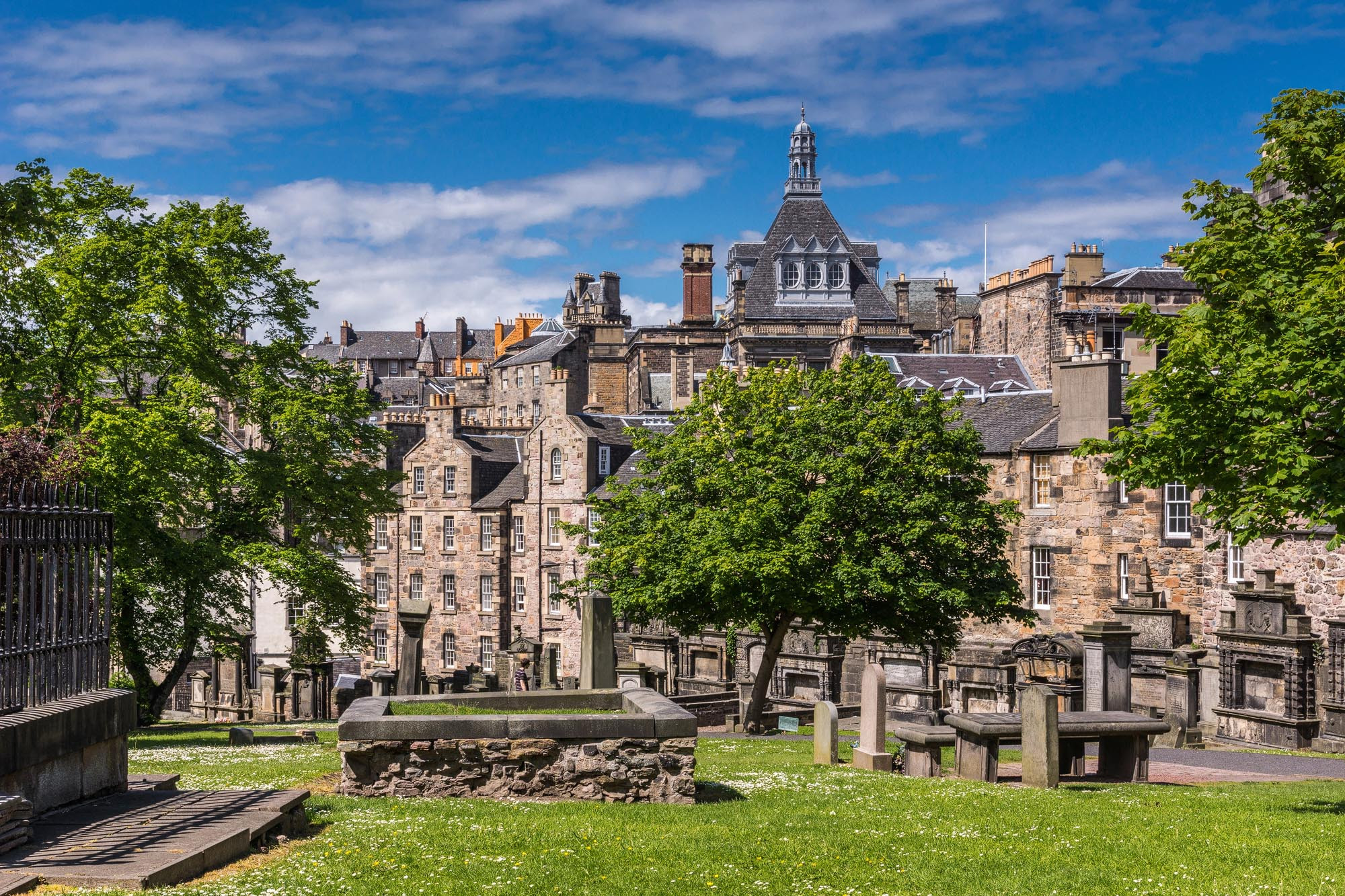
Alexander Henderson was buried in the south-west section of Greyfriars Kirkyard in Edinburgh, near the Adam mausoleum, in the burial ground of the Hendersons of Fordel - the family he had quietly claimed as his own. His death was described as an occasion of national mourning in Scotland. At the Restoration of Charles II in 1660, the inscriptions on his tombstone were obliterated as an act of political revenge; they were restored at the Glorious Revolution of 1688, when the Presbyterian settlement he had fought for was finally secured.
What Henderson achieved in his sixty-three years was remarkable: he helped draft the two most important constitutional documents in seventeenth-century Scotland; he served three times as Moderator of the General Assembly; he transformed Edinburgh University; he brokered treaties, led armies of persuasion through Europe's courts, and debated theology with a king. The portrait painted of him by Sir Anthony van Dyck - the same court painter who immortalised Charles I - shows a serious, austere man, clearly comfortable in the company of power. It is the face of someone who understood, more than almost anyone else of his generation, that ideas have consequences, and that the form of a church can shape the fate of nations.
Today, his grave in Greyfriars Kirkyard sits not far from the memorial to the Covenanters who suffered and died for the cause he championed. The old kirkyard, where the National Covenant itself was first signed in 1638, remains one of Edinburgh's most atmospheric historic sites - and the most fitting place to remember the man who, more than any other, made that day of signing possible.


