
The Flame that Lit Scotland's Reformation
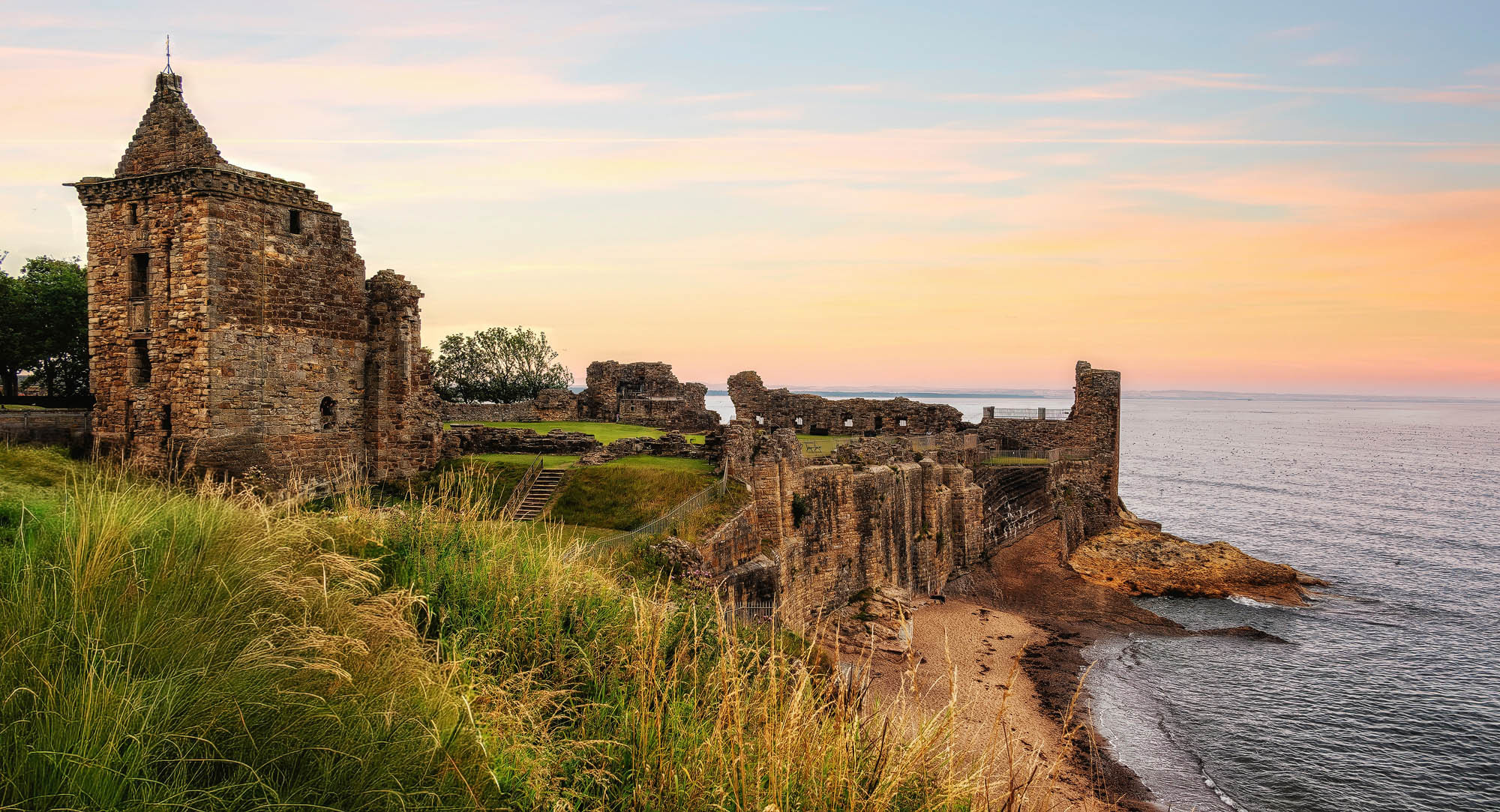
On a cold March morning in 1546, the cobbled streets of St Andrews witnessed one of the most pivotal moments in Scottish history. George Wishart, a 33-year-old scholar and preacher, was led to a stake outside the castle walls to be burnt alive for heresy. As flames consumed his body, Cardinal David Beaton watched from a castle balcony. Yet Wishart's death, far from silencing the Protestant cause, ignited a firestorm of reform that would transform Scotland forever. His final prophecy - that the Cardinal himself would soon face divine judgement - came true just three months later, galvanising a movement that would reshape the nation's soul.
Early Life and Education
George Wishart was born around 1513 at Pitarrow, a rural estate near Fordoun in Kincardineshire, not far from Montrose. He came from a younger branch of the Wisharts of Pitarrow, a family of some standing in northeast Scotland. His father, James Wishart, married Elizabeth Learmont in April 1512, and George was likely named after his maternal grandfather or granduncle, Prior George Leirmont. The Learmont connection would prove significant throughout his life.
Tragedy struck early when James Wishart died in May 1525, leaving the 12-year-old George to be raised by his mother Elizabeth and his uncle, Sir James Learmonth of Balcomie. This aristocratic upbringing ensured George received an excellent education. He demonstrated remarkable aptitude for languages, particularly Greek, which was still a relatively rare skill in early 16th-century Scotland.
Wishart's academic journey took him first to the University of Leuven in Belgium, from which he graduated in arts in 1531 or 1532. Some sources suggest he may have also studied at King's College, Aberdeen, though his name does not appear definitively in the college records. What is certain is that during his continental studies, Wishart was exposed to the revolutionary religious ideas sweeping through Europe. The Protestant Reformation, sparked by Martin Luther's 95 Theses in 1517, was gaining momentum, and the young Scottish scholar found himself drawn to these reformist doctrines.
The Dangerous Path of Teaching
By 1534, Wishart had returned to Scotland and secured a position as schoolmaster in Montrose. Here, his progressive educational methods soon attracted unwanted attention. He began teaching the New Testament in Greek to his pupils, a practice that allowed direct engagement with scripture without the mediation of the Catholic Church's Latin Vulgate translation. This was considered dangerously subversive.
In 1538, John Hepburn, Bishop of Brechin, summoned Wishart to answer charges of heresy. Rather than face trial in Scotland, where the stakes were literally life and death, Wishart fled to England. It was a pattern that would repeat throughout his life - the constant tension between his burning desire to spread reformed doctrine and the very real threat of execution.
His English refuge proved short-lived. In 1539, while preaching in Bristol, Wishart was again accused of heresy, this time for speaking against the worship and mediation of the Virgin Mary. He was forced to make a public recantation in the Church of St Nicholas, though how sincere this recantation was remains debatable. The experience of being questioned by Archbishop Thomas Cranmer must have been humiliating for the passionate young reformer.
Continental Influences and Scholarly Work
Between 1539 and 1540, Wishart travelled extensively in Germany and Switzerland, immersing himself in the centres of Protestant theology. It was during this period that he encountered the works of the great Swiss reformers - Heinrich Bullinger, Leo Jud, and others. Their theological positions, particularly those of Ulrich Zwingli and John Calvin, profoundly influenced Wishart's own understanding of reformed Christianity.
During this continental sojourn, Wishart undertook his most significant scholarly contribution to the Reformation. He translated the First Helvetic Confession of Faith from Latin into English. This confession, produced in 1536 by a Swiss committee including Bullinger, Jud, Myconius, Grynaeus, and Megander, was an attempt to unite Reformed and Lutheran Protestants under a common statement of belief. Wishart's translation, though not published until 1548 - two years after his death - was the first printed edition of this important document. It would serve as a unifying text during the early stages of the English Reformation under Edward VI.
By the end of 1542, Wishart had returned to England and secured a position at Corpus Christi College, Cambridge, where he spent about a year teaching. His pupil, Emery Tylney, later described him as a man of scholarly, earnest, and frugal life. During this Cambridge period, Wishart became acquainted with Hugh Latimer, another reformer who would himself later suffer martyrdom for his Protestant beliefs.
Return to Scotland and the Ministry of Fire
In 1543, Wishart returned to Scotland in the train of commissioners who had been appointed to arrange a marriage between Prince Edward of England and the infant Mary, Queen of Scots. The political climate in Scotland was tense and complex. The recent death of James V had left Scotland under a regency, and religious reform was beginning to gain traction among certain sections of the nobility and common people.
Wishart immediately resumed preaching in Montrose, but his activities soon expanded far beyond this single location. From 1544 onwards, he embarked on what can only be described as an itinerant evangelical ministry, travelling from east to west across Scotland. His preaching tours took him to Montrose, Dundee, Ayr, Perth, Edinburgh, Leith, and Haddington. Wherever he went, crowds gathered to hear this eloquent scholar explain scripture in terms they could understand.
His theological positions were uncompromising. At his trial, the charges against him would reveal the radical nature of his beliefs: he rejected auricular confession as a sacrament, denied the doctrine of free will, recognised the priesthood of all believing Christians, and rejected transubstantiation - the Catholic doctrine that the bread and wine literally become the body and blood of Christ. He proclaimed that the true Church existed wherever the Word of God was faithfully preached and the two dominical sacraments - baptism and communion - were rightly administered.
The Friendship with John Knox
It was during this period of itinerant preaching that Wishart formed his most significant relationship. A young Catholic priest named John Knox heard Wishart preach and was profoundly converted. The two men became inseparable, with Knox often seen in public bearing a two-handed sword, acting as bodyguard to the preacher whose life was constantly in danger.
Knox's later accounts provide many of the details we know about Wishart's final years. The older man clearly had a profound influence on the younger, and Knox's own career as the architect of the Scottish Reformation can be traced directly back to his discipleship under George Wishart. It is surely inconceivable that the preaching and example of Wishart did not have a strengthening effect on Knox, whom providence would use to secure the Protestant Reformation in Scotland.
Narrow Escapes and Growing Danger
Wishart's evangelical success made him a marked man. His faithful labours in Dundee particularly enraged Cardinal David Beaton, Scotland's most powerful churchman and the Archbishop of St Andrews. Beaton persuaded a priest named John Weighton to disguise himself and attend Wishart's preaching with the intention of assassinating him.
The plot was discovered, but Wishart's response revealed his Christian character. Rather than allow the outraged congregation to harm the would-be assassin, Wishart personally protected the man's life, displaying the compassion he preached. This incident, however, convinced Wishart to leave Dundee.
During his Dundee ministry, Wishart had also fearlessly ministered to those sick and dying of the plague, a service that earned him the people's love but further exposed him to danger. The Wishart Arch, also known as the East Port or Cowgate Port, is the only surviving portion of Dundee's town walls, and tradition holds that George Wishart preached from it in 1544 to plague victims outside the walls.
After another narrow escape from Cardinal Beaton's horsemen at Montrose, Wishart seems to have sensed that his time was running out. He is recorded as stating: "I know assuredly my travel is nigh an end. Neither shall this belong in doing, for there shall not many suffer after me."
Betrayal and Arrest
In December 1545, Wishart was preaching at Ormiston in East Lothian when his enemies finally closed in. Patrick Hepburn, third Earl of Bothwell, who was the Sheriff of East Lothian, took Wishart into custody. Bothwell had given his word that he would protect Wishart from Cardinal Beaton and would not hand him over to the Catholic authorities.
It was a promise he did not keep. Wishart was first transferred to Edinburgh Castle in late January 1546, and then handed over to Cardinal Beaton himself at St Andrews Castle. The betrayal must have been bitter, but Wishart faced his fate with remarkable courage and grace.
The Trial
The trial that followed was little more than a show. Cardinal Beaton, who had a personal vendetta against Wishart, ensured the outcome was never in doubt. The prosecution was led by John Lauder, Scotland's Public Accuser of Heretics, a man who had made a career of hunting down Protestant reformers.
Wishart was charged with eighteen counts of heresy, ranging from disobedience to the governor's command to stop preaching, to his rejection of key Catholic doctrines. When first charged with disobedience, Wishart cited Acts 5, declaring that he must obey God rather than men. Throughout the trial, he was not always given sufficient time to respond to accusations, and his appeals - including one to the Regent, Lord Arran - were ignored.
Cardinal Beaton was so eager to be rid of Wishart that he refused Lord Arran's request to delay the trial until the Regent could attend. Before pronouncing sentence, Beaton took the precaution of sending the audience away, suggesting he feared their reaction to what he was about to do.
Martyrdom
On 1 March 1546, George Wishart was led from St Andrews Castle to a scaffold erected to the west of the castle. A crowd had gathered, and among them were many who had heard him preach and been moved by his message. As Wishart was escorted to his execution by 100 armed men, he threw his purse to beggars watching from the roadside - a final act of charity.
The hangman who was to be his tormentor knelt before him and said, "Sir, I pray you to forgive me, for I am not guilty of your death." Wishart's response was characteristic: "Come hither to me." When the man came close, Wishart kissed his cheek and said: "Lo, here is a token that I forgive thee. My heart, do thine office."
Wishart was then placed upon a gibbet, hanged, and his body burned to powder. Cardinal Beaton watched the proceedings from a cushioned balcony of the castle, observing with satisfaction the destruction of his most eloquent opponent. But according to John Knox's account, Wishart made a final prophecy before he died, predicting that the Cardinal himself would soon face divine judgement.
As the flames consumed him, Wishart was heard to pray: "O Thou Saviour of the world, have mercy upon me. Father of Heaven I commend my spirit into Thy holy hands." When the people witnessed the tormenting of this man they had come to love and respect, they could not withhold their piteous mourning and complaining at this innocent lamb's slaughter.
The Aftermath and Legacy
George Wishart's prophecy came true with startling swiftness. On 29 May 1546, just three months after Wishart's execution, a group of Protestant noblemen led by Norman Leslie and others broke into St Andrews Castle at dawn. They found Cardinal Beaton in his bedchamber and murdered him, with the Cardinal reportedly crying out, "Alas! alas! slay me not! I am a priest!" His body was hung from the castle walls and later, according to Knox's vivid account, buried in a dunghill.
St Andrews Castle became a rallying point for Scottish Protestants, and John Knox was among those who took up residence there. Though the forces of Catholicism would eventually retake the castle, and Knox would endure years as a galley slave as punishment, the cause Wishart had championed could not be stopped.
The cruel injustice of Wishart's martyrdom had a profound effect on the Scottish nation. Rather than dampening enthusiasm for Protestantism, it increased it dramatically. The speed and brutality with which Cardinal Beaton had disposed of Wishart was seen by many as evidence of Catholic tyranny. Even Lord Arran, the Regent, felt unease at the proceedings. The common people's growing outrage at such deeds being done in the name of the Church furthered their contempt for the Catholic clergy.
Wishart's sacrificial commitment to Christ and the gospel bore loud testimony to the reality of his faith. His willingness to give his life rather than deny his Lord impressed people far more than the avarice and corruption they saw in Catholic clerics. His preaching had laid a foundation of biblical truth among the common people, who had previously been denied direct access to scripture by the clergy.
The martyrdom of George Wishart, along with that of Patrick Hamilton before him and others who would follow, helped prepare Scotland for the full Protestant Reformation that would arrive in 1560 under the leadership of John Knox. The Martyrs Memorial at St Andrews was later erected to honour Wishart, Hamilton, and other martyrs of the Reformation era.
Remembrance and Commemoration
George Wishart's legacy extends far beyond his role in the Scottish Reformation. Paving stones in St Andrews mark the spot where he died, ensuring that visitors to this historic city remember the price paid for religious freedom. In Dundee, a United Presbyterian church was named after him - Wishart Church, built in Dundee's Cowgate in 1841. It could seat over 700 people and was the church where missionary Mary Slessor worshipped during her time in Dundee. The church was renamed Wishart Memorial Church in 1901.
The Wishart Arch in Dundee stands as a permanent reminder of his courage in ministering to plague victims. Wishart's name has been commemorated in places as far afield as Saint Kentigern College in Auckland, New Zealand, which has a house named after him, and in the Scottish Orange Order, where a lodge is named The Wishart Arch Defenders in his honour.
George Wishart lived only 33 years - the same age, as many noted, as Christ at his crucifixion. Yet in that brief time, he accomplished work of lasting significance. His translation of the First Helvetic Confession helped spread Reformed theology throughout the English-speaking world. His fearless preaching planted seeds of Protestant faith that would flower into the Scottish Reformation. And his martyrdom provided the movement with a powerful symbol of Catholic persecution and Protestant faithfulness.
The flame that consumed George Wishart's body in St Andrews became the fire that purified the Scottish church. His blood, like that of martyrs throughout history, became the seed of the church. Today, he stands as one of Scotland's most significant religious reformers, a man who chose death over compromise and whose sacrifice helped secure religious liberty for generations to come.


