
Royal Princess, Abbess, and Pioneer of Christianity in Scotland
Saint Aebbe, also known as Abb, Ebba, or Tabbs, and often referred to as Aebbe the Elder to distinguish her from a later abbess of the same name, stands as one of the most significant figures in the early Christianisation of Scotland and northern England. Born around 615 into the royal family of Bernicia and dying on 25 August 683, Aebbe's life spanned a tumultuous period of political upheaval, religious transformation, and cultural change. As the daughter, sister, and aunt of kings, she wielded considerable political influence, yet chose to dedicate her life to establishing monastic communities that would serve as centres of faith, learning, and missionary work along the wild coastline of southeast Scotland.
Royal Birth and Exile
Aebbe was born a princess of the highest rank, the daughter of King Aethelfrith of Bernicia and his wife Acha of Deira. Her father, known as Aethelfrith the Ravager, was a formidable warrior-king who had ruled Bernicia from around 593. In 604, he invaded and conquered Deira, marrying Acha and becoming the first king of a unified Northumbria, amalgamating these two powerful Anglo-Saxon kingdoms into what would become one of the most influential realms of early medieval Britain.
Aebbe's childhood, however, was marked by the violent dynastic struggles that characterised the age. In 616, when she was barely a year old, her father was killed at the Battle of the River Idle near Bawtry by Edwin of Deira, who had returned from exile to reclaim his kingdom. Following Aethelfrith's death, the royal children faced mortal danger. Aebbe's mother Acha acted swiftly, taking her children and fleeing north to the safety of the Kingdom of Dalriada in northwest Scotland, which had been founded by Irish Gaelic settlers.
This exile, which might have seemed a catastrophe, proved to be spiritually transformative. In Dalriada, under the protection of King Domnall Brecc, Aebbe and her siblings encountered the vibrant Celtic Christianity brought to Scotland by Saint Columba and maintained by his followers on Iona. The royal exiles were converted to Christianity, an experience that would profoundly shape the rest of Aebbe's life. Among her brothers were Oswald, who would later become Saint Oswald the Martyr, and Oswiu, both of whom would rule Northumbria and champion the Christian faith.
Return from Exile and Religious Calling
The political fortunes of Aebbe's family turned dramatically in the 630s. Her brother Oswald defeated and killed King Edwin at the Battle of Heavenfield in 634, reclaiming the throne of Northumbria. With her brothers now ruling one of Britain's most powerful kingdoms, Aebbe could return from her Scottish exile. Yet despite her royal status and the opportunities this presented, she felt called to religious life.
Under the guidance of Finan, Bishop of Lindisfarne, Aebbe became a nun in the 630s. According to legend, her decision was partly motivated by a desire to avoid the persistent attentions of a Prince Aidan who sought her hand in marriage. One colourful tale claims that when Prince Aidan refused to accept her refusal, Aebbe prayed for divine intervention, and the tide stayed high around Kirk Hill for three days, protecting her from his advances. Whether this story is historical fact or pious legend, it captures something of Aebbe's determined commitment to her religious vocation.
Founder of Monasteries
With the generous support of her royal brothers, particularly King Oswald and later King Oswiu, Aebbe embarked on her life's work - establishing monastic communities that would serve as beacons of Christian faith in still largely pagan territories. Her first foundation was at Ebchester on the River Derwent in what is now County Durham, England. The village church there remains dedicated to her memory, though little else survives of her original monastery.
Around 635 to 640, Aebbe established her most famous and enduring foundation. She chose a dramatic location on a rocky headland known as Kirk Hill, immediately south of what would later be called St Abbs Head in her honour. This site, within the remains of a sixth-century fort called Urbs Coludi (meaning Colud's fort), provided both strategic defensibility and spiritual isolation. The location would later evolve into Coldingham Priory, though Aebbe's original foundation predated the Benedictine priory by several centuries.
The monastery Aebbe established at Coldingham was a "double separate monastery" - a distinctive feature of Celtic Christianity where separate communities of monks and nuns lived and worshipped on the same monastic grounds but in separate quarters. As abbess, Aebbe governed both communities, exercising considerable spiritual and temporal authority. Double monasteries were often led by abbesses of noble birth who possessed the education, administrative skills, and political connections necessary to manage such complex institutions.
A Centre of Faith and Learning
Under Aebbe's leadership, Coldingham flourished as a centre of religious learning, piety, and missionary work. The monastery played a crucial role in spreading Christianity amongst the Angles along the Northumbrian coast, many of whom still clung to their pagan traditions. Aebbe's royal connections and her reputation for wisdom and holiness attracted both the highest and lowest in society to her monastery.
The Venerable Bede, writing in the early eighth century, described Aebbe as "a very wise and holy woman", high praise from one of the most learned scholars of the age. Eddius Stephanus, in his Life of Saint Wilfrid, similarly honoured her wisdom and sanctity. Aebbe's monastery became a place of refuge, education, and spiritual counsel for both religious and secular figures.
One of her most famous visitors was Saint Cuthbert of Lindisfarne, one of the greatest saints of Anglo-Saxon England. Cuthbert, who generally avoided the society of women, thought so highly of Aebbe that he accepted her invitation to visit Coldingham to instruct the community. During his stay, Cuthbert maintained his austere practices, rising early each morning to pray and bathe in the icy waters of the sea in Horsecastle Bay, beneath the cliffs where the monastery stood. According to a miracle story that became famous throughout medieval Christendom, one morning a monk witnessed two otters emerge from the sea to join Cuthbert. The creatures licked his ice-cold feet to warm them and dried them with their fur before returning to the water - a sign, it was believed, of God's favour upon the holy man.
Political Mediator and Royal Counsellor
Aebbe's influence extended far beyond spiritual matters. As sister to King Oswiu and aunt to King Ecgfrith, she wielded considerable political power and often served as a mediator in ecclesiastical and royal disputes. Her monastery served not only as a spiritual retreat but also as a place of diplomacy and sanctuary.
One of her most significant interventions came on behalf of Saint Wilfrid of York, the great missionary, bishop, and builder of churches who had made powerful enemies at court. In 681, King Ecgfrith visited Coldingham with his second wife Ermenburga, who fell seriously ill during the visit. This illness was attributed to divine displeasure over the unjust imprisonment of Wilfrid and the seizure of holy relics he had brought to Northumbria. Aebbe interceded on Wilfrid's behalf, using her influence as both a respected abbess and the king's aunt to work toward his release.
Aebbe also played an important role in educating her great-niece, Aethelthryth (later Saint Etheldreda), daughter of King Anna of East Anglia and first wife of King Ecgfrith. When Aethelthryth, who had preserved her virginity despite her marriage, wished to leave her royal husband and enter religious life, she came to Aunt Aebbe's monastery at Coldingham. There, with Aebbe's support and tutelage, she received the veil and habit of a nun from Bishop Wilfrid in 672. After a year of instruction under Aebbe's wise guidance, Aethelthryth moved to East Anglia where she established Ely Abbey, which would become one of England's most important religious centres. The magnificent Ely Cathedral stands today on the site of Aethelthryth's foundation, a testament to the educational and spiritual formation she received under Aebbe's mentorship.
The Challenges of Leadership
Despite Aebbe's personal piety and wisdom, managing a large double monastery populated by the sons and daughters of noble families presented significant challenges. Many of these young nobles had been sent to the monastery not from religious vocation but as a convenient place for younger offspring who would not inherit family estates. Double monasteries consequently often struggled with discipline, as they could become places more focused on eating, drinking, and entertainment than on prayer and study.
According to Bede, in Aebbe's senior years her rule became somewhat lax, and the monks and nuns took advantage of the aging abbess's diminished authority. A monk named Adomnan (possibly Adomnán of Iona, though this identification is uncertain) who had spent time at Coldingham, reproved the community for spending their time weaving fine clothes, entertaining strange men, feasting, drinking, and gossiping instead of praying and studying. He prophesied that because of this moral laxity, the monastery would be destroyed by fire.
When this prophecy reached Aebbe, she was deeply distressed and filled with despair. Moved by her genuine remorse and concern, Adomnan assured her that whilst divine judgment was inevitable, the destruction would not occur during her lifetime. According to a priest named Eadgisl who lived at the monastery and later recounted the story to Bede, many of the monks and nuns remained unconcerned about their souls' welfare, being "sunk in slothful slumbers or else awake for the purposes of sin."
Death and the Prophecy Fulfilled
Saint Aebbe died peacefully on 25 August 683 at an advanced age, revered and loved by all who knew her. She had served as abbess of Coldingham for over 40 years, a remarkable tenure that had seen the monastery become one of the most important religious centres in southern Scotland and northern England. Many miracles were attributed to her intercessions both during her lifetime and after her death.
The prophecy of Adomnan proved accurate. Shortly after Aebbe's death in 683, fire consumed the monastery at Coldingham, just as had been foretold. Bede, writing some decades later, considered this an act of divine judgment upon a community that had strayed from its spiritual purpose. The monastic site was abandoned, and by the first half of the eighth century, as Bede confirms, the location was deserted.
Yet Aebbe's work was not forgotten. The early work she had done in establishing Christianity in southeast Scotland lived on. A book written around 1200 by the monks of Coldingham tells of many pilgrims visiting Kirk Hill and the spring at Well Mouth, located at the top of the beach now called Horsecastle Bay, seeking the intercession of the holy abbess.
Veneration and Legacy
Saint Aebbe was immediately venerated as a saint after her death, with her feast day celebrated on 25 August. Her reputation for holiness was such that numerous places bore her name. Her memory is preserved in place names throughout Scotland and northern England, most notably St Abbs Head, the dramatic headland where she founded her monastery. The village church at Ebchester in County Durham remains dedicated to her, as does a street and church in Oxford - St Ebbe's Church, which boasts a superb Norman doorway carved with strange beasts.
Her relics were discovered in the late eleventh century and divided between Durham Cathedral and Coldingham, ensuring that both English and Scottish communities could honour her memory. Archaeological investigations in recent years, particularly by DigVentures who announced discoveries in March 2019, have revealed traces of monastic buildings at Coldingham that may link back to Aebbe's original seventh-century foundation, providing tangible evidence of her pioneering work.
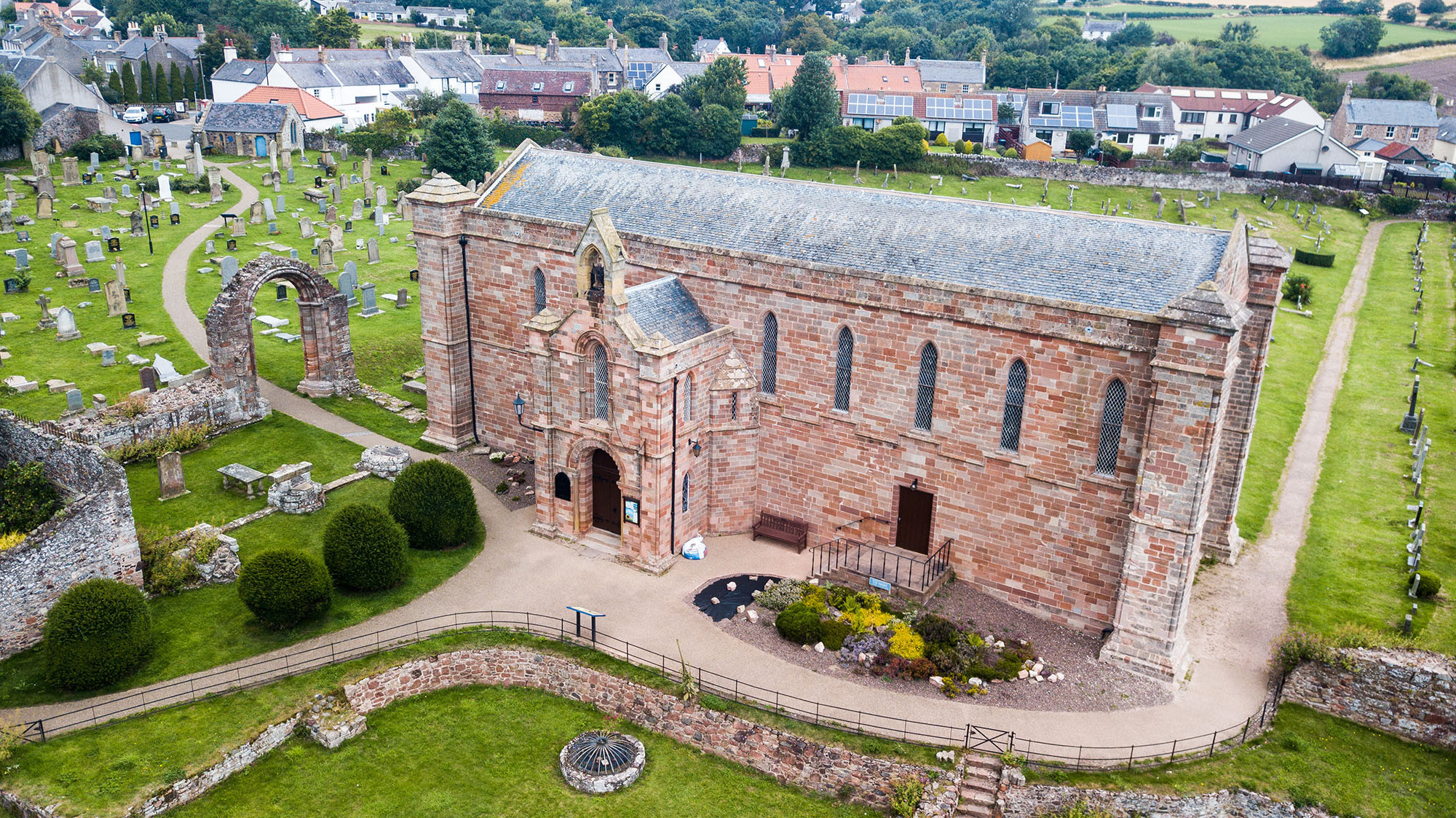
Coldingham Priory was eventually re-established, though the later Benedictine foundation differed significantly from Aebbe's original Celtic double monastery. The priory continued as an important religious site throughout the medieval period, always associated with the memory of its holy foundress.
Aebbe's legacy extends beyond buildings and place names. As a woman of royal birth who chose the religious life, she exemplified a common pattern in early medieval Christianity where noblewomen exercised considerable autonomy and authority through their roles as abbesses. She helped educate future saints, mediated political and ecclesiastical disputes, and established communities that brought Christian faith and learning to previously pagan populations. Her ability to bridge the worlds of politics and religion, to serve both as spiritual mother to her monastic community and as counsellor to kings, made her one of the most influential women of seventh-century Britain.
In more recent years, Aebbe's story has gained renewed attention as part of a broader reappraisal of the contributions of women to early Christian history. Modern scholarship recognises that women like Aebbe played crucial roles in the conversion of Anglo-Saxon England and the establishment of monastic culture, roles that were sometimes overshadowed in later male-dominated ecclesiastical histories.
Saint Aebbe the Elder stands as a testament to the power of faith, the importance of education, and the profound influence that determined women could wield even in the male-dominated world of early medieval Britain. From her dramatic beginnings as an exiled princess to her establishment of one of Scotland's earliest Christian centres, her life illuminates a fascinating period of British history when kingdoms rose and fell, religions competed for hearts and minds, and the foundations were laid for the medieval Christian culture that would shape Britain for centuries to come.


