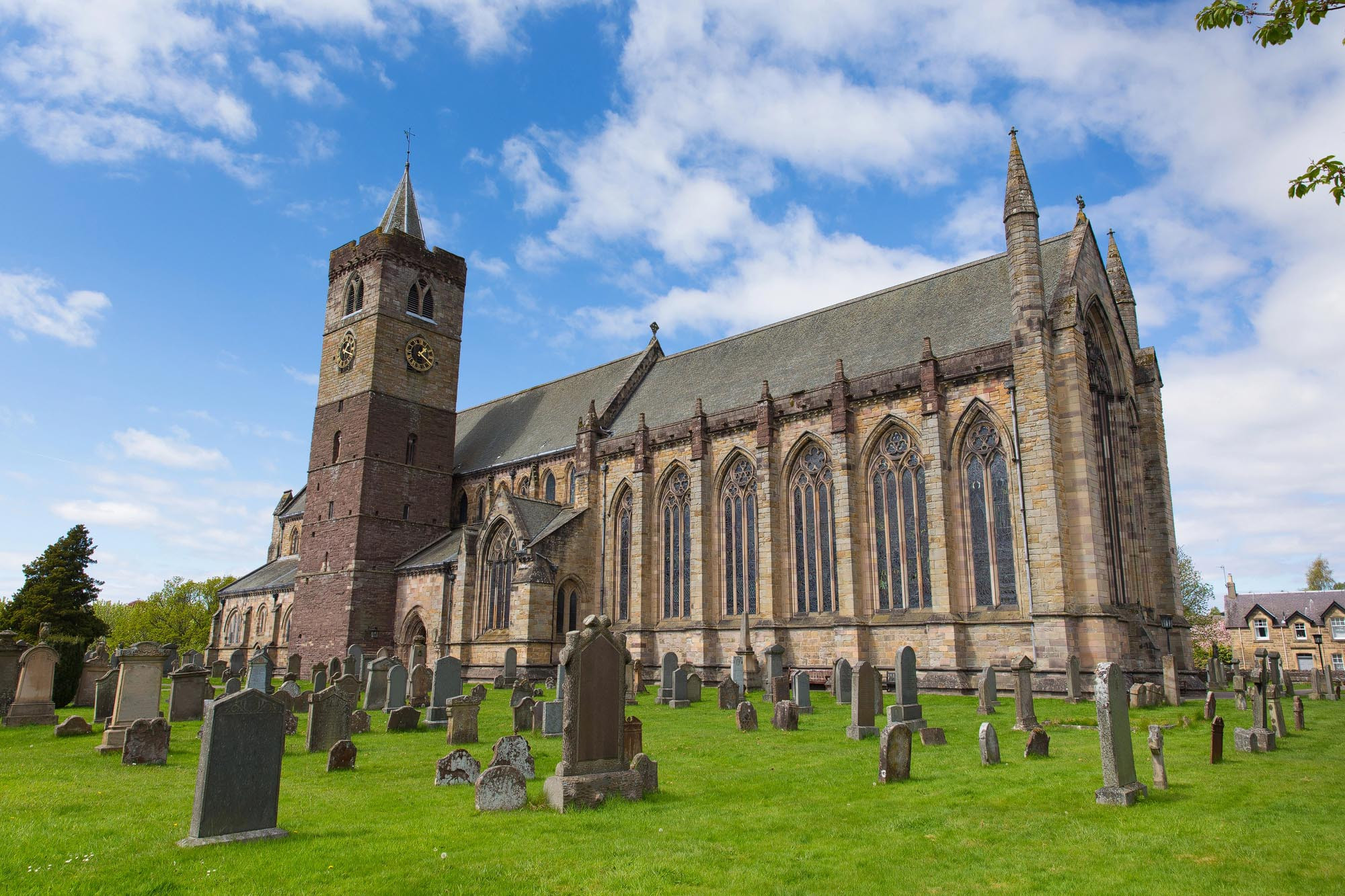

Scotland's First Dominican Bishop and Builder of Dunblane Cathedral
In the annals of medieval Scottish history, few figures combined scholarly brilliance, tenacious determination, and deep religious conviction quite like Clement of Dunblane. Born around 1200 - possibly in Scotland, though his origins remain uncertain - Clement rose from Dominican friar to become a bishop, a royal counsellor, and ultimately one of the men entrusted with governing the entire kingdom of Scotland. He died on 19 March 1258, leaving behind a cathedral that still stands as one of the finest medieval buildings in the country.
A Scholar Shaped by Europe's Great Universities
The precise details of Clement's early life are frustratingly sparse, as is so often the case with medieval figures of the church. What we do know is that he received an exceptional education, studying at either the University of Oxford or the University of Paris - and perhaps both. This exposure to the intellectual currents of 13th-century Europe would have shaped him profoundly, for these were the great centres of scholastic theology and canon law, drawing students and teachers from across Christendom.
It was in this world of learned debate and religious reform that Clement encountered the Dominican Order, founded by the Spanish friar Dominic de Guzmán. By 1219, Dominic had already established houses in Paris, Bologna, Madrid and Segovia, and the order was expanding rapidly across Europe. Clement was admitted to the Dominicans - according to some accounts, receiving the habit from Saint Dominic himself - and was consecrated to a life of preaching, scholarship, and service. At the time of Dominic's death in 1221, there were 21 Dominican houses across Europe. By 1230, five had been established in England, and the order was poised to enter Scotland.
An Unlikely Choice for an Impossible Task
The Bishopric of Dunblane had stood vacant since 1230, its revenues depleted and its cathedral in a state of near ruin. Faced with finding a suitable bishop, Pope Gregory IX charged the Bishops of St Andrews, Brechin and Dunkeld with nominating a candidate. Their choice - Clement, a Dominican friar - was remarkable for the era. He was consecrated as Bishop of Dunblane at Wedale on 4 September 1233 by William de Malveisin, Bishop of St Andrews, becoming in doing so the first member of the Dominican Order in the British Isles ever to hold a bishopric. The historian Archie Duncan later described the appointment as something that "can only be called daring".
There may, however, have been a degree of calculation behind this apparent boldness. Dunblane was a tiny, impoverished diocese confined largely to the earldoms of Strathearn and Menteith. Its income was negligible, much of it having been acquired over the years by more powerful religious institutions and secular lords. It is possible that the established churchmen in Scotland saw Clement's appointment as a way of giving this radical newcomer - a Dominican - a role in which he was likely to fail. If so, they misjudged their man entirely.
Finding a Roofless Cathedral
What Clement found when he arrived in Dunblane was staggering in its desolation. When he later visited Rome and made his report to the papal court, the Pope wrote to the Bishop of Dunkeld in spring 1237 conveying the grim picture: Clement had found the church so ruined that there was no place in the cathedral where he could lay his head; there was no college of clergy; divine offices were being celebrated in a roofless building by a single rural chaplain; and the episcopal revenues were so meagre and so thoroughly alienated to others that they scarcely sufficed to support him for half the year.
In truth, when Clement arrived he likely found little more than the lower four storeys of the existing tower - built around 1100 - and the ruined shell of an unfinished church attached to it. The church itself he proceeded to demolish, intent on building something far greater. To do so, however, he first needed money, and money was precisely what his diocese lacked.
A Diplomatic Triumph at the Papal Court
Clement's response to this crisis was characteristically determined. He travelled to Rome to plead his case directly before the papacy, navigating the complex world of 13th-century ecclesiastical politics with skill. While he did not achieve all of his aims - years of negotiations with powerful institutions that had absorbed his diocese's revenues proved difficult - he secured a crucial concession. In 1237, the Pope authorised the Bishops of Glasgow and Dunkeld to assess whether the Bishop of Dunblane should receive a quarter of the tithes of the churches within his diocese to fund the rebuilding of the cathedral and the reorganisation of the see. Perhaps most importantly, Clement succeeded in preventing the diocese from being absorbed into the nearby Inchaffray Abbey - an outcome that would have effectively ended Dunblane's existence as an independent bishopric.
With these funds secured, Clement set to work. Before his death in 1258, he had built the Lady Chapel and the great majority of the cathedral as it still stands today - including a six-bay, aisle-less chancel, a sacristy, chapter house, and an eight-bay aisled nave of magnificent proportions. His mural tomb remains in the choir of Dunblane Cathedral to this day, a lasting monument to the man who saved and rebuilt it. The cathedral he created also holds the distinction of having the largest surviving collection of medieval Scottish ecclesiastical woodwork after King's College Chapel in Aberdeen.
Called to Save a Second Diocese
Clement's success at Dunblane evidently did not go unnoticed. In the mid-1240s he was asked to perform a similar administrative and financial rescue for the Bishopric of Argyll - an even more daunting challenge. The diocese had stood vacant for several years, was by some margin the poorest in Scotland, and faced the additional complication of lying largely beyond the effective control of the Scottish Crown. This was frontier territory, with Gaelic lords and the ambitions of the Norwegian Crown pressing in from the west.
King Alexander II took active steps in the late 1240s to extend royal authority over Argyll and the Isles, launching a military expedition for that purpose. But on 6 July 1249, the king died on the Island of Kerrera, off the coast of Oban. Clement was at his side when he breathed his last - a measure of the trust Alexander had placed in this remarkable bishop.
Guardian of Scotland
The death of Alexander II left Scotland in a precarious position. His heir, the future Alexander III, was only eight years old. With a child king on the throne, a council of Guardians was appointed to govern the kingdom, and Clement was among those chosen to serve in this role. It was a position of enormous responsibility, and the council was not without its own tensions. It was divided broadly between two rival factions - one centred on the powerful magnate Walter Comyn, and the other around Alan Durward. Clement was associated with the Comyn faction, which gained the upper hand after Walter Comyn secured control of the government in 1251.
In 1255 the Durward faction staged a coup at Roxburgh and drove the Comyn allies from power. Clement's last recorded act reflects the turbulence of these years: he was one of those who delivered the sentence of excommunication against Alan Durward, following the efforts of Gamelin, Bishop of St Andrews, who had been excluded from his own diocese by Durward and had fled to Rome to seek papal support.
Scholar, Preacher, and Writer
Beyond his political and administrative achievements, Clement was by all accounts a man of considerable intellectual gifts. He was noted for his skill in languages - a valuable asset in a diocese that was entirely Gaelic-speaking. He was also a renowned preacher and an accomplished writer. Among his works, he penned a biography of Saint Dominic, founder of his order, as well as a book on pilgrimages to the Holy Land. He also wrote an account of the history of the Dominican Order in Scotland - a document of great historical value, preserving insights into the order's establishment and growth in the country.
Legacy and Veneration
Clement died in 1258, most likely on 19 March - a date later commemorated as his feast day. He was subsequently venerated as a saint, though no official record of a formal canonisation survives. The Chronicle of Melrose records his death, and the memory of his life was preserved with evident affection in the communities he had served.
His legacy rests above all on Dunblane. He found a diocese that was broken and all but bankrupt, a cathedral open to the sky and served by a single chaplain, and he rebuilt it into something magnificent. The choir of Dunblane Cathedral, where his mural tomb can still be seen, stands as both his memorial and his testament. For a man who arrived to find no place to lay his head, it is a fitting resting place.


