
Scotland's Forgotten Arctic Hero
Dr John Rae stands as one of the most remarkable yet underappreciated explorers in Scottish history. Born in the rugged Orkney Islands and forged by the harsh Arctic wilderness, Rae achieved what many thought impossible - he mapped vast stretches of Canada's northern coastline, discovered the final link in the Northwest Passage, and uncovered the tragic fate of the lost Franklin Expedition. Yet for much of history, his extraordinary accomplishments were overshadowed by Victorian sensibilities and the efforts of those who sought to diminish his legacy.
What set Rae apart from his contemporaries was not merely his physical endurance - though he walked more than 23,000 miles across the Arctic and charted over 1,800 miles of previously unknown coastline - but his willingness to learn from and adopt the survival techniques of the Inuit and First Nations peoples. In an era when such respect for indigenous knowledge was rare, Rae's open-mindedness made him the foremost cold-climate survival specialist of his time and earned him a reputation that endures among Arctic communities to this day.
An Orkney Childhood
John Rae was born on 30 September 1813 at the Hall of Clestrain in Orphir, on Orkney's West Mainland. He was the sixth of nine children born to John Rae senior, who served as factor - or estate manager - for the local landowner, Sir William Honyman, Lord Armadale. The elder Rae also held the position of Orkney agent for the Hudson's Bay Company, a connection that would profoundly shape his son's future.
The Hall of Clestrain provided young John with an idyllic setting for developing the skills that would later prove essential to his survival in the Arctic. The Orkney Islands, with their windswept landscapes, unpredictable weather, and proximity to the sea, were the perfect training ground for a future explorer. John spent his childhood sailing the family's small boat, shooting wild fowl on the hills and shores, fishing in local waters, and developing exceptional skills as a musket hunter and rock climber. By the age of fifteen, he had become remarkably proficient in outdoor pursuits.
The Rae household was culturally sophisticated despite its remote location. The family once hosted Sir Walter Scott at the Hall of Clestrain, demonstrating their standing in Scottish society. This combination of outdoor hardiness and intellectual cultivation would serve John well throughout his career.
Medical Training and the Call of the North
In 1829, at the age of sixteen, John Rae left Orkney to study medicine at the University of Edinburgh. He completed his training with distinction, graduating as a licentiate of the Royal College of Surgeons of Edinburgh in April 1833, aged just nineteen. Like many Orcadians of his generation - including two of his older brothers - Rae was drawn to the opportunities offered by the Hudson's Bay Company in Canada.
In the summer of 1833, Rae signed on as ship's surgeon aboard the Hudson's Bay Company vessel Prince of Wales, bound for Moose Factory in Ontario. However, fate intervened when the ship became ice-bound during its voyage, forcing the crew to overwinter on the desolate Charlton Island in James Bay. This unexpected trial proved to be a defining moment in Rae's life. His skills as both a hunter and physician kept most of the crew alive throughout the winter despite severe outbreaks of scurvy - a remarkable achievement that demonstrated his resourcefulness and medical competence.
When the Prince of Wales departed Moose Factory the following July, Rae made a decision that would change the course of his life. Rather than return to Scotland, he stayed on as surgeon and clerk at the remote trading post. "From what I saw," he later reflected, "I should like the wild sort of life to be found in the Hudson's Bay Company's service." This choice marked the beginning of an extraordinary career that would span more than two decades.
Learning from the Land
For the next ten years, Rae remained at Moose Factory, located on an island at the mouth of the Moose River. During this period, he devoted himself to mastering the skills necessary for survival in the harsh northern environment. He spent considerable time living with the Cree Indians and Métis people, learning their techniques for travelling and hunting in the Arctic wilderness. He studied the use of sleds and snowshoes, learned to construct winter shelters, and became expert at living off the land through hunting and fishing.
Rae's aptitude for these skills was extraordinary. Before long, a colleague described him as "the best and ablest snow-shoe walker not only in the Hudson Bay Territory but also of the age." The Inuit would later give him the name "Aglooka," a mark of respect for his abilities. Unlike most European explorers of his era, who viewed indigenous peoples through the lens of Victorian prejudice, Rae recognised the profound expertise of the Arctic's native inhabitants. He adapted their clothing, adopted their travel methods, and learned their survival techniques - an approach that would prove crucial to his success and longevity in the unforgiving northern environment.
The cold seemed to have little effect on Rae. He possessed remarkable physical endurance and an almost supernatural ability to withstand extreme conditions that incapacitated others. These qualities, combined with his medical knowledge and survival skills, made him uniquely qualified for Arctic exploration.
The First Arctic Expeditions
In 1844, Rae's exceptional abilities came to the attention of Sir George Simpson, Governor-in-Chief of the Hudson's Bay Company. Simpson was seeking someone to lead an expedition to survey unexplored portions of Canada's northern coastline, connecting the surveys previously completed by Peter Warren Dease and Thomas Simpson between 1836 and 1839. Rae was the obvious choice, but he first needed training in surveying techniques.
On 20 August 1844, Rae left Moose Factory and travelled by canoe to Upper Fort Garry (present-day Winnipeg) to receive instruction in surveying from George Taylor. When he arrived in October, however, he discovered that Taylor had fallen seriously ill and died shortly thereafter. Undaunted, Rae set out for Sault Ste. Marie, Ontario, to find another instructor. This winter journey of 1,200 miles, completed in just two months by dog sled along the north shore of Lake Superior, showcased Rae's exceptional stamina and determination. He then proceeded to Toronto, where he received the necessary training from Lieutenant John Henry Lefroy at the Toronto Magnetic and Meteorological Observatory.
Between 1846 and 1854, John Rae conducted four major expeditions to the Arctic, travelling more than 10,000 miles on foot or in small boats. His first expedition in 1846-47 took him to Repulse Bay via Hudson Bay and through Roes Welcome Sound. After arriving late in the season, Rae made the first crossing of the narrow isthmus at the base of the Melville Peninsula, now known as Rae Isthmus. When further progress became impossible, he returned to Repulse Bay and constructed a stone house called Fort Hope, where his party prepared to spend the winter.
This decision to overwinter on land on the Arctic coast was unprecedented - no exploring party had done so before. Unlike traditional naval expeditions that required massive supplies and equipment, Rae's party spent the remaining weeks before winter hunting, fishing, and gathering Arctic plants for fuel, making themselves largely self-sufficient. This approach, learned from indigenous peoples, would become Rae's signature method.
Mapping the Unknown
In the spring of 1847, Rae and his men travelled westward, surveying the shores of Committee Bay, Simpson Peninsula, and Pelly Bay - all geographical features that now bear the names Rae gave them. He reached Lord Mayor Bay, which had been discovered by John Ross in 1830, and made a crucial discovery: Boothia was not an island as everyone had believed, but a peninsula joined to the mainland by a narrow isthmus. This finding corrected a significant misconception held by the Admiralty that would have cost time and lives in the ongoing search for the Northwest Passage.
Rae's second Arctic journey came in 1848-49, when he was chosen as second-in-command to Sir John Richardson for an expedition to search for the missing Franklin Expedition. Sir John Franklin's two ships, HMS Erebus and HMS Terror, carrying 129 men, had sailed from London in 1845 in search of the Northwest Passage. Stromness in Orkney had been their last British port of call, where they drew water from Login's Well. Franklin himself had spent his final night on British soil in Stromness, entertained in the home of John Rae's sister, Marion, and her husband, Dr John Hamilton - a poignant connection that must have given Rae's subsequent search for Franklin additional personal significance.
The Richardson expedition searched between the Mackenzie and Coppermine rivers but found no trace of Franklin. In 1849, the Hudson's Bay Company appointed Rae to take charge of the Mackenzie River district at Fort Simpson, where he continued his surveying work and exploration.
The Third Expedition and Growing Renown
Rae's third Arctic expedition in 1851 proved to be particularly fruitful. Leading another search party for Franklin, he travelled approximately 5,300 miles and mapped 700 miles of the southern coast of Victoria Island. During this expedition, he discovered the first potential traces of Franklin's expedition - a piece of wood and part of a flagstaff containing remnants of cloth. Though these artefacts were not conclusive, they represented the first physical evidence of the lost ships.
For his Arctic explorations and discoveries during the 1846-47 and 1851 expeditions, Rae was awarded the Founder's Gold Medal of the Royal Geographical Society in 1852. He also received honorary degrees from McGill College, Montreal in 1853, and from the University of Edinburgh in 1856. His reputation as an explorer of exceptional skill and endurance was firmly established.
The Discovery of Rae Strait
Rae's fourth and final major Arctic expedition, conducted in 1853-54, would bring both his greatest achievement and his greatest controversy. Surveying the Boothia Peninsula, Rae made a discovery of immense geographical significance: King William Land was not a peninsula as previously thought, but an island. More importantly, he discovered a navigable channel between the island and the mainland - a waterway that would come to be known as Rae Strait.
This discovery was momentous. Rae Strait represented the final link in a navigable Northwest Passage from the Atlantic to the Pacific Oceans. For centuries, explorers had sought this route, and Rae had found it. The Norwegian explorer Roald Amundsen would successfully navigate this passage in 1903-06, following the route through Rae Strait that the Scottish surgeon had discovered half a century earlier.
Rae later reflected on the moment of discovery with characteristic modesty: he realised he was looking at "the final piece in the geographical jigsaw - the vital 'missing link' in the Northwest Passage." Yet this achievement, which should have secured his place among the great explorers of the age, would soon be overshadowed by controversy.
The Franklin Mystery Solved
On 21 April 1854, while at Pelly Bay during his fourth expedition, Rae encountered a group of Inuit who told him of a party of about forty white men who had died of starvation four years earlier, a considerable distance to the west. The Inuit provided detailed accounts of ships frozen in ice and men trekking south in a desperate attempt to reach safety.
Subsequently, more Inuit visited Rae's camp, bringing with them various artefacts they had found. These included silverware, buttons, and other items that had clearly belonged to members of the Franklin Expedition. One particularly significant piece was a small silver plate engraved on the back with "Sir John Franklin, K.C.H." The Inuit also provided more detailed information about the location where the bodies had been found and, most disturbingly, indicated that there was evidence of cannibalism among the desperate men in their final days.
Rae faced a difficult decision. The British Government was offering £10,000 to anyone who could discover the fate of the Franklin Expedition. He had obtained the most credible information yet about what had happened to the missing ships and their crews. However, visiting the actual site of the tragedy would require a considerable detour and might compromise the safety of his own expedition. On 4 August 1854, as soon as the ice cleared, Rae chose to sail for Britain with the news rather than continue exploring.
Victorian Scandal and Controversy
Upon his return to Britain, Rae prepared two reports on his findings: one for public consumption that omitted mention of cannibalism, and another for the British Admiralty that included all the details. However, the Admiralty mistakenly - or perhaps deliberately - released the uncensored report to the press. The reference to cannibalism caused an immediate and violent outcry in Victorian society, where such behaviour was considered utterly unthinkable for British naval officers and gentlemen.
Lady Jane Franklin, the widow of Sir John Franklin, was horrified by the implications of Rae's report. Rather than accept the tragic truth about her husband's fate, she launched a relentless campaign to discredit Rae and his sources. She enlisted the support of celebrated author Charles Dickens, who wrote a savage attack on Rae in his magazine Household Words, dismissing the Inuit accounts as "the wild tales of a herd of savages." Dickens went further in his 1856 play The Frozen Deep, which portrayed the Inuit as probable murderers and savages. Arctic explorer Sir George Richardson joined the chorus of criticism, stating that cannibalism could not possibly be the action of Englishmen but must have been perpetrated by the Inuit themselves.
Rae fought back vigorously, defending both his findings and the Inuit people who had provided the information. His robust defence of indigenous testimony and his refusal to bow to Victorian prejudices only deepened the establishment's hostility towards him. The controversy raged for years, with Rae heavily criticised for not having visited the site of the tragedy himself and for seemingly being motivated by the £10,000 reward money, which was not awarded until July 1856 after considerable bureaucratic delays.
An 1859 expedition by another explorer to the location identified by Rae confirmed his account in all its grisly detail, vindicating his report. However, by then, the damage to his reputation was done. Lady Franklin had successfully positioned her husband as the heroic discoverer of the Northwest Passage - a claim that was factually incorrect - and had largely erased Rae's contributions from the public record.
Later Years and Legacy
John Rae retired from the Hudson's Bay Company in 1856 and married Catherine Jane Fraser Thompson in 1860. Later that same year, he was invited to help survey the route of a transatlantic telegraph cable that would connect Scotland to North America via the Faroe Islands, Iceland, and Greenland. This work demonstrated that his expertise remained in demand despite the Franklin controversy. In 1864 and 1865, he undertook similar surveying work for telegraph routes through Greenland, Alaska, and British Columbia.
Rae then settled in Britain, dividing his time between London and Orkney. He rented Berstane House to the east of Kirkwall before eventually moving permanently to London. Despite the setbacks to his public reputation, Rae continued to be recognised by his peers. He was elected a Fellow of the Royal Society of London in 1880, an honour that acknowledged his contributions to science and exploration. He also served as a founding member and first Vice-President of the Hamilton Association for the Advancement of Science, Literature and Art.
Throughout his later years, Rae fought an ongoing battle with the Hydrographic Office of the Admiralty and with Sir Clements Robert Markham, secretary of the Royal Geographical Society, over their refusal to acknowledge the discoveries made in the Arctic by fur trader explorers like himself, Dease, and Simpson. The establishment consistently attributed these discoveries to Royal Navy expeditions, an injustice that Rae challenged until the end of his life.
In a famous anecdote from his later years, Rae is said to have snowshoed from Hamilton to Toronto - a distance of approximately 65 kilometres - in seven hours for a dinner engagement during the winter of 1859, demonstrating that his legendary physical abilities remained undiminished even in middle age.
Death and Remembrance
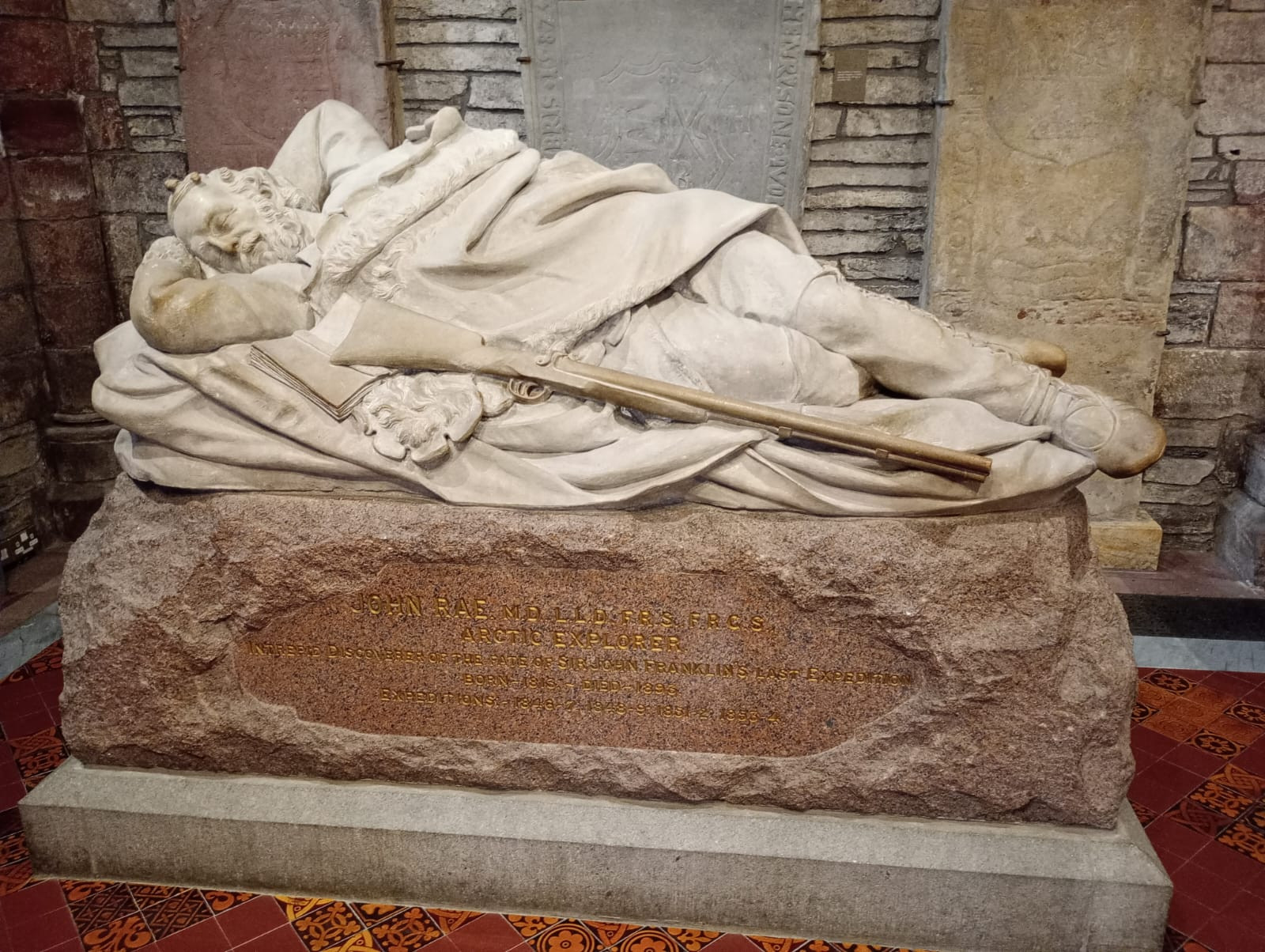
John Rae died on 22 July 1893 at his home at 4 Addison Gardens, London, at the age of 79. He died quietly, without the public recognition that should have been his due. His body was transported north to Orkney for burial in the grounds of St Magnus Cathedral in Kirkwall. The following year, a memorial paid for by public subscription was erected inside the cathedral - a testament to the respect in which he was held by those who knew the truth of his achievements.
The contrast with his contemporaries was stark. Fellow Scot David Livingstone, the African explorer, was buried with full imperial honours in Westminster Abbey. Franklin himself, who had died early in his failed expedition, was commemorated with a bust in Westminster Abbey that falsely credited him with discovering the Northwest Passage. Rae, who had actually discovered the vital link that made the Passage navigable, received no knighthood and little public recognition during his lifetime.
It was only in 2014, more than a century after his death, that a memorial stone to Dr John Rae was finally unveiled in Westminster Abbey's St John the Evangelist chapel, near the memorials to Franklin and other Arctic explorers. The stone, made of red Orkney sandstone with Celtic-style lettering, represented a long-overdue acknowledgement of his contributions.
A Modern Reassessment
In the twentieth and twenty-first centuries, historians have undertaken a comprehensive reassessment of Rae's legacy. His willingness to adopt indigenous knowledge and his respect for Inuit customs, traditions, and skills - attitudes that were radical in the Victorian era - are now recognised as pioneering. Great Arctic explorers like Roald Amundsen and Vilhjalmur Stefansson openly acknowledged their debt to Rae's methods and innovations in cold-climate survival and travel.
Rae is now understood to have been a man far ahead of his time. In an era characterised by racial arrogance and cultural superiority, he recognised that indigenous peoples of the Arctic possessed knowledge and skills that Europeans desperately needed to learn. His approach - travelling light, living off the land, adopting native clothing and techniques, and treating indigenous peoples as equals worthy of respect - made him successful where others failed.
Modern Arctic communities continue to honour Rae's memory. The respect he showed to indigenous peoples, his fair dealings, and his genuine friendships among Inuit and First Nations communities left a positive legacy that endures. In many ways, he represents a road not taken in the history of European exploration - one based on mutual respect and cultural exchange rather than conquest and superiority.
In July 2004, Orkney and Shetland MP Alistair Carmichael introduced a motion in the UK Parliament expressing regret that Dr Rae was never awarded the public recognition that was his due. In 2013, on the bicentenary of his birth, a statue was unveiled on the pier at Stromness, Orkney, depicting Rae in his explorer's clothing. Stromness Museum houses many artefacts relating to Rae, including his octant, shotgun, a portrait, and a beautiful pair of snowshoes that he made himself - material reminders of a remarkable life.
Today, Rae is recognised not merely as one of Scotland's greatest explorers, but as a pioneer whose methods and attitudes were revolutionary. He walked more than 23,000 miles across the Arctic, mapped approximately 1,800 miles of previously uncharted coastline, discovered the final link in the Northwest Passage, and solved the mystery of the Franklin Expedition's fate. Yet perhaps his greatest achievement was demonstrating that success in extreme environments comes not from imposing one's own methods, but from learning from and respecting those who have long called such places home. In that sense, John Rae's true discovery was the value of humility, respect, and cross-cultural learning - lessons that remain profoundly relevant today.


