
The Road Builder Who Opened the Highlands
General George Wade holds a unique place in Scottish history as the military engineer whose network of roads and bridges transformed the Highlands from an impenetrable wilderness into an accessible region. Born in 1673 in Killavally, County Westmeath, Ireland, Wade would rise from humble beginnings to become a Field Marshal, Member of Parliament, and the only person identified by name in a verse of the British national anthem. His legacy endures not in battles won or political triumphs, but in the 250 miles of military roads that still form the backbone of Highland communications nearly three centuries later.
Early Military Career
Wade was born into a family of English settlers in Ireland, the son of Jerome Wade, whose own father William had been a Cromwellian cavalry officer granted lands in Westmeath for his service. Young George spent his early years in Tangier, where his father served with the English garrison. At the age of seventeen, on 26 December 1690, Wade was commissioned as an ensign in the Earl of Bath's Regiment of Foot, beginning a military career that would span nearly six decades.
His early service took him to Flanders, where he fought at the Battle of Steenkerque in August 1692 during the Nine Years' War. His performance earned him promotion to lieutenant in February 1693. He transferred to Sir Bevil Granville's Regiment in 1694 and achieved the rank of captain by 1695. For nearly nine years Wade remained at this rank, a period of relative peace that would soon give way to renewed conflict.
The outbreak of the War of the Spanish Succession in 1702 provided Wade with opportunities for rapid advancement. Serving under the Duke of Marlborough in Flanders, he distinguished himself at the Battles of Kaiserswerth, Venlo, Roermond, and Liège. His conspicuous heroism in the field led to two promotions in 1703 alone - to major in March and lieutenant-colonel in October. He subsequently transferred to Portugal, where his continued excellent service saw him rise to colonel and then brigadier general by 1708. In this capacity, he served as second-in-command to James Stanhope in Minorca, leading one of the storming parties on Fort St Philip. He later fought at the Battle of Saragossa in August 1710.
By the time Wade returned to England in 1711, he was an established military figure with a considerable fortune accumulated through his service. He was promoted to major-general on 3 October 1714 and appointed commander of British forces in Ireland, though he preferred to focus on his burgeoning political career.
The Jacobite Threat and Bath
Wade entered politics as Member of Parliament for Hindon in Wiltshire in 1715, but his parliamentary ambitions were quickly interrupted by the Jacobite Rising of that year. The government gave him command of two regiments of dragoons and dispatched him to suppress the threatened rising in the South-West, centred on Bath. Wade proved highly effective in counter-intelligence work, overseeing the arrest of numerous Jacobite conspirators and uncovering a substantial weapons cache including eleven chests of firearms, three pieces of cannon, and 200 horses.
His success in Bath marked the beginning of a long association with the spa city. In 1717, he further enhanced his reputation by foiling a plot involving the Swedish ambassador to support the Jacobites. Wade became MP for Bath in 1722, a seat he would hold for the remaining 25 years of his life. He became deeply involved in Bath's civic life, paying for improvements to the city, contributing generously to charities and corporation feasts, and even commissioning portraits of the corporation at his own expense. When he arranged for the removal of houses north of Bath Abbey to create an alternative route, he acquired property on the north side of the Churchyard and had Number 14 rebuilt for himself - a fine Palladian townhouse that survives today as a Grade I listed building.
In 1719, Wade saw his last foreign military action, serving as second-in-command to Viscount Cobham during the War of the Quadruple Alliance. Their force of 4,000 troops successfully raided the Spanish coastline, capturing and occupying Vigo for ten days. That same year, Wade became one of the original backers of the Royal Academy of Music, establishing a London opera company that would commission numerous works from Handel and other composers, demonstrating his cultivated tastes beyond military matters.
Mission to the Highlands
In July 1724, King George I dispatched Wade to Scotland with a crucial mission: to inspect the state of the Highlands following the Jacobite uprisings of 1689, 1715, and 1719. He was specifically tasked with investigating why the Disarming Act, designed to prevent Highland clans from bearing arms, had proven so ineffective. Wade spent several months touring the region, personally visiting clan chiefs and assessing the military situation.
His report to the king in December 1724 was blunt and comprehensive. He estimated that of approximately 22,000 men capable of bearing arms in the Highlands, more than half were ready to rise in support of the Jacobite cause. The Disarming Act had failed because only loyal clans surrendered their weapons, whilst those sympathetic to the Stuarts simply hid theirs. Wade concluded that the fundamental problem was geographical isolation. The Highlands were virtually impassable to government troops, with only single-file tracks where previously armies had relied on difficult mountain paths known only to local clansmen.
Wade's recommendations were comprehensive: construct new barracks and forts, build proper roads and bridges throughout the region, and re-establish the Highland Companies - militia units drawn from the clans themselves to police their own territories. King George I accepted these proposals enthusiastically, appointing Wade Commander-in-Chief of His Majesty's forces, castles, forts and barracks in North Britain on 10 May 1725, with the express remit of implementing his own recommendations.
Building the Highland Roads
Between 1725 and 1737, Wade supervised one of the most ambitious engineering projects ever undertaken in Scotland. Working parties of 100 soldiers, overseen by corporals, sergeants, subalterns, and a captain, constructed approximately 250 miles of roads and 40 bridges across some of Britain's most challenging terrain. Each working party was even accompanied by a drummer to maintain rhythm and morale during the arduous labour.
Construction took place only during the warmer months between April and October, as Highland winters made such work impossible. Even summer conditions proved challenging, with uncertain weather and the notorious Highland midge tormenting the work parties. The roads were built to a standard width of sixteen feet, though this sometimes narrowed to ten feet where terrain demanded. Construction involved excavating to a depth of three-quarters to one metre, filling the bottom half with compacted stones and boulders, and topping with compacted gravel. Back drains were dug on the uphill side, with ditches or stone-filled channels on the downhill side to manage water runoff.
Wade engaged skilled craftsmen in masonry and carpentry to ensure major structures met high standards. His most spectacular achievement was the Tay Bridge at Aberfeldy, designed by architect William Adam and completed in 1734. This magnificent structure cost over £4,000, making it the single most expensive element of the entire network. A reference in verse, said to be inscribed on a stone at the start of one of his roads, perfectly captures the transformation he wrought: "If you had seen this road before it was made, you would lift up your hands and bless General Wade."
Wade's first major route connected Fort William, Fort Augustus, and Fort George (in Inverness) along the Great Glen, largely following the eastern shore of Loch Ness. He even placed a gunboat on the loch for additional military firepower. His second and most important road ran over 100 miles from Dunkeld in Perthshire to Inverness, passing through Pitlochry, Blair Atholl, and crossing the bleak Drumochter Pass into Speyside. This route closely follows what is now the modern A9 highway. Other roads connected Perth, Crieff, Fort Augustus and various strategic points across the Highlands.
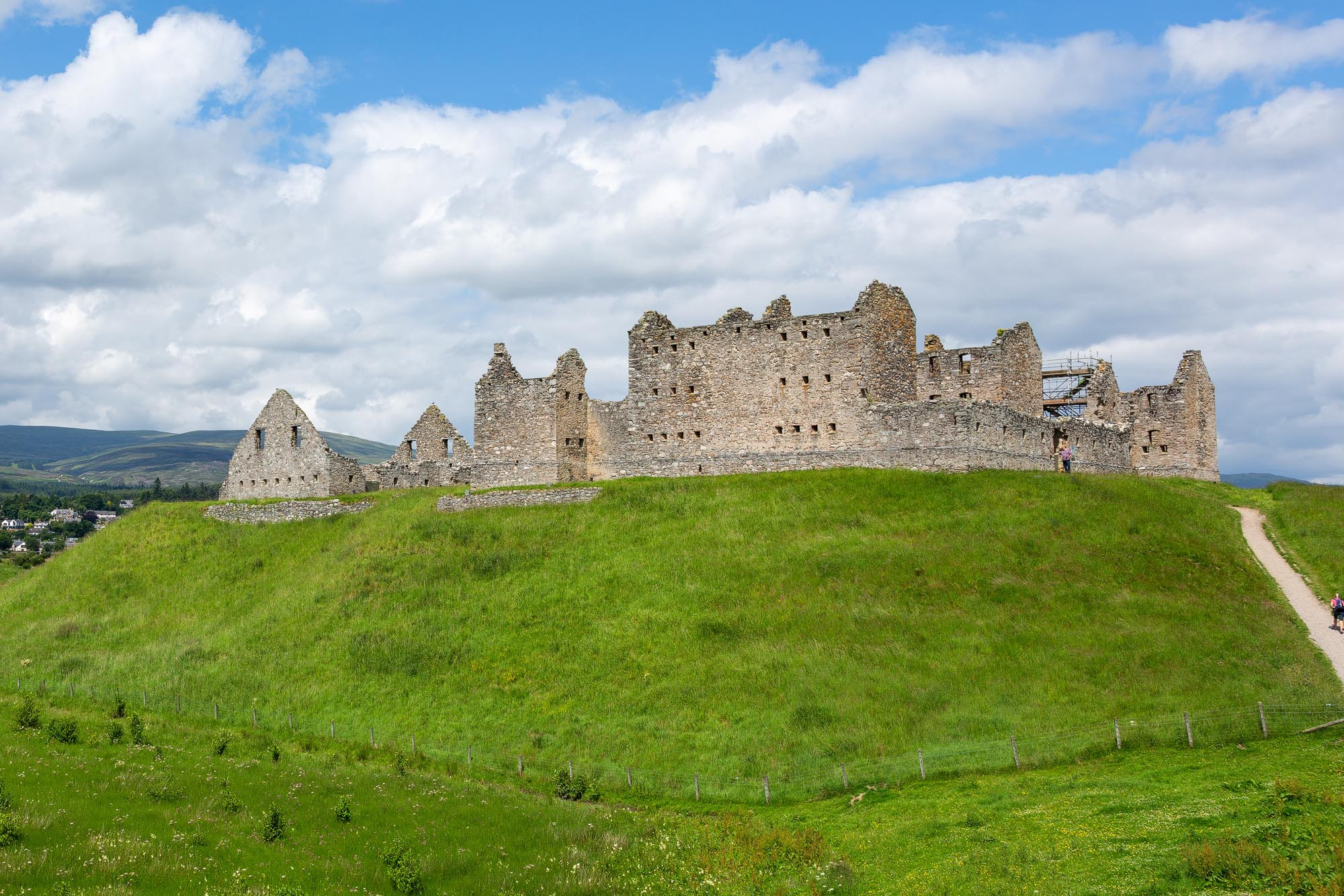
The road network centred on Ruthven Barracks near Kingussie, completed in 1721, and linked the strengthened forts at Fort William, the newly constructed Fort Augustus (named after Prince William Augustus, Duke of Cumberland), and Fort George in Inverness. Wade also supervised the construction of inns called "Kingshouses" along the routes to provide accommodation for travellers and troops.
The Black Watch and Highland Diplomacy
Wade's approach to pacifying the Highlands extended beyond infrastructure. In 1725, he raised six companies of "Highland Watches" drawn from clans loyal to the government, including three companies of Campbells and men from other trusted families. These troops wore dark tartan that gave them the Gaelic name "Am Freiceadan Dubh" - the Black Watch. Four more companies were added in 1739, and these units were subsequently reorganised as the Black Watch Regiment, marking the beginning of widespread use of Highland troops in the British Army that continues to this day.
Wade also conducted an extensive campaign of personal diplomacy, visiting clan chiefs whose loyalty to the Crown was suspect. These visits often involved helping to drink them out of their stores of claret, building relationships through shared hospitality whilst subtly reinforcing government authority. His approach was characterised by fairness and respect for Highland culture, even as he worked to bring the region under firmer control.
Wade was promoted to lieutenant-general in April 1727 and became Governor of Berwick-upon-Tweed in 1732, followed by his appointment as Governor of Fort William, Fort George, and Fort Augustus in 1733. He achieved the rank of full general in July 1739, and in 1740 left Scotland to return to England, having transformed the strategic landscape of the Highlands. Major William Caulfeild, who had assisted Wade, continued the road-building programme, eventually constructing an additional 800 miles of roads, though Wade's name remained attached to the entire network.
Return to War and the '45
In 1742, Wade was appointed Lieutenant-General of the Ordnance and made a member of the Privy Council. On 14 December 1743, he was elevated to Field Marshal, the highest substantive rank in the British Army. At the age of 71, he was given joint command of the Anglo-Austrian force in Flanders against the French during the War of the Austrian Succession. However, the appointment proved a mistake. Wade was too old for such responsibility and lacked the strength either to overrule his joint commanders or outmanoeuvre the superior French forces. He fell ill and returned to England by the end of 1744, having achieved little. King George II diplomatically pronounced him "an able officer... but not alert."
Despite this setback, Wade was given command of government forces during the Jacobite Rising of 1745, when Prince Charles Edward Stuart - "Bonnie Prince Charlie" - landed in Scotland and mounted the most serious challenge yet to Hanoverian rule. Such was the concern in London that an extra verse was added to "God Save the King," specifically mentioning Wade: "Lord grant that Marshal Wade, May by thy mighty aid, Victory bring. May he sedition hush, And like a torrent rush, Rebellious Scots to crush. God save the King!"
It was a verse that would prove bitterly ironic. Wade concentrated his forces in Newcastle upon Tyne, expecting the Jacobites to advance down the east coast of England. Instead, Charles Edward's army swept down the west coast with astonishing speed, taking Carlisle and pushing as far as Derby, only 125 miles from London. Wade attempted to march his troops cross-country from Newcastle to intercept them, but freezing conditions, starving men, and the speed of the Jacobite advance left him scrambling. By the time he reached Hexham, fifteen miles west of Newcastle, Carlisle had already fallen.
More humiliatingly, the very roads Wade had built to control the Highlands had proven invaluable to the Jacobite army, allowing them to move swiftly through Scotland. The Corrieyairack Pass, Wade's most spectacular engineering achievement, was used by Bonnie Prince Charlie's forces on their march south. Wade was replaced as Commander-in-Chief by the Duke of Cumberland, who would eventually defeat the Jacobites at Culloden in April 1746.
Final Years and Legacy
Wade's failure in 1745 made him a temporary target for satire, but he remained in favour with the king and was re-elected by Bath in 1747. The experience of trying to march troops across country from Newcastle to Carlisle inspired one final contribution to Britain's road network: Wade helped plan a military road west of Newcastle, though this required substantial destruction of Hadrian's Wall. He died before construction began in 1751.
General George Wade died unmarried on 14 March 1748, leaving a fortune of £100,000 - an enormous sum that reflected his successful investments, including part ownership of lead mines at Strontian. He left the bulk of his estate to his four illegitimate children: two sons, Captains William and John Wade, and two daughters, Jane and Emilia. His daughter Jane had married Ralph Allen, the influential Bath postmaster who became known as "the man of Bath." Wade also provided generously for the widow and children of his brother William, Canon of Windsor.
He was buried at Westminster Abbey, where his monument, created by the renowned sculptor Louis-François Roubiliac, commemorates his life and achievements. The sculptor was reportedly upset that the monument had been placed too high to be properly appreciated.
Wade's lasting legacy is not in the battles he fought or the Jacobites he failed to crush, but in the roads and bridges he built. Though some 250 miles were constructed under his direct supervision during his time in Scotland (1725-1740), his successor Caulfeild would build an additional 800 miles, yet all became known as "Wade's Roads." By the late 18th century, some of the steeper and more remote sections had been abandoned as travellers preferred easier routes, but many sections were incorporated into the civilian road network as it expanded through the 19th century.
Today, significant portions of Wade's roads remain in use. The A9 follows much of his route from Dunkeld to Inverness. The A82 between Inverness and Fort William incorporates sections of his Great Glen road. Original sections can still be seen at places like Killiecrankie and Whitebridge. His bridges, including the magnificent Tay Bridge at Aberfeldy and the High Bridge near Fort William, stand as monuments to 18th-century engineering.
Wade's roads served their immediate military purpose, but their greater achievement was opening the Highlands to trade, travel, and tourism. They brought economic development to remote communities and allowed the region's stunning landscapes to be appreciated by visitors. By the late 18th century, travellers like James Boswell and Samuel Johnson could tour the Highlands with relative ease, followed in the early 19th century by pioneering female tourists like Sarah Murray and Dorothy Wordsworth.
In the words inscribed at the start of one of his roads, Wade's transformation of Highland communications truly deserved lifted hands in blessing. The road builder from Ireland had permanently altered the Scottish landscape, creating a legacy that endures into the 21st century.


