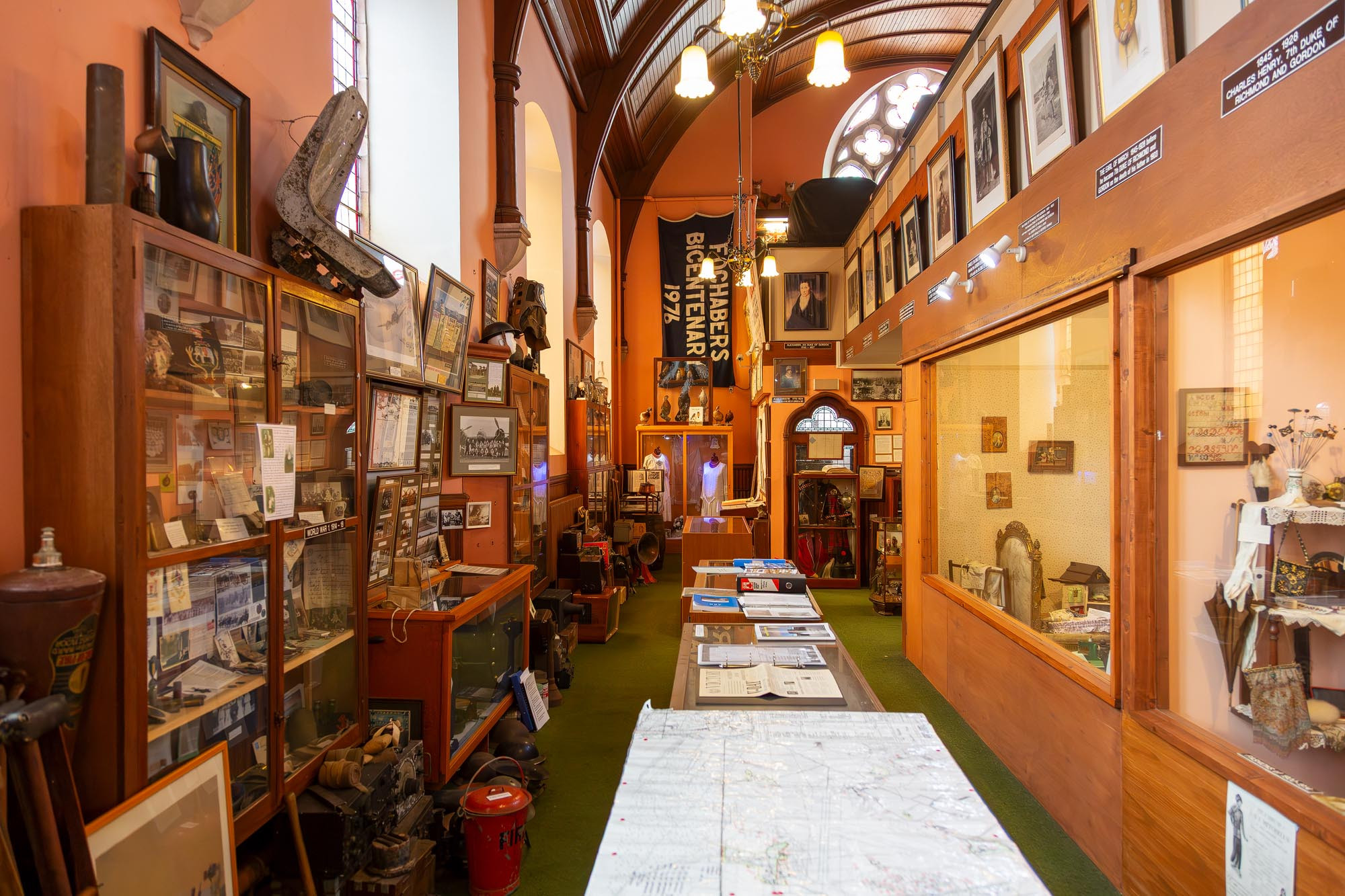
Tucked inside a converted Gothic church on Fochabers’ handsome High Street, the Fochabers Folk Museum & Heritage Centre is one of Moray’s most charming and surprising wee museums. Opened in 1984 and run entirely by dedicated volunteers, it packs an astonishing amount of local history into its former place of worship – from horse-drawn carriages and recreated Victorian shops to wartime artefacts and vintage cameras. It’s the kind of place you pop into expecting a quick look around, only to emerge an hour later, wondering where the time went. Best of all, entry is free, with donations warmly welcomed.

A Brief History of Fochabers
To understand the museum, it helps to know a little about the remarkable village it celebrates. Fochabers as we see it today didn’t always exist in its current location. The original settlement sat right on the doorstep of Gordon Castle, the grand seat of the Dukes of Gordon. By the late 18th century, Alexander Gordon, the 4th Duke of Gordon, had grown tired of having the village quite so close to his front door and decided to do something about it.
In 1776, he commissioned the architect John Baxter of Edinburgh to design an entirely new planned village a short distance to the south. The result is one of Scotland’s finest examples of an Enlightenment-era planned settlement – with its characteristic wide, straight streets, rectangular layout, and handsome Georgian buildings. Fochabers is now a conservation area, with most of the buildings on High Street listed as being of historical or architectural interest.

The village has produced some remarkable characters over the centuries. Alexander Milne (1742–1838) was born in Fochabers and worked as a footman for the Duke of Gordon. When ordered to powder his red hair, Milne refused, left his employment, and emigrated to the American colonies. He made his fortune in New Orleans through brick-making and land development, eventually leaving $100,000 in his will – an enormous sum at the time – to found a free school for the children of Fochabers. Milne’s Institution, later Milne’s Primary School and Milne’s High School, still educates children in the village today.
Another famous Fochaberian was William Marshall (1748–1833), who rose from humble beginnings to become one of Scotland’s most celebrated fiddle composers and a highly regarded clockmaker. He started life as a butler at Gordon Castle before becoming factor on the Duke’s lands. His beautiful Strathspeys, jigs, and reels are still performed at ceilidhs and concerts across Scotland, and one of his longcase clocks takes pride of place in the museum today.
Fochabers is also home to Baxters, the famous family-run food company founded by George Baxter as a grocery shop in 1868 and now known worldwide for their soups, jams, and preserves. And for music fans, the village has another claim to fame – Fish, the lead singer of Marillion, acquired his nickname while living in Fochabers.
The Museum Building
The museum is housed in the former Pringle Church, a handsome Gothic revival building on the High Street with a distinctive tower and beautiful stained glass windows. When you step inside, it’s immediately clear that this is no ordinary museum – the building itself is part of the experience. The soaring arched windows, the barrel-vaulted timber ceiling on the upper floor, and the warm salmon-pink walls all add atmosphere and character that a purpose-built exhibition space could never replicate.

Our Visit
Arriving in Fochabers
My youngest daughter Lauren and I visited the Fochabers Folk Museum on a day out last September. We’d already been to the Earth Pillars walk nearby and had parked on Fochabers High Street. The museum is impossible to miss – the converted church building dominates this stretch of the street, and the colourful character statue sitting at the entrance certainly catches your eye. Parking on the High Street is free and plentiful, which is always appreciated.
We noticed the “OPEN” sign by the door and decided to pop in, not entirely sure what to expect. A sign indicated that admission was free, with donations welcome. I’m glad we went in – what we found inside was far more impressive than we’d anticipated.
The Ground Floor
Stepping through the arched doorway, we were immediately struck by just how much has been crammed into the space. The ground floor of the former church is an absolute treasure trove – display cases, vintage advertising signs, old photographs, domestic artefacts, and curiosities fill every available surface. Bunting is strung cheerfully from wall to wall, and the warm glow of old-fashioned lamps gives the whole place an inviting, atmospheric feel.

One of the first things we explored was the recreated Victorian shop, which is an absolute delight. It’s packed with period products and packaging – Lyons Tea, McVitie & Price biscuits, Fry’s chocolate, Rinso washing powder, Mitchell’s Bogie Roll tobacco, Yorkshire Relish – all presided over by a mannequin shopkeeper in a white cap and apron. It’s the kind of display you could stare at for ages, spotting new details each time you look.

Nearby, a recreated post office display features wooden sorting pigeonholes labelled with Scottish town names like Lanarkshire, Airdrie, Coatbridge, and Hamilton. Beneath the glass are old banknotes, postal scales, stamps, coins, and even a label for “Live Pigeons” – a reminder of a very different era of postal services.

The eclectic nature of the collection is part of what makes it so appealing. In one corner, you’ll find a wooden washboard and tub sitting alongside taxidermied hares and old weighing scales. In another, there’s a display cabinet of medical instruments and craftsmen’s tools, topped with a row of vintage oil lamps and lanterns. A collection of antique mantel clocks fills an entire shelving unit, which felt especially fitting given Fochabers’ connection to the renowned clockmaker William Marshall.

We also enjoyed the display of vintage cameras, including Eastman Kodak and Ensign models, which charts the evolution of photography over the decades. A collection of vintage glass bottles, old domestic items, and a wonderful display of personal accessories on red velvet – pocket watches, cigarette cases, lockets, and manicure sets – added to the sense that every aspect of daily life has been lovingly preserved here.


One display that particularly caught our attention was the “Views of Fochabers 1880–1945” board – a collection of framed historic photographs showing the village’s streets, buildings, and surrounding landscapes through the decades. It’s fascinating to compare these old images with the Fochabers of today and see just how much – and how little – has changed.

The RAF Dallachy Exhibition
A significant section of the ground floor is dedicated to RAF Dallachy, the wartime fighter station that operated just a few miles from Fochabers near Spey Bay. The exhibition tells the story of the base, which opened in March 1943 and was used by several squadrons from across the Commonwealth, including 144 Squadron RAF, 404 Squadron RCAF (Royal Canadian Air Force), 455 Squadron RAAF (Royal Australian Air Force), and 489 Squadron RNZAF (Royal New Zealand Air Force).

The most poignant part of the exhibition concerns “Black Friday” – 9th February 1945 – when a force of 31 Beaufighter aircraft took off from RAF Dallachy to attack the German destroyer Z33 sheltering in Førde Fjord, Norway. The narrow geography of the fjord made the attack extremely dangerous, and the Beaufighters were met with intense anti-aircraft fire and enemy fighters. Nine Beaufighters were lost that day, along with 14 Allied aircrew. It was the worst single-day loss for any Coastal Command strike wing during the entire war. The museum holds some remarkable artefacts from this period, and the photographs and personal accounts on display bring this tragic chapter of history to life in a way that’s both moving and deeply respectful.
Alongside the RAF Dallachy material, there’s also a touching display of First World War memorabilia, including a 1913 Seaforth Highlanders handbook and British Red Cross Society badges and items from the 1914–1918 period.

Milne’s Free School & the Annexe
Through to the museum’s newer annexe area, we found the recreated Milne’s Free School classroom, which is one of the highlights of the whole museum. It’s a wonderful recreation of a 19th-century classroom, complete with a stern-looking mannequin teacher in his academic gown and mortar board seated at the front, a young pupil mannequin in period dress, old school desks with slate boards, a harmonium, wall maps, a chalkboard, and rows of school class photographs. A large framed image of the original Milne’s Institution building hangs on the wall, and an abacus stands in the corner. It really transports you back in time.

Adjacent to the schoolroom is a lovely display of vintage dresses from the 1950s and 1960s, each carefully dated. A stunning 1952 wedding dress with veil takes pride of place, alongside evening dresses from 1956, 1960, and 1966. It’s a beautiful and carefully curated collection.

The Upper Gallery
A staircase leads up to the upper gallery, and this is where the museum really took our breath away. The former church’s magnificent barrel-vaulted timber ceiling arches overhead, and the entire space is filled with the largest collection of horse-drawn vehicles in northeast Scotland. Carriages, gigs, traps, and phaetons are lined up along both sides, with a mannequin coachman in top hat and greatcoat sitting atop one of the grandest carriages in the centre. It’s an extraordinary sight.


At one end of the gallery, a beautifully carved and painted wooden horse stands next to a carriage, surrounded by old horse bits and tack. The level of detail in these exhibits is remarkable, and you really get a sense of what rural transport looked like in northeast Scotland during the 19th century.

From the upper gallery, there’s also a wonderful vantage point looking down over the ground floor below, giving you a real appreciation of just how much has been packed into this former church. You can see the display cases, vintage signs for Lyons Tea and Thomson’s Dye Works, shelves of lanterns, barrels, and artefacts stretching off in every direction.

True to the museum’s eclectic spirit, the upper floor also features some delightfully unexpected items among the carriages. Lauren was particularly amused by a Sinclair ZX Spectrum +2 computer with its game cassettes – including The Simpsons: Bart vs the Space Mutants – sitting among all the Victorian and Edwardian artefacts. It’s these little surprises that give the museum so much of its charm.

Videos from Fochabers Folk Museum & Heritage Centre
Frequently Asked Questions
How much does it cost to visit Fochabers Folk Museum?
Admission to the Fochabers Folk Museum & Heritage Centre is completely free. Donations are welcomed and go directly towards the upkeep of the museum, which is run entirely by volunteers. There is a donation box near the entrance.
When is Fochabers Folk Museum open?
The museum is open seasonally, typically from Easter through to September. Opening hours are Tuesday to Friday from 1pm to 4pm, and Saturday and Sunday from 2pm to 4pm. As the museum is volunteer-run, it’s always worth checking their Facebook page or the Fochabers Heritage website for the latest information before visiting.
Is there parking at Fochabers Folk Museum?
There is no dedicated museum car park, but there is free on-street parking available along Fochabers High Street directly outside the museum. We had no trouble finding a space during our visit.
Is Fochabers Folk Museum wheelchair accessible?
The ground floor of the museum is accessible, but the upper gallery where the carriage collection is displayed is reached by stairs only and is not wheelchair accessible. The newer annexe area with the Milne’s Free School classroom is also on the ground level.
Are dogs allowed in Fochabers Folk Museum?
Due to the nature of the displays and the confined spaces within the museum, it’s best to check with the volunteers on arrival. Assistance dogs are welcome.
How long does a visit to Fochabers Folk Museum take?
We spent around 45 minutes to an hour exploring the museum, and we could easily have stayed longer. There is far more to see than you might initially expect, so allow yourself plenty of time to browse.
Is Fochabers Folk Museum suitable for children?
Yes, the museum is great for children. The eclectic range of objects, the recreated schoolroom, and the upper gallery full of carriages are all likely to capture young imaginations. Lauren thoroughly enjoyed the visit.
Key Information
- Location: High Street, Fochabers, Moray IV32 7DX
- Grid Reference: NJ 3475 8587
- Managed by: Fochabers Heritage (Scottish Charity No: SC042471) – entirely volunteer-run
- Entry: Free (donations welcome)
- Parking: Free on-street parking on High Street
- Facilities: No toilets or café within the museum. Public toilets and shops/cafés available nearby on the High Street
- Accessibility: Ground floor accessible; upper gallery accessed by stairs only
- Dogs: Check on arrival; assistance dogs welcome
What Else is Nearby?
Gordon Castle Walled Garden – Just north of Fochabers, Gordon Castle features one of the oldest and largest walled gardens in Britain, dating from 1803. The garden is open to visitors and offers beautiful walks, a café, and a shop selling produce grown on site.
Earth Pillars Walk, Ordiequish – A short circular walk about 2.5 miles south of Fochabers through pine woodland to a viewpoint overlooking the River Spey. The walk gets its name from curious red sandstone formations carved by glacial erosion. We visited this on the same day.
Winding Walks & Duchess of Richmond Memorial Cairn – A network of forest trails east of Fochabers, with the longest route leading to a distinctive pyramid-shaped memorial cairn on Whiteash Hill with panoramic views over the Moray Firth. The Moray Monster mountain bike trails also start here.
Spey Bay & the Scottish Dolphin Centre – About 5 miles north of Fochabers at the mouth of the River Spey, Spey Bay is a great spot for dolphin watching and coastal walks. The Scottish Dolphin Centre (Whale and Dolphin Conservation) has a café and gift shop.
Baxter’s Highland Village – Located on the outskirts of Fochabers, this visitor centre for the famous food brand offers a food hall, restaurant, and the chance to sample and buy Baxter’s products.
Final Thoughts
The Fochabers Folk Museum & Heritage Centre is a real gem. It’s the kind of volunteer-run, community-spirited place that puts many professionally staffed museums to shame. The sheer volume and variety of artefacts on display is remarkable, and the building itself – with its Gothic arches, stained glass, and vaulted ceiling – adds enormously to the experience. Whether it’s the recreated Victorian shop, the poignant RAF Dallachy exhibition, the magnificent carriage collection, or just the joy of discovering a Sinclair ZX Spectrum among 19th-century artefacts, there’s something here for everyone.
Lauren and I both thoroughly enjoyed our visit, and I’d strongly recommend making time to stop in if you’re passing through Fochabers. It’s free to enter, it’s right on the High Street, and it will almost certainly surprise you with how much it has to offer. Just remember to pop a donation in the box on your way out – these dedicated volunteers deserve every penny.

Leave a comment below