Scotland’s North East 250 might just be the country’s best-kept secret. This magnificent 250-mile circular touring route weaves through some of the finest landscapes, historic sites, and cultural treasures that Scotland has to offer – yet it remains refreshingly uncrowded compared to its more famous sibling, the North Coast 500.

The NE250 is a route that promises world-class whisky distilleries, dramatic mountain passes, ancient castles, rugged coastline, and charming fishing villages. I live directly on part of the NE250, and I can attest to the amazing places it offers.
What is the North East 250?
The North East 250 is a circular driving route that explores six of Scotland’s most inspiring regions: the Granite City of Aberdeen, Royal Deeside, the Cairngorms National Park, Speyside, the Moray Firth Coast, and the dramatic Aberdeenshire coastline. Launched in 2017 by local businessman Guy Macpherson-Grant, whose family roots on Speyside stretch back to the 16th century, the route was designed to showcase the incredible diversity of north-east Scotland.
The beauty of the NE250 is its flexibility. Being circular, you can start anywhere along the route and travel in either direction. The three official starting points are Aberdeen Airport, Glenshee in the Cairngorms, and Ballindalloch in Speyside. Most visitors, however, begin in Aberdeen, as it’s easily accessible by air, rail, or road from across the UK.

Unlike the North Coast 500, which can feel rushed and crowded during peak season, the NE250 offers a more relaxed pace. The roads are generally excellent – well-maintained A-roads and scenic B-roads that wind through varied terrain without the single-track challenges found on the NC500... If you've ever been to Wick, you will know the pothole problem there! We found that 5-7 days was ideal for experiencing the route properly, though you could comfortably do it in three days if time is limited.
The Route: A Journey Through Time and Landscape
Royal Deeside: Castles and Royalty
We chose to drive the route clockwise, heading west from Aberdeen along the A93 into Royal Deeside. The name itself tells you something special awaits – this is the valley of the River Dee, beloved by Queen Victoria and still the summer retreat of the Royal Family at Balmoral.
The Castle Trail begins almost immediately. Within the first 30 miles, we encountered some of Scotland’s finest tower houses and stately homes. Drum Castle, dating from the 13th century, is one of the oldest tower houses in Scotland and gave us a fascinating glimpse into 700 years of Scottish history. Just down the road, Crathes Castle’s fairytale turrets rise above ancient yew hedges, whilst Castle Fraser’s Z-plan tower house represents Scottish baronial architecture at its finest.

The jewel in Deeside’s crown, however, is Balmoral Castle. Whilst the royal residence itself is only partially open to visitors, the estate grounds are magnificent. We wandered through the gardens, explored the exhibitions, and understood exactly why Queen Victoria fell in love with this landscape. The backdrop of Lochnagar mountain adds to the majesty.
Between the grand estates, we discovered charming towns like Ballater, with its Victorian heritage and excellent cafés, and Braemar, gateway to the Cairngorms and host to the famous Highland Games each September.
The Cairngorms: Scotland’s Wild Heart
As we climbed towards Glenshee, the landscape transformed dramatically. The Cairngorm Mountains dominate Britain’s largest national park – a vast wilderness of granite peaks, ancient Caledonian forests, and high mountain plateaus. Even in summer, there’s a wild, elemental quality to this terrain that takes your breath away.
The drive over the Cairnwell Pass reaches 2,199 feet, making it the highest public road in Britain. In good weather, the views are stupendous – endless rolling mountains, purple with heather in late summer. In winter, these mountains transform into Scotland’s premier skiing destination, with the Glenshee ski centre offering the country’s most extensive slopes.

We spent considerable time simply pulling into viewpoints, breathing the crisp mountain air, and watching for wildlife. The Cairngorms are home to red deer, mountain hares, golden eagles, and the rare Scottish wildcat. If you’re lucky, you might spot a capercaillie or even a pine marten.
Speyside: The Water of Life
Descending from the mountains, we entered Speyside – and entered whisky heaven. This compact region, following the valley of the River Spey, contains the highest concentration of whisky distilleries in Scotland. The pure mountain water, perfect barley-growing conditions, and centuries of tradition have made Speyside synonymous with exceptional single malt whisky.
We couldn’t possibly visit every distillery (though we tried!), but highlights included Glenlivet, which has been legally distilling since 1824, and Glenfiddich, where the tour culminated in a generous dram whilst overlooking the valley. Ballindalloch, Scotland’s first single estate distillery, offers something unique – here they grow their own barley and even feed the draff (spent grain) back to their Aberdeen Angus cattle.

Between distillery visits, we explored charming towns like Aberlour, Rothes, and Dufftown. These are working distillery communities, not tourist traps, which gave us an authentic sense of whisky’s central role in local life and economy.
For those who prefer non-alcoholic pursuits, the Speyside Way long-distance footpath offers beautiful riverside walks, and the region’s birdwatching opportunities are exceptional – ospreys fish the rivers and lochs throughout summer.
The Moray Coast: Fishing Villages and Sunshine
Following the River Spey to its mouth, we reached the Moray Firth Coast – often called Scotland’s “Sunshine Coast” for its surprisingly benign climate. This stretch of coastline is a revelation, with picturesque fishing villages, golden beaches, and abundant wildlife.
At Spey Bay, we visited the Scottish Dolphin Centre and were rewarded with sightings of bottlenose dolphins playing in the surf. The Moray Firth is home to over 130 of these magnificent creatures, making it one of the best places in Britain for dolphin watching.

The coastal villages each have distinct characters. Lossiemouth boasts two superb beaches and was the birthplace of Britain’s first Labour Prime Minister, Ramsay MacDonald. Cullen, perched dramatically on cliffs, gave its name to Cullen Skink – a rich, creamy smoked haddock soup that we enjoyed in a harbourside café. Portsoy’s 17th-century harbour hosts the annual Scottish Traditional Boat Festival, and the village’s marble workshop crafts beautiful jewellery from local serpentine.

Banff and neighbouring Macduff mark the route’s northernmost point. Here we explored Duff House, a stunning Georgian mansion housing part of the National Galleries of Scotland’s collection. The baroque architecture and fine art felt wonderfully unexpected in this small coastal town.
The Aberdeenshire Coast: Dramatic and Evocative
Turning south, the character of the coastline changes dramatically. This is the North Sea coast – rugged, windswept, and hauntingly beautiful. Tall cliffs plunge to hidden bays, ruined castles perch on dramatic headlands, and vast sandy beaches stretch for miles.
Pennan is a tiny village of whitewashed cottages squeezed between cliff and sea, immortalised in the film “Local Hero”. The red telephone box featured in the movie still stands outside the Pennan Inn. Fraserburgh, Scotland’s largest shellfish port, gave us insight into the working fishing industry, whilst the Museum of Scottish Lighthouses told fascinating stories of heroism and engineering.

But the undisputed highlight of this coast is Slains Castle. These atmospheric ruins crown a clifftop near Cruden Bay, their roofless walls and towers creating a silhouette that seems pulled from Gothic fiction. Indeed, they were – Bram Stoker stayed nearby whilst writing Dracula, and many believe these ruins inspired his description of Count Dracula’s Transylvanian castle. Standing in the courtyard as waves crashed far below, with ravens wheeling overhead, we could certainly understand the connection.

Cruden Bay itself offers something altogether more pleasant – a sweeping expanse of pink sand and dunes, backed by one of Scotland’s finest links golf courses. Further south, we stopped at Newburgh to observe the resident seal colony at the mouth of the Ythan River. Over 400 seals haul out here, and watching them bask and play was utterly enchanting.
Returning to Aberdeen: The Granite City
Our circuit concluded back in Aberdeen, Scotland’s third-largest city and once the heart of Europe’s North Sea oil industry. Built predominantly from local grey granite that sparkles in sunlight, Aberdeen has a distinctive architectural character. Marischal College, the world’s second-largest granite building, dominates Broad Street with its elaborate Gothic Revival façade.
We spent a full day exploring the city. The Aberdeen Maritime Museum brought the region’s seafaring and oil industry heritage to life, whilst the Aberdeen Art Gallery houses an impressive collection. Union Street, the main thoroughfare, offers excellent shopping, and the harbour area has been beautifully regenerated with restaurants and cultural venues.

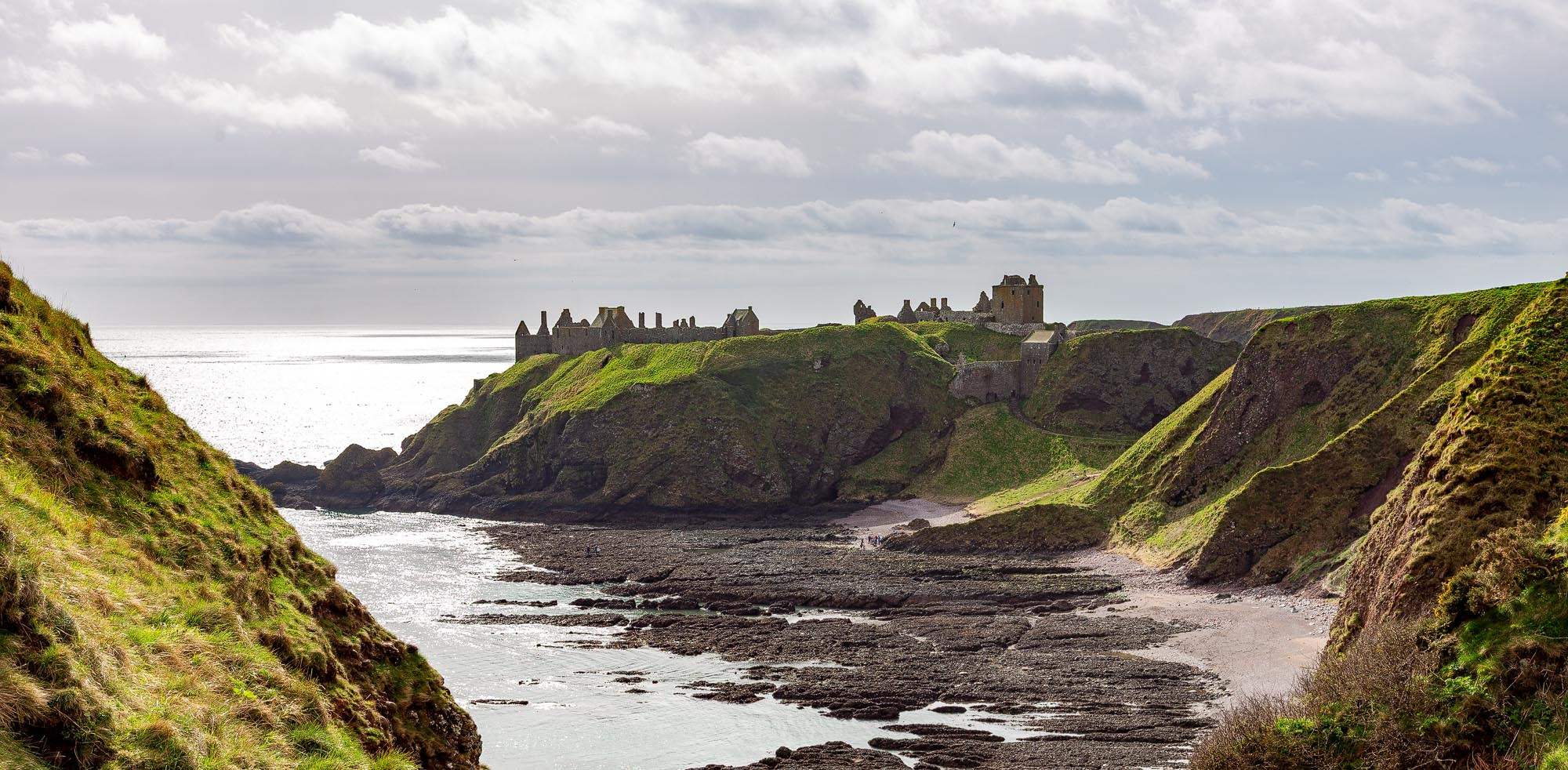
For those with more time, Dunnottar Castle lies just 15 miles south of Aberdeen and absolutely deserves a detour. This spectacular fortress, perched on a rocky headland, has witnessed pivotal moments in Scottish history and provided one of the most photographed views in Scotland.
Our Experience Driving the Route
Planning and Timing
We chose to drive the NE250 in late May, and the timing proved perfect. The weather was settled (by Scottish standards!), accommodation was easier to book than in high summer, and we encountered minimal traffic. Spring also meant the hillsides were carpeted with wildflowers, and wildlife was particularly active.
The route can be driven year-round, though each season offers different attractions. Summer brings the best weather and longest days, perfect for outdoor activities and distillery tours. Autumn paints the forests in spectacular colours and brings the whisky harvest season. Winter transforms the Cairngorms into a skiing playground, whilst spring offers the best wildlife watching and fewer crowds.
We allowed six days for our journey, which gave us time to explore properly without feeling rushed. Our itinerary looked roughly like this: Day 1 (Aberdeen to Braemar), Day 2 (Braemar through the Cairngorms to Speyside), Day 3 (Speyside distilleries and Elgin), Day 4 (Moray Coast to Banff), Day 5 (Aberdeenshire Coast), Day 6 (returning to Aberdeen with stops). This pace allowed for leisurely castle visits, distillery tours, coastal walks, and plenty of photo stops.
Driving Conditions
The driving itself is a pleasure. The roads are generally of excellent quality – predominantly A-roads with some scenic B-roads for variety. Unlike the narrow, winding single-track roads of the North Coast 500, the NE250 uses proper two-lane roads for most of its length. This makes for less stressful driving and allows you to actually enjoy the scenery rather than concentrating on oncoming traffic in passing places.
The Cairnwell Pass requires respect in poor weather or winter conditions, but in good weather it’s simply spectacular. Some coastal roads are delightfully twisty, but never challenging. Parking was rarely a problem – castles and attractions have proper car parks, towns have adequate street parking or car parks, and coastal viewpoints have lay-bys.
For electric vehicle drivers, the route is well served with charging points, particularly in the larger towns like Elgin, Buckie, Forres, and Lossiemouth. We saw numerous EV charging stations during our drive.
Accommodation and Facilities
The route is well served with accommodation at all price points. We mixed our stays between traditional hotels, boutique guesthouses, and one particularly memorable night in a castle B&B near Ballater. Advanced booking is recommended for summer months and during special events like the Braemar Gathering or the Spirit of Speyside Whisky Festival.
Every town along the route offers restaurants, cafés, and shops. We ate exceptionally well – fresh seafood on the coast, hearty Highland fare in the mountains, and fine dining in Aberdeen. Local produce features heavily, from Aberdeen Angus beef to fresh-caught salmon and shellfish.
Petrol stations are plentiful enough that you won’t get caught short, though it’s sensible to fill up in larger towns rather than counting on finding fuel in remote areas. Most larger towns have supermarkets if you need supplies.
What Makes the North East 250 Special?
Having now driven both the North Coast 500 and the North East 250, we can honestly say they offer very different but equally rewarding experiences. The NC500 is all about dramatic natural landscapes – mountains, sea lochs, and remote coastlines. The NE250 balances natural beauty with cultural richness – it’s where you go for castles, whisky heritage, and Scotland’s history alongside stunning scenery.
The variety is remarkable. In a single day, you might tour a Jacobean castle, drive through mountain passes, sample world-class whisky, and watch dolphins play in coastal waters. Few routes anywhere offer such diversity in such a compact area.
What struck us most was the authenticity. These are real, working communities, not places that exist solely for tourism. Yes, visitors are warmly welcomed and well catered for, but you’re also experiencing genuine Highland and coastal life. The distilleries still produce whisky, the harbours still land fish, the farms still work the land.
The route also offers excellent value. Many castles are managed by the National Trust for Scotland (membership grants free entry), beaches and coastal walks cost nothing, and while distillery tours have fees, they’re reasonable and usually include generous samples. Compared to more heavily touristed parts of Scotland, prices feel fair.
Wildlife and Nature
For nature lovers, the NE250 is exceptional. The Cairngorms support an incredible array of species, from red squirrels and pine martens to golden eagles and ospreys. The Moray Firth’s dolphin population is world-class, and you’re virtually guaranteed sightings if you visit the Dolphin Centre or take a boat trip from several coastal towns.

Seal colonies at Newburgh and other coastal spots are easily observed, whilst birdwatchers will find themselves in paradise. The coastline supports vast seabird colonies, the forests harbour rare species like capercaillie and Scottish crossbill, and the mountains host ptarmigan and snow bunting.
In autumn, the red deer rut in the Cairngorms provides one of nature’s great spectacles, with stags bellowing challenges that echo across the glens. Spring brings nesting ospreys, whose fishing dives are breathtaking to witness.
Practical Tips for Your North East 250 Adventure
Book accommodation in advance, especially for summer travel. The route is growing in popularity, and smaller villages have limited options.
Allow more time than you think. There’s so much to see that you’ll constantly want to stop. What looks like a 30-minute drive can easily take two hours with photo stops and diversions to viewpoints.
Get a National Trust for Scotland membership if you plan to visit multiple castles. It pays for itself after just 2-3 properties and includes free parking.
If you’re visiting distilleries, designate a driver or book a guided tour. Scottish drink-driving laws are strict (20mg alcohol per 100ml blood), and rightly so on these roads.
Pack layers. Even in summer, mountain weather can change rapidly, and coastal winds can be bracing. We started one day in t-shirts in Deeside and were in fleeces and waterproofs by the time we reached the Cairngorms.
Don’t rush. This isn’t a route to “tick off” – it’s a journey to savour. Some of our best memories came from unplanned stops at viewpoints or impromptu walks on deserted beaches.
What Else is Nearby?
Dunnottar Castle – Just south of Aberdeen, this spectacular clifftop fortress is one of Scotland’s most dramatic castles. The walk down to the headland and the castle’s role in Scottish history make it unmissable.
The Cairngorm Mountain Railway – Britain’s highest mountain railway takes you to 3,600 feet on Cairn Gorm itself, offering spectacular views and access to mountain walks.
Findhorn Bay – This beautiful tidal bay near Forres is excellent for birdwatching and beach walks, with the unique Findhorn Foundation ecovillage nearby.
Elgin Cathedral – Once known as the “Lantern of the North”, these 13th-century cathedral ruins remain one of Scotland’s most beautiful medieval buildings.
Forvie National Nature Reserve – Near Newburgh, this vast coastal reserve protects dunes, heathland, and Britain’s largest mainland breeding colony of eider ducks.

Final Thoughts
The North East 250 exceeded our expectations in every way. We’d heard it called “Scotland’s best-kept secret”, and whilst that’s changing as more people discover this gem, it remains delightfully uncrowded compared to more famous routes.
What makes it special isn’t just the individual attractions - though the castles, distilleries, and coastline would each merit a trip in their own right. It’s the cumulative effect of experiencing such variety in such a compact area, all while driving excellent roads through beautiful countryside.
Whether you’re a history buff exploring castles, a whisky enthusiast touring distilleries, a nature lover seeking wildlife, or simply someone who appreciates stunning landscapes and warm Scottish hospitality, the North East 250 delivers. It’s become one of our favourite Scottish journeys, and we’re already planning a return visit to explore the attractions we missed and revisit our favourites.

If you’re looking for an authentic Scottish road trip that balances natural beauty with cultural depth, that offers world-class attractions without overwhelming crowds, and that showcases the very best of north-east Scotland – the North East 250 is calling. Answer it. You won’t be disappointed.
All information was correct at the time of writing, please check things like entry costs and opening times before you arrive.

Leave a comment below