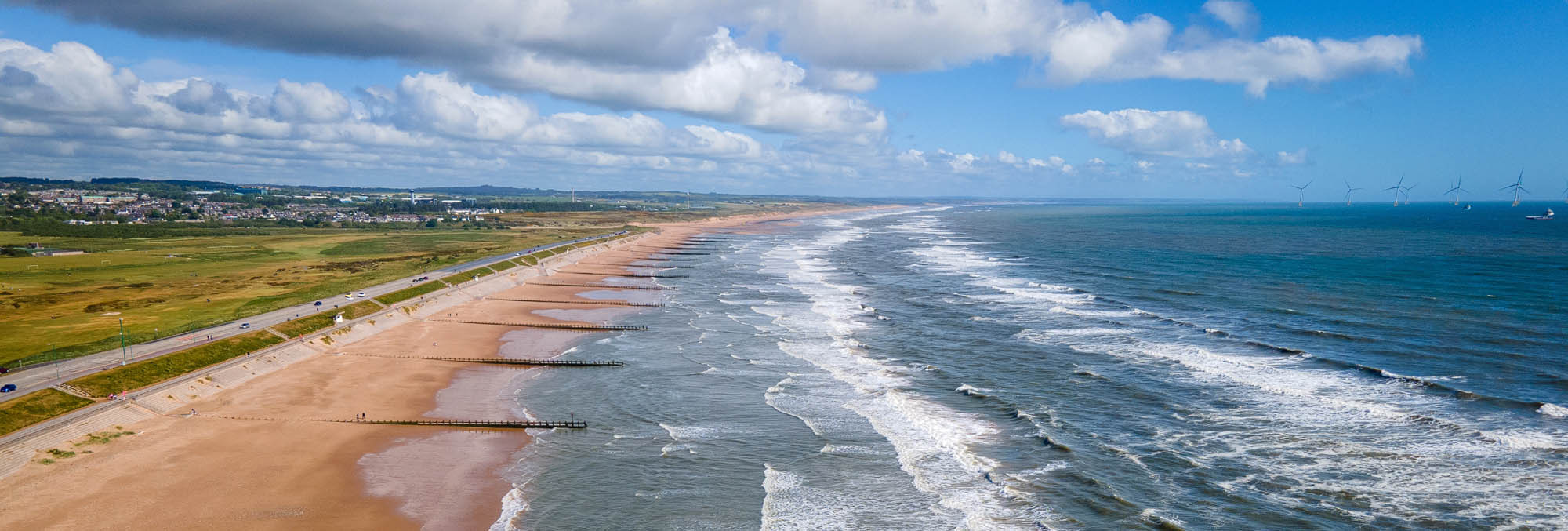
Aberdeen Beach is one of those places that surprises people. When you think of Aberdeen, you might picture granite buildings, the oil industry, or perhaps the busy harbour – but a two-mile stretch of golden sand with a vibrant esplanade, Art Deco architecture, and bottlenose dolphins? That tends to catch folk off guard. Janette and I have visited Aberdeen Beach many times over the years, and it remains one of the most underrated urban beaches in Scotland, making it an ideal stop during a short city break.
Stretching in a broad, sweeping curve from Aberdeen Harbour in the south to the mouth of the River Don in the north, the beach sits just a mile from the city centre. It’s backed by the Beach Esplanade – a long promenade popular with walkers, cyclists and runners – and flanked by the wide green expanse of Queens Links. Whether you’re after a bracing walk along the sand, a family day out at the amusement park, or simply a seat on the esplanade watching the North Sea roll in, Aberdeen Beach delivers.
A Brief History of Aberdeen Beach
Aberdeen’s relationship with its beach goes back centuries. The sandy shoreline and the dunes behind it were once a wild, wind-battered stretch of coast, frequented by fishermen from the nearby village of Footdee and the occasional hardy swimmer. Construction of the Beach Esplanade began in 1898, and this was really the starting point for transforming the area from untamed coastline into a proper seaside destination.
The real transformation came in the 1920s. Aberdeen Town Council launched an ambitious “Beach Improvement Scheme” with the bold aim of making the city the “Brighton of the North.” This wasn’t just civic optimism talking – the council invested heavily in creating a first-class holiday resort, extending the esplanade and developing entertainment facilities along the beachfront.
The crowning achievement of the scheme was the Beach Ballroom, which opened on 3rd May 1929 with a magnificent masquerade ball. Designed by architects Thomas Roberts and Hume of Bathgate in the Art Deco style, the ballroom was built primarily from granite and features an unusual octagonal form. Its most famous feature is the expansive maple dance floor, supported by an incredible 1,400 steel springs – giving it a gentle bounce that dancers have enjoyed for nearly a century.
The Beach Ballroom quickly became one of Scotland’s finest dance halls and attracted some of the biggest names in entertainment. The Beatles, The Who, Pink Floyd and the Small Faces all performed here. Known affectionately as “The People’s Ballroom,” it became a cherished community venue for weddings, dances, concerts and civic events. During the Second World War, servicemen stationed in Aberdeen slept on makeshift beds inside the ballroom, waking to gaze up at its ornate domed ceiling. The building is now a Category B listed structure and remains an important part of Aberdeen’s cultural life.

Another key building from this era was the Beach Baths, an indoor bathing station designed by city architect John Rust. It opened in 1898, serving beach-goers for over 70 years before closing in 1972 and being subsequently demolished. In its heyday, Aberdeen attracted visitors from across Britain and established itself as a genuine holiday resort – something that might seem hard to imagine now, but the infrastructure and ambition were very real.
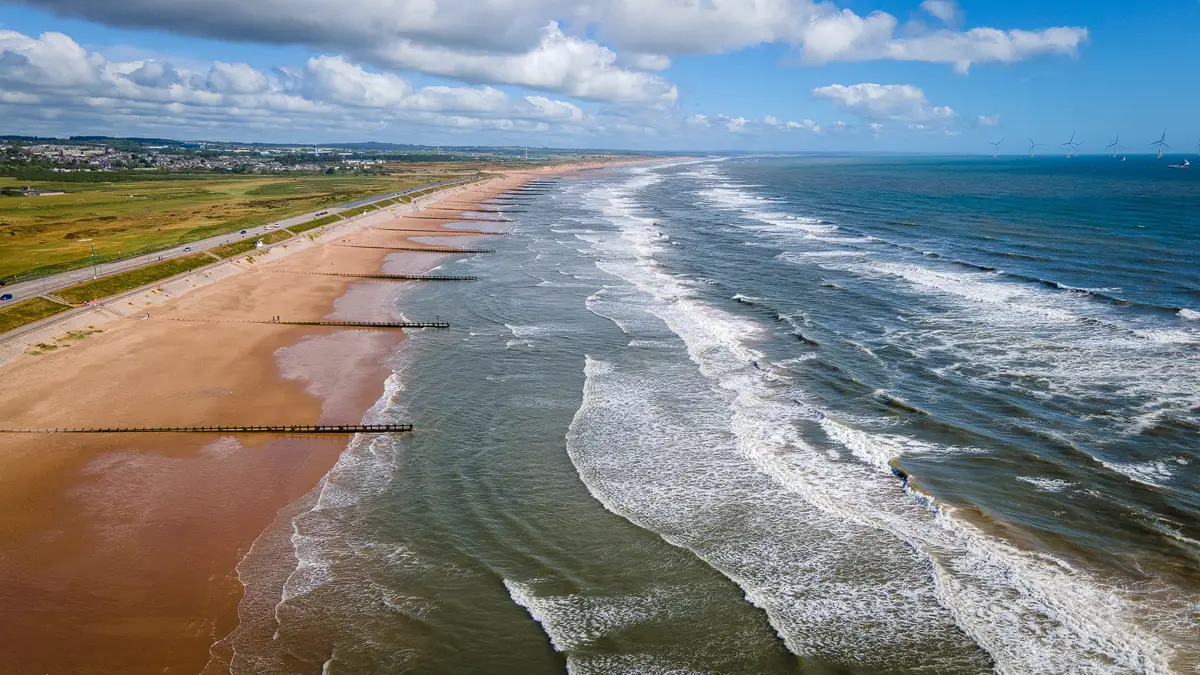
The beach itself has always battled erosion from the North Sea. A series of distinctive wooden groynes run perpendicular to the shoreline, designed to retain sand and slow the coastal erosion process. In more recent years, a large-scale sand replenishment programme saw sand transported by ship from sites further south along the coast and deposited on the beach, while V-shaped rock armour formations were installed offshore as an additional defence.
The £50 Million Beachfront Redevelopment
As of 2025–2026, Aberdeen Beach is undergoing its most significant transformation in 35 years. A £50 million redevelopment – part of a wider £150 million City Centre and Beach Master Plan – is reshaping the beachfront area. The Broadhill, a well-known landmark sitting between Kings and Queens Links, was the first element to be completed, officially opening in July 2025 in time for the Tall Ships Race. The five-hectare site has been enhanced with new access steps, footpaths, viewpoints, drystone walls, seating and over 10,000 new trees.
Work continues on a new beach park featuring a large play area centred around “The Rope Factory” – a bespoke 23-metre-tall play tower inspired by Aberdeen’s historic rope-making industry, designed with input from local schoolchildren. A skatepark designed by leading European firm Betongpark, a sports arena, and a 2.5-hectare events field with an amphitheatre are all due for completion in autumn 2026. Beach Boulevard has been permanently closed to road vehicles and will become part of the park. The former Beach Leisure Centre is being demolished, though the Linx Ice Arena continues to operate as normal.
Visitors should be aware that construction work will be visible during 2026, though the beach itself and esplanade remain fully accessible. Future phases include beach huts, improved shore access, upgrades to the Beach Ballroom, and a community clubhouse for swimmers, surfers and lifesaving clubs.
Our Visit to Aberdeen Beach
Arriving at the Beach
Janette and I arrived at Aberdeen Beach on a bright but breezy morning – fairly standard conditions for this part of the northeast coast. We parked along the esplanade, where there is a good amount of free roadside parking, though some sections are pay and display. If you’re arriving from the south on the A90, the simplest route is to follow signs towards the harbour and then round to the beach. From the north, come off at the Haudigan roundabout, follow the Parkway to the A96, cross the River Don bridge and you’re on the esplanade with a 1.5-mile drive south to the main resort area.
The Beach Boulevard Retail Park is nearby and offers over 900 free spaces if you’re struggling for a spot on the esplanade, though there’s a four-hour limit. Aberdeen city centre is only about a mile away, making it perfectly feasible to walk to the beach from Union Street in around 15 to 20 minutes.

Walking the Beach
Stepping down from the esplanade onto the sand, the first thing that strikes you is just how long this beach is. You can walk for a solid two miles if you want to, from the harbour wall at the southern end all the way to Donmouth Local Nature Reserve where the River Don empties into the North Sea. The sand is golden and firm underfoot near the water’s edge, becoming softer and dryer higher up towards the dunes.
The wooden groynes are a defining feature of Aberdeen Beach, marching out into the surf at regular intervals along the entire length. They’re weathered, algae-covered things – testimony to decades of battling the North Sea. On a day with any swell at all, the waves crash through and around them in quite a dramatic fashion. They’re functional rather than beautiful, but they give the beach real character and make for excellent photographs.

We walked south initially, towards the busier end of the beach where the amusement park and Beach Ballroom sit. The skyline here is unmistakably urban – the tower blocks of Seaton, the Codona’s ferris wheel, and the distinctive domed roof of the Beach Ballroom all compete for your attention. There were surfers out in the waves, which surprised me – Aberdeen might not be your first thought for surfing, but the beach does pick up decent swells from the North Sea, and there’s a small but dedicated surfing community here.
Turning north, the character of the beach changes. The urban backdrop gives way to the green expanse of Queens Links and Kings Links Golf Course. The further north you walk, the quieter and more natural it becomes, until you reach the dunes and the nature reserve at Donmouth. This is a lovely stretch for birdwatching, and it feels a world away from the amusement park at the other end.

Donmouth Local Nature Reserve
At the northern tip of the beach, where the River Don meets the sea, you’ll find Donmouth Local Nature Reserve. The landscape here is wilder and more rugged – sand dunes topped with marram grass, and the remnants of the Second World War still visible in the form of concrete pillboxes and anti-tank defences half-buried in the sand. It’s quite a striking sight, this contrast between the natural beauty of the dunes and these stark military structures, and it’s a reminder that Aberdeen’s coastline played a role in Britain’s wartime defences. During the war, anti-aircraft batteries were even positioned on the esplanade itself, near the Beach Ballroom.

Footdee – The Hidden Fishing Village
One of the real highlights of a visit to Aberdeen Beach is taking a wander through Footdee, or “Fittie” as locals call it. This tiny historic fishing village sits at the southern end of the beach, right at the mouth of Aberdeen Harbour, and it’s one of the most charming and unexpected corners of the city.
The settlement dates back to medieval times, with the first recorded reference to the area in 1398. The name is thought to derive from a dedication to St Fittick (or St Fothan) rather than, as many Aberdonians believe, from its position at the “fit o’ the Dee.” The current village was laid out in 1808–09 by John Smith, then Superintendent of Aberdeen’s Public Works, who designed 28 single-storey thatched cottages arranged around two squares – North Square and South Square. Middle Row and Pilot Square were added later as the fishing community grew. The cottages were built facing inwards, with their backs to the harbour, to protect against the harsh North Sea winds.

Today, Footdee is a Conservation Area and all its buildings are individually listed. The fishing families are largely gone, but the village retains a wonderfully eccentric character. Many of the outbuildings and sheds have been transformed into colourful, artistic creations – some bizarre, some beautiful, all unique. Wandering the narrow lanes between the granite cottages, it feels genuinely like stepping into a different world from the rest of Aberdeen. When the North Sea oil boom arrived in the late 1960s, there were fears that Fittie might be demolished to make way for development – as happened to Old Torry across the harbour in 1971 – but thankfully it survived.
Codona’s Amusement Park and Nearby Attractions
For families, the southern end of the beach is where the action is. Codona’s Amusement Park sits right on the beachfront and has been entertaining families for decades. It’s a proper seaside funfair with rollercoasters, a log flume, the Grampian Eye ferris wheel, dodgems, adventure golf and ten-pin bowling – the kind of place that keeps the kids happy for hours. Our three loved it when they were younger.

Queens Links Leisure Park is adjacent, with a Cineworld cinema, restaurants and eateries. The Linx Ice Arena offers public skating sessions, and Transition Extreme – an indoor activity centre with climbing walls, a skatepark and high ropes – is also nearby. Aberdeen Science Centre, just 100 metres from the beach, is another excellent option for families, particularly on a rainy day. You could easily spend a full day in this area without running out of things to do.
Dolphin Spotting
One of the most remarkable things about Aberdeen Beach is the wildlife. The waters off Aberdeen are home to bottlenose dolphins – part of the resident northeast Scotland population of approximately 190 individuals, the most northerly resident bottlenose population in the world. These dolphins range from the Moray Firth south to the Firth of Tay and beyond, and Aberdeen Harbour is one of the best spots in the UK to see them from land.
The prime viewing location is Torry Battery on the south side of the harbour, where the Greyhope Bay Centre offers a café, education space and an 80% encounter rate for dolphin sightings on any given day. The dolphins are drawn to the harbour mouth by migrating salmon and sea trout, and the best months for spotting them are between January and June. Seals, harbour porpoise, and occasionally minke and humpback whales have also been recorded off the Aberdeen coast. If you’re visiting the beach, it’s well worth keeping an eye on the sea – particularly near the harbour end.
Frequently Asked Questions
Is Aberdeen Beach free to visit?
Yes, the beach and esplanade are completely free to access at all times of the year. There are no entrance charges. Some parking areas are free, while others are pay and display.
Can I swim at Aberdeen Beach?
Swimming is permitted but at your own risk – there are no lifeguards on duty. The water is cold year-round (this is the North Sea!), and there can be strong currents, particularly near the groynes and harbour entrance. Aberdeen Beach is a designated bathing water site, and real-time water quality predictions are displayed on an electronic sign at the beach between June and September.
Is Aberdeen Beach dog friendly?
Yes, dogs are welcome on Aberdeen Beach throughout the year. It’s a popular spot for dog walking, particularly along the quieter northern stretches towards Donmouth. Please clean up after your dog.
Is the beach accessible for wheelchair users?
The esplanade is flat, wide and fully accessible. However, access down to the sand itself is via steps or a slipway, and the soft sand can be difficult for wheelchairs. The esplanade provides excellent views of the beach and sea without needing to go onto the sand.
Is there parking at Aberdeen Beach?
Yes, there is parking along the esplanade (a mix of free and pay-and-display bays). The Beach Boulevard Retail Park offers over 900 free spaces with a four-hour limit. Additional parking is available at Queens Links. Note that some parking may be affected by the ongoing beachfront redevelopment works during 2025–2026.
Are there toilets and facilities at Aberdeen Beach?
Public toilets are available along the esplanade. There are cafes, restaurants and takeaways at Queens Links and along Beach Boulevard. The Linx Ice Arena, Codona’s Amusement Park and Aberdeen Science Centre are all within easy walking distance.
Can you see dolphins from Aberdeen Beach?
You can, though the best viewing spot is Torry Battery on the south side of the harbour rather than the beach itself. Bottlenose dolphins are seen almost daily at the harbour entrance, particularly between January and June. The Greyhope Bay Centre at Torry Battery has free binoculars for visitors.
Key Information
- Location: Sea Beach, Beach Esplanade, Aberdeen, AB24 5NR
- Grid Reference: NJ 9527 0715
- Managed by: Aberdeen City Council
- Entry: Free
- Parking: Esplanade roadside parking (free and pay-and-display). Beach Boulevard Retail Park has 900+ free spaces (4-hour limit)
- Facilities: Public toilets, cafés, restaurants, Codona’s Amusement Park, Linx Ice Arena, Aberdeen Science Centre, Beach Ballroom
- Accessibility: Esplanade fully accessible. Beach access via steps or slipway
- Dogs: Welcome year-round
What Else is Nearby?
Footdee (Fittie) – The historic fishing village at the harbour mouth, described above, is an absolute must-visit. Wander the narrow lanes and admire the quirky sheds and colourful gardens. A hidden gem within the city.
Torry Battery & Greyhope Bay Centre – Cross the harbour to Torry Battery for spectacular dolphin watching and panoramic coastal views. The Greyhope Bay Centre offers a café and education space in an off-grid container conversion.
Duthie Park & David Welch Winter Gardens – One of Europe’s largest indoor gardens, set within Aberdeen’s beautiful Duthie Park. Free entry and a wonderful escape on a wet day. Read our full guide to the Winter Gardens here.
Aberdeen Maritime Museum – Located on the historic Shiprow in the city centre, this excellent free museum tells the story of Aberdeen’s relationship with the North Sea – from fishing and shipbuilding to the offshore oil industry.
Old Aberdeen & St Machar’s Cathedral – The medieval quarter of the city, with cobbled streets, the University of Aberdeen campus, and the stunning 15th-century St Machar’s Cathedral with its remarkable heraldic ceiling.
Final Thoughts
Aberdeen Beach is a genuinely rewarding visit, and one that I think is overlooked by many visitors to Scotland. It doesn’t have the turquoise waters of Harris or the dramatic backdrop of the Cuillin, but what it does offer is a proper seaside experience within walking distance of a vibrant city. The stretch of golden sand is impressive, the history of the beachfront is fascinating, and the fact that you might see bottlenose dolphins from the shore of a major city is something quite special.
With the £50 million redevelopment well underway, the beachfront is going to look very different – and significantly better – in the coming years. Whether you’re visiting Aberdeen for the first time or you’ve lived here for years, a walk along this beach is time well spent. Just bring a jacket – the North Sea wind has a habit of reminding you which coast you’re on.
If you’re planning a longer trip to the area, have a look at our 5-day Aberdeenshire itinerary, our guide to golf courses in Aberdeen, or browse our Aberdeen & Aberdeenshire accommodation listings. For more Scottish beach inspiration, see our comprehensive guide to the best beaches in Scotland.
All information was correct at the time of writing, please check things like entry costs and opening times before you arrive.


Leave a comment below