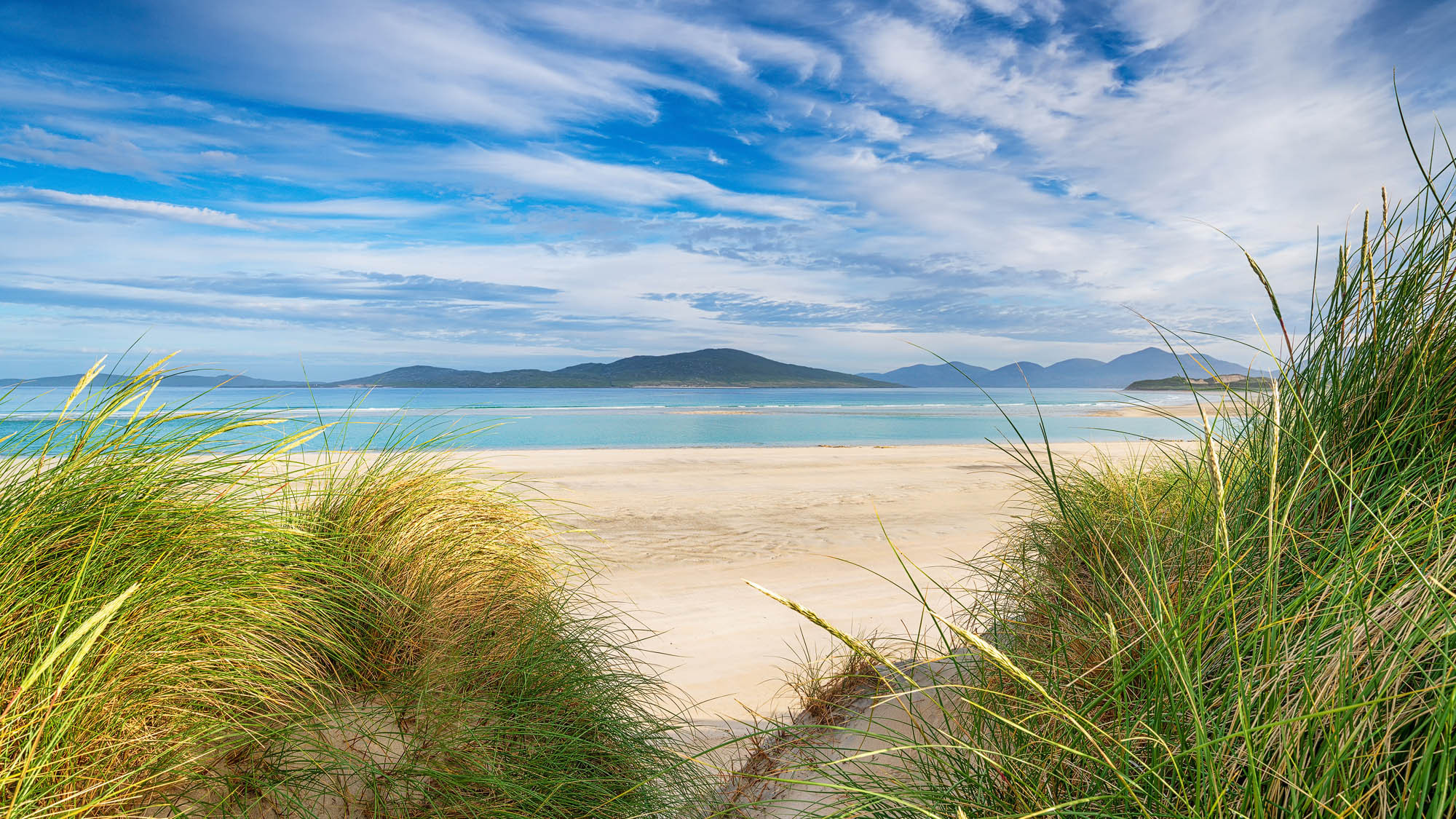
Scotland has nearly 19,000 kilometres of coastline. That is not a typo. For a country you can drive across in a few hours, the sheer amount of coast is staggering – more than France, more than Spain, and nearly three times that of England. And scattered along that coastline are beaches that routinely get compared to the Caribbean, the Maldives, and the South Pacific.
The difference, of course, is the water temperature. But if you can get past that – and after a few seconds of gasping, you do – what you are left with is some of the most beautiful sand and sea anywhere on the planet, without the crowds, the resort fees, or the twelve-hour flight.
Janette and I have spent years visiting beaches across Scotland with our three daughters, and I still find myself surprised by what we discover. Turquoise water lapping at white shell sand on Harris. WW2 tank traps standing guard on the Moray coast. Red sandstone cliffs framing golden bays in Angus. Every region has its own character, shaped by millions of years of geology and thousands of years of human history.
This is not a list of ten beaches chosen to fill a blog post. This is a comprehensive guide to the best beaches in Scotland, covering every coast from the Outer Hebrides to East Lothian, from Caithness to Galloway. I have personally visited every beach on this list, and I have tried to include the practical information – parking, facilities, what to expect – that most articles on this topic skip entirely.
Table of Contents
- Why Scotland's Beaches Are World Class
- The Outer Hebrides
- Inner Hebrides and the West Coast
- The Northwest Highlands
- The North Coast
- The Moray Coast and Northeast Scotland
- The East Coast
- Southwest Scotland
- Practical Guide to Scotland's Beaches
- Frequently Asked Questions
Why Scotland's Beaches Are World Class
Before getting into individual beaches, it is worth understanding why Scotland's beaches look the way they do. The answer lies in geology, glaciation, and a unique coastal habitat called machair.
Scotland's west coast and islands sit on some of the oldest rocks on Earth – Lewisian gneiss, formed up to 3 billion years ago. These ancient hard rocks create the dramatic headlands and sheltered bays that frame so many western beaches. The white sand on beaches like Luskentyre and Seilebost comes not from rock erosion but from crushed shells and coral, ground down by the Atlantic over millennia and carried ashore by prevailing westerly winds.
On the east coast, the geology is different. Younger sandstones and glacial deposits create longer, broader beaches with golden and red-toned sand. The Moray coast, where I live, sits on Old Red Sandstone – the same geological formation responsible for the towering cliffs at Dunnottar and the red sands of Lunan Bay further south.
Machair – a Gaelic word pronounced roughly "mach-er" – is a coastal habitat almost unique to Scotland and the west coast of Ireland. It forms when calcareous shell sand is blown inland by Atlantic winds, creating a flat, flower-rich grassland behind the dunes. Machair supports an extraordinary diversity of wildflowers in summer and is one of the rarest habitats in Europe. You will find it behind many of the Hebridean beaches in this guide.
Scotland also benefits from the Gulf Stream, which brings warmer Atlantic water to the west coast. This is why beaches on Harris and the west Highlands can have that astonishing turquoise colour – the combination of white shell sand, shallow water, and relatively clear ocean currents creates colours you would not expect at 57 degrees north.
The Outer Hebrides
If you are serious about beaches, the Outer Hebrides should be at the top of your list. The western coastline of Harris and Lewis contains what many consider to be the finest beaches in Europe, and having seen them myself, I would not argue with that.
Luskentyre Beach, Isle of Harris

Luskentyre is, by almost any measure, the finest beach in Scotland. It regularly tops polls as the best beach in Britain, and a 2025 study of Tripadvisor reviews found that around 94% of visitors gave it five stars – higher than any other beach in the UK. Standing on the sand for the first time, you immediately understand why.
The beach stretches for over a mile along the west coast of South Harris, backed by machair and dunes, with the mountains of North Harris rising across Luskentyre Bay. At low tide, the sand extends hundreds of metres out, creating vast tidal flats that shimmer with reflected light. The water colour shifts through shades of turquoise, emerald and aquamarine depending on the light and the tide.
What photographs cannot capture is the silence. Even on a busy summer day, the beach is large enough that you can find your own space. In the shoulder months – May, June, September – you may have entire stretches to yourself. There is a small car park at the end of the road with space for perhaps 20 cars, and a short walk over the dunes brings you onto the sand.
Getting to Harris requires either a CalMac ferry from Uig on Skye to Tarbert (around 1 hour 40 minutes), or a ferry from Ullapool to Stornoway on Lewis followed by a drive south. I would recommend spending at least two nights on Harris – the beaches alone justify it, and the pace of life here is something worth adjusting to. For more on the Outer Hebrides, have a look at our article on the best Scottish islands to live on.
Seilebost Beach, Isle of Harris
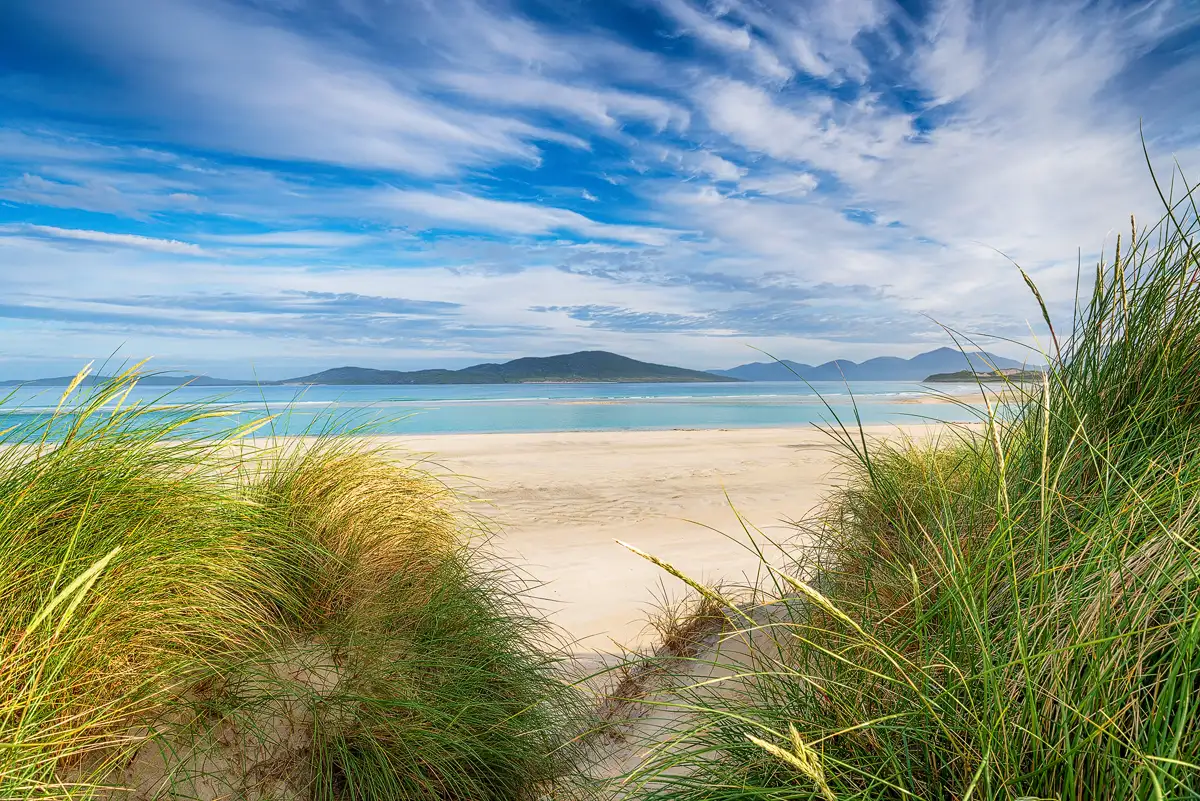
Just around the headland from Luskentyre, Seilebost is equally beautiful but slightly easier to access and often quieter. Where Luskentyre is vast and expansive, Seilebost feels more intimate – a crescent of white sand framed by grassy dunes, looking across the bay to the same mountain backdrop.
The road from Tarbert passes through the small crofting settlement of Seilebost, and parking is available at a couple of spots along the road. From the dunes, the view across the sand and turquoise water to the mountains of North Harris is genuinely breathtaking. I have been to beaches around the world, and this view ranks with anything I have seen.
The machair behind Seilebost is particularly beautiful in June and July when wildflowers are in bloom – orchids, buttercups, clover, and dozens of other species carpet the ground in colour. If you visit Harris, do not just visit one beach. Drive the entire west coast road from Tarbert south to Rodel, stopping at Luskentyre, Seilebost, and Scarista along the way. Each has its own character.
Uig Sands, Isle of Lewis

Uig Sands sits on the west coast of Lewis and is famous as the place where the Lewis Chessmen – a hoard of 93 carved Norse gaming pieces from the 12th century – were discovered in 1831. The chessmen are now split between the National Museum of Scotland in Edinburgh and the British Museum in London, but the beach where they were found remains as wild and remote as it was 200 years ago.
This is a vast tidal beach. At low tide, the sand extends well over a kilometre from the dunes to the waterline, creating an enormous natural playground. The sand is fine white shell sand, similar to what you find on Harris, and backed by impressive dune systems. The surrounding landscape is classic Lewis moorland – open, treeless, and beautifully desolate.
Uig Sands is less visited than the Harris beaches despite being equally impressive. If you are staying in Stornoway, it is about a 40-minute drive west. The road takes you through some of the most atmospheric landscape in the Hebrides – peat bogs, lochs, and scattered crofts. A car park is available at the end of the road near Ardroil.
Inner Hebrides and the West Coast
The Inner Hebrides – Mull, Skye, and the smaller islands – along with the mainland west coast, offer a different beach experience to the Outer Hebrides. The geology is more varied, the landscapes more dramatic, and many of the best beaches are more accessible for those with limited time.
Calgary Bay, Isle of Mull

Calgary Bay is Mull's finest beach and one of the best in the Inner Hebrides. It sits in a sheltered bay on the northwest coast of the island, backed by machair and woodland, with views out towards the islands of Coll and Tiree. The sand is white and the water remarkably clear, and the bay's sheltered position makes it one of the better swimming beaches on Mull.
What makes Calgary Bay distinctive is the contrast between the white sand and the dark volcanic basalt that borders it. Mull's geology is dominated by ancient volcanic activity – the island was a major volcanic centre around 60 million years ago – and the dark, jagged rock formations at either end of the beach create a dramatic frame. Calgary is also the origin of the name Calgary in Alberta, Canada – Colonel James Macleod named the Canadian city after this bay in 1876.
There is a good-sized car park, a seasonal café selling drinks and ice cream, and an art walk through the woodland behind the beach. Calgary Bay gets busy in high summer – it is one of Mull's most popular family beaches – but arriving early or visiting in the shoulder months will reward you with a quieter experience. Mull is reached by CalMac ferry from Oban to Craignure (around 45 minutes), and Calgary is about an hour's drive northwest from the ferry terminal.
Camusdarach Beach, Morar

Camusdarach is one of those beaches that seems almost too beautiful to be real. A crescent of bright white sand faces west towards the Small Isles – Rum, Eigg, Muck, and Canna – whose distinctive profiles line the horizon like a mountain range rising from the sea. On a clear day, the views from this beach are among the best in Scotland.
The beach is famous as a filming location for the 1983 film Local Hero, and walking onto the sand for the first time, you can see why the location scouts chose it. The sand is fine and white, the water is astonishingly clear, and the backdrop of islands gives the whole scene a sense of drama that few beaches can match.
Camusdarach is reached from the B8008 coast road between Arisaig and Mallaig. There is a small car park (it fills quickly in summer) and a short walk through dunes to the beach. The road from Fort William to Mallaig – the famous "Road to the Isles" – is one of the finest drives in Scotland, and Camusdarach makes an excellent stop along the way. If you are following our 7-day Scotland itinerary, this beach fits perfectly into Day 3.
Claigan Coral Beach, Isle of Skye

Coral Beach on Skye is not quite what you might expect from the name. The "sand" is actually made from the bleached, crushed skeletons of a type of coralline algae called maerl, which gives the beach its distinctive pale, almost white appearance. Mixed with pebbles and backed by a grassy headland, it looks unlike any other beach on Skye.
The walk to Coral Beach is part of the experience. From the car park near Claigan (north of Dunvegan), it is roughly a 1.5-mile walk each way along a well-maintained path. The path follows the coast, offering views across Loch Dunvegan to the Outer Hebrides, and on a clear day the walking is a genuine pleasure. Allow about 30 minutes each way.
The beach itself is relatively small – perhaps 200 metres of shoreline – but the unusual colour and texture of the sand, combined with turquoise water and views to the islands of Isay and Mingay, make it well worth the effort. It can get busy in peak summer, so aim for early morning or late afternoon if you want the beach to yourself. For more on Skye, see our comprehensive guide to things to do on the Isle of Skye.
The Northwest Highlands
The northwest coast of mainland Scotland – from Durness down to Lochinver – has some of the most spectacular and remote beaches in the country. Many of these are on or near the North Coast 500 route, making them accessible as part of a road trip, though some require a fair walk to reach.
Sandwood Bay, Sutherland

Sandwood Bay is often described as the most beautiful beach in Britain, and I would not disagree. What sets it apart from every other beach on this list is its total remoteness. There is no road to Sandwood Bay. To get there, you walk – a 4.5-mile trek each way across open moorland from the car park at Blairmore, near Kinlochbervie.
The walk takes about 90 minutes in each direction across relatively flat terrain, following a good track through peat moorland. It is not difficult, but it does mean you need to commit the best part of a day. What you get in return is extraordinary: a mile-long crescent of pink-white sand, backed by towering sand dunes and flanked by sandstone cliffs. At the southern end, the 65-metre sea stack Am Buachaille rises dramatically from the surf. Behind the beach, a freshwater loch adds another dimension to an already remarkable scene.
Because of the walk-in, Sandwood Bay never gets crowded. Even in August, you might share the beach with a dozen other people at most. The beach faces northwest and catches the full force of Atlantic swells, so swimming is not advisable – but the drama of the waves, the emptiness, and the sheer scale of the landscape make this an unforgettable experience. Take food and water, wear decent boots, and leave plenty of daylight for the return walk.
Balnakeil Beach, Durness

Balnakeil is Durness's larger beach, stretching for over a mile along Balnakeil Bay towards Faraid Head. The sand is golden-white and the water often takes on that improbable Caribbean blue that characterises the best north coast beaches. At low tide, the beach is enormous – you could comfortably fit several football pitches on the sand and still have room to spare.
Walking north along Balnakeil towards Faraid Head is one of the great beach walks in Scotland. The headland at the far end is a Ministry of Defence property (there is an early warning radar station), but you can walk most of the way and be rewarded with views along the north coast in both directions. The dunes behind the beach are impressive and home to a good population of skylarks and meadow pipits in spring and summer.
Parking is available at Balnakeil, either near the old church and graveyard or further along at the Balnakeil Craft Village – a collection of artist studios and workshops housed in a former Cold War military base. Have a look around the craft village before or after your beach visit; it is an interesting place. Durness itself has a handful of shops, a couple of good places to eat, and is a key stop on the NC500.
Sango Sands, Durness

Where Balnakeil is vast and open, Sango Sands is compact and dramatic. This small beach sits directly below the cliffs at Durness village, with a campsite right on the clifftop above. The contrast between the wild sea, the dark rocks scattered across the sand, and the turquoise water makes Sango one of the most photogenic beaches in Scotland.
The beach is accessed via steep steps from the campsite or the road above. It is split into several small coves by rocky outcrops, and at low tide you can explore between them. The views out over the North Atlantic from the clifftop are spectacular – on a clear day you can see the outline of Cape Wrath to the northwest and the mountains of the Scottish mainland stretching east.
If you are doing the NC500, Durness is an essential stop. Between Balnakeil and Sango Sands, you have two world-class beaches within a ten-minute drive of each other. The Sango Sands campsite is regularly rated as one of the best in Scotland, and I can see why – waking up to those views would be something special.
Achmelvich Beach, Assynt

Achmelvich is a compact, sheltered bay about 5 miles northwest of Lochinver in Assynt. The beach has bright white sand, shallow turquoise water, and is backed by rocky hillsides dotted with white crofting houses. It feels remarkably Mediterranean for a beach at this latitude.
The sheltered position makes Achmelvich one of the better swimming beaches on the northwest coast – the water is still cold, but on a calm day the shallows warm up enough to make a dip genuinely enjoyable rather than purely character-building. There is a small campsite nearby, a youth hostel within walking distance, and a seasonal food van that does a good line in fish and chips.
Achmelvich gets busy in peak summer – the car park is small and fills quickly – so arriving early is advisable if you are visiting in July or August. The surrounding Assynt coastline has several other excellent beaches worth exploring, including Clachtoll (about 3 miles north) and Clashnessie. The landscape in this part of Scotland is extraordinary, with the distinctive shapes of Suilven, Canisp, and Quinag dominating the horizon.
The North Coast
The north coast of Scotland, running from Durness east to John o'Groats, is less visited than the west coast but has some tremendous beaches. The landscape here is flatter and more open than the west, and the beaches tend to be longer and more exposed to the North Atlantic swell.
Dunnet Beach, Caithness

Dunnet Beach is a two-mile sweep of golden sand on the north coast of Caithness, just a few miles from Dunnet Head – the most northerly point of mainland Britain (not John o'Groats, despite what many people think). The beach is backed by impressive sand dunes and faces Dunnet Bay, with views across to the island of Hoy in Orkney on clear days.
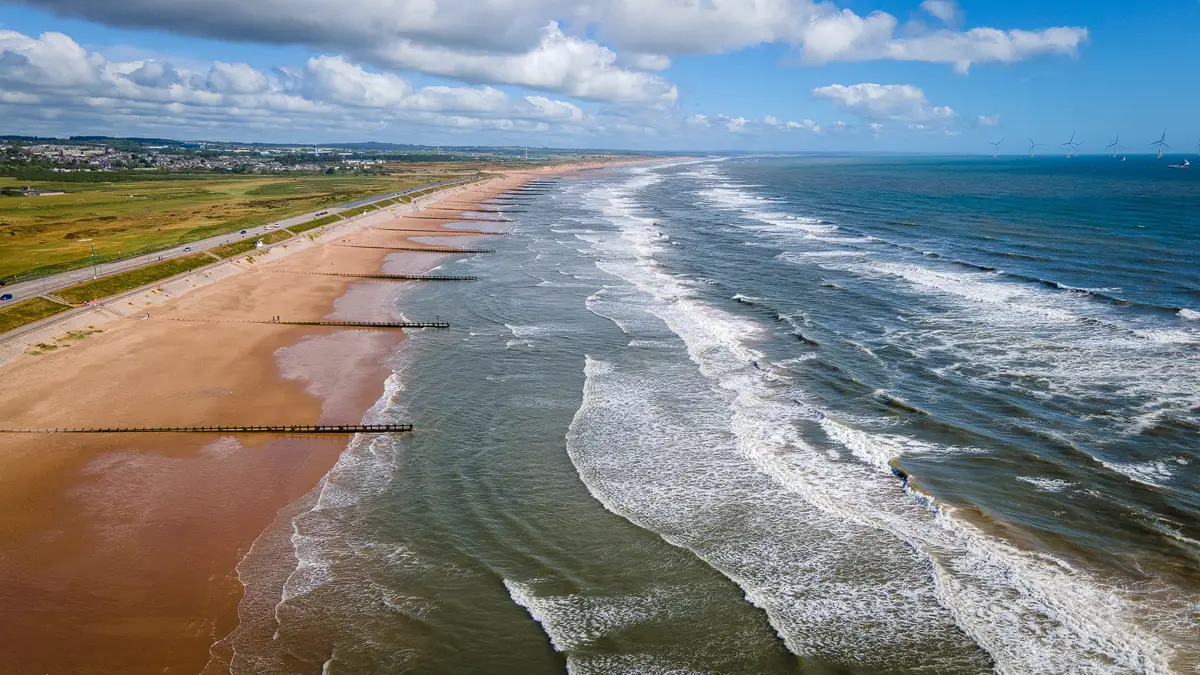
What strikes you most about Dunnet is the scale. From the air – and the drone shot above gives you a sense of this – the beach stretches endlessly in both directions, with barely a soul on it. Even in high summer, the beach is large enough that it never feels crowded. The flat Caithness farmland behind the dunes creates a distinctive atmosphere quite different from the mountainous west coast.
Dunnet is a popular surfing beach, with consistent swells rolling in from the North Atlantic. Beginners and experienced surfers alike use this beach, and there are sometimes surf schools operating here in summer. A car park is available at the west end of the beach, and the village of Dunnet has a few facilities including a hotel with an award-winning restaurant.
Dornoch Beach, Sutherland

Dornoch is a charming Highland town with a medieval cathedral, a world-famous golf course (Royal Dornoch), and a beautiful stretch of beach running south from the town along the Dornoch Firth. The sand is golden and the beach is flat and wide – ideal for families with young children.
The beach is easily accessible from the town, with a car park right by the entrance. It is backed by dunes and links grassland (the golf course runs along part of the beachfront), and the sheltered position on the firth means it is often calmer than the exposed north coast beaches. Dornoch itself has good amenities – shops, restaurants, a lovely bookshop – making it a comfortable base for exploring the eastern section of the NC500.
The Moray Coast and Northeast Scotland
I may be biased, living near Buckie in Moray, but I think the Moray coast is one of the most underrated stretches of coastline in Scotland. It does not get the Instagram attention of Harris or the NC500 hype of Durness, but it has outstanding beaches, fascinating history, and some of the best wildlife watching in the country. The Moray Firth coast is lined with beautiful fishing villages, and the North East 250 driving route takes in much of what this area has to offer.
Lossiemouth East Beach

Lossiemouth East Beach is, in my opinion, one of the most impressive beaches in Scotland – and one of the least known outside Moray. It stretches for seven miles from Lossiemouth to Garmouth, backed by tall sand dunes and almost entirely empty. The sand is golden and the beach is wide and flat, ideal for long walks, running, or simply disappearing into the landscape.
Access was significantly improved in 2022 when a new footbridge was opened, replacing the old Seatown bridge that had been closed since 2019. The new Lossiemouth bridge spans the River Lossie from the esplanade and is a fine piece of engineering – wider and more accessible than its predecessor. Cross the bridge and you are onto the dunes within minutes.
I have photographed sunrise on East Beach more times than I can count, and the light here is frequently extraordinary. The combination of east-facing aspect, tall dunes, and the broad sweep of the Moray Firth creates conditions for some genuinely spectacular sunrises. The beach is also a good spot for surfing – Lossiemouth is home to New Wave Surf School, and the consistent waves here are popular with local surfers.
Lossiemouth West Beach and Covesea

If East Beach is Lossiemouth's wild side, West Beach is its more accessible sibling. Stretching west from the town towards Covesea Lighthouse, this beach is backed by low dunes and is easily reached from the promenade. The lighthouse at Covesea makes a superb focal point for photography, particularly at sunset when the light reflects off the wet sand.
West Beach also has some fascinating WW2 history. Remnants of coastal defences – including concrete tank traps and pill boxes – are scattered along the shoreline, placed during the war to defend against potential German landings on the long, flat Moray beaches. RAF Lossiemouth, one of the busiest military airfields in the UK, sits immediately behind the beach, and you will often see Poseidon P-8 maritime patrol aircraft or Typhoon fighters overhead.
West Beach is also one of the better locations on the Moray coast for seeing the Northern Lights. The north-facing aspect and relatively low light pollution make it a popular spot for aurora chasers.
Roseisle Beach

Roseisle is one of the most unusual beaches in our guide. The beach itself is a long, flat stretch of golden sand on the Moray Firth, but what makes it distinctive is the combination of ancient pine forest, sand dunes, and WW2 military archaeology. Lines of concrete anti-tank cubes march along the sand – placed here during the Second World War when an invasion via these broad, flat beaches was considered a genuine threat.
Behind the beach, Roseisle Forest is a beautiful pine and broadleaf woodland with walking trails and a good chance of seeing red squirrels. There are three marked trails, and combining a woodland walk with a beach visit makes for a great half-day out. The beach is quiet even in summer – most visitors gravitate to Lossiemouth or Findhorn instead – so you will often have large stretches to yourself.
Parking is available at the Roseisle Country Park car park, and a short walk through the forest brings you to the dunes and beach. Dolphins and seals are regularly spotted from the beach – the Moray Firth is home to the world's most northerly population of bottlenose dolphins, and they are frequently seen feeding close to shore.
Sandend Beach, Aberdeenshire

Sandend is a small fishing village with a beautiful flat sandy beach that has become increasingly popular with surfers. The beach sits in a sheltered bay, flanked by the village on one side and rocky cliffs on the other, with Glenglassaugh Distillery visible on the hillside above.
Despite living locally, I had never been to Sandend until a few years ago when my family and I stopped by after visiting the Portsoy Ice Cream Shop. We were immediately struck by how beautiful it was – a wide, flat beach backed by dunes, with WW2 tank traps adding historical interest near the dune line. The girls had a great time jumping between the tank traps while I flew the drone.
Sandend has a small car park with public toilets, and a caravan park sits between the car park and the beach. Surf lessons are available, and the consistent waves make it a popular alternative to the more well-known surf beaches at Lossiemouth. Just a mile to the west, the dramatic clifftop ruins of Findlater Castle are well worth a detour.
Cullen Beach

Cullen is arguably the most picturesque fishing village on the entire Moray Firth coast, and its beach is a big part of the appeal. The bay curves around beneath the impressive railway viaduct (no longer in use but visually stunning), with the colourful sea town – traditional stone cottages with orange pantile roofs – climbing the hillside above.
The beach is a mix of sand and rock, excellent for rock-pooling at low tide. Cullen is also home to the Cullen Sea School, which offers kayaking, paddle-boarding, and coastal rowing. The town itself is famous for Cullen Skink – a rich soup made from smoked haddock, potatoes, and onions that originated here. Several local establishments serve their own versions, and it is well worth trying on a cold day.
For a great walk, follow the coastal path from Cullen to Portknockie, passing sea caves, natural arches, and the spectacular Bow Fiddle Rock. For much more detail on the Moray coast beaches, see my dedicated guide to beaches in Moray.
Nairn Beach

Nairn was once described as "the Brighton of Scotland" by Victorian tourists, and while that comparison might be a stretch, the town's long sandy beach remains one of the best-served beaches in the Scottish Highlands. A proper promenade backs the beach, with a leisure centre, play parks, putting green, and several cafés nearby.
The beach itself is wide and sandy, stretching east from the harbour towards the mouth of the River Nairn. It is popular with families, dog walkers, and, increasingly, kitesurfers and windsurfers who take advantage of the consistent winds that blow along the Moray Firth. The beach holds a Scotland Beach Award, recognising its cleanliness and management.
Nairn is well positioned for combining a beach visit with other attractions. Cawdor Castle is about 6 miles south, Fort George is 10 miles west, and Inverness is a 25-minute drive. If you are visiting the Highlands and want a beach day with proper facilities – toilets, cafés, ice cream – Nairn is hard to beat.
Loch Morlich Beach, Cairngorms

Not every great Scottish beach is on the coast. Loch Morlich sits at around 300 metres elevation in the Cairngorms National Park, surrounded by ancient Caledonian pine forest, and its sandy beach looks more like something you would find on a Scandinavian lake than in the Scottish Highlands. Behind the beach, the massive plateau of Cairn Gorm rises to over 1,200 metres – making this one of the most dramatic backdrops of any beach in the country.
The beach is on the northwest shore of the loch and is surprisingly large – a wide crescent of golden sand that slopes gently into clear freshwater. On a warm summer day, it fills with families paddling, swimming, and building sandcastles, and the water – while still cold – is noticeably warmer than the sea. Kayaking and paddleboarding are popular here, and the Loch Morlich Watersports Centre hires out equipment from April to October.
What makes Loch Morlich special is the setting. The surrounding Glenmore Forest Park is one of the last remnants of the ancient Caledonian pine forest that once covered much of the Highlands. Red squirrels, crested tits, and Scottish crossbills can all be seen in the woods around the loch, and ospreys regularly fish the water in summer. There are excellent walking and cycling trails through the forest, and the Cairngorm Mountain funicular railway is a short drive up the road.
Parking is available at the Glenmore Visitor Centre or the beach car park (there is a charge). Loch Morlich is about 7 miles from Aviemore, which has good accommodation, restaurants, and transport links. If you are visiting the Cairngorms, an afternoon at this beach is a lovely change of pace from hill walking.
The East Coast
Scotland's east coast does not get the same beach attention as the west, but it has its own distinctive character. The beaches here tend to be longer, backed by dunes and links grassland, with golden rather than white sand. The east coast is also generally drier and sunnier than the west – the mountains catch most of the rain before it reaches this side of the country.
West Sands, St Andrews

West Sands needs no introduction for film fans – this is the beach from the opening scene of Chariots of Fire, where the runners splash through the surf in one of cinema's most iconic sequences. The beach is nearly two miles long, backed by the St Andrews Links golf courses, and is one of the finest urban beaches in Scotland.
At low tide, West Sands is vast. The wet sand stretches hundreds of metres from the dunes to the waterline, creating a massive natural playground that fills with families, dog walkers, kite flyers, and runners recreating that famous film scene. The views south along the Fife coast are excellent, and looking back towards St Andrews, you can see the town's medieval skyline – castle ruins, cathedral tower, and university spires – rising above the dunes.
St Andrews itself is well worth exploring beyond the beach. The university town has excellent restaurants, fascinating history, and of course the Old Course – the birthplace of golf. West Sands has good car parking (there is a charge), and the beach is an easy walk from the town centre.
Lunan Bay, Angus

Lunan Bay is one of the most beautiful beaches on Scotland's east coast, and it has a character entirely different from the white shell-sand beaches of the west. The sand here has a distinctive red-golden colour, derived from the Old Red Sandstone cliffs that frame the bay on both sides. The ruined Red Castle – a 12th-century fortification – sits on the clifftop to the north, adding a touch of drama to what is already a stunning scene.
The beach stretches for about a mile and a half, with the Lunan Water flowing across the sand into the sea at the southern end. It is a popular spot for surfing and sea kayaking, and the rock pools at both ends of the bay are excellent for exploring with children. The beach holds a Scotland Beach Award and is looked after by the local community.
Lunan Bay is about 5 miles south of Montrose and is reached via minor roads from the A92. There is a small car park near the beach, though it can fill up on sunny weekends. The beach is relatively quiet midweek, even in summer. If you are visiting Aberdeenshire or Angus, this beach is well worth the detour.
North Berwick Beach, East Lothian

North Berwick is East Lothian's premier seaside town, and its beach is the perfect combination of natural beauty and traditional seaside charm. The view from the West Beach is one of the most distinctive on the east coast: Bass Rock – a volcanic plug home to the world's largest colony of Northern gannets – dominates the horizon to the left, while the distinctive volcanic cone of North Berwick Law rises behind the town.
The beach is golden sand, backed by dunes and the Glen Golf Course. It is popular with families in summer and makes a great day trip from Edinburgh (North Berwick is about 40 minutes by train from Waverley). The town has good restaurants, the excellent Scottish Seabird Centre (which offers remote camera views of the Bass Rock gannet colony), and an outdoor swimming pool that opens in summer.
East Lothian has several other excellent beaches worth exploring if you are in the area, including Yellowcraigs, Gullane, and the dramatic Belhaven Bay near Dunbar. The entire coastline from Musselburgh to Dunbar is the sunniest and driest part of Scotland, making it a good option if the west coast forecast is looking wet.
Southwest Scotland
The southwest coast of Scotland – Ayrshire and Dumfries & Galloway – is often overlooked in beach articles, which tend to focus on the Highlands and islands. That is a shame, because there are some excellent beaches down here, and the warmer Gulf Stream waters make them some of the most swimmable in the country.
Girvan Beach, Ayrshire

Girvan is a friendly Ayrshire coastal town with a long sandy beach that looks out onto one of Scotland's most recognisable landmarks – Ailsa Craig, the volcanic plug that rises over 1,100 feet from the Firth of Clyde. The island is famous as the source of granite used to make curling stones, and from Girvan Beach its distinctive dome shape dominates the western horizon.
The beach stretches north from the harbour, backed by a promenade, play park, and the Quay Zone leisure centre. It is a proper family beach – flat, sandy, well-maintained, and with good facilities nearby. The play park is excellent, with swings, slides, climbing frames, and a small boating lake. We visited on a rainy day and the kids still had a brilliant time.
Girvan is about an hour south of Glasgow via the A77. If you are visiting, consider also driving north along the Ayrshire coast via the A719, which takes in Dunure Castle, the curious Electric Brae (an optical illusion that makes it look like your car is rolling uphill), and Culzean Castle.
Powillimount Beach, Dumfries and Galloway

Powillimount is the kind of beach most people do not know exists. Tucked away on the Solway coast between Dumfries and the English border, it is a vast expanse of tidal sand backed by woodland and farmland. At low tide, the sand stretches for what feels like miles out towards the Solway Firth, with views across the water to the hills of Cumbria.
This is not a conventional beach – there are no facilities, no car park to speak of, and no ice cream van. What there is, is space, silence, and a sense of remoteness that you would not expect this close to the M74. The Solway coast is one of the least visited parts of Scotland, and beaches like Powillimount are a big part of why it deserves more attention.
Be aware that tidal conditions on the Solway can change rapidly. The estuary is notorious for fast-moving tides and quicksand in places, so stick to the firm sand near the dune line and check tide times before you visit.
Practical Guide to Scotland's Beaches
Right to Roam
Scotland's Land Reform (Scotland) Act 2003 gives everyone the right of responsible access to most land and inland water. This includes beaches. Unlike in England, where some beaches have restricted access, in Scotland you can walk on virtually any beach, at any time, provided you do so responsibly. This means keeping dogs under control, taking your rubbish home, and respecting the land and other people using it.
When to Visit
May and June are generally the best months for Scotland's beaches. The days are long (up to 18 hours of daylight in the north), the wildflowers are in bloom, and the main tourist season has not yet kicked in. July and August are warmer but busier, and midges can be a nuisance on sheltered west coast beaches. September is often excellent – warm enough for a comfortable visit, with fewer crowds and sometimes spectacular autumn light.
That said, Scottish beaches are beautiful year-round. Winter visits offer dramatic skies, storm-watching, and near-total solitude. Just wrap up warm.
Wild Swimming and Water Safety
Scotland's sea temperatures range from about 6°C in winter to 14°C in summer on the west coast, and slightly cooler on the east coast. A wetsuit makes a huge difference if you plan to spend more than a few minutes in the water. Wild swimming has become increasingly popular in Scotland, but please take it seriously – cold water shock is a real risk, and there are no lifeguards on the vast majority of Scottish beaches. Swim with others, know your limits, and be aware of tidal currents.
Dogs on Beaches
Most Scottish beaches are dog-friendly year-round, though some town beaches may have seasonal restrictions (typically from May to September). Check local signage when you arrive. Under the right to roam, dogs should be kept under control around livestock and wildlife – particularly during bird nesting season (April to July) when ground-nesting birds may be breeding in the dunes.
Tides
Tides make a significant difference to the Scottish beach experience. Many of the best beaches – Luskentyre, West Sands, Dunnet – are dramatically different at high and low tide. Low tide generally gives you more sand to explore, reveals rock pools, and opens up areas that are underwater at high tide. Check tide times before you visit using a tide app or the BBC Weather website.
Frequently Asked Questions
What is the best beach in Scotland?
Luskentyre Beach on the Isle of Harris is consistently rated as the best beach in Scotland and the best in Britain. Its white sand, turquoise water, and mountain backdrop make it genuinely world-class. However, "best" depends on what you are looking for – Sandwood Bay wins for remoteness, Camusdarach for views, and the Moray coast beaches offer the best combination of quality and accessibility.
Can you swim at Scottish beaches?
Yes, though the water is cold. Sea temperatures range from around 6°C in winter to 14°C in summer. A wetsuit is advisable for anything more than a quick dip. Some of the more sheltered west coast beaches – Achmelvich, Calgary Bay, and the Harris beaches – are among the best for swimming, as they tend to have calmer water and sandy bottoms.
Are Scottish beaches clean?
Generally, yes. Scotland has over 50 beaches that hold the Scotland Beach Award, recognising excellence in cleanliness, management, and environmental quality. Remote beaches are typically very clean, and organised beach cleans are common in coastal communities. Carry a bag and take any litter you find – it all helps.
Do you need to pay to access beaches in Scotland?
No. Under Scotland's right to roam legislation, access to beaches is free. Some car parks charge a fee (typically £2-5 per day), but the beaches themselves are always free to visit.
What are the best beaches near Edinburgh?
North Berwick West Beach (40 minutes by car or train), Yellowcraigs (35 minutes), Gullane Beach (30 minutes), and Portobello Beach (15 minutes, Edinburgh's own city beach) are all excellent options within easy reach of the capital.
What are the best beaches near Inverness?
Nairn Beach (25 minutes), Rosemarkie Beach (30 minutes on the Black Isle), and the beaches at Dornoch (45 minutes) and Lossiemouth (50 minutes) are all easily accessible from Inverness.
Are Scottish beaches good for surfing?
Scotland has excellent surfing, particularly on the north coast (Dunnet, Thurso East) and the Moray coast (Lossiemouth, Sandend). The north coast catches Atlantic and North Sea swells, and Thurso East is considered one of the best cold-water reef breaks in Europe. The water is cold year-round, so a good winter wetsuit is essential.
Final Thoughts
I have been visiting Scottish beaches my entire life, and I am still finding new ones that take my breath away. That is the thing about Scotland's coastline – with nearly 19,000 kilometres of it, you could spend a lifetime exploring and barely scratch the surface.
What I love most about our beaches is their diversity. You can stand on white Caribbean-style sand on Harris in the morning, drive across to the red sandstone cliffs of the east coast in the afternoon, and finish the day watching the sunset over WW2 tank traps on the Moray Firth. No other country of Scotland's size offers this kind of variety, and none of it costs a penny to access.
If this article inspires you to visit even one beach you had not considered before, it has done its job. And if you are planning a trip to Scotland, have a look at our free travel itineraries – they will help you make the most of your time.
All information was correct at the time of writing, please check things like entry costs and opening times before you arrive.


Leave a comment below