Orkney is one of those places that completely rewrites your expectations. Most people – even most Scots – carry a vague impression of a remote, flat, windswept cluster of islands where there’s nothing much to see beyond a few old stones. I’ll be honest: before my first visit, I wasn’t entirely sure what all the fuss was about either. I’d spent years exploring Scotland’s west coast, the Highlands, and the Hebrides, and Orkney always seemed like a trip for another day. That was a mistake. Orkney is extraordinary – and not in a quiet, understated way. It’s home to some of the most important archaeological sites in Europe, a food and drink scene that punches above its weight, wildlife that rivals anywhere in Britain, and a cultural identity that feels more Scandinavian than Scottish. Once you go, you’ll understand why so many visitors describe it as the highlight of their entire Scotland trip.
This guide covers everything you need to plan a visit – how to get there, when to go, what to see, where to eat and drink, and how to make the most of your time on the islands. Whether you’re planning a long weekend or a full week of island-hopping, this should give you a solid foundation.

Where Is Orkney?
Orkney is an archipelago of around 70 islands situated off the north coast of mainland Scotland, separated from Caithness by the Pentland Firth – a stretch of water roughly ten miles wide with some of the most powerful tidal currents in Europe. Around 20 of the islands are inhabited, with a total population of approximately 22,500. The largest island, known simply as the Mainland, is where you’ll find the two main towns: Kirkwall (the capital) and Stromness.
Despite feeling remote, Orkney is surprisingly accessible. It’s closer to Norway than it is to London, and its Norse heritage runs deep – the islands were part of the Kingdom of Norway until 1468, when they were pledged to Scotland as part of a marriage dowry. That Scandinavian influence is still visible everywhere, from place names to architecture to the annual Christmas Ba’ games in Kirkwall.
One thing worth noting straight away: locals refer to the islands as “Orkney”, not “the Orkneys”. It’s a small distinction, but it matters to folk who live there.
Getting to Orkney
There are four main ways to reach Orkney, and your choice will depend on where you’re starting from, whether you’re bringing a car, and how much time you have.
By Ferry
NorthLink Ferries (Scrabster to Stromness) – This is the most popular route for visitors driving from the Scottish mainland. The MV Hamnavoe sails up to three times daily, and the crossing takes around 90 minutes. The approach into Stromness is genuinely spectacular, passing the towering cliffs of Hoy and the famous Old Man of Hoy sea stack. If the weather is clear, grab a spot on deck – it’s one of the finest ferry approaches in Britain. Scrabster is just outside Thurso, which is roughly three hours north of Inverness on the A9.

Pentland Ferries (Gills Bay to St Margaret’s Hope) – A slightly shorter crossing of around an hour, departing from Gills Bay near John o’Groats and arriving at St Margaret’s Hope on South Ronaldsay. This route is often cheaper and can be a good option if you’re exploring the south end of Orkney first. The vessel is smaller than the Hamnavoe, and in rough weather the crossing can be lively.
NorthLink Ferries (Aberdeen to Kirkwall) – An overnight sailing from Aberdeen that takes around six hours, calling at Kirkwall several times per week. This route is ideal if you’re coming from the east coast or want to avoid the long drive north. Cabins are available, and NorthLink’s catering is genuinely good.
JOG Ferry (John o’Groats to Burwick) – A seasonal foot-passenger ferry running in summer. It’s a quick 40-minute crossing but you can’t take a car, so it’s best suited to day-trippers or those happy to use public transport on the islands.
By Air
Loganair operates direct flights to Kirkwall Airport from Edinburgh, Glasgow, Aberdeen, Inverness, and Dundee. Flight times are short – under an hour from most departure points – and fares can be competitive if booked in advance. Orkney also has its own inter-island air service, including the world’s shortest scheduled flight between Westray and Papa Westray, which takes around 90 seconds.
Getting Around Orkney
Having a car is the easiest way to explore Orkney, particularly the Mainland. Roads are quiet and well-maintained, driving distances are short (Kirkwall to Stromness is only about 15 miles), and there’s almost never any traffic. If you’re not bringing your own vehicle, there are several car hire firms on the islands.
Orkney also has a reasonable bus network on the Mainland, operated by Stagecoach, connecting the main towns and linking up with ferry schedules. For the outer islands, local buses exist but services can be infrequent, so check timetables in advance. Cycling is another excellent option – the terrain is mostly flat, and the quiet roads make for pleasant riding, provided the wind isn’t against you (which, in Orkney, is never a guarantee).
The inter-island ferry network, operated by Orkney Ferries, connects the Mainland to most of the inhabited outer islands. Services run regularly, though schedules vary by season and by island. Book vehicle spaces in advance during summer – they fill up quickly.
When to Visit Orkney
Orkney has something to offer in every season, but the experience changes dramatically depending on when you go.
Late May to early September is peak season and offers the longest daylight hours – in midsummer, Orkney barely gets dark at all. This is the best time for wildlife (puffins, seabirds, seals with pups), outdoor activities, and accessing the outer islands on expanded ferry timetables. It’s also when the islands are busiest, particularly around the major Neolithic sites.
April and early May bring spring colour and the return of migratory birds. Hen harriers perform their remarkable sky-dancing displays, and the landscape starts to come alive after winter. Visitor numbers are lower, and accommodation is easier to find.
September and October can be beautiful – autumn light in Orkney is exceptional for photography, seal pupping season begins on the beaches, and the crowds thin out considerably.
Winter is for the adventurous. Days are short, the weather can be fierce, and some outer island services reduce. But you’ll often have the archaeological sites entirely to yourself, and Orkney’s winter traditions – the Kirkwall Ba’ games at Christmas and New Year, the St Lucy procession in December – are worth experiencing. You also stand a decent chance of catching the Northern Lights, or “Merry Dancers” as they’re known locally. Orkney is one of the best places in Scotland to see the Northern Lights.
Whatever the season, dress in layers and bring waterproofs. Orkney weather changes fast, and the wind is a near-constant companion.
Kirkwall and Stromness
Orkney’s two towns have very different characters, and both deserve your time.

Kirkwall
Kirkwall is the capital and commercial centre, with a population of around 9,000. The centrepiece is St Magnus Cathedral, a striking Norse-era cathedral built from local red and yellow sandstone and founded in 1137 by Earl Rognvald in honour of his martyred uncle, Magnus Erlendsson. It’s the most northerly cathedral in Britain and one of the best-preserved Norse cathedrals in Europe – remarkably, it has been in continuous use for nearly 900 years.
Across the road from the cathedral, the ruins of the Bishop’s Palace (where the Norwegian King Hakon died in 1263 after the Battle of Largs) and the Earl’s Palace (often described as one of the finest examples of Renaissance architecture in Scotland) are well worth a wander. The Orkney Museum, housed in a 16th-century townhouse, provides an excellent overview of the islands’ history from Neolithic times to the present.
Kirkwall’s main street is a narrow, flagstone-paved affair lined with independent shops. You’ll find excellent jewellery shops here – Orkney has a strong tradition of Nordic-inspired craft jewellery, with Ola Gorie and Sheila Fleet being two of the best-known names. The Highland Park distillery shop on Albert Street is also worth popping into.
Stromness

Stromness is smaller, quieter, and arguably more atmospheric. Its narrow main street winds along the harbour, with stone houses stepping down to the water’s edge. Many of the buildings have their own private piers and slipways – a remnant of the town’s history as a major port for the Hudson’s Bay Company and the herring industry.
The Pier Arts Centre houses a superb collection of 20th-century British art, including works by Barbara Hepworth and Ben Nicholson, and the Stromness Museum is a lovely old-fashioned local museum with natural history and maritime collections. For food, Hamnavoe Restaurant on Graham Place is one of the best seafood restaurants on the islands.
If you arrive by ferry from Scrabster, Stromness is your first impression of Orkney – and it’s a very good one.
The Heart of Neolithic Orkney
This is what draws many visitors to Orkney in the first place, and with good reason. The Heart of Neolithic Orkney is a UNESCO World Heritage Site comprising four major monuments, all dating from roughly 3000 to 2500 BC. To put that in perspective, these structures predate the Egyptian pyramids and Stonehenge. The fact that they survive in such remarkable condition, on a group of treeless islands battered by Atlantic weather for five millennia, is astonishing.

Skara Brae
Skara Brae is probably the most famous site. A Neolithic village of ten clustered houses, it was buried under sand dunes for roughly 4,500 years until a severe storm in 1850 stripped away the sand and revealed it to the modern world. What makes Skara Brae so striking is how domestic and recognisably human the dwellings feel – stone beds, dressers, storage boxes, even what appear to be display shelves. These weren’t primitive caves; they were homes, designed with thought and care. The visitor centre provides good context, and the replica house gives you a better sense of scale than peering down into the originals.
Ring of Brodgar
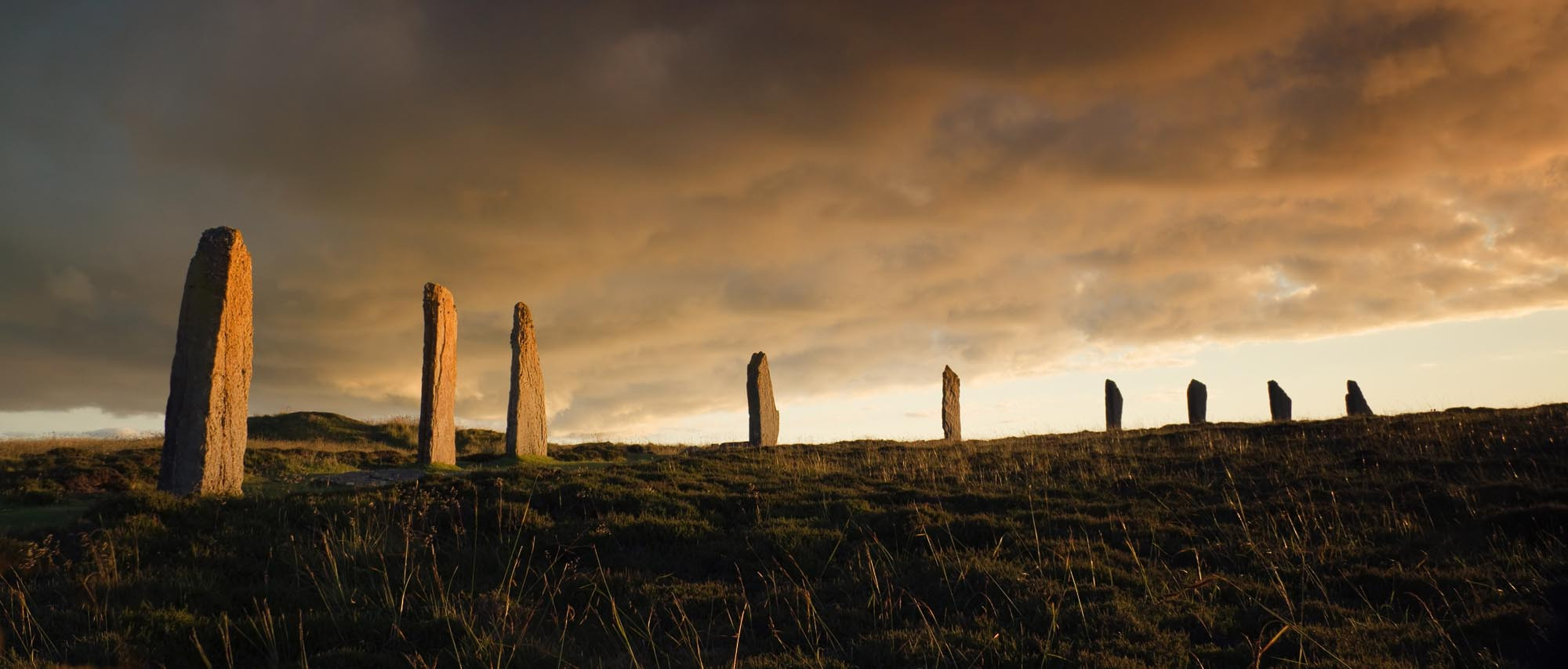
The Ring of Brodgar is a vast stone circle – originally 60 stones, of which 27 still stand – set on a narrow strip of land between the Loch of Harray and the Loch of Stenness. Built around 2500 BC, its exact purpose remains unknown, which only adds to its power. On a moody Orkney evening with low cloud and nobody else around, this is one of the most atmospheric places in Scotland. The walk around the full circle takes about 20 minutes and is free to access.

Stones of Stenness
The Stones of Stenness are just down the road from Brodgar and are believed to be even older – possibly dating to around 3100 BC. Only four of the original twelve stones remain, but they’re impressively tall, with some standing over five metres high. The Watchstone, a solitary monolith standing between the two sites, is also worth stopping for.
Maeshowe

Maeshowe is a chambered cairn dating to around 2800 BC. From the outside, it looks like a large grass-covered mound, but inside is a masterfully engineered stone chamber aligned so that the setting sun on the winter solstice shines directly down the entrance passage and illuminates the back wall. The construction quality is remarkable – the stonework is so precise that many of the joints are still watertight after five millennia. Centuries later, Norse Vikings broke into Maeshowe and left behind one of the largest collections of runic inscriptions found anywhere in the world. Access is by guided tour only, bookable through Historic Environment Scotland.
Beyond the four UNESCO sites, Orkney is littered with other Neolithic and Iron Age remains. The Broch of Gurness on the north coast of the Mainland is one of the best-preserved brochs in Scotland. On Rousay – sometimes called the “Egypt of the North” for its density of archaeological sites – you’ll find the Midhowe Cairn, an enormous burial chamber protected under a modern building, and the neighbouring Midhowe Broch. Cuween Hill Cairn, near Finstown, is a smaller tomb where you’ll need to crawl through a low entrance passage to reach the chamber inside – not for the claustrophobic, but genuinely thrilling if you’re up for it.
Wartime History – Scapa Flow, the Italian Chapel, and the Churchill Barriers
Orkney’s strategic position – guarding the northern approaches to Britain – meant it played a critical role in both World Wars. Scapa Flow, the vast natural harbour enclosed by the Mainland and the southern islands, served as the main base for the Royal Navy’s Home Fleet.

In 1919, 74 ships of the surrendered German Imperial Fleet were scuttled by their own crews at Scapa Flow in one of the most dramatic acts of the entire conflict. Seven of those wrecks remain on the seabed and now form one of the best wreck-diving sites in the world. The Scapa Flow Museum on Hoy (recently refurbished) tells the full story of both wars in Orkney and is well worth a visit.
In October 1939, a German U-boat slipped through the eastern defences of Scapa Flow and sank HMS Royal Oak, killing 835 crew. The disaster prompted Winston Churchill to order the construction of permanent barriers blocking the eastern channels. These Churchill Barriers – four concrete causeways linking the Mainland to Lamb Holm, Glimps Holm, Burray, and South Ronaldsay – were built by Italian prisoners of war between 1940 and 1945. Today you drive across them without thinking twice, but they were an enormous feat of wartime engineering.

The most poignant legacy of the Italian POWs is the Italian Chapel on Lamb Holm. In their limited free time, prisoners converted two Nissen huts into a beautiful Roman Catholic chapel, creating an ornate painted interior, a concrete facade, and intricate decorative metalwork using whatever materials they could scavenge – scrap metal, concrete, plasterboard. The artist Domenico Chiocchetti stayed behind after the war to finish his work, and returned again in 1960 to restore it. It’s one of the most moving places you’ll visit in Scotland – a testament to human creativity and faith in the most unlikely circumstances.
Island Hopping
The Mainland has enough to keep you busy for several days, but some of Orkney’s most memorable experiences are on the outer islands. Each has its own distinct character, and even a single day trip can transform your visit.

Hoy is the hilliest and most dramatic of the Orkney islands, and feels quite different from the low-lying Mainland. The walk to the Old Man of Hoy – a 137-metre red sandstone sea stack – is a three-hour return trek from Rackwick Bay and one of the finest coastal walks in Scotland. Keep your eyes on the sky: Hoy is home to white-tailed eagles and golden eagles, and you may spot both. The Dwarfie Stane, a 5,000-year-old rock-cut tomb carved from a single block of sandstone, is unique in Britain. Hoy is reached by ferry from Houton on the Mainland or from Stromness.
Rousay packs an extraordinary number of archaeological sites into a small island. A single road loops the coast, passing the Midhowe Cairn, the Midhowe Broch, and Taversoe Tuick – a two-storey burial cairn where you descend a ladder into a lower chamber that feels genuinely eerie. The ferry from Tingwall on the Mainland takes about 25 minutes.
Westray is known for its puffin colony at Castle o’Burrian and the beautiful Noup Head cliffs, where thousands of seabirds nest on towering rock faces. The neighbouring island of Papa Westray has the Knap of Howar, claimed to be the oldest preserved stone house in northern Europe, dating to around 3700 BC. The 90-second flight between the two islands is officially the world’s shortest scheduled air service.
Sanday and Stronsay are quieter still, with beautiful white sand beaches and a gentler pace. North Ronaldsay, the most northerly island, is famous for its seaweed-eating sheep – kept on the beach by a 13-mile dry-stone dyke that encircles the entire island. It’s also a recognised Dark Sky Island, making it a superb spot for stargazing and aurora watching.
If you’re interested in how island life compares across Scotland, I’ve written a detailed guide on which Scottish island is best to live on.
Wildlife
Orkney is one of the best wildlife-watching destinations in Britain, and it doesn’t require specialist knowledge or expensive boat trips to enjoy. Much of the islands’ wildlife is visible from the roadside, from cliff paths, or simply from your car window.

Seabirds are the headline act. During breeding season (roughly April to August), Orkney’s cliffs come alive with thousands of puffins, guillemots, razorbills, kittiwakes, fulmars, and gannets. Marwick Head on the Mainland is home to the largest seabird colony on the island, with around 25,000 birds. The Brough of Birsay is another excellent spot, and the Castle o’Burrian on Westray offers some of the closest puffin encounters anywhere in Scotland.

Seals are everywhere. Both grey and common (harbour) seals live around Orkney year-round, and you’ll regularly see them hauled out on rocks or bobbing in the water near harbours. Orkney is one of the most important seal habitats in Europe – an estimated 17.5% of the world’s grey seal population is found in these waters.
Orca are regularly spotted in Orkney waters, particularly between May and September. Several photo-identified pods pass through the islands as part of wider movements between Iceland and the Northern Isles. There are no dedicated whale-watching boat tours (sightings are too unpredictable), but land-based watching from headlands like Hoxa Head, Marwick Head, and the Brough of Birsay can be rewarding. Roughly 90% of UK orca sightings occur around Orkney and Shetland. Minke whales, harbour porpoises, and dolphins are also frequently seen.
On land, look out for short-eared owls (locally called “cattie faces”), hen harriers, otters, and the Orkney vole – a distinct subspecies found nowhere else in the world. The absence of foxes, badgers, and weasels (Orkney has none) means ground-nesting birds thrive here in numbers that have declined dramatically on the mainland. The RSPB manages 12 nature reserves across the islands, many with viewing hides.
Food and Drink
Orkney’s food and drink scene is genuinely excellent – far better than you might expect from a group of islands with a combined population smaller than a medium-sized town. The quality of local produce is exceptional, and there’s a real culture of supporting island producers.

Whisky
Highland Park is the star. Founded in 1798 by Magnus Eunson – a church officer and part-time whisky smuggler who allegedly hid bottles under his pulpit – Highland Park has been named “Best Spirit in the World” on multiple occasions. The distillery is one of only a handful in Scotland that still malts its own barley on traditional malting floors, and its whisky gets its distinctive character from Orkney’s unique heathered peat, sourced from Hobbister Moor. The distillery is on the outskirts of Kirkwall and offers a range of tours and tastings.
Scapa Distillery, just half a mile from Highland Park, has been producing single malt since 1885. It’s one of the smallest distilleries in Scotland and produces a lighter, unpeated style that’s quite different from its neighbour. The recently opened Scapa Noust tasting room is a beautiful space. Deerness Distillery, on the East Mainland, is a newer arrival producing award-winning gin (Sea Glass Gin is particularly good) and is now moving into whisky production too.
Beer
Orkney has two excellent craft breweries. The Orkney Brewery at Quoyloo in the West Mainland produces a range of ales including Dark Island, Skullsplitter (a strong 8.5% Viking-themed ale), and Corncrake. Their visitor centre and restaurant are worth a stop. The Swannay Brewery in Evie produces Scapa Special (previously voted Champion Beer of Scotland) and a range of modern craft beers alongside more traditional ales.
Food
Orkney’s seafood is outstanding – crab, lobster, scallops, and mussels are all landed locally. Orkney beef is prized across Scotland. The island’s Orkney Cheddar has Protected Geographical Indication (PGI) status, and the extra-mature varieties are seriously good. For something more unusual, seek out beremeal products – bere is an ancient variety of barley that has been grown in Orkney for around 6,000 years. The Barony Mill in Birsay, the last working water-powered beremeal mill in Britain, still grinds it into flour for bannocks and biscuits.
For eating out, Helgi’s on Kirkwall harbour is popular for seafood and local ales, and The Foveran near Kirkwall offers fine dining with island ingredients. In Stromness, the Hamnavoe Restaurant is a favourite. The Orkney Brewery’s restaurant at Quoyloo is also a good lunch stop if you’re touring the west side of the Mainland.
Beaches and Coastline
Orkney has over 500 miles of coastline across its islands, and the variety is remarkable – from the towering sandstone cliffs at Yesnaby and Marwick Head to the sweeping white sand beaches of Sanday and Stronsay.

The west coast of the Mainland is the most dramatic stretch, running from Costa Head in the north down through Marwick Head and Yesnaby to Stromness. This coastline takes the full force of Atlantic weather, and the results are spectacular – eroded stacks, blowholes, and cliff formations that change with every tide.
If it’s sandy beaches you’re after, the outer islands deliver. Sanday has some of the finest beaches in Scotland – miles of pristine white sand with barely a footprint on them. The Bay of Skaill on the Mainland (right next to Skara Brae) is also beautiful. Warbeth Beach, just outside Stromness, is a lovely spot for a walk.

Swimming is possible in summer, though water temperatures rarely creep above 13°C even in August, so a wetsuit is advisable. Wild swimming has become increasingly popular in Orkney in recent years, particularly around the more sheltered bays.
Walking and Outdoor Activities
Orkney is superb walking country. The terrain is mostly gentle – Hoy aside, the islands are relatively flat – but the coastal paths offer constantly changing scenery, and the density of archaeological sites means there’s always something to discover on foot.
The St Magnus Way is a 58-mile waymarked walking route across the Mainland and the island of Egilsay, following the story of St Magnus, the patron saint of Orkney. It can be completed over several days or broken into shorter sections. Much of the route crosses open countryside, so good waterproofs and sturdy footwear are essential.
Shorter walks worth seeking out include the cliff path at Yesnaby, the walk to the Brough of Birsay (accessible only at low tide across a causeway), and the coastal circuit around Hoxa Head for dramatic views across Scapa Flow. On Hoy, the walk to the Old Man of Hoy from Rackwick is the standout, but the walk to the Dwarfie Stane is much shorter and equally interesting.

Beyond walking, Orkney offers excellent diving (the Scapa Flow wrecks are world-class), sea kayaking, fishing (both sea and freshwater), and cycling. The quiet roads and flat terrain make the Mainland ideal for cycling, and several operators hire bikes in Kirkwall and Stromness.
Where to Stay
Orkney has a good range of accommodation across all budgets – hotels, B&Bs, self-catering cottages, hostels, and campsites. Kirkwall and Stromness have the widest selection, but there are excellent options scattered across the Mainland and the outer islands too.
In peak season (June to August), accommodation fills up fast, so book well in advance – particularly if you want a specific property or need to be near ferry terminals for island-hopping. Self-catering cottages are an excellent option for longer stays and give you the chance to cook with local Orkney produce.
For more options and recommendations, have a look at our Scotland accommodation guide, which includes a dedicated Orkney section.
How Long to Spend in Orkney
This depends on what you want to see, but here’s a rough guide:
- Two to three days – Enough to cover the main Neolithic sites, the Italian Chapel and Churchill Barriers, Kirkwall, Stromness, and a distillery visit. You’ll get a good taste of Orkney, but you’ll feel rushed.
- Four to five days – Allows time for one or two outer island day trips (Hoy and Rousay are the most popular), more exploring of the Mainland, and a more relaxed pace.
- A full week – Ideal. You can comfortably cover the Mainland, visit two or three outer islands, spend time on beaches, and leave space for the kind of spontaneous discoveries that make Orkney special.
If you’re planning Orkney as part of a wider Scotland road trip, my 7-day Scotland itinerary includes tips on extending your trip northwards.
Practical Tips
- Book ferry vehicle spaces early in summer – both the mainland ferries and inter-island services fill up.
- Pre-book Maeshowe – this is the only major Neolithic site that requires a guided tour, and places are limited.
- Carry cash – while most places accept cards, some smaller shops, car parks, and rural businesses are cash-only.
- Check tide times for the Brough of Birsay – you can only cross the causeway at low tide, and getting stranded is a real possibility if you don’t time it right.
- Fuel up in Kirkwall or Stromness – there are petrol stations on some outer islands, but don’t rely on them.
- Mobile signal is reasonable in Kirkwall and Stromness but patchy across the rest of the islands. Don’t assume you’ll have data everywhere.
- Electric vehicle charging points are available across the islands, though numbers are still limited. Plan your routes if driving an EV.
- Midges are far less of a problem in Orkney than on the west coast of the mainland – the constant wind keeps them at bay. One less thing to worry about. Check out our Midge Survival Guide and Midge Forecast Tool.
Frequently Asked Questions
How long does the ferry to Orkney take?
The NorthLink crossing from Scrabster to Stromness takes approximately 90 minutes. Pentland Ferries from Gills Bay to St Margaret’s Hope takes about an hour. The overnight NorthLink sailing from Aberdeen to Kirkwall takes roughly six hours.
Can you visit Orkney as a day trip?
Technically yes – the JOG Ferry from John o’Groats runs a seasonal day-trip service in summer – but I wouldn’t recommend it. You’d spend most of your time travelling and see only a fraction of what the islands have to offer. A minimum of two nights is advisable, and a week is ideal.
Do I need a car in Orkney?
A car makes things significantly easier, especially if you want to visit the Neolithic sites, outlying beaches, and wildlife spots on the Mainland. Bus services exist but are limited outside Kirkwall and Stromness. If you don’t bring a car on the ferry, car hire is available locally. For the outer islands, you can manage without a car on smaller islands like Papa Westray, but larger ones like Hoy and Westray are easier with transport.
What is the best time of year to visit Orkney?
Late May to early September offers the best weather, longest daylight, and peak wildlife activity. For fewer crowds, April, May, and September are excellent. Winter has its own appeal – atmospheric archaeological sites, Northern Lights potential, and unique local traditions – but expect short days and rough weather.
Is Orkney good for families?
Very much so. The beaches are superb for children, the archaeological sites are endlessly fascinating (most kids love crawling into cairns), the wildlife is visible and accessible, and the quiet roads make driving less stressful than on the mainland. Many of the main attractions are free or low-cost.
Can you see the Northern Lights from Orkney?
Yes. Orkney’s northerly latitude (around 59°N) and relatively low light pollution make it one of the better locations in the UK for seeing the aurora borealis. The best chances are between September and March on clear, dark nights. North Ronaldsay, as a designated Dark Sky Island, is particularly good. Check aurora forecasts before heading out.
Is Orkney windy?
Yes. Extremely. Orkney is one of the windiest inhabited places in Britain, and the wind is present to some degree on most days. It’s part of the character of the islands – trees struggle to grow here, and the landscape has been shaped by it. Dress accordingly, hold onto your hat, and embrace it.
Final Thoughts
Orkney has a way of getting under your skin. It’s not a place of obvious drama in the way that Skye or Glencoe can be – there are no towering mountains or deep glens here. Instead, it works on a different frequency: the quiet power of a 5,000-year-old stone circle at dusk, the sound of puffins chattering on a cliff edge, the taste of a Highland Park dram in the distillery where it was made, the strange beauty of a landscape where the sky dominates everything. Janette and I talk about Orkney often, and every conversation ends the same way – we need to go back.
If you’re planning a trip to Scotland and debating whether to include Orkney, stop debating. Make the time. It’s one of the most remarkable places in Europe, and it deserves far more than a passing thought.
For more ideas on planning your Scotland trip, browse our free Scotland travel itineraries or explore the interactive Scotland map to see what else is waiting for you.
All information was correct at the time of writing, please check things like entry costs and opening times before you arrive.


Leave a comment below