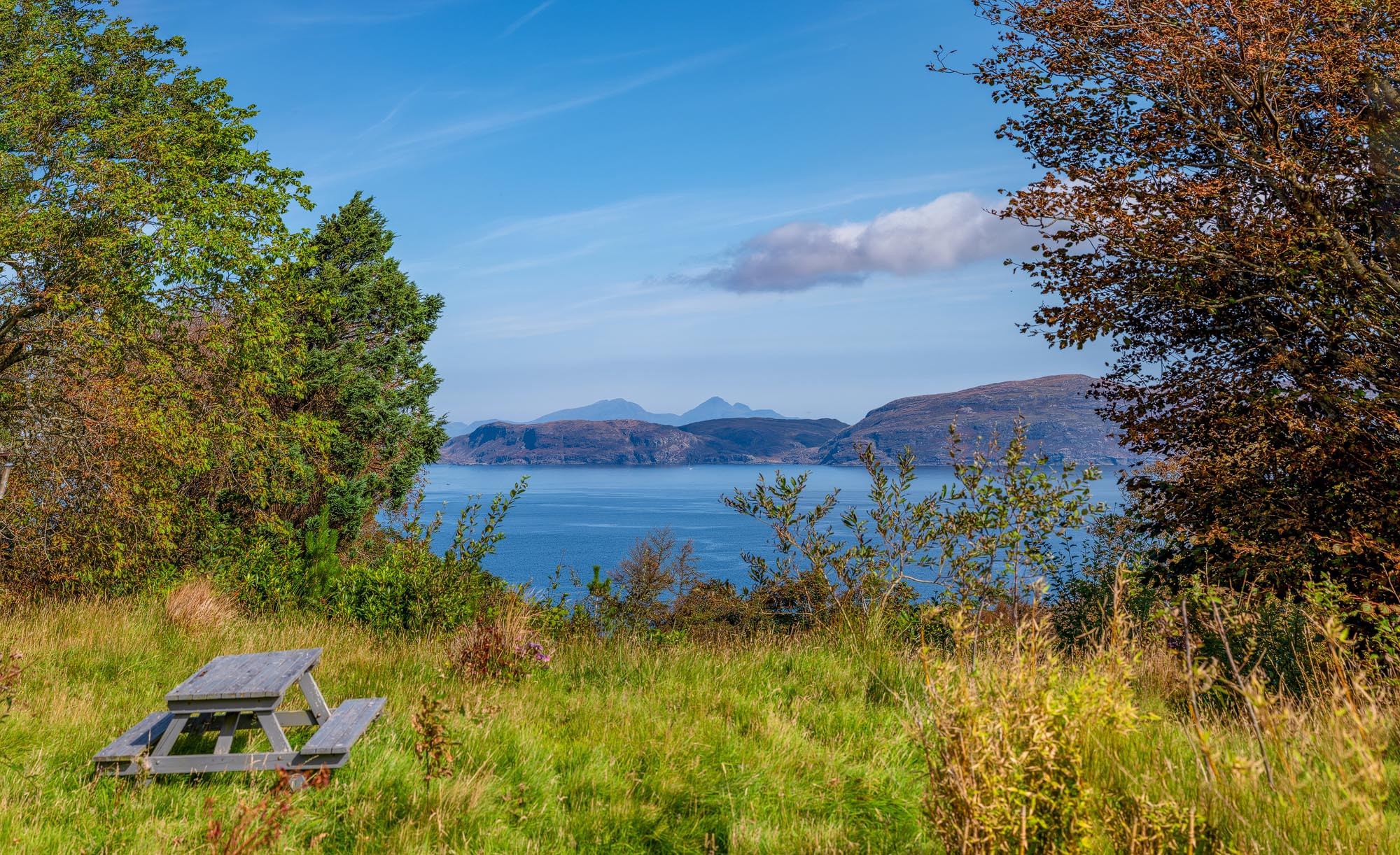
The Isle of Mull is one of those places that gets under your skin. It’s the second largest island in the Inner Hebrides – roughly 338 square miles of volcanic mountains, sea lochs, white sand beaches, ancient castles and some of the best wildlife watching in Europe. And yet, compared to somewhere like Skye, it flies relatively under the radar. That’s part of its appeal.
Mull sits just off Scotland’s west coast, a 45-minute ferry ride from Oban. It’s close enough to reach comfortably from Glasgow or Edinburgh in a day, but remote enough that stepping off the ferry feels like entering a different world. The pace slows. The roads narrow. The scenery opens up. And if you’re lucky with the weather – and let’s be honest, this is the west coast of Scotland, so “lucky” is doing some heavy lifting – you’ll see colours that look like they’ve been borrowed from the Caribbean.
I’ve been visiting Mull on and off for years, and Janette and I always come away thinking we haven’t seen enough of it. There’s a depth to the island that a quick day trip from Oban can’t scratch. This guide covers everything you need to plan a proper visit – how to get there, what to see and do, where to eat, what wildlife to look for, and all the practical stuff that makes the difference between a good trip and a great one.
Where is the Isle of Mull?
Mull belongs to the Inner Hebrides, the chain of islands running down Scotland’s west coast. It sits in Argyll and Bute, separated from the mainland by the Sound of Mull – an 18-mile stretch of water between the island’s northeast coast and the Morvern peninsula. To the south lie Colonsay, Islay and Jura. To the west, out in the Atlantic, are Coll, Tiree, and the uninhabited Treshnish Isles. The tiny islands of Staffa and Iona sit just off Mull’s western tip.
In terms of size, Mull is the fourth largest island in the whole of Britain (after Lewis and Harris, Skye and mainland Shetland). It’s about 26 miles from north to south and 28 miles east to west at its widest point. The landscape is surprisingly varied – volcanic mountains in the centre, dramatic sea cliffs on the west coast, sheltered woodland in the east, and some genuinely spectacular beaches scattered around the coastline. For anyone familiar with our Scottish Highlands guide, think of Mull as a concentrated version of that landscape, surrounded by sea.
How to get to Mull
There’s no bridge to Mull. You’re getting a ferry, and Caledonian MacBrayne (CalMac) operates three routes to the island. Which one you choose depends on where you’re coming from and what kind of trip you’re planning.

Oban to Craignure (45 minutes)
This is the main route and the one most visitors use. Oban is well connected by road from Glasgow (about 2.5 hours) and Edinburgh (about 3.5 hours), and there’s a direct ScotRail train from Glasgow Queen Street that takes around three hours along one of the most scenic railway lines in Britain. Scottish Citylink also runs coaches from Glasgow. The ferry itself is a large vessel carrying both cars and foot passengers, with multiple sailings per day. If you’re taking a car in summer, book well in advance – crossings can sell out weeks ahead.
Lochaline to Fishnish (18 minutes)
A shorter, quieter crossing from the Morvern peninsula to a point between Craignure and Tobermory. This is a “turn up and go” service with no advance booking required, and it’s ideal if you want to create a loop – arriving on Mull via one route and leaving by another. Lochaline itself is a pleasant wee village worth a wander.
Kilchoan to Tobermory (35 minutes)
The most adventurous option. Kilchoan sits on the Ardnamurchan peninsula – a spectacularly remote part of the mainland that’s worth a trip in its own right. This ferry drops you directly into Tobermory harbour, which is a lovely way to arrive. It’s also a “turn up and go” service, but the boat is small, so arrive early, especially for the last sailing of the day.
The beauty of having three ferry routes is that you can plan a one-way trip through Mull rather than retracing your steps. Drive down through Morvern to Lochaline, cross to Fishnish, explore the island, then take the main ferry back to Oban – or do it the other way round.
Getting around Mull
Driving on Mull
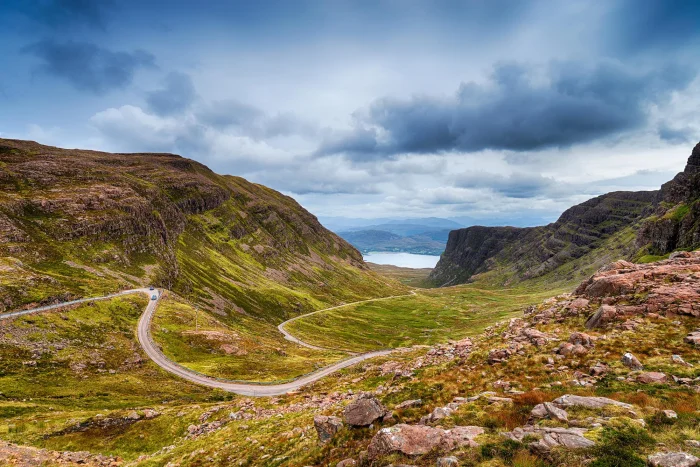
A car is by far the best way to explore Mull, but you need to know what you’re getting into. The vast majority of roads on the island are single-track with passing places. Only the stretch from Craignure to Salen (about 10 miles) and the road into Tobermory have two lanes. Everything else is narrow, winding, and often in variable condition.

The key thing to understand is that distances on Mull take much longer than you’d expect from looking at a map. The 50-mile drive from Bunessan in the south to Tobermory in the north takes around an hour and a half. Add in sheep on the road, Highland cows blocking passing places, and the constant temptation to stop and photograph something, and you can easily double that. Don’t try to cram too much into a single day.
Fuel is available in Tobermory, Craignure and at a few other points, but it’s noticeably more expensive than the mainland. Fill up in Oban before you board the ferry if you can. Mobile phone signal is patchy across much of the island – don’t rely on Google Maps for navigation in the more remote areas. A paper road map is genuinely useful here.
Public transport on Mull
West Coast Motors operates bus services connecting the main settlements – Craignure to Tobermory, Craignure to Fionnphort (for the Iona ferry), and Tobermory to Dervaig and Calgary. The services are limited, with only a handful of departures per day, but they do make it possible to visit Mull without a car if you plan carefully. A day trip from Oban to either Tobermory or Iona via Fionnphort is perfectly doable by public transport.
When to visit Mull
Summer (June to August) is the most popular time, and with good reason. The days are long, most businesses are open, the boat trips to Staffa and the Treshnish Isles are running, and the puffins are in residence. The downside is that accommodation books up months in advance, the ferry can be rammed, and the midges are at their absolute worst. Mull’s west coast location and damp, sheltered terrain make it prime midge territory from late May through September.
Spring (April to May) is arguably the sweet spot. The weather can be surprisingly good, the island is quieter, many businesses have reopened for the season, and the wildlife is active – eagle courtship displays, seal pups, and the first puffins arriving on the Treshnish Isles. The midges haven’t fully mobilised yet either, which is a significant bonus.
Autumn (September to October) brings its own rewards. The tourist numbers thin out, the landscape turns russet and gold, and the light for photography is often spectacular. Some boat trips and seasonal businesses wind down through October, but the walking is excellent and the wildlife watching is still outstanding.
Winter is quiet. Very quiet. Many businesses close or run reduced hours, daylight is limited, and the weather can be brutal. But if you’re after solitude and dramatic skies, there’s something special about Mull in winter. Book a hotel with a decent restaurant and a roaring fire, and let the island come to you.
How long to spend on Mull
You can visit Mull on a day trip from Oban, and plenty of people do. But a day trip really only gives you time for Tobermory or Iona – not both, and certainly not a thorough exploration of the island. Three to four days is a more realistic minimum if you want to see the main highlights, take a boat trip to Staffa, and still have time to sit on a beach or explore a side road. A full week is ideal and there is genuinely enough to fill it.
Tobermory
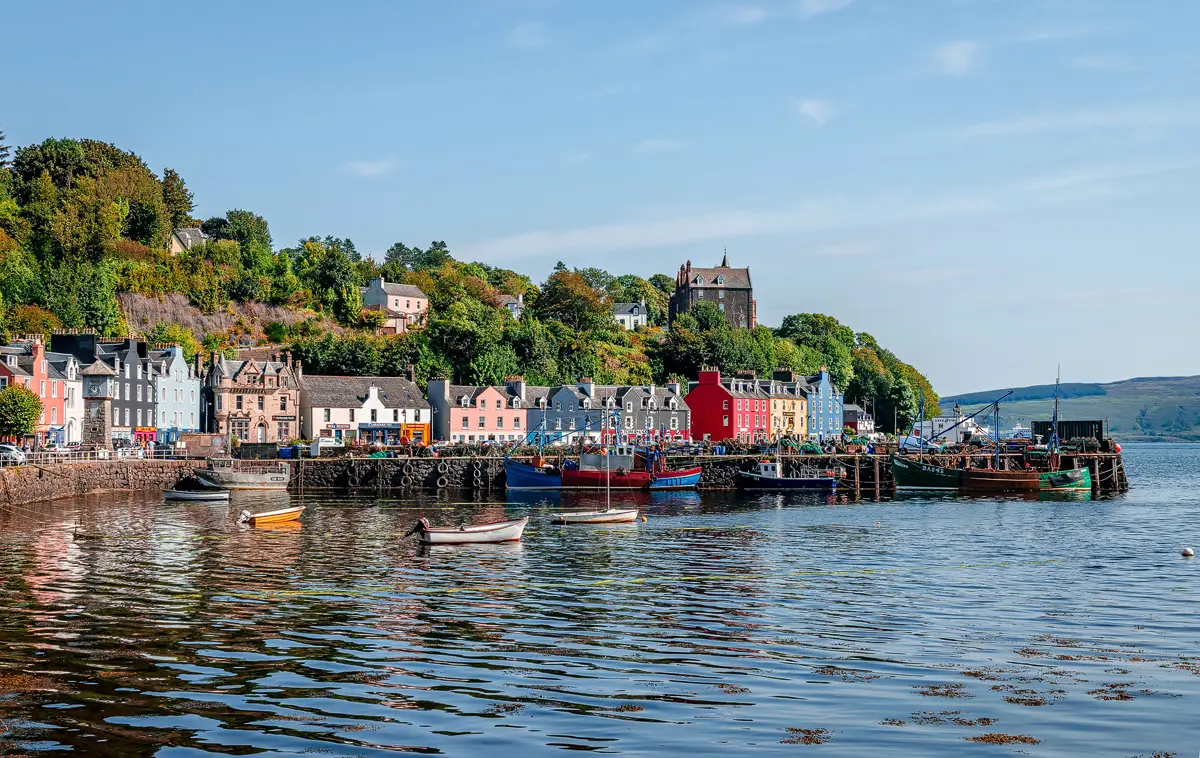
Tobermory is Mull’s capital, its largest settlement, and the first place most visitors head for. The colourful waterfront is one of the most photographed scenes in Scotland – a crescent of painted buildings in pinks, blues, yellows and greens, reflected in the sheltered harbour on a calm day. The town was purpose-built as a fishing port in 1788 by Thomas Telford for the British Fisheries Society, though the famous colours came much later, emerging organically in the late 20th century as businesses sought to make their frontages stand out.
If the buildings look familiar to families with young children, that’s because Tobermory was the real-life setting for the BBC children’s programme Balamory, which ran from 2002 to 2005. The show’s popularity means the harbour still draws family visitors who recognise the coloured houses from the screen.
Beyond the postcard view, Tobermory is a proper working town with independent shops, excellent restaurants, a good museum (the Mull Museum on Main Street), and a lively atmosphere in summer. It’s also the main base for boat trips – wildlife cruises, Staffa and Treshnish excursions, and whale watching trips all depart from the harbour. In the evenings, the Mishnish pub is the social hub, and you can often catch live music there.
There’s also the legend of the Spanish Armada galleon. In 1588, a ship from the Armada – variously identified as the San Juan de Sicilia or the Florida – sheltered in Tobermory Bay before being blown up and sunk. Local legend says it was loaded with gold, and treasure hunters have been searching the bay floor for over four hundred years. The treasure has never been found, which either means it was never there or it’s very well hidden.
Things to see and do on Mull
Duart Castle
Perched on a rocky headland overlooking the Sound of Mull, Duart Castle is the first thing you see when approaching Craignure on the ferry from Oban. It’s a dramatic silhouette – one of the most recognisable castle views in Scotland – and it only gets better up close.

Duart has been the ancestral seat of Clan MacLean since the 13th century, though its history hasn’t been straightforward. The Campbells seized it in the 18th century and allowed it to fall into ruin. It sat roofless and crumbling for nearly two hundred years before Sir Fitzroy MacLean bought it back and undertook a major restoration in 1910. Today the castle is open to visitors in the summer months, with exhibits tracing the clan’s turbulent history, beautifully restored rooms, and views from the battlements that stretch across to the mainland. There’s a tearoom serving local produce too, which is worth a stop.
Calgary Bay
Calgary Bay is Mull’s most famous beach, and when you see it, you understand why. A wide sweep of white sand backed by green machair and sheltered headlands, with water that turns an improbable shade of turquoise on sunny days. It looks like it belongs in the tropics, not the Inner Hebrides.

The bay is about an hour’s drive northwest from Craignure. There’s a good car park, a seasonal café selling drinks and ice cream, and an art walk through the woodland behind the beach. It gets busy in high summer – it’s one of the most popular family beaches on the island – but arriving early or visiting outside July and August will give you a much quieter experience. There’s a bit of trivia here too: Calgary in Alberta, Canada was named after this bay by Colonel James Macleod in 1876. For more on Scotland’s beaches, see our best beaches in Scotland guide, where Calgary Bay features.
Eas Fors Waterfall
Eas Fors is one of the most unusual waterfalls in Scotland. Located a couple of miles south of Ulva Ferry on the B8073, it cascades in three distinct stages – starting on one side of the road, crossing underneath, and eventually plunging over a cliff directly into the sea. The final drop is the showstopper, falling roughly 30 metres against a backdrop of dark rock and seaweed-covered shoreline.

You can see the upper sections from the road, but it’s worth taking the short, slightly rough walk down to see the final drop. After heavy rain, the whole thing is spectacular. Even in drier conditions, it’s a worthwhile stop.
Ben More
Ben More is the only Munro on Mull, standing at 966 metres (3,169 feet). It’s a serious mountain walk – not one for beginners or poor weather – but for experienced hillwalkers, the views from the summit are extraordinary. On a clear day you can see across to the Outer Hebrides, Skye, Jura, and the mountains of the mainland. The most common starting point is from the south shore of Loch na Keal at Dhiseig.

The mountain is volcanic in origin – Mull was a major volcanic centre around 60 million years ago, and the geology tells a remarkable story if you know what to look for. The Loch Ba Ring Dyke, a circular geological formation created by the collapse of the ancient volcanic caldera, is one of the most significant structures of its kind in the world. If geology interests you, consider booking a guided walk with a local expert – it completely transforms how you see the landscape. For more on walking in Scotland, see our best walks in Scotland guide.
Staffa and Fingal’s Cave
Staffa is a tiny uninhabited island about six miles west of Mull, and it’s one of the most astonishing natural sights in Scotland. The island is made up of hexagonal basalt columns formed by ancient volcanic activity – the same geological process that created the Giant’s Causeway in Northern Ireland. Fingal’s Cave, a sea cavern at the southern end, has been drawing visitors since the 18th century. The acoustics inside are extraordinary – the sound of waves echoing off the columnar walls inspired Felix Mendelssohn to compose his Hebrides Overture in 1829.

Boat trips to Staffa run from several departure points on Mull – Tobermory, Ulva Ferry, Fionnphort, and Iona – between roughly April and October, weather and sea conditions permitting. Most trips also visit the Treshnish Isles as part of a combined excursion. Landings on Staffa allow you to walk along a causeway into the cave mouth and explore the clifftop above. It’s genuinely unforgettable.
The Treshnish Isles and puffins
The Treshnish Isles are a chain of small uninhabited islands northwest of Mull, and they’re one of the best places in Britain to see puffins at close range. The island of Lunga is the star – between mid-April and early August, thousands of puffins nest in burrows on the clifftops, and they are remarkably unfazed by humans. You can sit within a couple of metres of them as they waddle about with beaks stuffed full of sand eels. It’s an incredible experience.

Most boat operators combine a Treshnish Isles trip with a visit to Staffa, making for a full-day excursion. These trips are extremely popular and book up quickly in summer, so reserve your place as early as possible. For more on Scotland’s puffin colonies, see our dedicated puffins in Scotland article.
Iona
Iona sits just off the southwestern tip of Mull, separated by a narrow strait crossed by a short CalMac ferry from Fionnphort (about 10 minutes, no booking required). It’s tiny – only about three miles long and a mile and a half wide – but its significance in Scottish and European history is enormous.

St Columba arrived here from Ireland in 563 AD and founded a monastery that became one of the most important centres of early Christianity in western Europe. The present Iona Abbey is largely medieval, built on the site of Columba’s original foundation, and it draws pilgrims and visitors from around the world. The Reilig Odhrain – the ancient burial ground beside the abbey – is said to contain the remains of 48 Scottish kings, including Macbeth and Duncan (yes, those ones). Beyond the abbey, Iona has beautiful white sand beaches on its north coast, a wonderful sense of peace, and the kind of light that makes photographers very happy. Allow at least half a day, ideally more.
The Ross of Mull
The southern peninsula of Mull, known as the Ross, is one of the island’s quieter areas and has a character quite different from the rest. The geology changes here – the dark volcanic rock gives way to pink granite, and the coastline is dotted with white sand beaches and rocky coves. The village of Bunessan has a small selection of shops and services, and the Ross of Mull Historical Centre is worth a visit for its local heritage displays.

The road ends at Fionnphort, the departure point for the Iona ferry. Just south of Fionnphort is the tidal island of Erraid, accessible on foot at low tide. Robert Louis Stevenson fans will recognise it as the island where David Balfour is shipwrecked at the beginning of Kidnapped. Stevenson’s father and uncle worked on the Dubh Artach lighthouse visible from Erraid, and the family connection to this corner of Mull runs deep.
Isle of Ulva
Ulva is a small island just off Mull’s west coast, reached by a brief ferry crossing from Ulva Ferry (a few minutes). The island was the subject of a community buyout in 2018, when local residents successfully purchased it from private ownership with support from the Scottish Land Fund. It’s a quiet, unspoiled place with walking trails, ruined crofting settlements, and wonderful coastal scenery. The Boathouse café on the island serves home-cooked food and is a lovely spot for lunch. Sheila’s Cottage, a restored thatched dwelling, tells the story of Ulva’s people and their connection to the land.
Scenic drives
Mull is brilliant for driving, provided you’re comfortable with single-track roads. The route from Salen around the north shore of Loch na Keal, past Ulva Ferry and up to Calgary, is one of the most scenic coastal drives in Scotland. The stretch of road along Loch na Keal is particularly dramatic, with the water on one side and the cliffs of the Ardmeanach peninsula rising on the other.

Another excellent drive is the road from Craignure south through Glen More to Fionnphort. This takes you past Loch Scridain and through some properly wild scenery – the sort of landscape where you might see eagles overhead and deer on the hillside. The entire route to the Ross of Mull is a delight.
MacCulloch’s Fossil Tree
On the remote Ardmeanach peninsula, accessible only on foot via a rough coastal path, you’ll find MacCulloch’s Fossil Tree – a 50-million-year-old tree trunk preserved in the volcanic rock. It was fossilised when lava flowed over the living forest during Mull’s volcanic era. The walk to reach it is about five miles each way from the road end at Burg, and it’s rough, muddy and tide-dependent in places. But for anyone with an interest in geology, it’s an extraordinary thing to see. The National Trust for Scotland manages the site.
Wildlife on Mull
Mull has earned a reputation as one of the premier wildlife destinations in Britain, and it’s thoroughly deserved. The combination of varied habitats – from mountain moorland to sheltered sea lochs, ancient woodland to open ocean – supports an exceptional range of species. For wildlife watchers, Mull delivers.
White-tailed eagles
This is the big one. Mull is widely known as “Eagle Island” and is the best place in the UK to see white-tailed eagles – the country’s largest bird of prey, with a wingspan that can reach 2.5 metres. The species was driven to extinction in Britain through persecution and was reintroduced from Norway in a programme that began on the Isle of Rum in 1975. Mull now supports around 22 breeding pairs, and they’re a regular sight along the coastline and around the sea lochs.

The Mull Eagle Watch programme, a partnership between Forestry and Land Scotland and RSPB Scotland, offers guided viewing sessions from April to September. The Fishnish wildlife hide, near the Lochaline ferry terminal, is another excellent spot. Boat trips with operators like Mull Charters offer the chance to see white-tailed eagles swooping down to snatch fish from the water at close range – it’s a breathtaking experience.
Mull also supports around 35 pairs of golden eagles, which tend to inhabit the higher mountain areas and open moorland rather than the coast. Seeing both eagle species in a single day is entirely possible.
Otters
Mull has one of the healthiest otter populations in Britain. There’s a well-known saying that there’s one otter for every mile of Mull’s 300-mile coastline, and while I can’t vouch for the maths, it does give you an idea of how common they are. They’re most often seen along the shores of the major sea lochs – Loch na Keal, Loch Scridain, and Salen Bay are all good areas.

The best time to spot otters is around three hours either side of low tide, when they’re actively fishing in the shallows. Dawn and dusk are prime times. Look for three bumps in the water (head, back and tail) and the distinctive V-shaped ripple as they swim. A good pair of binoculars and a bit of patience are essential – otters can appear when you least expect them. Please remember to keep your distance and avoid disturbing them.
Other wildlife
Beyond the eagles and otters, Mull’s wildlife list is impressive. Red deer are abundant – you’ll see them on the hillsides, often in large herds. Highland cows are a common sight too, particularly photogenic against Mull’s dramatic backdrops. Harbour and grey seals haul out on rocky shores around the island. Hen harriers, buzzards, short-eared owls and peregrine falcons are all present. In the surrounding waters, minke whales, basking sharks, common and bottlenose dolphins, and harbour porpoises are all regularly recorded, especially from May to October.

A guided wildlife tour with a local operator is well worth the investment, especially if it’s your first visit. The guides know the territories, the behaviour patterns, and the best locations for the time of year. They’ll dramatically increase your chances of seeing the “big three” – white-tailed eagles, otters and red deer.
Food and drink on Mull
For an island of its size, Mull punches well above its weight for food and drink. The surrounding waters provide exceptional seafood – langoustines, scallops, crab, lobster, mussels – and the island’s restaurants make the most of it.
Tobermory Distillery
Tobermory Distillery has been producing whisky on Mull since 1798, making it one of the oldest commercial distilleries in Scotland. What makes it unusual is that it produces two distinct single malts from the same distillery: Tobermory, which is unpeated with a lighter, fruity character, and Ledaig, a heavily peated expression with maritime smoke and a distinct island character. Tours and tastings are available, and the distillery shop is a good place to pick up bottles you won’t easily find elsewhere.

Isle of Mull Cheese
Just outside Tobermory, Sgriob-ruadh Farm is home to the Isle of Mull Cheese dairy. The family-run operation produces award-winning Isle of Mull Cheddar – a rich, complex cheese made with unpasteurised milk from their own herd – and Hebridean Blue. Their Glass Barn serves food featuring local produce and offers dairy tours. It’s a great stop, especially if you’re interested in artisan food production.
Where to eat
Café Fish in Tobermory, perched above the harbour, serves outstanding seafood landed from the boats below. The Ninth Wave Restaurant near Fionnphort is a fine dining experience using ingredients sourced within a few miles of the kitchen. The Bellachroy in Dervaig claims to be the oldest inn on Mull and serves hearty pub food with local produce. On Iona, the Argyll Hotel restaurant is well regarded. The Mull and Iona Food Trail – a self-guided route around the islands’ food producers – is a good way to eat your way around the island and discover producers you might otherwise miss.
Accommodation on Mull
Mull has a good range of accommodation covering everything from campsites and hostels to B&Bs, self-catering cottages, country hotels and even a castle or two. Tobermory has the widest selection, but there are options scattered across the island. The key advice is to book early, especially for summer. Accommodation fills up months in advance during peak season, and there’s limited scope for last-minute improvisation.
For a special stay, look at hotels like the Western Isles Hotel in Tobermory (good views over the harbour), or consider a self-catering cottage if you’re staying for several days – the flexibility of having your own kitchen is handy on an island where the nearest restaurant might be 45 minutes of single-track road away.
Practical information
Here are the practical bits that can make or break a Mull trip:
Fuel: Fill up in Oban before boarding the ferry. Fuel is available on Mull (Tobermory, Craignure, and Fionnphort area) but is more expensive than the mainland. Don’t let your tank drop too low – the next filling station might be further than you think.
Mobile signal: Patchy. Some areas of Mull have decent 4G coverage (Tobermory, Craignure, Salen), but large parts of the island have weak or no signal. Download offline maps before you arrive and don’t rely on your phone for navigation in remote areas.
Cash: There are ATMs in Tobermory, but many smaller businesses across the island now accept card payments. It’s still worth carrying some cash as a backup.
Shopping: Tobermory has a Co-op and various shops for supplies. Elsewhere on the island, options are limited. If you’re self-catering, consider stocking up in Oban or Tobermory rather than relying on smaller village shops.
Midges: Mull is midge territory. If you’re visiting between late May and September, bring midge repellent and consider a head net if you’re planning to spend time outdoors in sheltered, damp areas. Read our complete guide to midges in Scotland for survival strategies.
Weather: This is the west coast of Scotland. Rain is not a question of if but when. Pack waterproof layers regardless of the forecast, and be prepared for the weather to change several times in a single day. That said, when the sun comes out on Mull, the island is absolutely stunning.
Frequently asked questions
Can you visit Mull as a day trip from Oban?
Yes, it’s possible. The most straightforward day trip options are to take the ferry to Craignure and then either head north to Tobermory by bus or car, or drive south to Fionnphort and catch the ferry across to Iona. Trying to do both in a single day is ambitious unless you have a car and start very early. A day trip gives you a taste of the island, but you won’t get the full experience.
Do I need a car on Mull?
You don’t strictly need one, but a car makes a massive difference to what you can see and do. Public transport on Mull is limited to a few bus routes connecting the main settlements. Without a car, you’ll miss many of the best beaches, viewpoints, and wildlife-watching spots. If you’re not bringing your own vehicle, consider hiring one on the mainland or booking guided tours on the island.
When is the best time to see puffins on Mull?
Puffins nest on the Treshnish Isles (particularly Lunga) from mid-April to early August. Late May through July is generally the best period, when the birds are most active feeding their chicks. Boat trips to the Treshnish Isles run during this season from various departure points on Mull.
How far in advance should I book the ferry?
For the main Oban to Craignure route in summer, book as early as possible – ideally several weeks ahead, especially if you’re taking a car. Foot passenger spaces are usually easier to get. The Lochaline to Fishnish and Kilchoan to Tobermory routes don’t take advance bookings, so just turn up early.
Is Mull suitable for families?
Absolutely. Calgary Bay is a fantastic family beach, the wildlife watching is exciting for all ages, and Tobermory has the Balamory connection that younger children love. The Mull Aquarium in Tobermory is a catch-and-release aquarium that’s great for kids. The main thing to plan for is the driving – distances take longer than expected, and younger children may find the single-track roads a bit wearing.
Are there midges on Mull?
Yes, and they can be fierce. Mull’s west coast location, damp climate and sheltered terrain are exactly what midges love. They’re at their worst from late May to September, particularly in calm, overcast conditions. Come prepared with repellent and head nets if you plan to spend time outdoors during midge season.
What is the Mull Rally?
The Mull Rally is an annual closed-road car rally, typically held in October, that uses Mull’s public roads as stages. It’s a major event in the Scottish motorsport calendar and draws competitors and spectators from across the country. If you’re visiting during the rally, some roads will be closed at scheduled times – check the rally website in advance. It’s quite a spectacle if you’re into motorsport.
Final thoughts
Mull is one of those islands that rewards the time you give it. Rush through on a day trip and you’ll come away with a few nice photographs and a vague impression of colourful buildings and single-track roads. Stay for a few days and the island starts to open up – you’ll find your own quiet beach, spot your first eagle, get lost down a side road that turns out to be the best drive of the trip, and understand why people come back year after year.
It’s not Skye, and it’s not trying to be. For anyone interested in seeing the contrast, our Isle of Skye guide covers the other great Inner Hebridean island in similar depth. But Mull has its own personality – wilder, quieter, less polished, and in many ways more authentically Scottish. The wildlife alone would justify a visit. The scenery, the food, the history and the people make it something more. Janette and I always say we’ll go back, and we always mean it.
All information was correct at the time of writing, please check things like entry costs and opening times before you arrive.

Leave a comment below