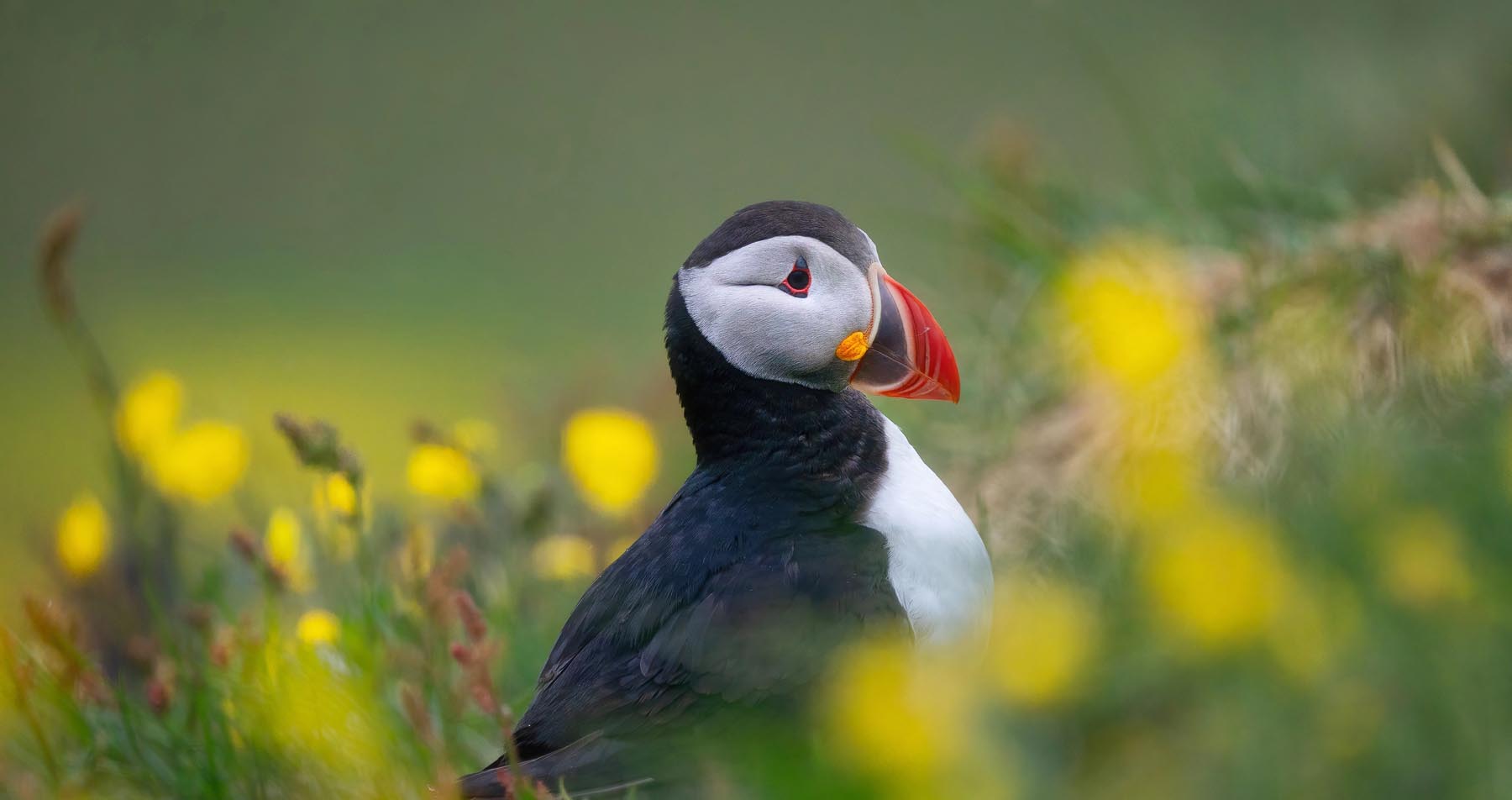
Few wildlife encounters in Scotland are quite as magical as coming face to face with a puffin. These charismatic little seabirds, with their striking black and white plumage, vibrant orange beaks, and endearingly comical waddle, have captured the hearts of visitors and locals alike for centuries. Known affectionately in Scotland as ‘Tammie Norries’, ‘sea parrots’, or simply the ‘clowns of the sea’, Atlantic puffins are one of our most beloved summer visitors.
Janette and I have been fortunate enough to observe puffins at several locations around Scotland over the years, and each encounter has been utterly memorable. There’s something quite extraordinary about watching these birds go about their business – whether they’re crash-landing on clifftops, waddling purposefully towards their burrows with beaks stuffed full of sand eels, or simply standing at the entrance to their homes, surveying the world with those quizzical, almost human expressions.

Scotland holds a special responsibility for these remarkable birds. Around 75% of the UK’s puffin population breeds here, making our islands and coastlines some of the most important puffin habitats in Europe. In this guide, we’ll share everything you need to know about where and when to see puffins in Scotland, along with fascinating facts about their lives and the conservation challenges they face.
About the Atlantic Puffin
The Atlantic puffin (Fratercula arctica) is the only puffin species native to the Atlantic Ocean. Its scientific name translates beautifully as ‘little brother of the north’, possibly a reference to the Celtic monks who once shared their remote island homes with these characterful birds. Standing around 25 centimetres tall and weighing approximately 500 grams, puffins are surprisingly small when you see them in person – about the size of a small pigeon.

What makes puffins instantly recognisable is, of course, that magnificent beak. During the breeding season, it transforms into a vivid display of orange, red, and yellow, with distinctive blue-grey ridges at the base. The beak is specially adapted for catching fish – backward-pointing spines on the roof of the mouth and tongue allow puffins to hold multiple fish crosswise while continuing to catch more. It’s not unusual to see a returning parent with ten or more sand eels neatly arranged in its bill.
Outside the breeding season, puffins undergo a remarkable transformation. They shed the colourful plates of their beaks, and their faces darken to grey. This winter plumage is rarely seen by humans, as puffins spend approximately eight months of the year far out on the open Atlantic Ocean, never coming to land at all.
Fascinating Puffin Facts
- Puffins can live for over 20 years in the wild, with some individuals recorded at over 30 years old
- They mate for life, reuniting with the same partner at the same burrow year after year
- Puffins can flap their wings up to 400 times per minute, reaching speeds of 55 mph in flight
- They can dive to depths of around 60 metres and stay underwater for up to a minute
- A baby puffin is called a ‘puffling’ – possibly the most adorable name in the animal kingdom
- Puffins dig their own burrows using their beaks and feet, creating tunnels up to a metre long
- They show affection by rubbing their beaks together in a behaviour known as ‘billing’

Best Time to See Puffins in Scotland
Puffins return to Scotland’s shores from late March to early April each year, having spent the winter months far out at sea in the North Atlantic. The breeding season runs from April through to August, with the birds departing for the open ocean once their chicks have fledged.
For the best puffin-watching experience, we’d recommend visiting between late April and mid-July. During this period, the birds are at their most active and visible – courting, nest-building, incubating eggs, and feeding their hungry pufflings. June and early July are particularly rewarding, as this is when you’re most likely to see adult puffins returning to their burrows with beaks full of sand eels for their chicks.

By late July and into August, many puffins begin to depart, and by early August, you may find colonies significantly quieter. The timing can vary slightly from year to year depending on weather conditions and food availability, so it’s always worth checking with local wildlife organisations or boat operators before planning your visit.
Where to See Puffins in Scotland
Scotland offers numerous opportunities to see puffins, from accessible day trips from Edinburgh to remote island adventures. Here are our top recommendations:
Isle of May, Firth of Forth
The Isle of May is home to the largest puffin colony on Scotland’s east coast, with over 40,000 breeding pairs. Located in the Firth of Forth, it’s remarkably accessible – boat trips run from Anstruther in Fife (about 45 minutes crossing) and from North Berwick in East Lothian. The island is managed as a National Nature Reserve by NatureScot, and rangers are on hand during the breeding season to welcome visitors and share information about the wildlife.

We’ve visited the Isle of May several times, and the experience never fails to impress. Walking the paths across the island, you’ll find puffins standing just metres away, seemingly unbothered by your presence. The island also hosts impressive colonies of guillemots, razorbills, and kittiwakes, as well as a population of grey seals.
Lunga and the Treshnish Isles, Inner Hebrides
For truly intimate puffin encounters, the uninhabited island of Lunga in the Treshnish Isles is hard to beat. Boat trips operate from the Isle of Mull, and visitors can spend several hours on the island during peak season. The puffins here are remarkably confiding, and you can often sit within a couple of metres of them as they go about their business.

Many of the same boat operators also visit Staffa, famous for its dramatic basalt columns and Fingal’s Cave, making for an unforgettable day combining geological wonder with wildlife watching.
Sumburgh Head and Hermaness, Shetland
Shetland is a puffin paradise, and the locals’ affectionate name ‘Tammie Norrie’ for these birds speaks to centuries of coexistence. Sumburgh Head at the southern tip of the main island offers one of the most accessible puffin colonies in Britain – you can watch them from the clifftop paths without needing a boat trip. The RSPB runs a visitor centre here.

At the other end of Shetland, Hermaness National Nature Reserve on the island of Unst – Britain’s most northerly point – hosts over 20,000 breeding pairs. The dramatic clifftop scenery, with views out to Muckle Flugga lighthouse, makes this one of Scotland’s most spectacular wildlife-watching locations.
Orkney Islands
Orkney offers several excellent puffin-watching sites, including Marwick Head, the Brough of Birsay, and Noup Head on Westray. These locations are accessible without boat trips, though the colonies tend to be smaller than those in Shetland. The dramatic cliff scenery and the chance to combine puffin watching with exploring Orkney’s incredible Neolithic heritage make this a wonderful destination.
Other Notable Locations
- St Kilda, Outer Hebrides – Home to the UK’s largest puffin colony with around 130,000 breeding pairs, though remote and weather-dependent to visit
- Handa Island, Sutherland – A Scottish Wildlife Trust reserve with excellent puffin viewing around the Great Stack
- Dunnet Head, Caithness – One of the few mainland Scotland sites where puffins can be seen
- Cruden Bay and Bullers of Buchan, Aberdeenshire – Small colonies on the east coast, accessible on foot
- Fair Isle – Located between Orkney and Shetland, home to one of the world’s most famous bird observatories
- Shiant Isles, Outer Hebrides – Known as the ‘Enchanted Isles’, accessible by private boat

Conservation Status and Challenges
Despite their popularity, Atlantic puffins face significant conservation challenges. They are currently listed as ‘Vulnerable’ on the global IUCN Red List of Threatened Species and are classified as ‘Red’ on the UK Birds of Conservation Concern list – the highest level of concern. The latest Seabirds Count census found that 24% of the puffin population in Britain and Ireland has been lost since 2000.
The primary threats to puffins include climate change and overfishing, both of which affect the availability of sand eels – their primary food source. As sea temperatures rise, sand eel populations have declined and shifted northward, leaving some puffin colonies struggling to find sufficient food for their chicks. In severe years, widespread breeding failure can occur.
Other threats include predation by gulls and skuas, the introduction of rats and other predators to breeding islands, oil spills, and entanglement in fishing nets.
Conservation efforts are underway across Scotland. In April 2024, a sandeel fishing ban came into effect in English and Scottish waters of the North Sea – a measure campaigned for by the RSPB and other conservation organisations, which is hoped to provide a lifeline for struggling seabird populations. Projects like SOS Puffin, run by the Scottish Seabird Centre, work to protect puffin colonies in the Firth of Forth, including removing invasive tree mallow from Craigleith Island.
Practical Tips for Puffin Watching
What to Bring
- Binoculars – essential for close-up views and observing behaviour
- Camera with a telephoto lens if you’re interested in photography
- Warm, waterproof layers – Scottish weather is unpredictable, even in summer
- Sturdy footwear with good grip for clifftop paths and island terrain
- A hat – both for sun protection and defence against dive-bombing terns
- Seasickness tablets if prone to motion sickness on boat trips
- Food and drinks – many island locations have no facilities
Responsible Puffin Watching
- Stay on marked paths to avoid trampling burrows
- Keep a respectful distance and let the birds approach you
- Never chase, corner, or attempt to touch puffins
- Keep noise levels low
- Take all litter home with you
- Follow any specific guidelines provided by rangers or boat operators
Frequently Asked Questions
When is the best time to see puffins in Scotland?
The best time to see puffins is between late April and mid-July, when they are breeding and most active on land. June and early July are particularly good for seeing adults bringing food to their chicks.
Do I need to take a boat to see puffins?
Not necessarily. Several mainland or accessible island locations allow puffin watching without boat trips, including Sumburgh Head in Shetland, locations across Orkney, and Dunnet Head on the north coast. However, boat trips often provide the best experiences and access to larger colonies.
Can I see puffins near Edinburgh?
Yes! The Isle of May is less than two hours from Edinburgh, with boats departing from Anstruther in Fife or North Berwick in East Lothian. The Scottish Seabird Centre in North Berwick also offers remote camera views of puffins year-round.
How close can I get to puffins?
At many Scottish colonies, puffins are remarkably confiding and may approach within a few metres if you sit quietly. However, always let the birds set the terms of any encounter – never chase or corner them.
Why are puffins called ‘Tammie Norries’?
This traditional Scots name, particularly used in Shetland and Orkney, has uncertain origins. It may derive from the bird’s scientific name or from an old saying about a ‘foolish-looking man’. Other Scottish names include ‘coulterneb’ (referring to their plough-blade-shaped beak) and the Gaelic ‘Seumus Ruadh’ meaning ‘Red Seumus’.
Are puffins endangered?
Atlantic puffins are classified as ‘Vulnerable’ globally and are on the UK Red List of Birds of Conservation Concern. Their numbers have declined significantly due to climate change affecting food supplies, and conservation efforts are ongoing.
Do puffins migrate?
Yes. Puffins spend around eight months of the year at sea in the North Atlantic, only returning to land between April and August to breed. During winter, they range widely and may travel thousands of kilometres from their breeding colonies.
Key Information
- Species: Atlantic Puffin (Fratercula arctica)
- Scottish Names: Tammie Norrie, Coulterneb, Sea Parrot
- Best Viewing Period: Late April to mid-July
- UK Population: Approximately 580,000 breeding pairs (75% in Scotland)
- Conservation Status: IUCN: Vulnerable | UK: Red List
- Useful Resources: RSPB, Scottish Seabird Centre, Scottish Wildlife Trust
What Else is Nearby?
If you’re planning a puffin-watching trip to Scotland, consider combining it with visits to these nearby attractions:
- Scottish Seabird Centre, North Berwick – An award-winning wildlife centre with live camera feeds from local seabird colonies, interactive exhibits, and boat trip bookings
- Bass Rock – The world’s largest Northern gannet colony, visible from North Berwick and accessible by boat trip
- Anstruther and the East Neuk of Fife – Charming fishing villages with excellent seafood, including the famous Anstruther Fish Bar
- Staffa and Fingal’s Cave – Dramatic basalt columns and sea caves, often combined with Treshnish Isles puffin trips
- Skara Brae, Orkney – UNESCO World Heritage Neolithic village, perfect for combining with Orkney puffin watching
Final Thoughts
There are few wildlife experiences in Scotland quite as joyful as watching puffins. These remarkable birds, with their colourful beaks, comedic expressions, and determined little waddles, have a way of bringing smiles to even the most seasoned wildlife watchers. Janette and I always come away from a puffin encounter feeling uplifted and privileged to have spent time in their company.
Scotland’s responsibility as a global stronghold for Atlantic puffins makes protecting these birds all the more important. By visiting responsibly, supporting conservation organisations, and advocating for marine protection, we can all play a part in ensuring that future generations will still be able to experience the magic of the Tammie Norrie.
If you haven’t yet had the pleasure of meeting Scotland’s puffins, we can’t recommend it highly enough. Plan your trip for the summer months, bring your binoculars and your patience, and prepare to fall completely in love with these extraordinary little clowns of the sea.
All information was correct at the time of writing, please check things like entry costs and opening times before you arrive.