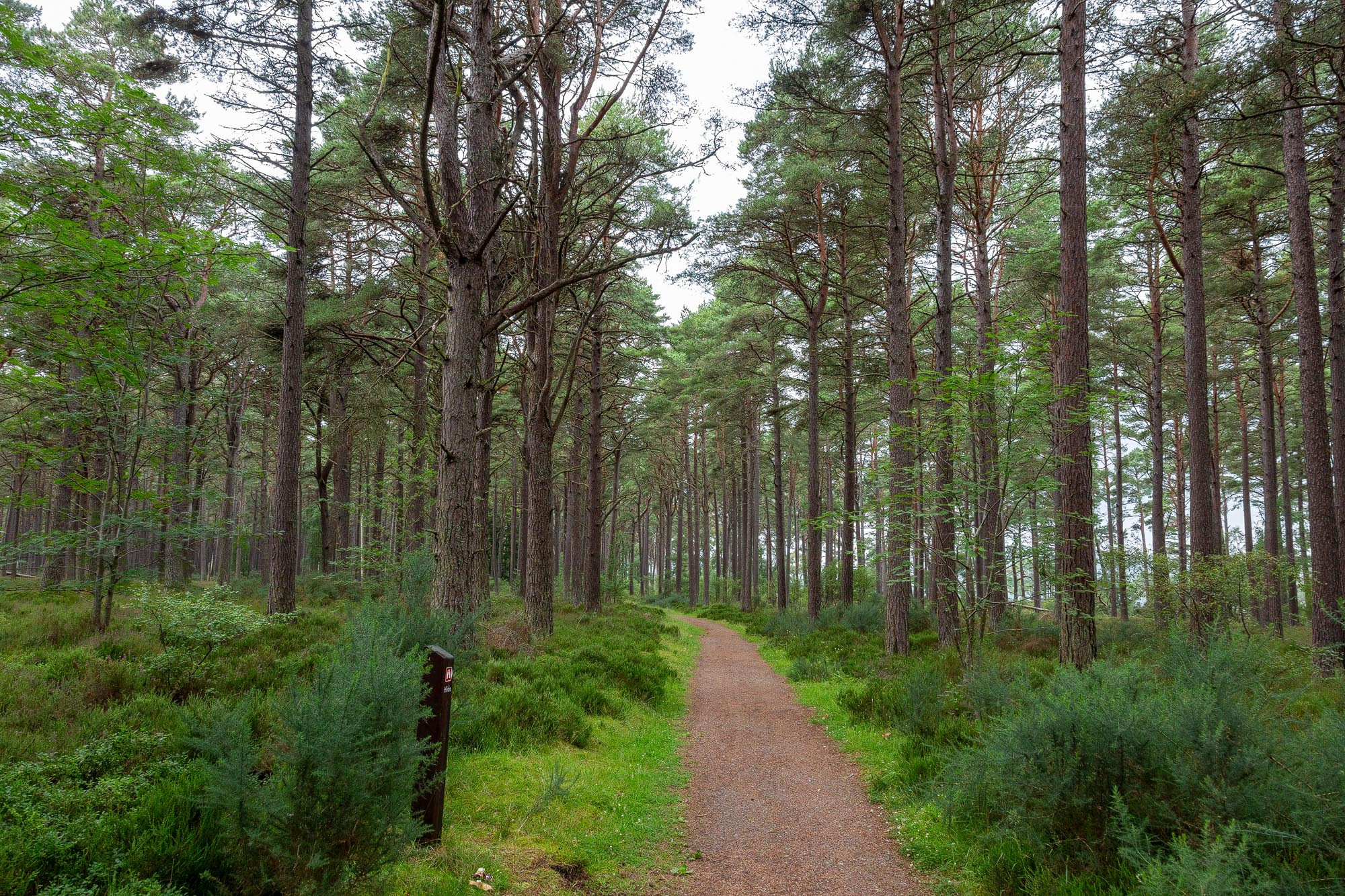
Balblair Wood – A Hidden Highland Gem on the Shores of Loch Fleet
Tucked away on the north shore of Loch Fleet, just a few miles south of Golspie in Sutherland, Balblair Wood is one of those places that quietly takes your breath away. Part of the Loch Fleet National Nature Reserve, this beautiful pocket of Scots pine woodland sits right on the edge of one of Scotland’s most important tidal basins – a place where ancient trees meet saltmarsh, and where some of the country’s rarest wildflowers cling to existence beneath a canopy that has stood, in one form or another, for centuries.
My wife Janette and I brought our three daughters – Ellie, Olivia and Lauren – for a family walk through the forest to the bird hide and back. It turned out to be one of those understated Highland outings that everyone thoroughly enjoyed, even the kids. There’s something about the stillness of the pines and the glimpses of loch through the trees that makes Balblair Wood feel genuinely special.

History and Background
Balblair Wood has a longer story than its relatively young trees might suggest. The woodland you walk through today was largely replanted in 1905, after the previous forest was flattened in a devastating storm. That earlier woodland had its own dramatic end too – timber salvaged from trees blown down in a gale was used to build Golspie’s Drill Hall in 1892, a building modelled after the Seaforth Highlanders’ hall in Kashmir, no less.
But the presence of three exceptionally rare wildflowers – creeping lady’s tresses, twinflower and one-flowered wintergreen (also known as St Olaf’s candlestick) – hints at something much older. These species are typically associated with ancient native pine forests, suggesting that natural Scots pine woodland may have flourished here long before the plantation was established. Remarkably, Balblair Wood is home to around 90% of the entire UK population of the one-flowered wintergreen, making it a site of extraordinary botanical importance.
The wider Loch Fleet area has been recognised for its ecological value since 1970, when it first became a nature reserve under the Scottish Wildlife Trust. It was designated a Site of Special Scientific Interest (SSSI) in 1975, and in 1998 it achieved National Nature Reserve status. Today it’s managed by NatureScot and forms part of the Dornoch Firth and Loch Fleet Special Protection Area, which was described by the Joint Nature Conservation Committee as one of the best examples of a large complex estuary in northwest Europe that has been relatively unaffected by industrial development.

The area around Balblair Wood also carries a significant military history. On 15th April 1746 – just one day before the Battle of Culloden – the Battle of Littleferry was fought in the fields and along the shoreline near here. A Jacobite force of around 400–500 men led by the 3rd Earl of Cromartie was ambushed by local government-loyal militia as they marched towards Littleferry. The Jacobites were routed – many were killed, others drowned trying to swim Loch Fleet, and the Earl himself was captured and taken prisoner at Dunrobin Castle. The defeat denied Prince Charles much-needed reinforcements on the eve of Culloden. A memorial stone was unveiled at the battlefield site in April 2022, and a self-guided battlefield trail now marks the route of the engagement.
Loch Fleet itself was formed at the end of the last ice age, when it was a wide-open bay with the tidal delta reaching as far inland as Rogart. Over time, currents dragged shingle across the entrance, creating the tidal basin we see today. The Mound – Thomas Telford’s impressive causeway built in 1816 to carry the road across the head of the loch – now acts as a tidal barrier and is clearly visible from parts of the Balblair Wood walk.
Our Visit
Getting There and Parking
Finding Balblair Wood is straightforward enough. From the A9, turn off in Golspie onto the minor road that runs past the golf course, heading towards Littleferry. The road passes through the woodland and the car park is on the left. It’s a small, informal pull-in area with space for maybe half a dozen cars, surrounded by trees. There’s no charge for parking.
The nearest postcode for sat-nav purposes is KW10 6TD, though bear in mind this isn’t exact – just keep heading south on the minor road past the golf course and you’ll spot the car park on your left before you reach Littleferry.

Into the Woods
From the car park, you pass through a wooden gate where a cluster of NatureScot information boards greet you. These are really well done – there’s a detailed map of the reserve, a welcome panel with information about the wildlife and trails, and bilingual signage in both English and Scottish Gaelic (Coille Bhaile a’ Bhlàir being the Gaelic name for the wood). There’s even a dispenser for leaflets, though it was empty on our visit.


A short walk brings you to a wooden footbridge crossing a small burn, and from there you’re properly into the woodland. The path is well-maintained – a firm gravel surface that’s wide enough for the family to walk side by side. The girls were immediately struck by the scale of the Scots pines. These are proper old trees now, well over a century old, and their tall, straight trunks rise up like columns on either side of the path, with heather, blaeberry and gorse filling the gaps between them.


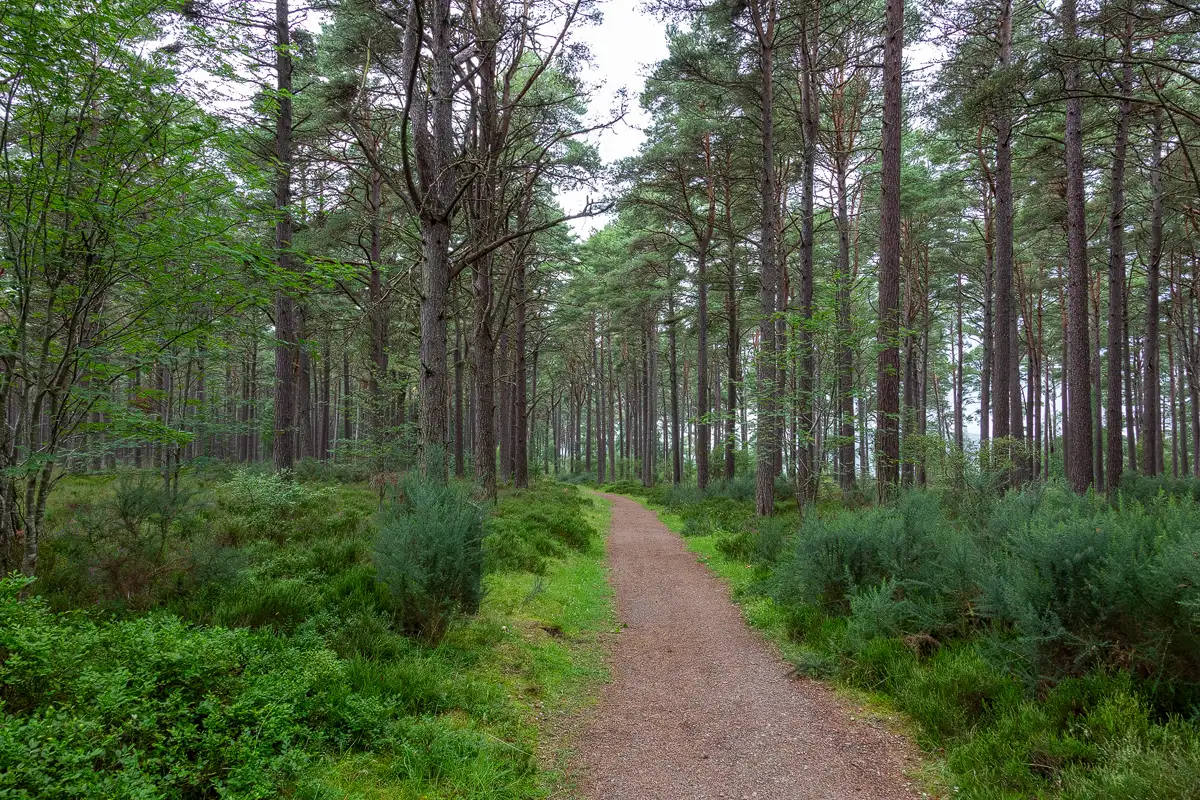
Not far along the path, we passed a lovely picnic area with several round wooden tables tucked under the shade of some large beech trees. It’s a peaceful spot – the leaf litter carpet and dappled shade make it feel very sheltered and private. We made a mental note to bring a picnic next time.


One delightful little discovery along the way was a set of rustic chairs and a table carved from old tree stumps, tucked away in a clearing among some birch trees. The girls loved it – it looked like something out of a fairy tale, slowly being reclaimed by moss and nature. It’s these little details that make a walk here feel so characterful.

The Bird Hide
The main destination for our walk was the Balblair Bay bird hide, which sits about a kilometre from the car park – roughly a 20-minute walk. It’s well signposted from the main trail (follow the waymarkers that bear left), and the path to the hide is an easy, flat walk.
The hide itself is a well-built timber structure, positioned perfectly at the edge of the woodland where it meets the saltmarsh and the tidal waters of Loch Fleet. There’s a bench outside for those who just want to sit and take in the view, but the real treat is inside. The hide has wide viewing slots looking out across the loch, with excellent identification panels showing the birds you’re likely to see – curlew, greylag goose, shelduck, osprey, redshank, greenshank and more.


There’s also a chalkboard where visitors can note what they’ve spotted, and the girls enjoyed reading through the recent sightings and adding to it. Even on our overcast visit, the view from the hide across the saltmarsh to the waters of Loch Fleet was atmospheric and peaceful. If the tide is low, you might spot seals hauled out on the exposed sandbanks – we weren’t so lucky on our visit, but the promise of it is enough to bring binoculars next time.


Frequently Asked Questions
Is Balblair Wood free to visit?
Yes, Balblair Wood is completely free to visit. There’s no entry charge and parking is free in the small car park off the minor road between Golspie and Littleferry.
How long is the walk to the bird hide?
The walk from the car park to the Balblair Bay bird hide is approximately 1 kilometre each way, taking around 20 minutes at a gentle pace. The return trip to the hide and back is roughly 2 kilometres in total. If you continue on the full Balblair Wood Trail circuit, it’s around 2.8 kilometres (1.7 miles).
Is the path suitable for pushchairs or wheelchairs?
The main path from the car park towards the bird hide is wide and mostly firm gravel, making it reasonably accessible for sturdy pushchairs. However, some sections can become loose or muddy in wet weather. Wheelchair users would manage the initial sections but may find the more remote parts of the trail challenging.
Are dogs allowed at Balblair Wood?
Dogs are welcome at Balblair Wood, but NatureScot asks that they are kept on a short lead or under close control from April to August to protect ground-nesting birds. Please follow the Scottish Outdoor Access Code and pick up after your dog.
Are there toilets at Balblair Wood?
There are no toilet facilities at Balblair Wood. The nearest public toilets are in Golspie at the Fountain Road car park, approximately 3 kilometres away.
What wildlife might I see?
Balblair Wood and Loch Fleet are rich in wildlife. In the woodland, look out for Scottish crossbills, siskins, treecreepers and great spotted woodpeckers. Red squirrels and roe deer are occasionally spotted. From the bird hide, you may see ospreys, oystercatchers, curlews, shelducks, wigeon and eider ducks. At low tide, harbour seals sometimes haul out on the exposed sandbanks. Pine martens are present but rarely seen.
When is the best time to visit?
Balblair Wood is worth visiting at any time of year. Spring and summer bring wildflowers and the return of ospreys and terns. Autumn and winter are excellent for overwintering wildfowl and waders, including large flocks of greylag and pink-footed geese. The woodland itself is beautiful in all seasons.
Key Information
- Location: Balblair Wood, near Golspie, Sutherland, Highland, KW10 6TD
- Grid Reference: NH 806 957
- Managed by: NatureScot (part of Loch Fleet National Nature Reserve)
- Entry: Free
- Parking: Free car park off the minor road between Golspie and Littleferry
- Facilities: Bird hide, information panels, picnic tables, benches. No toilets on site (nearest in Golspie)
- Accessibility: Main path is wide and mostly flat with firm gravel surface. Some sections may be loose or muddy. Gentle slopes throughout
- Dogs: Welcome, but keep on lead or under close control April–August
What Else is Nearby?
Dunrobin Castle – Just a mile north of Golspie, this fairy-tale castle is the seat of Clan Sutherland and one of the most spectacular stately homes in Scotland. The gardens are modelled on Versailles, and the daily falconry displays are not to be missed.
The Big Burn Walk, Golspie – A magical woodland gorge walk on the northern edge of Golspie, following a tumbling stream to a stunning waterfall. It takes around an hour and is wonderful with children.
Ben Bhraggie and the Duke of Sutherland Monument – The prominent hilltop statue visible from much of the Balblair Wood walk. You can hike to the summit from Golspie for panoramic views across Sutherland and the Moray Firth.
Littleferry and the Battle of Littleferry Trail – Continue along the road from Balblair Wood to the tiny hamlet of Littleferry, where you can explore the dunes, beach, and the self-guided battlefield trail commemorating the 1746 Jacobite engagement.
Carn Liath Broch – An atmospheric Iron Age broch ruin located about 3 miles north of Golspie on the A9. It’s free to visit and sits right beside the road with a small car park opposite.
Final Thoughts
Balblair Wood won’t take up your whole day, but it will stay with you. The combination of ancient-feeling Scots pine forest, the peaceful trail to the bird hide, and those views across the saltmarsh to Loch Fleet make it a genuinely rewarding walk – and an ideal family outing. The girls enjoyed it far more than they expected, and the bird hide was a real highlight.
If you’re on the North Coast 500 or exploring East Sutherland, Balblair Wood is well worth a stop. Bring binoculars, bring a picnic, and take your time. This is one of Scotland’s quieter gems, and it’s all the better for it.


Leave a comment below