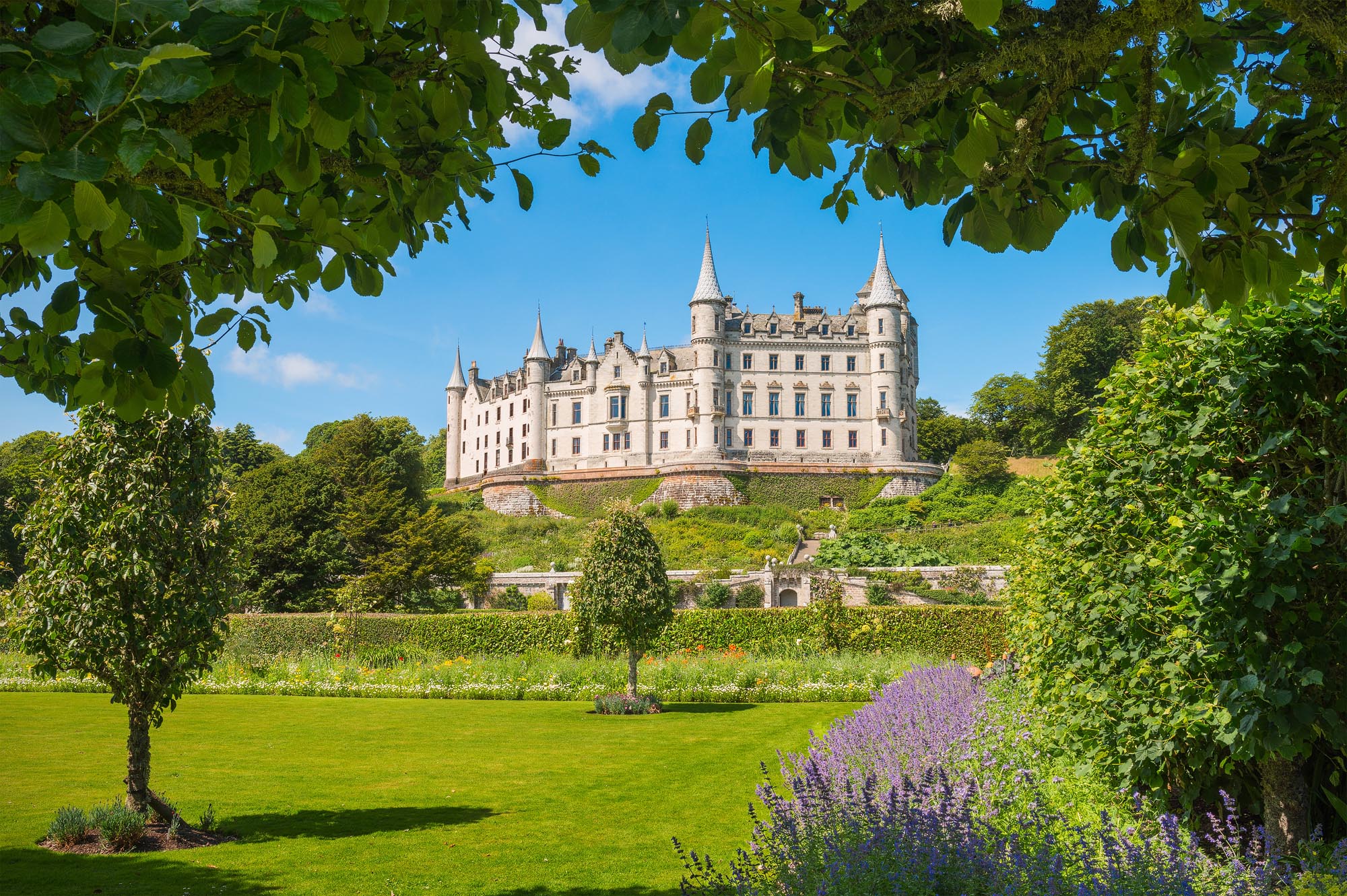
Perched on a high terrace above immaculate gardens on the east coast of Sutherland, Dunrobin Castle is one of the most breathtaking sights in the Scottish Highlands. With its conical spires, gleaming white walls and fairytale silhouette, it looks more like a French château than a Highland stronghold – and that is very much by design. Often described as the “Jewel in the Crown of the Highlands”, Dunrobin is the most northerly of Scotland’s great houses and the largest in the Northern Highlands, with a staggering 189 rooms.
- Introduction
- The History of Dunrobin Castle
- Our Visit to Dunrobin Castle
- Frequently Asked Questions
- Key Information
- What Else is Nearby?
- Conclusion
Dunrobin Castle was one of the first places Janette and I visited on our first tour around the Dornoch area while staying at Grannie’s Heilan’ Hame. We had spotted it across the Dornoch Firth from Embo as this large white building on the far shore, only getting the smallest hint at its true grandeur. Up close, you can truly appreciate the scale of this extraordinary place – a castle that has been home to the Earls and Dukes of Sutherland for over seven hundred years and remains a private residence to this day.

What struck us most on that first visit was the contrast between the castle’s storybook exterior and its complicated history. This is a place of extraordinary beauty, but also a place inextricably linked to the Highland Clearances – one of the most painful chapters in Scottish history. Understanding both sides of Dunrobin’s story makes a visit here all the more powerful.

The History of Dunrobin Castle
Medieval Origins and the Sutherland Earldom
The story of Dunrobin Castle begins in the early 13th century when the lands of Sutherland were acquired by Hugh, Lord of Duffus, a grandson of Freskin de Moravia. Freskin was a Flemish nobleman whose descendants would become hugely influential across the north of Scotland, with connections to Duffus Castle in Moray, Skelbo Castle near Loch Fleet, and Dornoch Cathedral.
The Earldom of Sutherland was created around 1235, making it one of the oldest earldoms in Scotland. An early medieval fort may well have existed on the site before the stone castle was built. The earliest surviving portion of the castle, featuring thick stone walls and an iron yett (gate), dates from around 1275 and is first mentioned in records in 1401. The castle’s name is thought to derive from Robert, the 6th Earl of Sutherland, who died in 1444 – “Dun Robin” meaning “Robin’s Hill” in Gaelic.
The original castle was a square keep with walls over six feet thick. Unusually, the ceilings of each floor were formed by stone vaults rather than timber, giving the structure exceptional strength. You can still see traces of this medieval core from inside the castle, particularly through the round window that looks down into the old courtyard where the original stonework meets the later additions.

Clan Conflicts and the Gordon Takeover
As holders of one of just seven medieval earldoms in Scotland, the Sutherlands were part of the ruling elite, intermarrying with other leading families and even royalty. The 5th Earl married Princess Margaret, daughter of Robert the Bruce, while the 6th Earl married the daughter of Alexander Stewart – the infamous Wolf of Badenoch, who terrorised large parts of the Highlands and burned Elgin Cathedral.
When the 8th Earl died in 1508, a power struggle ensued. The earldom passed to the Gordon family through marriage when Elizabeth Sutherland wed Adam Gordon. In 1518, while Adam Gordon was away, Alexander Sutherland – the legitimate heir – seized the castle. The Gordons retook it swiftly, capturing Alexander and placing his severed head on a spear atop the castle tower. His son John attempted to reclaim the castle in 1550 but was killed in the castle garden. It was a brutal period that underscores the violent rivalries that shaped Highland Scotland.
The Jacobite Rising of 1745
One of the most dramatic episodes in Dunrobin’s history came during the Jacobite Rising of 1745. The Clan Sutherland supported the British government, which put them directly at odds with the Jacobite cause. In April 1746, the Earl of Cromartie, George Mackenzie – a committed Jacobite – received reports that the Prince’s men had been victorious at the Battle of Culloden. Without waiting to verify the news, he gathered his forces and stormed Dunrobin Castle, seizing it in the name of the Stewart king.
It was only after his men had settled comfortably into the castle that word arrived that Culloden had actually been a devastating defeat for the Jacobite cause. The Sutherland militia quickly surrounded the castle and captured the Earl. The room where he was discovered is still known as the Cromartie Room. Meanwhile, the 17th Earl of Sutherland had narrowly escaped the initial attack, slipping out through a back door and sailing to Aberdeen, where he joined the Duke of Cumberland’s army before returning to reclaim his castle.
The Highland Clearances
It is impossible to write honestly about Dunrobin Castle without addressing the Highland Clearances. Between 1811 and 1821, the 1st Duke of Sutherland and his wife, the Countess of Sutherland, oversaw the forced eviction of around 15,000 tenants from their estates – the largest privately owned in Europe at 1.5 million acres. Families who had lived on the land for generations were displaced to make way for large-scale sheep farming.
The brutal treatment of the residents was led by the estate’s factor, Patrick Sellar, who was notorious for his contempt of the Gaelic-speaking tenants. Houses were burned, sometimes with the elderly and infirm still inside. Sellar was tried for culpable homicide but acquitted in 1816. Many of those evicted were forced to the coast to try their hand at fishing, while thousands emigrated to Canada, Australia and New Zealand. The Emigrants Statue at Helmsdale, just up the coast from Dunrobin, stands as a poignant memorial to those who were forced to leave.
The castle we see today was largely rebuilt with the wealth generated during this period, a fact that lends a complicated weight to its grandeur. The towering statue of the 1st Duke atop Ben Bhraggie, visible from the castle gardens, remains one of the most controversial monuments in Scotland. Visitors should be aware that the castle itself does not extensively address the Clearances, though the nearby Historylinks Museum in Dornoch covers this period in detail.
Sir Charles Barry’s Transformation
Between 1835 and 1850, the celebrated architect Sir Charles Barry – best known for designing the Palace of Westminster in London – remodelled Dunrobin Castle in the Scots Baronial style for the 2nd Duke of Sutherland. Barry drew heavily on French château influences, particularly the work of architect Viollet-le-Duc, to create the fairy-tale exterior we see today. He retained the medieval tower and 17th-century extensions within the new structure, so the castle is essentially several centuries of building wrapped inside one magnificent skin.
Barry also designed the formal gardens below the castle, taking inspiration from the gardens of Versailles. The sweeping parterre layout with its geometric flowerbeds, topiary and fountains was laid out in the 1850s and has changed remarkably little in the 170 years since.
Dunrobin Castle’s own railway station on the Far North Line was opened in 1870 as a private station for the castle. The present waiting room was built in 1902 and is now a Category B listed building. Remarkably, the station still operates as a request stop during the summer months, making Dunrobin one of the few castles in Scotland you can arrive at by train.
Fire, War and Restoration
During the First World War, the castle served as a naval hospital. In 1915, a fire caused extensive damage to the roof and much of Barry’s interior, though the blaze was confined to the newer additions. The renowned Scottish architect Sir Robert Lorimer was commissioned to restore the interior, and his work is what visitors see today in many of the state rooms – including the grand dining room and the sycamore-panelled library.
The castle was again used as a hospital during the Second World War in 1940. Following the death of the 5th Duke of Sutherland in 1963, the Earldom and Dukedom were separated. The Dukedom passed through the male line while the Countess of Sutherland inherited the Earldom.
The Modern Era
Between 1965 and 1972, Dunrobin had an unexpected chapter as a boys’ boarding school, taking on forty pupils and five teachers in its first year. The school closed in 1972, and the castle reverted to private accommodation. Since 1973, the house and gardens have been open to the public, welcoming visitors from around the world between April and October each year. The castle remains the home of the present Countess of Sutherland, with private quarters separate from the visitor areas.

Our Visit to Dunrobin Castle
Arriving at Dunrobin
Dunrobin Castle sits just off the A9, about a mile north of Golspie and roughly an hour’s drive north of Inverness. It’s a natural stop on the NC500 route, and if you’re heading clockwise from Inverness, Dunrobin will be one of your first major attractions on the east coast stretch.
There is a large car park right in front of the castle with space for around 200 cars and four coaches. Parking is free and included with your admission ticket. On our visit on a busy summer day, the car park was well-used but we had no trouble finding a space. The rear of the castle – the side you see first from the car park – looks quite different to the garden-facing front, with its clock tower and a somewhat sterner, more fortress-like appearance. It’s only when you descend to the gardens that the fairytale château reveals itself.

We purchased our tickets at the entrance – a family ticket for two adults and three children. The distinctive red folding tickets make for a lovely keepsake. Tickets can also be purchased online in advance, which is recommended during peak summer months when coach tours can make it busy.

Inside the Castle
The self-guided tour around Dunrobin Castle is excellent. You follow a one-way route through around twenty rooms across three floors, with strategically placed information boards in each room providing fascinating context. Although the tour is not guided, staff members are positioned in several rooms and are more than happy to answer questions and share stories. Please note that photography is not permitted inside the castle, so I was fortunate to take our photos on an earlier visit when this rule was more relaxed.

The tour begins in the entrance hall with its magnificent staircase, complete with a chandelier, family portraits and stag heads adorning the walls. Several visitors have compared it to Hogwarts, and you can see why – the scale is genuinely impressive, with light flooding in from above and the ornate ironwork balustrades drawing your eye upward.
The dining room is one of the grandest spaces in the castle. Designed by Sir Robert Lorimer after the 1915 fire, it features rich wood panelling, a Khorassan carpet on the floor and a fine silver dining set from the Georgian and Victorian eras. The twenty-two Jacobean-style dining chairs each bear their own unique family coat of arms, which is a wonderful detail.

The music room centres on a beautiful grand piano, set in a wood-panelled space with wonderful acoustics. Fine paintings hang on the walls, including a portrait of an Irish chieftain, Sir Neil O’Neil, 2nd Baronet of Killeleagh. The natural light streaming through the large windows made this one of my favourite rooms to linger in.

A narrow wooden spiral staircase with lattice-panelled walls takes you to the upper floors. It’s atmospheric and gives you a real sense of the castle’s age – quite a contrast to the grandeur of the state rooms below.

The drawing room is home to magnificent tapestries depicting scenes from classical antiquity and some outstanding furniture, including an 18th-century French table made by the royal cabinet-maker Joseph Baumhauer. Large Venetian paintings of Venice adorn the walls above an elaborate marble fireplace.

The library is a real highlight, housing over 10,000 books. The room is beautifully lined with sycamore wood throughout, designed to Lorimer’s specification. Items of interest include a globe of the world and a Georgian reading rest. The portrait above the fireplace adds to the room’s warmth and character – you could happily spend all afternoon in here.

Among the bedrooms on the upper floor, the standout is the Green and Gold Room, said to have been specially decorated for a visit from Queen Victoria in 1872. The green panelled walls with gold detailing, the ornate four-poster bed topped with white doves, and the large tapestry make this one of the most opulent rooms in the castle.

The military room contains a fascinating collection of weapons, uniforms, medals and flags connected to the 93rd Highlanders (Sutherland Highlanders). The medal displays are particularly impressive and give a poignant insight into the military service of the Sutherland family and their people.

The Gardens
Descending from the castle to the gardens is where Dunrobin truly takes your breath away. The formal Victorian gardens, designed by Sir Charles Barry and completed in the 1850s, are arranged into two parterres centred around circular pools. The geometric flowerbeds, immaculately clipped topiary and sweeping lawns descend in terraces towards the sea, drawing clear inspiration from the gardens of Versailles. Little has changed in over 170 years, and the combination of the castle rising above and the Moray Firth stretching to the horizon beyond makes this one of the most beautiful garden views in Scotland.


It’s possible to walk around all areas of the formal garden, and there are plenty of hidden details to discover, including gravestones from a horse cemetery and a Greek sacrificial altar. The best spot for a family photo is at the fountain in the main parterre with the castle rising behind you – it’s the classic Dunrobin shot and well worth the walk down.


The Falconry Display
The falconry displays in the castle gardens are one of the undeniable highlights of any visit to Dunrobin. Shows run twice daily at 11.30 am and 2.30 pm throughout the season and are included in the admission price. The resident falconer demonstrates the ancient art of hunting with birds of prey, featuring peregrine falcons, gyrfalcons, Harris hawks and sometimes owls and eagles too.
The falconer swings a baited lure around his head, and the birds swoop down at tremendous speed to grab it – it’s a thrilling display of their hunting prowess. The kids absolutely loved this show, and it was highly educational. We’d recommend timing your visit around one of the display times; it’s the kind of experience that stays with you.


The Victorian Museum
Within the castle gardens sits a Victorian museum, originally built as a summer house by William, Earl of Sutherland, and later extended by the 3rd Duke. Inside, you will find an eclectic collection that includes taxidermy specimens from the family’s safari expeditions, ethnographic items collected from around the world (particularly Africa), and – most importantly – a significant collection of Pictish symbol stones and cross-slabs from the local area.
I should be honest and say that despite visiting Dunrobin many times, I have never actually spent long in the museum. The extensive taxidermy collection makes me uncomfortable, though I appreciate it reflects the cultural norms of the Victorian era. If Pictish history interests you, the stones here are well worth seeing.
Gift Shop and Tearoom
At the end of the castle tour, you emerge into the gift shop. It’s well-stocked with a wide range of quality Scottish crafts and gifts, including woollens, hats, scarves, toiletries, postcards, chocolates, jams and many other souvenirs. It was a welcome change to find that the items here were not ludicrously overpriced like many tourist attractions – we picked up some fridge magnets (our new goal for every new place we visit). The staff were really lovely and chatted with the kids enthusiastically.

The tearoom is also worth a visit, serving hearty homemade soup, freshly prepared sandwiches, hot meals, homemade cakes and pastries, and local ice creams. It’s open daily throughout the season and provides a welcome refuelling stop, especially after exploring the gardens.

Frequently Asked Questions
How much does it cost to visit Dunrobin Castle?
Admission prices for 2026 are: Adults £16.00, Concession £14.00, Children (6+) £10.00, and a Family ticket (2 adults + up to 3 children) £47.00. Children under six go free. Tickets can be purchased online in advance or on arrival – booking online is recommended during peak season. Admission includes access to the castle, museum and gardens.
When is Dunrobin Castle open?
Dunrobin Castle is open from 1st April to 31st October each year. From April to September, the castle opens daily from 10.00 am to 5.30 pm (last entry 4.30 pm). In October, hours are 10.30 am to 5.00 pm (last entry 4.00 pm). Always check the castle’s social media for any last-minute closure updates.
How long does a visit to Dunrobin Castle take?
You should allow at least 2–3 hours to see the castle, gardens and museum comfortably. If you plan to catch a falconry display (highly recommended), factor that into your timing too. We found it easy to spend a full half-day here.
Is Dunrobin Castle accessible for wheelchair users?
As a historic building, Dunrobin has limited accessibility. There are stairs throughout the castle tour, and the upper floors are not accessible for wheelchair users or visitors with limited mobility. Wheelchair access to the gardens can be arranged on request – contact the castle in advance to discuss your needs.
Does anyone still live in Dunrobin Castle?
Yes. Dunrobin Castle remains a private residence. The present Countess of Sutherland lives in the private wing, which is separate from the visitor areas.
Is Dunrobin Castle haunted?
What good would a Scottish castle be without a ghost story? Dunrobin is said to be haunted by the daughter of the 14th Earl – a young woman named Margaret whose father disapproved of her suitor. When she was forbidden from seeing him, she attempted to escape from an upstairs window by climbing down a rope of bedsheets but sadly fell to her death. The room where she was imprisoned is known as the Seamstress’s Room, and her ghost is said to roam the upper corridors, wailing about her lost love.
Can I arrive at Dunrobin Castle by train?
Yes! Dunrobin Castle has its own railway station on the Far North Line between Inverness and Wick/Thurso. It operates as a request stop during the summer months, making it a unique and scenic way to arrive. The Stagecoach X99 bus service also stops nearby.

Key Information
- Location: Golspie, Sutherland, KW10 6SF – half a mile north of Golspie on the A9, approximately 50 miles north of Inverness.
- OS Grid Reference: NC849012
- Managed by: Dunrobin Castle Limited (privately owned by the Sutherland family).
- Entry: Paid – Adults £16.00, Children £10.00, Family £47.00 (2026 prices). Includes castle, museum and gardens.
- Parking: Large free car park for 200 cars and 4 coaches, directly at the castle entrance.
- Facilities: Tearoom, gift shop, toilets, Victorian museum, falconry displays (11.30 am and 2.30 pm daily).
- Accessibility: Limited – the castle tour involves stairs and is not wheelchair accessible. Garden access for wheelchair users can be arranged on request.
- Dogs: Assistance dogs only inside the castle and gardens.
What Else is Nearby?
The area around Dunrobin Castle is packed with things to see and do. Here are some of our favourites:
The Big Burn Walk, Golspie – Just a short distance from the castle, this lovely walk follows a wooded gorge with multiple bridges and waterfalls, culminating in a spectacular waterfall with a viewing platform. It’s the perfect add-on to a Dunrobin visit and ideal for families.
Carn Liath Broch – A short drive north along the A9, this remarkably well-preserved 2,000-year-old Iron Age roundhouse sits right beside the road overlooking the coast. It’s free to visit and gives fantastic views back towards Dunrobin Castle and the Duke of Sutherland monument on Ben Bhraggie.
Loch Fleet National Nature Reserve – Between Golspie and Dornoch, this beautiful tidal basin is a haven for wildlife including harbour seals, ospreys and otters. Skelbo Castle overlooks the loch from the southern shore.
Dornoch – This charming Royal Burgh is just 15 minutes south and well worth half a day in its own right. Don’t miss the stunning Dornoch Cathedral, the Historylinks Museum, and lunch at Sandstone Cafe. If you are planning a longer stay in the area, have a look at my 5-day Dornoch travel itinerary.
Falls of Shin – Around 30 minutes west, this waterfall is famous for Atlantic salmon leaping upstream from May to September. There is a visitor centre, café, play park and forest walks.
Golspie Golf Club – If you fancy a round of golf during your visit, this James Braid-designed links course sits in the shadow of Ben Bhraggie with views across the Dornoch Firth.

Conclusion
Dunrobin Castle is, quite simply, one of the finest visitor attractions in the Scottish Highlands. The sheer scale of the castle, the beauty of its gardens, the thrill of the falconry display and the depth of history on offer make it an essential stop whether you are exploring Sutherland, driving the NC500, or looking for a memorable day out from Inverness.
Yet it is also a place that asks you to sit with some uncomfortable truths. The fairy-tale exterior was built on the back of the Highland Clearances, and any honest appreciation of Dunrobin must acknowledge the suffering that funded its grandeur. For Janette and me, that contrast is part of what makes visiting here so compelling – you leave not just with beautiful photographs, but with a deeper understanding of the complex history that shaped this part of Scotland.
Dunrobin remains my second favourite castle in Scotland (after Duffus Castle, naturally!), and I would encourage anyone visiting the Highlands to make the journey north to see it. It really is worth venturing beyond the central belt and exploring the more remote corners of this magnificent country.

Leave a comment below
Comments: