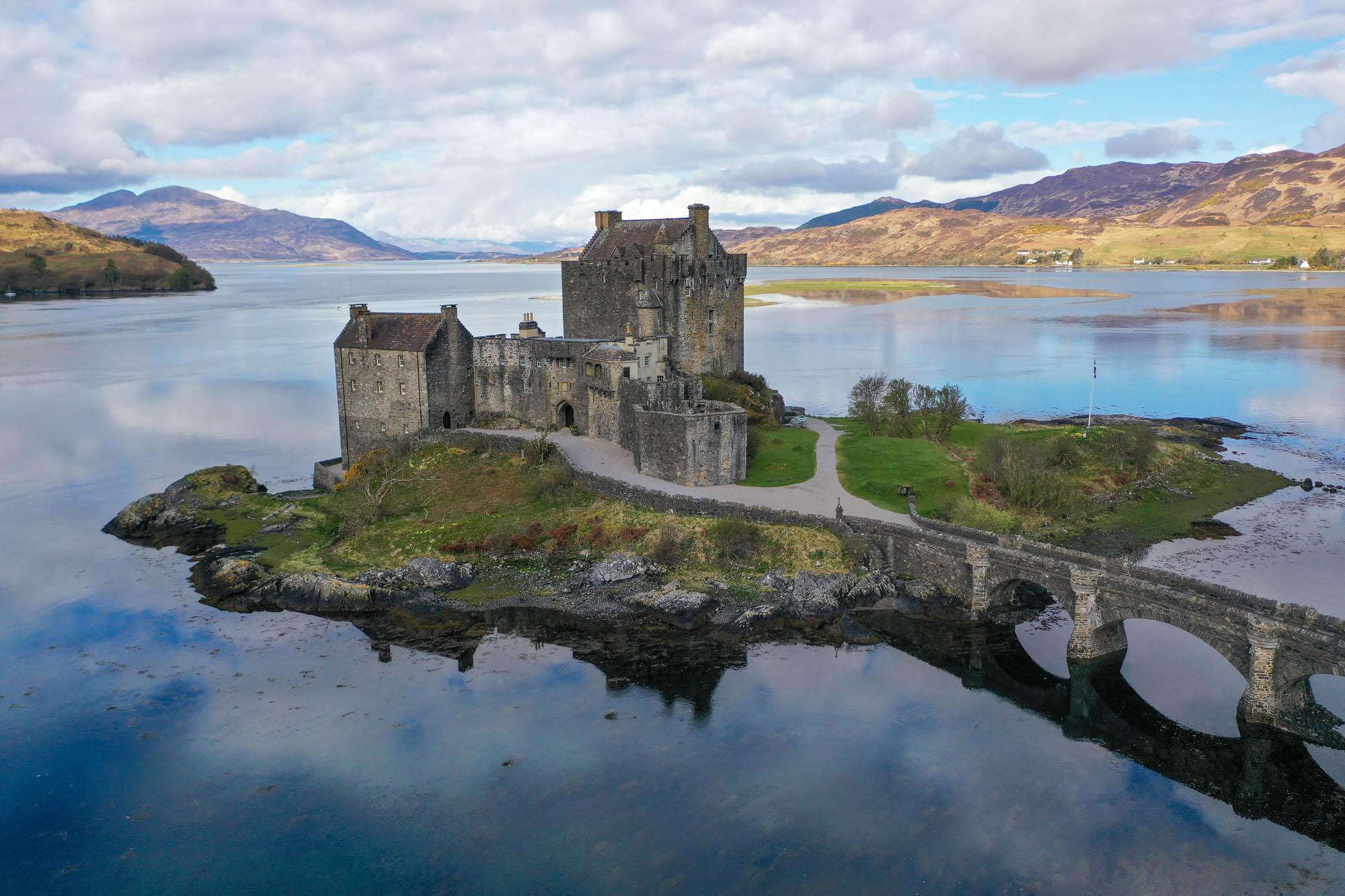
Some places on a map photograph themselves. You show up, you point the camera, and the result is essentially a postcard you happened to press the shutter on. Eilean Donan is one of those places. Rising from a tiny tidal island where three sea lochs meet, with the Kintail hills folding away behind it and the Five Sisters keeping watch to the south-east, it has a habit of looking exactly the way a Scottish castle is supposed to look – regardless of weather, season, or which angle you come at it from.
Janette and I rolled up on a calm spring morning with the A87 unusually quiet, the water flat as a mirror, and the last of the winter’s snow still clinging to the Kintail tops. It was, to be honest, the sort of Highland day you half expect to pay extra for.
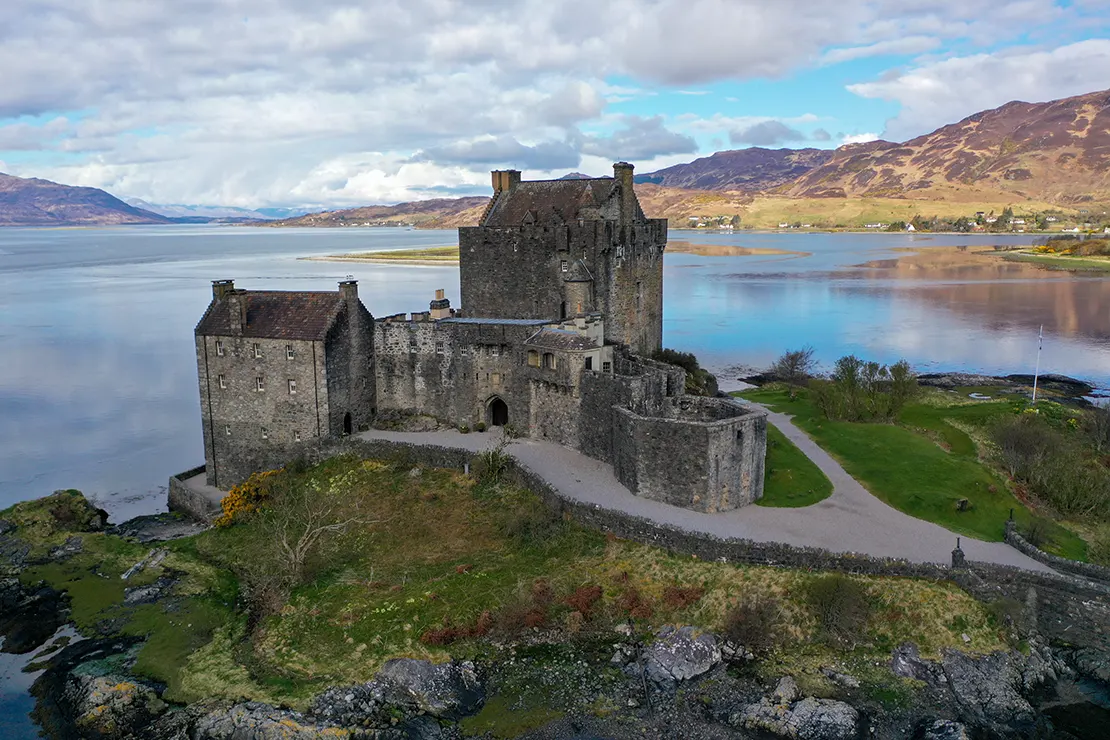
What follows is part history lesson, part practical visitor guide, and part photographer’s love letter to a place that has earned its reputation as the most photographed castle in Scotland several times over.
A Castle Built on Saints, Soldiers and the Ruins of Gunpowder
The name Eilean Donan means simply “Island of Donnán,” a nod to the 6th-century Irish-Celtic saint, Donnán of Eigg, who is thought to have founded a small monastic cell on the island in the late 7th century. Saint Donnán himself met a grisly end on the Isle of Eigg in 617 AD, martyred alongside his entire monastic community. No trace of his chapel survives here, but fragments of vitrified stone found on the island hint at an even earlier Iron Age fortification, so people have clearly felt the pull of this spot for a very long time indeed.
The first proper castle went up in the early 13th century, during the reign of Alexander II (1214–1249). At the time, this was frontier country – the meeting point of the Celtic-Norse Lordship of the Isles and the Earldom of Ross – and Eilean Donan’s location made it a natural defensive stronghold against Norse raids. The original structure was a large curtain-wall affair that enclosed most of the island, with walls reportedly up to 14 feet thick in places.
One of the founding legends is marvellous in its oddness: the son of a Matheson chief, we’re told, gained the power to speak with birds and used the wisdom he acquired to win the respect of Alexander II, who then asked him to build a castle to defend the realm. Not your standard Highland origin story, but I rather enjoy it.
The Mackenzies, the MacRaes, and a Last-Arrow Legend
By the late 13th century, Eilean Donan was in the hands of the Mackenzies of Kintail, who would hold it (in various states of disputed ownership) for the next several centuries. The MacRaes arrived in Kintail in the mid-14th century and quickly embedded themselves as the Mackenzies’ hereditary bodyguards – the “Mackenzies’ coat of mail,” as the old phrase had it – before formally becoming constables of the castle in 1511.
The medieval record is studded with stories. In 1331, Thomas Randolph, Earl of Moray and Warden of Scotland, sent word ahead that he intended to visit. The garrison marked the occasion by rounding up fifty local wrongdoers, executing them, and displaying their heads on the castle walls. Randolph apparently approved. Different times.
Then there’s the 1539 attack, which is one of those tales that sounds too neat to be true but apparently is. Donald Gorm Macdonald of Sleat, having picked a fight with the Mackenzies, learned that Eilean Donan was barely defended and launched a surprise assault with 400 men. Inside were exactly two people: the recently-appointed constable and the warden, both of whom were killed by arrows in the early moments of the attack. But just as the fighting began, Duncan MacGillechriosd of the MacRaes turned up, loosed his arrows one after another until only a single shaft remained, and fired his last arrow directly into Donald Gorm – fatally wounding him and breaking the siege. It remains one of the great last-arrow stories in Scottish history.
1719: Spanish Soldiers, Royal Navy Frigates, and 343 Barrels of Gunpowder
Eilean Donan’s role in the 1715 Jacobite Rising was relatively subdued, but 1719 was another matter entirely. That year, as part of a doomed Spanish-backed effort to put James Stuart on the throne, a small force of around 300 Spanish soldiers landed on the west coast of Scotland. Forty-six of them were posted to Eilean Donan, where they established a magazine of 343 barrels of gunpowder and waited for weapons and reinforcements that would never come.
The government caught wind of the plan and dispatched three Royal Navy frigates – HMS Worcester, HMS Flamborough and HMS Enterprise – to deal with the problem. On 10 May 1719, they sailed into Loch Alsh and opened fire. The castle’s 14-foot walls shrugged off much of the initial bombardment, so the attack stretched over three days before Captain Herdman of the Enterprise finally sent his men ashore. The Spanish defenders surrendered quickly and were taken prisoner. Then someone either very enterprising or very reckless decided to use the garrison’s own 343 barrels of gunpowder to blow up what remained of the walls. The result was spectacular and comprehensive. What the Royal Navy couldn’t bring down with cannon, they finished off with what the Spanish had left behind.
A month later, Jacobite forces were defeated at the Battle of Glen Shiel, just a few miles up Loch Duich, and the rising fizzled out. Eilean Donan, meanwhile, lay in ruins.

A 200-Year Ruin and a Man with a Vision
For the best part of two centuries, the shattered walls stood open to the weather, slowly turning into one of those atmospheric heaps that Victorian travellers liked to sketch and write earnest poetry about. It might have stayed that way forever had Lieutenant Colonel John Macrae-Gilstrap not bought the island in 1911 and decided to put it back together again.
There is a wonderful local story attached to the reconstruction. Macrae-Gilstrap’s clerk of works, a local man called Farquhar MacRae, is said to have had a vivid dream in which he saw the original castle exactly as it had been before 1719 – and the rebuild is supposed to have followed his dream-plan. Whether that’s literally true or a useful bit of mythmaking, the reconstruction that followed – carried out by architect George Mackie Watson between 1912 and 1932 – is impressively convincing. The arched stone bridge that now connects the island to the mainland was also built during this period, replacing the original tidal causeway.
The castle formally reopened on 22 July 1932. It welcomed its first paying visitors in 1955. In 1983, ownership passed to the Conchra Charitable Trust (a registered Scottish charity, SC 017346), which still runs it today. The purpose-built visitor centre on the mainland opened in 1998. Archaeological excavations in 2008 and 2009 confirmed that substantial fragments of the 13th-century castle still survive within the reconstruction, so although what you’re looking at is largely a 20th-century rebuild, the bones underneath are genuinely medieval.
Our Visit to Eilean Donan
Arriving at the Castle
We approached from the east along the A87, coming up from Invergarry with the road hugging Loch Duich and the Five Sisters of Kintail filling the rear-view mirror. You can’t miss Eilean Donan when you get to it – the car park sits directly opposite the island, with the castle framed perfectly across the water the moment you pull in.

The main car park is a generous size, with an overflow area just beyond the main road for busier days. It’s worth knowing that parking is charged by the hour during the castle’s opening times, but becomes free once the site closes for the day – a handy piece of information if you’re chasing golden-hour light (more on that shortly). Disabled parking bays are positioned around twenty metres from the visitor centre entrance, and the centre itself is fully step-free and wheelchair-friendly.
On a quiet spring morning like ours, we had our pick of spaces. Arrive in July or August and things look rather different – Eilean Donan is on practically every Highland coach-tour itinerary, and the car park can fill up fast between about 11am and 3pm.
Crossing the Footbridge
The arched stone bridge that carries you from the mainland to the island is one of the most satisfying short walks in Scotland. It’s perhaps sixty metres long, slightly humpbacked, and perfectly framed to deliver you right up to the castle’s main entrance. As you approach, you start to appreciate just how compact the island actually is – the castle takes up most of it, with just a thin ring of grass and rocks around the walls.

Because Eilean Donan is genuinely tidal, the view from the bridge changes depending on when you turn up. At high tide, the water comes right up to the rocks and the castle looks like it’s floating. At low tide, mudflats are exposed around the base and you can trace the original shoreline. Our visit caught it somewhere in between, with a glass-calm loch holding a pin-sharp reflection of the castle and the sky above it.
Above the main south entrance, if you look up as you approach, you’ll see the coat of arms of John Macrae-Gilstrap along with a Gaelic inscription that translates roughly as “So long as there is a MacRae inside, there shall never be a Fraser outside.” A little piece of clan humour built into the stonework. The main door itself is part of the medieval castle that somehow survived the 1719 explosion, and the working portcullis behind it is genuinely operational – visitors occasionally see it being raised or lowered during the day.
Circling the Island
The full circuit around the outside of the castle is short – no more than five or ten minutes on foot – but it rewards a bit of time. We wandered slowly, Janette pointing out the daffodils and fresh spring growth dotted between the darker grey of the castle stone, the Saltire snapping gently on its flagpole at the east end of the lawn.

Around the back of the castle, on the east side, is the hornwork – an irregular hexagonal artillery bastion added in the late 1500s to provide a firing platform for the newly-fashionable cannon. Inside it sits a stone-lined well, more than ten metres deep, which in its day could be covered over with a drawbridge. From this angle you get one of the best views of the keep and the whole massed bulk of the castle rising from the rocks.
On the south side of the island, tucked near the bridge, stands the war memorial to the members of Clan MacRae who died in the First World War. Two grey field guns flank the memorial, and the stonework carries lines from John McCrae’s poem In Flanders Fields. It’s a quiet spot, and given that Macrae-Gilstrap began rebuilding the castle in 1911 only to lose so many clansmen a few years later, the memorial feels inextricably linked to the story of the reconstruction itself.
A Different View from the Air
Lifting the drone up and actually seeing Eilean Donan from above changed my whole understanding of the place. On the ground it feels like a castle on an island. From a hundred feet up you realise it’s a castle at the exact meeting point of three sea lochs – Loch Duich curving in from the south-east, Loch Long reaching up to the north-east, and Loch Alsh heading west towards the Skye Bridge and the Cuillins. The medieval Mackenzies didn’t pick this island by accident. Controlling Eilean Donan meant controlling the entire waterway between the mainland and the Hebrides.

It’s also from the air that you really see how much of the castle’s presence comes from its setting rather than its size. Compared to somewhere like Edinburgh or Stirling, Eilean Donan is actually quite compact. But drop it into a three-lochs confluence with mountains on every horizon, and the effect is genuinely something else.
What You’ll Find Inside
We stuck to the exterior on this visit – the drone work was the main job and we wanted to do the circuit properly – but for completeness, here’s what’s waiting if you buy a ticket and head in.
The entrance fee gets you into the keep, the banqueting hall, the kitchens and scullery, the sea-gate, the billeting room, and several bedrooms furnished largely as they would have been in the 1930s. The Banqueting Hall is the centrepiece on the first floor, complete with a carved stone fireplace depicting a hunting scene and the Macrae-Gilstrap coat of arms at its centre. The kitchen and scullery exhibits are surprisingly atmospheric – all copper pans and period implements – and the small museum includes the Clan MacRae Roll of Honour and personal items from the reconstruction era. A touch-screen virtual tour is available free on request at the visitor centre, which also offers glimpses of rooms that aren’t on the standard visitor route.
Two things worth knowing before you head inside. First, photography is not permitted inside the castle – so everything you see in there has to live in your memory rather than your phone. Second, backpacks and large bags aren’t allowed inside either, but there are free security lockers just outside the visitor centre to leave them in.
Lights, Camera… and One Persistent Outlander Myth
Eilean Donan has had a busy career on screen. It turned up as early as 1948 in the Bonnie Prince Charlie film starring David Niven, and again in 1953’s The Master of Ballantrae. The big modern appearances came in 1986, when it doubled as the village of Glenfinnan in Highlander, and in 1999, when it served as MI6’s Scottish headquarters in the James Bond film The World Is Not Enough. It also features in Elizabeth: The Golden Age (2007) and Made of Honour (2008), among others. The castle is also set to reprise its role in the modern remake of Highlander with Henry Cavill.
One quick myth-bust while we’re here. Because of its postcard-perfect Highland looks, a surprising number of visitors turn up firmly convinced that Eilean Donan featured in Outlander. It didn’t. Not once. Not even in the background. The assumption seems to have become its own self-reinforcing internet rumour, but Sam Heughan and Caitríona Balfe have never filmed a scene here, and there’s no character or location in the books or the series associated with it either. If Outlander locations are what you’re after, Doune Castle (Castle Leoch) is the serious pilgrimage – Eilean Donan just photographs beautifully enough that people assume it must have been in everything.
Frequently Asked Questions
How much does it cost to visit Eilean Donan Castle?
As of 2026, admission is £13.00 for adults, £12.00 for concessions (seniors aged 60+), £6.50 for children aged 5–15, and free for under-5s. A family ticket covering two adults and up to three children costs £38.00. Tickets can only be purchased on site, on the day of your visit – there is no online pre-booking system.
When is Eilean Donan Castle open?
The castle is open daily from 1 February to 22 December, with hours varying by season. Winter months (February, March, and late October to December) run 10am–4pm with last admission at 3pm. Spring and autumn extend to 10am–6pm or 9.30am–6pm depending on the month, and the high summer months (June to August) run 9am–6pm with last admission at 5pm. The castle is typically closed from late December through the end of January for annual maintenance.
Can I visit Eilean Donan Castle for free?
You can’t go inside the castle without a ticket, but thanks to Scottish outdoor access rights you can walk across the footbridge and around the outside of the island for free at any time of day. Parking is also free outside castle opening hours, so a visit at dawn, dusk, or after the coach parties have left is an excellent way to experience the castle without crowds or cost. Registered disabled visitors are also granted free island access at all times.
Is Eilean Donan Castle wheelchair accessible?
The visitor centre, coffee shop and gift shop are fully accessible, with wide doors, level entry and two accessible toilets. The castle interior is extremely challenging for wheelchair users and less mobile visitors – uneven steps, narrow stairways and multiple floor levels are the reality of a 13th-century structure. As a Scheduled Monument, the castle is legally prevented from adding handrails or lifts. A free touch-screen virtual tour is available at the visitor centre as an alternative, and island access is free for registered disabled visitors so the bridge crossing and exterior can still be enjoyed.
Are dogs allowed at Eilean Donan Castle?
Dogs are not permitted inside the castle itself, though registered assistance dogs are welcome in the visitor centre and water can be provided on request. Dogs on leads are generally fine on the bridge and around the outside of the island, but it’s worth being mindful of the tight space and other visitors.
Can I take photos inside Eilean Donan Castle?
No – internal photography is not permitted under any circumstances. The exterior, the bridge, the grounds and the views across the loch are all fair game, so you won’t leave without plenty of images.
Was Eilean Donan Castle in Outlander?
No. Despite a persistent belief to the contrary, Eilean Donan has never appeared in the Outlander TV series. For Outlander location-hunters, Doune Castle (which plays Castle Leoch) is the definitive filming site.
Key Information
- Location: Eilean Donan Castle, Dornie, by Kyle of Lochalsh, IV40 8DX
- Grid Reference: NG 881 258
- Managed by: The Conchra Charitable Trust (Scottish Charity SC 017346)
- Entry: Paid – £13.00 adult, £12.00 concession, £6.50 child (5–15), family ticket £38.00 (2026 prices)
- Parking: Large paid car park and overflow directly opposite the castle; free outside opening hours
- Facilities: Visitor centre, gift shop, coffee shop, food hall, Heilan Scran fish-and-chip takeaway, toilets, free lockers
- Accessibility: Visitor centre fully accessible; castle interior step-heavy and not wheelchair-friendly; free island access for registered disabled visitors
- Dogs: Not permitted inside castle; assistance dogs welcome in visitor centre
What Else is Nearby?
The Skye Bridge (8 miles west) – The free road crossing to the Isle of Skye, opened in 1995 to replace the old ferry service. The bridge has a tarmac footpath if you fancy walking across for a view back towards Kyleakin.
The Isle of Skye itself – Cross the bridge and you’re on one of Scotland’s most spectacular islands. Iconic stops include the Old Man of Storr, the Quiraing, the Fairy Pools, and Neist Point. Even a half-day detour from Eilean Donan gives you a taste.
Plockton (14 miles west) – A genuinely pretty west-coast village with palm trees along its seafront (yes, really), colourful cottages, and a sheltered harbour looking across to the Applecross peninsula. Easily a half-day destination in its own right.
The Glenelg Brochs and Bernera Barracks (17 miles south) – A short but scenic drive over the Mam Ratagan pass takes you to Dun Telve and Dun Troddan, two of the best-preserved Iron Age brochs in Scotland. The ruined Bernera Barracks sit nearby – a direct physical echo of the same Jacobite-era conflict that destroyed Eilean Donan.
The Five Sisters of Kintail and the Falls of Glomach (5–15 miles east) – The dramatic mountain ridge at the head of Loch Duich offers serious hillwalking, and for waterfall-hunters, the Falls of Glomach are among the tallest in the UK at 113m – but they take a proper hike to reach.
Final Thoughts
Eilean Donan lives up to its reputation. The setting genuinely is as good as the photographs suggest, the history is genuinely as dramatic as the guides make out, and the rebuild job done by Macrae-Gilstrap, Farquhar MacRae and George Mackie Watson between 1912 and 1932 is so convincing that you have to remind yourself you’re not looking at a continuously occupied medieval castle. It’s the rare tourist attraction that more or less earns its own queue.
My one piece of local-knowledge advice: if you possibly can, come early, come late, or come out of season. The castle at first light on a calm spring morning, with a mirror-flat loch doubling the whole thing, is something you simply don’t get in high summer. And if you’re serious about photography, stick around after closing time. The car park is free, the bridge remains open, and with the visitor centre shut and the coach parties long gone, you’ll have one of Scotland’s most iconic views almost entirely to yourself.


Leave a comment below