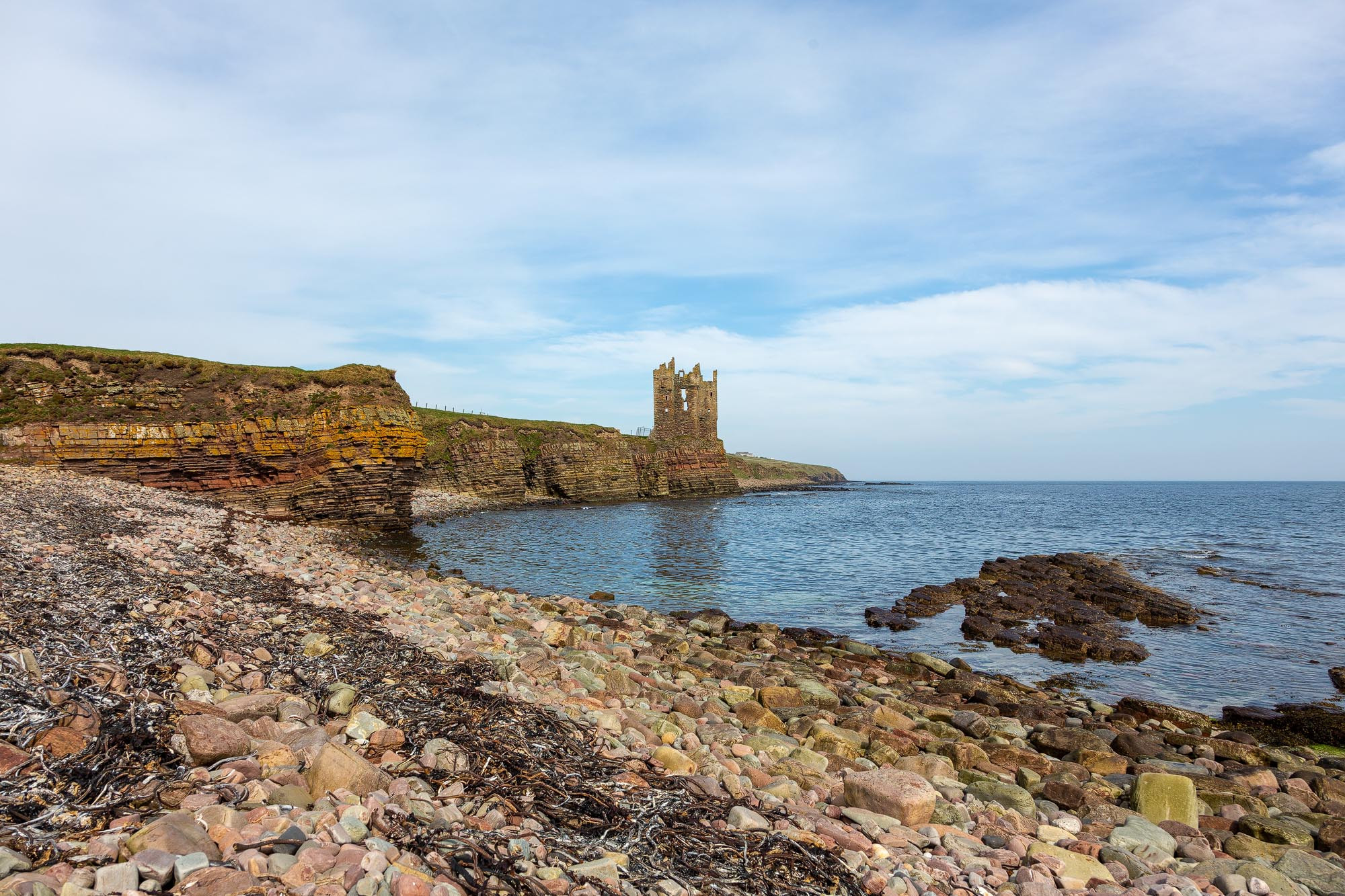
Perched on the very edge of a crumbling sandstone cliff, with the North Sea swirling below and nothing but open sky above, Old Keiss Castle is one of the most dramatically positioned ruins in all of Scotland. This late 16th-century tower house clings to its clifftop promontory on the northern shore of Sinclair’s Bay in Caithness, looking as though it could tumble into the waves at any moment – and indeed, parts of it already have. It’s a place that stopped us in our tracks, and one that deserves far more attention than it gets.

The History of Old Keiss Castle
Old Keiss Castle was built in the late 16th or early 17th century by George Sinclair, 5th Earl of Caithness. The site may have been home to an even older fortification known as “Raddar,” though no trace of that earlier structure survives today. The 5th Earl chose this exposed coastal headland for his new residence, constructing a Z-plan tower house that rose four storeys high, plus an attic, with a vaulted basement below.
The design featured a central rectangular block with two round towers at diagonally opposite corners – one containing a spiral staircase, the other crowned by a square caphouse. It was a compact but elegant building, though the walls were surprisingly thin for a fortified residence at just over three feet wide. Interestingly, there appears to have been little in the way of landward defences, suggesting the castle was designed primarily to guard against seaborne attack.
The castle was certainly standing by 1623, when King James VI commissioned Sir Robert Gordon to march into Caithness with an armed force. The Sinclairs were a powerful but often troublesome clan in the far north, and the castle played its part in the family’s turbulent history. George Sinclair of Keiss later recovered the Earldom of Caithness from the Campbells in 1681, becoming the 7th Earl. He died at Keiss Castle in 1698, but by 1700 the building was already described as ruinous.
By 1726, records mention the castle as being partially repaired with “a convenient house lately built” beside it. However, the writing was on the wall. In the early 18th century, the estate passed to the Sinclairs of Dunbeath, who made Keiss their principal residence in 1752. Around 1755, they built a new mansion house – Keiss House – further inland, and the old castle was finally abandoned.

That new house was itself extensively remodelled in 1860 by the renowned architect David Bryce, who gave it the Scottish Baronial appearance it has today – complete with harled walls, bartizans, corbiestepped gables, and a battlemented tower. It remains a private residence and is still occupied. Meanwhile, the old castle continued its slow collapse. The northeast angle, which contained the original entrance, was lost when the cliff face beneath it fell away, leaving the remaining structure in its current precarious state. Old Keiss Castle is now a scheduled monument, fenced off for safety, and visitors are rightly warned not to attempt to enter.
Our Visit to Old Keiss Castle
Getting There – Keiss Harbour
Janette and I arrived at Keiss after spending time at Nybster Broch, just a couple of miles further up the coast. We drove into the village and followed the road down to Keiss Harbour, where there’s free parking for several cars. The harbour itself is a lovely spot – it was built in 1831 during the herring boom and is still used by local fishermen setting lobster and crab creels. Eagle-eyed TV fans might also recognise it as a filming location for the Netflix series The Crown, where it doubled as Mullaghmore Harbour in County Sligo.


From the harbour, the route to the castle is well signed. There’s a smart wooden shelter with an information board and a photograph of the castle silhouetted against a dramatic sunset, pointing you in the right direction along the John O’Groats Trail and Keiss North Shore path.

The Coastal Walk – Pillboxes and History
The walk from the harbour to the castle is roughly three-quarters of a mile and takes around 15 minutes at a steady pace. We passed the Sinclair Bay glamping pods – a row of modern holiday cabins with views across the bay – before the path opened out onto grassy clifftops.

What struck us almost immediately were the WW2 defences. Sinclair’s Bay was considered highly vulnerable to invasion from Nazi-occupied Norway during the Second World War, and a string of concrete pillboxes and anti-tank obstacles were hastily erected along this stretch of coast in 1940. Several of these Type 24 machine gun pillboxes survive along the walk to the castle, and they’re fascinating to see up close.


An excellent information board from the “Caithness at War” trail explains the history. These pillboxes were built to a Scottish Command variant design, with larger embrasures than the standard War Office pattern. This particular example was constructed entirely of brick with no concrete reinforcing – possibly due to a national cement shortage at the time – which would have offered very little protection had it ever been needed in anger. They were spaced roughly every 400 yards around Sinclair’s Bay from Keiss Castle to Noss Head.


The Castle Up Close
As we rounded the small bay, the castle came properly into view, and it really is a jaw-dropping sight. The remaining tower rises tall and slender from a stack of beautifully layered red and grey sandstone, with the sea washing around the rocks below. You can see exactly where the northeast corner has sheered away with the cliff, exposing the interior like a dolls’ house. The empty window openings, the remains of the spiral staircase, the ghost of former floor levels – it’s all there, open to the sky and the elements.


The castle is fenced off on the landward side with a metal barrier, and rightly so – the structure is in a genuinely dangerous state. But you can get close enough to really appreciate the scale and the setting. From the clifftop, looking down at the castle with the sea beyond, it’s one of those quintessential Scottish views that makes you reach for the camera again and again.

From the Air – Drone Views
I had the drone with me, and this was exactly the kind of site that benefits from an aerial perspective. From above, you can truly appreciate the Z-plan layout of the castle – the two round towers at opposite corners of the rectangular central block, exactly as the historical descriptions suggest. You can also see just how precarious the position is, with the cliff edge continuing to erode on all sides.


One of the most revealing shots was looking directly down into the roofless interior. You can make out the vaulted basement, the positions of the former floors, and – most remarkably – the spiral staircase still intact within one of the round towers. It’s an incredible survival, and from above you can peer right down the stairwell as if looking through a telescope into the past.


From the drone, I was also able to capture both the old and new castles in a single frame – the ruined 16th-century tower house on the cliff edge, and the white-harled 18th-century mansion sitting comfortably in its green fields behind. The contrast between the two could hardly be more striking.

Videos from Old Keiss Castle
Frequently Asked Questions
Is Old Keiss Castle free to visit?
Yes, Old Keiss Castle is a free, open-access site. There is no admission charge and no opening hours – you can visit at any time during daylight. The castle ruin is fenced off for safety, but you can view it closely from the surrounding clifftop.
Where do I park for Old Keiss Castle?
Park at Keiss Harbour, where there is free parking for several cars. The nearest postcode for sat nav is KW1 4XD. From the harbour, follow the signed coastal footpath north for approximately three-quarters of a mile to reach the castle.
How long does it take to walk to the castle?
The walk from Keiss Harbour to the castle takes around 15 minutes along an easy, mostly flat coastal path. Allow extra time to explore the WW2 pillboxes along the way and to take in the views.
Can I go inside Old Keiss Castle?
No. The castle is in a structurally dangerous condition, with active cliff erosion undermining the foundations. It is fenced off with metal barriers and must not be entered under any circumstances. However, you can get close enough to see it well from the clifftop path.
Is the walk suitable for wheelchairs or pushchairs?
The path is mostly grassy and uneven, with no formal surfacing beyond the first section near the harbour. It would not be suitable for wheelchairs. Pushchairs with sturdy wheels might manage in dry conditions, but it’s not ideal. The clifftop path is also unfenced in places, so care is needed with children and dogs.
Are dogs allowed?
Yes, dogs are welcome on the coastal walk but should be kept on a lead, as the path passes through farmland with livestock and runs close to unfenced cliff edges.
What else is there to see on the walk?
The walk passes several well-preserved WW2 Type 24 machine gun pillboxes with information boards from the “Caithness at War” trail. You’ll also pass the Sinclair Bay glamping pods and can see Keiss Broch and Whitegate Broch near the coast. The views across Sinclair’s Bay to Noss Head Lighthouse are superb throughout.
Key Information
- Location: Old Keiss Castle, Keiss, Wick, Caithness, KW1 4XF
- Grid Reference: ND 3569 6164
- Managed by: Scheduled monument (unmanaged ruin)
- Entry: Free, open access
- Parking: Free parking at Keiss Harbour (KW1 4XD for sat nav)
- Facilities: None at the castle. The Village Inn pub is in Keiss village. Nearest shops and public toilets in Wick (8 miles south).
- Accessibility: Uneven grassy coastal path, not suitable for wheelchairs. Unfenced cliff edges.
- Dogs: Yes, on a lead (livestock and cliff edges)
What Else is Nearby?
Nybster Broch – Just 1.3 miles north along the coast, this is one of the most important and accessible Iron Age broch settlements in Caithness. The site includes the broch itself plus the curious Mervyn’s Tower, built in the 19th century from excavated stones.
Caithness Broch Centre – Located in the old schoolhouse at Auckengill, about 2 miles north. This small but excellent museum tells the story of Caithness’s remarkable concentration of Iron Age brochs – more than any other area of Scotland.
Castle Sinclair Girnigoe – A spectacular clifftop castle ruin about 4 miles south near Wick. Once the seat of the Earls of Caithness and one of the most dramatic castle sites in Scotland, it’s well worth the detour.
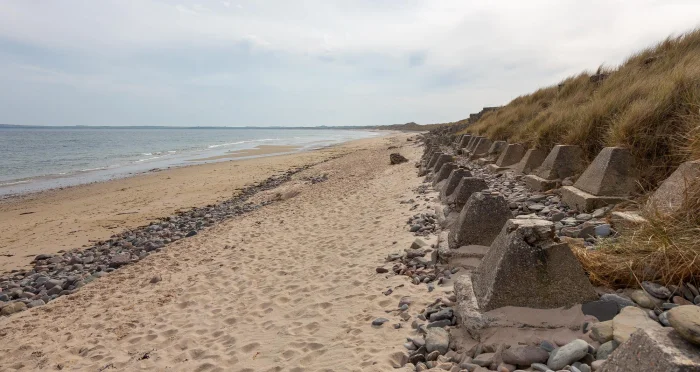
Keiss Beach – A beautiful stretch of sandy beach south of the harbour, with views across Sinclair’s Bay. Look out for the WW2 anti-tank cubes and “dragon’s teeth” near the car park, and keep an eye open for seals and even orcas – Sinclair’s Bay is a known hotspot for the 27s pod.
Castle of Mey – The late Queen Mother’s beloved Highland retreat, around 8 miles northwest. The castle and its beautiful walled gardens are open to visitors during the summer months.
Final Thoughts
Old Keiss Castle is one of those places that stays with you. The combination of the dramatic clifftop setting, the layered sandstone geology, the WW2 history along the walk, and the sheer romance of the ruin itself makes it a genuinely memorable visit. It’s not a big, restored heritage attraction with a café and gift shop – it’s a windswept, crumbling tower on the edge of a cliff in the far north of Scotland, and that’s exactly what makes it so special.
If you’re driving the North Coast 500 or exploring Caithness, make time to park at Keiss Harbour and walk along the coast. The castle won’t be there forever – the sea is slowly claiming it, just as it claimed the original entrance centuries ago. See it while you still can.


Leave a comment below