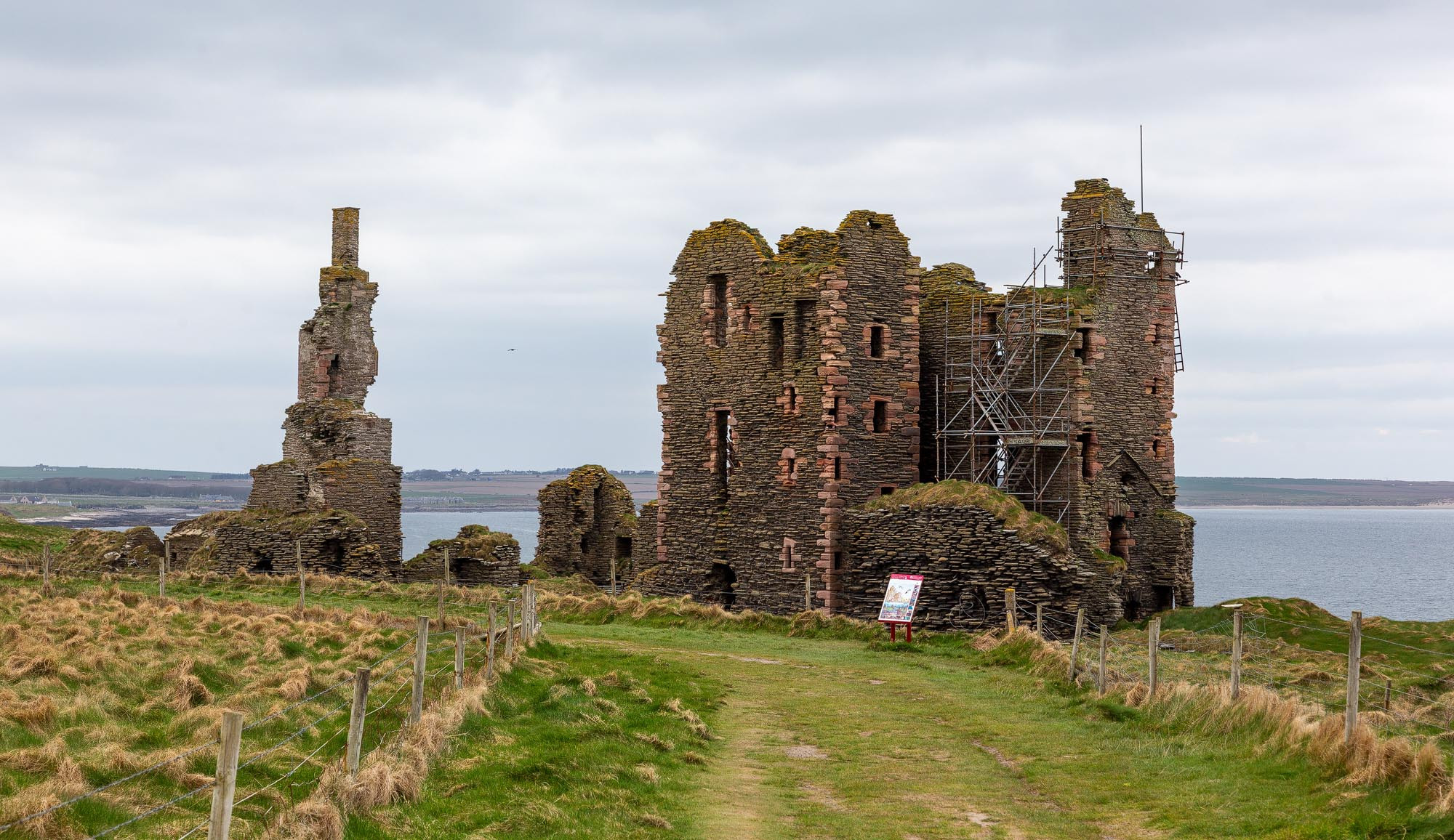
Perched on the edge of a dramatic rocky promontory on the Caithness coastline, Castle Sinclair Girnigoe is one of the most spectacularly situated ruins in all of Scotland. Once the mighty stronghold of the Sinclair Earls of Caithness, this 15th-century fortress clings to layered Old Red Sandstone cliffs that plunge into the waters of Sinclair’s Bay. It’s a place where history, treachery, and wild natural beauty collide – and it’s the only Scottish castle to have been listed by the World Monuments Fund as one of the 100 most endangered sites in the world. My wife Janette and I visited on a grey but dry afternoon, and it was one of the most memorable castle visits we’ve had in Scotland.
The History of Castle Sinclair Girnigoe
The story of Castle Sinclair Girnigoe is inseparable from the story of Clan Sinclair, one of the most powerful families in medieval Scotland. The Sinclairs were Earls of both Orkney and Caithness, with castles stretching from Kirkwall to Rosslyn Chapel near Edinburgh. It was likely Henry Sinclair who first built a fortification on this dramatic coastal promontory after acquiring the Earldom of Orkney by marriage in 1379.

The castle as we understand it today was substantially built by William Sinclair, 2nd Earl of Caithness, between around 1476 and 1496. William constructed curtain walls with ranges of domestic buildings, transforming the site into a formidable residence fit for one of the most powerful families in the north of Scotland. Tragically, William never saw his castle completed – he was killed at the Battle of Flodden in 1513.
His son John, the 3rd Earl, continued the work, adding more domestic buildings in the outer ward. The 4th Earl made Girnigoe his chief residence and rebuilt the tower house at the centre of the fortress. But it was the 5th Earl – George Sinclair, known to history as the “Wicked Earl” – who left the deepest mark on the castle’s story.
The Wicked Earl was a man who seemed perpetually at war with his neighbours, particularly Clan Gunn. In 1588, the Earl of Sutherland retaliated by burning Wick and besieging Castle Girnigoe for twelve days – though without success. The castle’s defences held firm. Such were the improvements made under the Wicked Earl that in 1606 he obtained an Act of Parliament to rename the castle from Girnigoe to Castle Sinclair. The renaming has caused centuries of confusion, as both names remained in common use, and for many years historians believed there had been two separate castles here rather than one that was extended and renamed. The modern compromise – Castle Sinclair Girnigoe – neatly solves the problem, even if it is a bit of a mouthful.

Perhaps the most chilling story from the castle’s history involves the 4th Earl, who in 1577 imprisoned his own son, John, Master of Caithness, in the dungeons on suspicion of rebellion. John was held in the castle for seven years before his father had him fed only salted beef, with nothing to drink. He eventually died insane from thirst. It’s a grim tale that hangs over the ruins to this day.
The castle’s decline began when Cromwell’s troops occupied it in 1651, using it as their major stronghold in the north for several years and causing significant damage. When the 6th Earl died without an heir in 1676, his cousin Sir John Campbell of Glenorchy claimed the Earldom. George Sinclair of Keiss, believing himself the rightful heir, gathered men from Wick and stormed the castle, stripping it of its roofs, floors, doors, and furniture to prevent the Campbells from ever using it.
This dispute culminated in the Battle of Altimarlach in 1680 – often cited as the last clan battle fought on Scottish soil. The Campbells won the battle, but the Sinclairs eventually recovered the Earldom. Castle Sinclair Girnigoe, however, was left a ruined shell. It passed to the Dunbar family around 1700, who never repaired it, and the once-mighty fortress was left to the mercy of the Caithness winds and waves.
Today, the castle is owned by the Clan Sinclair Trust, who have carried out impressive conservation and stabilisation work over the past two decades, including the construction of a modern footbridge to replace the original drawbridge.
Our Visit
Getting There and Parking
Castle Sinclair Girnigoe is located about three miles north of Wick, reached via the minor road that leads to Noss Head Lighthouse. The road is single-track in places, but perfectly manageable. You’ll find the car park just before the lighthouse itself – it’s a gravelled area managed by Highland Council with room for a good number of cars, campervans, and motorhomes.

Parking operates on an “invitation to pay” basis. When we visited, the rates were £1 for up to two hours, £2 for up to four hours, £3 for up to twelve hours, and £5 for up to 24 hours. Motorhomes have a maximum stay of 24 hours at £10. Blue badge holders park free of charge. The ticket machine accepts both coins and card payment, which is handy this far north where you might not have cash to hand.

The Walk to the Castle
From the car park, you cross the road and go through a wooden gate to join a well-maintained path that leads towards the coast. The walk is about ten minutes and is mostly flat, crossing open moorland with views out across Sinclair’s Bay. Even on a grey day, the sense of space and remoteness here is wonderful – you can see the sweep of Reiss Beach and the farmland beyond the bay.

There are excellent information boards along the path, set on distinctive red frames, covering both the castle’s history and the natural history of the Noss Head area. These are well worth stopping to read – they include illustrated reconstruction drawings that help you imagine the castle in its heyday, along with geological and wildlife information.

If you glance behind you as you walk, you’ll get a fine view of Noss Head Lighthouse, a handsome white tower built in the 19th century. Then, as you continue towards the coast, the castle gradually reveals itself – and the first sighting is genuinely thrilling.

Exploring the Castle
Nothing quite prepares you for the setting of Castle Sinclair Girnigoe. As the path descends slightly towards the coast, the ruins emerge ahead – dark, jagged stonework clinging to a narrow fin of rock that juts out into the sea. The tower house, still standing to several storeys in places, dominates the scene, while lower walls and foundation remains stretch along the promontory. With Sinclair’s Bay behind and sheer cliffs dropping to the water below, it’s a breathtaking sight.

Access to the castle itself is across the Andrew J. Sinclair Bridge, a modern wooden footbridge that spans the deep rock-cut ditch where the medieval drawbridge once stood. It was donated and opened in May 2008, and it makes for a wonderfully atmospheric entrance – walking across the bridge towards the arched gateway, with the towering chimney stack looming above you and the sea crashing below, is one of those pinch-yourself moments.


Once through the archway, you find yourself within the castle complex. To your left, the impressive tower house rises several storeys high, built from Caithness flagstone and red sandstone that gives the ruins a distinctive, layered appearance. Conservation scaffolding was visible on parts of the tower when we visited – a reminder that the Clan Sinclair Trust’s restoration work is ongoing. A “Danger – Keep Out” sign warns visitors away from the most fragile areas, and safety fencing has been sensibly placed around the base of the tower.


You can explore the inner courtyard area between the older castle remains and the tower. Grass-topped walls define the outlines of rooms and corridors, and with a little imagination you can picture the layout of what was once a grand residence – complete with great hall, chapel, bakehouse, and workers’ lodgings.


The Cliffs and Coastline
What truly elevates Castle Sinclair Girnigoe above many other castle ruins is its extraordinary natural setting. The layered Old Red Sandstone cliffs are works of art in their own right – millions of years of geological history stacked in neat horizontal lines. Narrow geos (coastal inlets) cut between the castle and the surrounding headland, and a dramatic sea stack stands guard just below the promontory.

Janette headed down the narrow path that winds below the bridge and around the base of the castle towards the sea stack and the tiny inlet. It’s a path that demands sure footing and isn’t for the nervous – the drops are genuine – but the views are absolutely spectacular. Looking up at the castle walls from below, with the sea stack framing the scene, is probably the most dramatic vantage point on the whole site.


The coastline here is also wonderful for wildlife. Gulls and terns wheel overhead, seals can often be spotted basking on the rocks below, and the clear waters of the bay can occasionally reveal dolphins and even orcas if you’re lucky. We didn’t spot any marine mammals on our visit, but the birdlife was plentiful.
Frequently Asked Questions
How much does it cost to visit Castle Sinclair Girnigoe?
Entry to the castle itself is free. There is an “invitation to pay” car park at Noss Head, managed by Highland Council, with charges starting from £1 for up to two hours. Blue badge holders can park free of charge.
Is Castle Sinclair Girnigoe accessible for wheelchair users?
Unfortunately, the site is not wheelchair accessible. The path from the car park is a rough farm track that can be boggy in wet weather, and the castle itself involves uneven terrain, steep drops, and narrow paths. Good walking boots are strongly recommended.
Can I take my dog to Castle Sinclair Girnigoe?
Yes, dogs are welcome but must be kept on a lead at all times. The path crosses farmland with sheep grazing nearby, and the cliff edges and steep drops around the castle also make a lead essential for your dog’s safety.
When is Castle Sinclair Girnigoe open?
The castle exterior and grounds are accessible year-round, 365 days a year. Internal access across the bridge is generally available from May to September, though the main entrance gate may sometimes be locked outside of these months as the site is unmanned.
How long does it take to walk to the castle from the car park?
The walk takes approximately 10 minutes each way. The path is mostly flat across open moorland, covering about half a mile. Allow at least an hour for the full visit including exploring the castle and coastline.
Are there toilets or a café at Castle Sinclair Girnigoe?
No, there are no toilet or catering facilities at the site. The nearest facilities are in Wick, approximately three miles to the south. It’s a good idea to bring a flask and snacks, as the grassy areas near the castle make a lovely spot for a picnic.
Is Castle Sinclair Girnigoe safe for children?
Older children will enjoy the castle, but close supervision is essential. While the most dangerous areas are fenced off, there are still steep cliff edges and drops around the promontory. Young children should be kept very close at hand throughout the visit.
Key Information
- Location: Noss Head, Wick, Caithness, KW1 4QT
- Grid Reference: ND 3781 5491
- Managed by: The Clan Sinclair Trust
- Entry: Free (donations welcomed)
- Parking: Highland Council pay car park at Noss Head – from £1 for 2 hours; coins and card accepted; blue badge holders free
- Facilities: Information boards along path; no toilets, café, or shop on site
- Accessibility: Not wheelchair accessible; rough path and uneven terrain; sturdy footwear recommended
- Dogs: Welcome, must be kept on a lead (livestock and cliff edges)
- Website: www.castlesinclairgirnigoe.org
What Else is Nearby?
Noss Head Lighthouse – Just a few hundred metres from the car park, this handsome 19th-century lighthouse overlooks Sinclair’s Bay. It’s not open to the public, but makes for a pleasant short walk and good photographs.
Old Wick Castle (Castle Oliphant) – Another dramatic clifftop ruin, this 12th-century Norse tower is one of the oldest castles in Scotland. It’s located south of Wick and makes a fine companion visit to Sinclair Girnigoe.
Wick Heritage Museum – An award-winning museum in the town centre that tells the story of Wick’s herring fishing industry. Absolutely packed with fascinating artefacts and well worth an hour or two.
Whaligoe Steps – About seven miles south of Wick, these 330 hand-cut steps descend a dramatic cliff to a tiny harbour once used by herring fisherwomen. One of the most remarkable sights in Caithness.
John o’Groats – Scotland’s famous “end of the road” is just a 30-minute drive north of Wick. Love it or hate it, the signpost is irresistible, and the views across to Orkney are superb.
Final Thoughts
Castle Sinclair Girnigoe is one of those places that stays with you long after you leave. It’s not the biggest ruin in Scotland, nor the best preserved, but the combination of its wild clifftop setting, its layers of dramatic history, and the visible effort being made to preserve it for future generations makes it something truly special. If you’re driving the NC500 or exploring Caithness, this should be very near the top of your list. Janette and I came away buzzing, and we’d happily return in a heartbeat.


Leave a comment below