Ardvreck Castle, Sutherland – A Haunting Highland Ruin on Loch Assynt
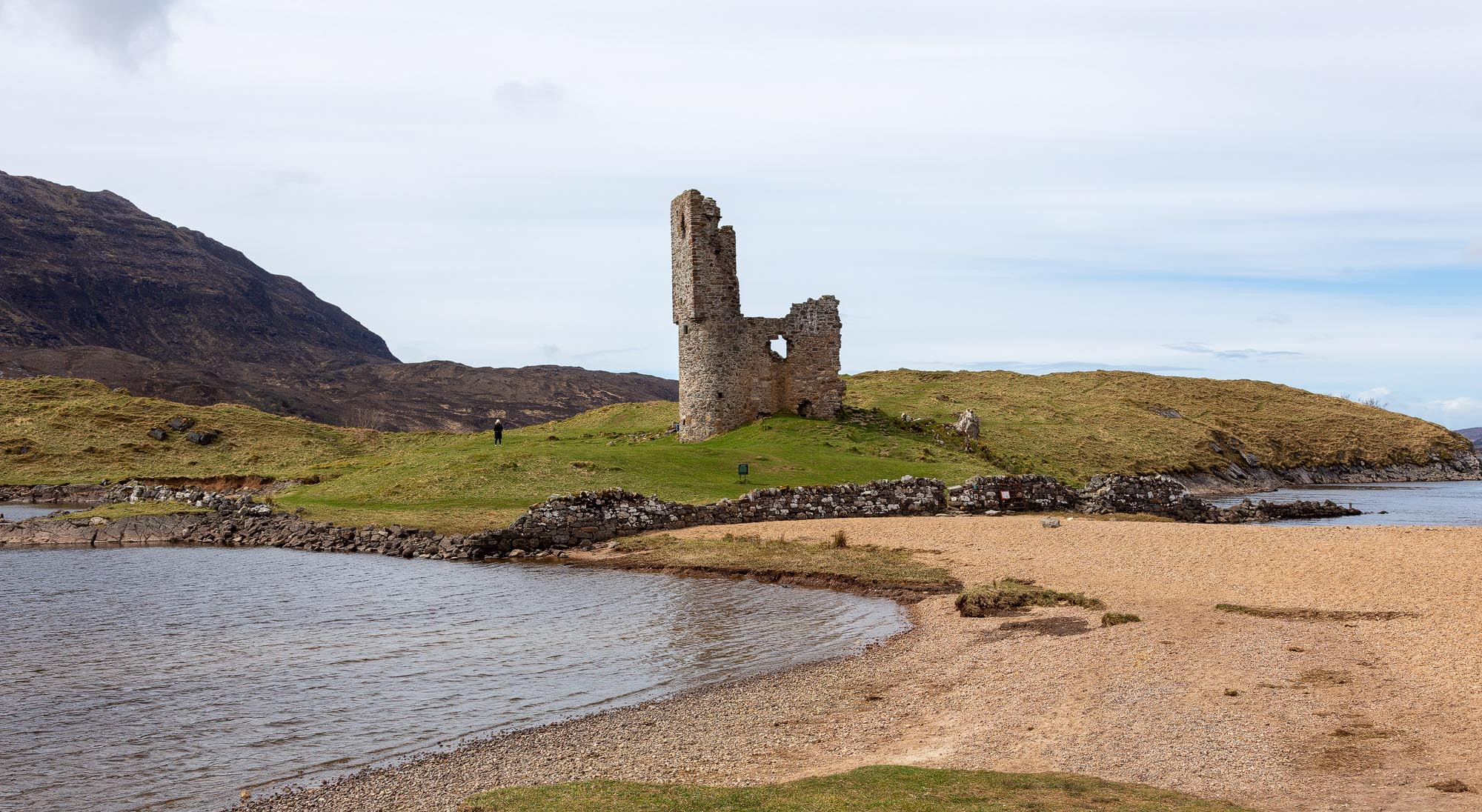
Standing on a rocky promontory that juts defiantly into Loch Assynt, the ruins of Ardvreck Castle are one of the most hauntingly beautiful sights in the Scottish Highlands. This 15th-century tower house, once the seat of the MacLeods of Assynt, has witnessed clan warfare, one of Scotland’s most infamous betrayals, and centuries of slow decay at the hands of the Highland elements. Today, Ardvreck is a scheduled monument and a firm favourite on the North Coast 500 route – and having visited with my wife Janette, I can honestly say the setting alone makes it one of the most memorable castle ruins we’ve explored anywhere in Scotland.

The History of Ardvreck Castle
The name Ardvreck – or Ard Bhreac in Scottish Gaelic – translates roughly as “speckled point”, a fitting description for the mottled rocky headland on which the castle was built. The MacLeods of Assynt had held these lands since around the 13th century, and it was Angus Mor III who constructed the castle around 1490, replacing an earlier stronghold at Assynt Castle near Inchnadamph.
The original castle was a relatively simple three-storey rectangular tower house, built in the typical Scottish style of the period. Its position on the promontory made it naturally defensible – when the waters of Loch Assynt rise, the promontory is sometimes cut off entirely, leaving the castle on its own small island. A curtain wall and defensive ditch guarded the narrow neck of land connecting the promontory to the shore, while the surrounding area housed stables, kitchens, a kiln barn, and a small walled garden.
In the late 16th century, Donald Ban IX extended the castle with the addition of a round stair tower at the south-east corner, corbelled outward on the upper floors to form square rooms. Vaulted cellars with gunloops were also added at this time, giving the castle the L-plan form whose outline is still visible today.

The Betrayal of Montrose
Ardvreck Castle’s most infamous moment came on 30 April 1650, during the Wars of the Three Kingdoms. James Graham, the 1st Marquess of Montrose, had been fighting for the Royalist cause in support of Charles II. After a devastating defeat at the Battle of Carbisdale on 27 April, the exhausted Montrose fled westward and sought sanctuary at Ardvreck Castle.
What happened next remains one of the most debated episodes in Scottish history. One account holds that Neil MacLeod of Assynt was away from the castle, and his wife Christine tricked Montrose into the dungeon before sending for Covenanter troops. Another version suggests that Neil MacLeod was very much present but treacherously handed over his guest in exchange for a reward – said to be £25,000 and 400 bolls of oatmeal, which reportedly turned out to be rancid. Either way, the act was widely condemned as a shocking violation of Highland hospitality.
Montrose was taken to Edinburgh, where he was executed on 21 May 1650 by hanging, drawing, and quartering. His body was dismembered and displayed publicly as a warning to other Royalists. The betrayal at Ardvreck would haunt the MacLeods for generations, leaving them politically isolated after the Restoration of the monarchy.

The Mackenzie Takeover and Calda House
The MacLeods’ enemies, the Mackenzies of Wester Ross, exploited the family’s weakened position. By purchasing various MacLeod debts, they claimed ownership of Ardvreck Castle and in June 1672 besieged the property. John MacLeod held the castle for 14 days but was ultimately forced to surrender when siege equipment was brought forward. The fall of Ardvreck effectively ended MacLeod rule over Assynt.
The Mackenzies found the austere tower house unsuitable for their tastes. When Kenneth MacKenzie II brought his new wife Frances to Ardvreck, she was apparently unimpressed by its cheerless, uncomfortable living conditions. In 1726, MacKenzie began building a far grander residence – Calda House – within sight of the old castle. Named after the nearby Calda Burn, it was a substantial three-storey mansion with 14 bedrooms and was considered the first symmetrical house in the north-west Highlands.
However, the extravagance of the build and Frances’s lavish lifestyle plunged the family deep into debt. The house’s story came to a dramatic end in 1737 when it was destroyed by fire. Some accounts blame a lightning strike during a raucous Saturday evening party that continued past midnight into the Sabbath – divine retribution, said the locals. Others suggest local MacKenzie supporters deliberately torched it rather than see a rival clan occupy the house. Whatever the truth, both Calda House and Ardvreck Castle have stood as ruins ever since.
Ghosts and Legends
As you might expect from a castle with such a turbulent past, Ardvreck has its share of ghostly tales. The most famous legend tells of a MacLeod chief’s daughter, Eimhir, who was promised to the Devil in exchange for help building the castle. Rather than honour the bargain, Eimhir threw herself from the tower into Loch Assynt. Her body was never found, but locals say her weeping can still be heard around the loch. Some believe she became the “Mermaid of Assynt”, and that when the loch’s waters rise, it is Eimhir’s tears mourning the life she never lived.
A second ghost – a tall, mysterious figure dressed in grey – is said to haunt the tower itself. Many believe this to be the restless spirit of the Marquess of Montrose, forever condemned to pace the very place where he was betrayed.

Our Visit to Ardvreck Castle
Getting There and Parking
Janette and I arrived at Ardvreck Castle by car, having just come from visiting Wailing Widow Falls a short distance along the A837. The castle is impossible to miss as you drive along the north shore of Loch Assynt – you catch glimpses of the ruins from the road well before you reach the car park.
There’s a dedicated free car park signposted from the A837, with space for several cars and a motorhome or two. When we visited, the car park was reasonably busy but we found a space without any trouble. It’s worth noting that Highland Council has been carrying out improvement works to expand and formalise the parking area, so facilities should be even better by the time you read this.

Information Boards and the Walk to the Castle
Before heading to the castle itself, it’s well worth spending a few minutes reading the excellent information boards near the car park. Set into a low curved stone wall, these panels cover the castle’s history, the story of Calda House, the local wildlife, and the archaeology of the area. They’re well-written and give you a great grounding in what you’re about to see.

The walk from the car park to the castle takes around five to ten minutes along a well-maintained gravel and grass path. There are further information boards along the route, and as you approach the promontory, the castle ruins gradually reveal themselves ahead of you. It’s a lovely walk with the loch on your left and the sweeping Sutherland hills all around.


Exploring the Ruins
Reaching the castle itself is a real treat. The remaining walls stand to an impressive height, with the tower and stair turret still rising several storeys above the grassy promontory. You can walk right up to the ruins and around them, though you should exercise care as the ground is uneven and there’s always the risk of falling masonry from a structure this old.
One of the most fascinating features is the vaulted basement, which is secured behind an iron grille but still clearly visible. Peering through the bars, it’s hard not to think of the Marquess of Montrose and the dark days he may have spent imprisoned here before his final journey to Edinburgh. The stonework around the vaulted arches is remarkably well-preserved given the castle’s age.

Walking around to the north side of the ruins offers a completely different perspective, with the crumbling walls framed against the mountains beyond. From here you can also look across the loch to spot the roofless shell of Calda House on the opposite shore – it’s a poignant sight, two buildings linked by history, both brought to ruin by the passage of time and the turbulence of Highland clan politics.


The Views and the Setting
If I’m being completely honest, the setting at Ardvreck is just as memorable as the castle itself – perhaps even more so. Standing on the promontory, the views across Loch Assynt to the imposing bulk of Quinag are absolutely breathtaking. The mountain dominates the skyline to the south-west, its distinctive profile reflected in the dark waters of the loch on calmer days.

We also flew the drone to capture some aerial footage, and from above you really appreciate the castle’s strategic position. The promontory is even more dramatic from the air – you can clearly see why the MacLeods chose this naturally defensible spot, with water on three sides and the narrow neck of land easily guarded. The L-shaped footprint of the original tower house and the round stair turret are perfectly visible from directly overhead.


Videos from Ardvreck Castle
Frequently Asked Questions
Is Ardvreck Castle free to visit?
Yes, Ardvreck Castle is a free, open-access site. There are no entry fees and no opening hours – you can visit at any reasonable time during daylight hours. The castle is an unstaffed ruin, so there are no tickets or guided tours available.
Is there parking at Ardvreck Castle?
Yes, there is a free dedicated car park just off the A837, signposted as “Ardvreck Car Park”. The car park has space for several vehicles including motorhomes. Highland Council has recently carried out improvement works to expand and upgrade the parking facilities. During peak summer months (June–August), the car park can fill up, particularly between noon and 3pm.
How long does it take to visit Ardvreck Castle?
Most visitors spend between 30 minutes and an hour at the site. The walk from the car park to the castle takes around 5–10 minutes each way. If you want to explore the ruins thoroughly, take in the views, read the information boards, and also walk to see Calda House, allow at least an hour to an hour and a half.
Is Ardvreck Castle wheelchair accessible?
The path from the car park is reasonably well-maintained gravel and grass, but it is not a fully surfaced accessible path. The terrain around the castle itself is uneven, grassy, and can be muddy in wet weather. Wheelchair users and those with limited mobility may find the path to the castle challenging, though the information boards near the car park are accessible and the castle can be viewed from a distance.
Can I take my dog to Ardvreck Castle?
Yes, dogs are welcome at Ardvreck Castle. As it’s an open, outdoor site, there are no restrictions on dogs. Please keep your dog under control and be mindful of livestock in the surrounding fields, particularly during lambing season.
Are there toilets or facilities at Ardvreck Castle?
There are no toilet facilities, cafés, or shops at the Ardvreck Castle car park. The nearest services can be found at Lochinver (approximately 10 miles west) or Inchnadamph (about 2 miles east). Come prepared with your own refreshments and make sure you have what you need before you arrive.
Is Ardvreck Castle on the North Coast 500?
Yes, Ardvreck Castle sits right on the A837, which forms part of the North Coast 500 route. It makes an excellent stop if you’re driving the NC500, particularly if you’re travelling between Durness/Kylesku and Ullapool. After crossing the iconic Kylesku Bridge, you’re only about 15 minutes’ drive from Loch Assynt.
Key Information
- Location: A837, Loch Assynt, near Inchnadamph, Sutherland, IV27 4HL
- Grid Reference: NC 240 236
- GPS Coordinates: 58.1658, -4.9887
- Managed by: Unstaffed open site (Scheduled Monument)
- Entry: Free, open access at all reasonable times
- Parking: Free dedicated car park off the A837
- Facilities: Information boards only – no toilets, café, or shop
- Accessibility: Gravel and grass path to castle; uneven terrain around the ruins
- Dogs: Welcome (please keep under control near livestock)
What Else is Nearby?
Calda House – Just a short walk along the road from Ardvreck Castle, the impressive roofless shell of Calda House stands on the south side of the A837. Built by the Mackenzies in 1726 and burned down in 1737, it’s well worth a look, though be aware it’s a dangerous structure and should only be viewed from a safe distance.
Wailing Widow Falls – Located just a few minutes’ drive along the A894 towards Kylesku, this spectacular waterfall plunges from Loch na Gainmhich surrounded by towering mountain peaks. It’s one of the most scenic waterfalls in the Highlands and pairs perfectly with a visit to Ardvreck Castle – we visited it just before the castle.
Knockan Crag National Nature Reserve – About 15 minutes south on the A835, Knockan Crag is famous for the “Moine Thrust”, a geological fault line that helped reshape our understanding of how mountains are formed. There are excellent walking trails and interpretive panels explaining the geology.
Kylesku Bridge – Approximately 15 minutes north on the A894, this elegant curved concrete bridge spanning Loch a’ Chàirn Bhàin is an iconic sight on the NC500. There’s a viewpoint and a memorial to the XIIth Submarine Flotilla who trained in these waters during World War II.
Bone Caves of Inchnadamph – A couple of miles east of Ardvreck, these limestone caves are one of Scotland’s most important archaeological sites. Bones of lynx, bears, reindeer, and even Arctic fox have been found here, along with evidence of human habitation dating back thousands of years. The caves require a moderate uphill walk to reach.
Final Thoughts
Ardvreck Castle won’t take long to explore in terms of the physical remains – it’s a relatively small ruin compared to some of Scotland’s grander castles. But the combination of its dramatic lochside setting, its rich and sometimes dark history, and the sheer wild beauty of the Sutherland landscape makes it one of the most atmospheric castle ruins Janette and I have visited anywhere in Scotland.
If you’re driving the North Coast 500 or exploring the north-west Highlands, Ardvreck Castle is an essential stop. Pack a warm jacket, allow an hour or so, and take the time to soak in a place where five centuries of Highland history are written in crumbling stone against one of the most magnificent backdrops Scotland has to offer.


Leave a comment below