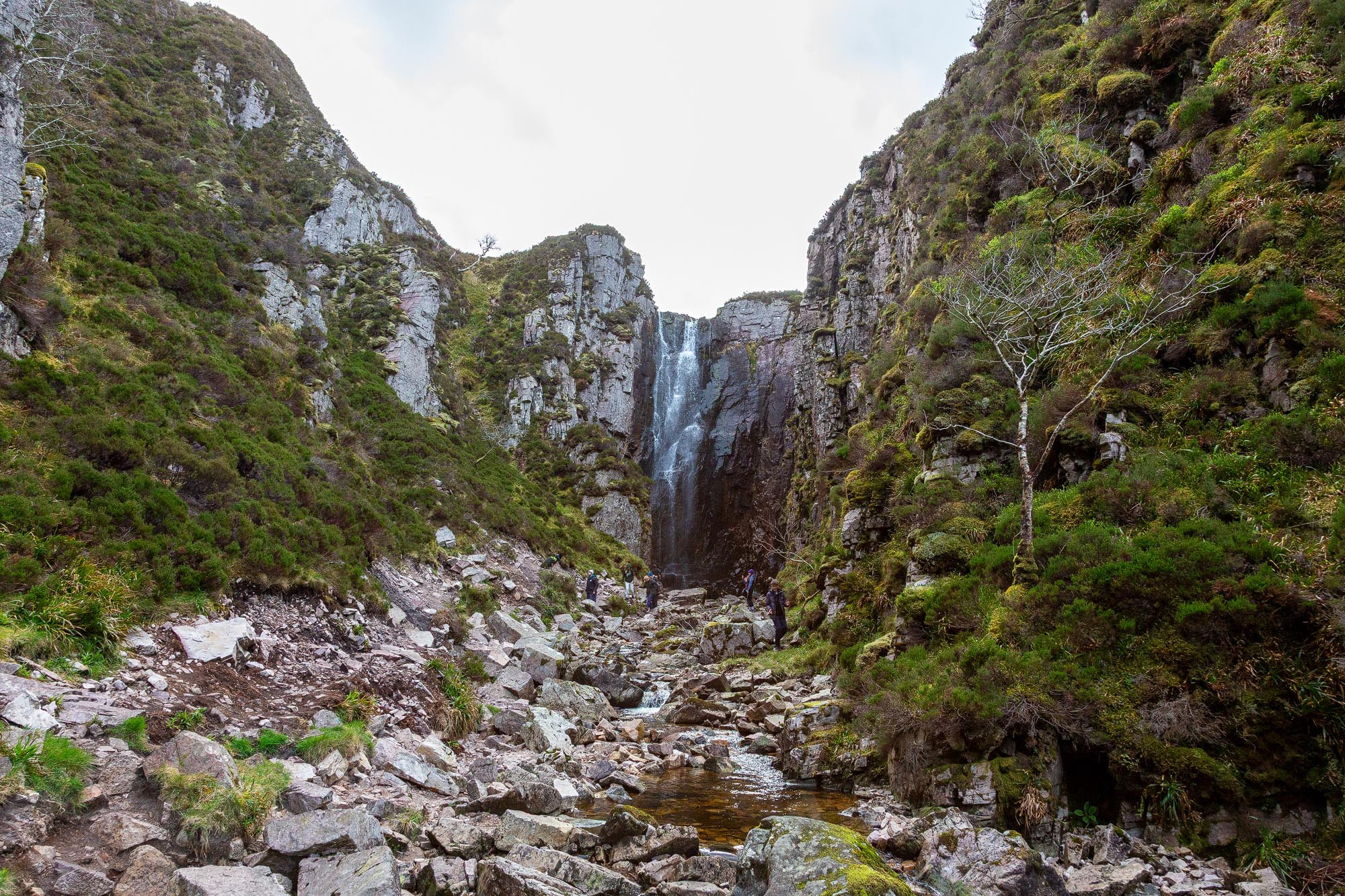
Wailing Widow Falls, Assynt – One of Scotland’s Most Dramatic Waterfalls
Hidden away in the wild heart of Assynt, just a short walk from the A894, Wailing Widow Falls is one of the most spectacular waterfalls in Scotland. Also known as Loch na Gainmhich Waterfall or Allt Chranaidh Waterfall, this 30-metre cascade plunges from the outflow of Loch na Gainmhich into a steep-sided gorge that feels like something from another world entirely. Despite sitting right beside one of Scotland’s most scenic driving routes – and forming part of the wider North Coast 500 experience – the falls remain something of a hidden gem, easily missed by those who don’t know what to look for.
My wife Janette and I visited Wailing Widow Falls during a trip through the northwest Highlands, and it quickly became one of the highlights of our journey. The combination of the dramatic gorge, the thundering waterfall, and the sheer remoteness of the setting made this a genuinely unforgettable experience.

The History and Legends of Wailing Widow Falls
Wailing Widow Falls goes by many names. You’ll see it referred to as Loch na Gainmhich Waterfall, Allt Chranaidh Waterfall, and even Hanged Man Falls, depending on which story you happen to encounter. The Gaelic name “Loch na Gainmhich” translates roughly as “Sandy Loch,” derived from the Gaelic word gainmheach meaning sandy or gravel – a reference to the character of the loch from which the waterfall flows.
The name “Wailing Widow” comes from a haunting local legend. The most commonly told version describes a young deer hunter who, on a rainy day with poor visibility, failed to see the edge of the gorge and fell to his death from the top of the falls. When his mother – a widow – came to the place of his death the following morning, she was so consumed by grief that she threw herself from the same spot.
There is another darker tale attached to the glen – the story of the Hanged Man. According to local tradition, a cattle rustler from the Isle of Lewis known as Donald of the Moss fled to Assynt, where he was granted sanctuary on the condition that he kept the peace. He didn’t. After murdering a young man for his plaid, Donald was hunted down, caught, forced to dig his own grave and plait his own noose, and was hanged from a rock spire in the glen leading to the falls.
There is also a more recent and deeply unsettling story associated with the falls. According to local tradition recorded by the Assynt Place Names project, a couple of newlyweds were camping beside Loch na Gainmhich in the 1990s when the wife woke on a foggy morning, became disoriented, and walked over the cliff edge to her death. Whether true or embellished over time, the story is a sobering reminder of just how dangerous the unfenced cliff top can be in poor visibility.
A separate and equally chilling account is told in Cameron McNeish and Richard Else's book The Sutherland Trail. They describe a woman who fell to her death at the falls, after which her husband – an insurance broker who had recently doubled the value of her life insurance policy – was tried for her murder. The case returned a verdict of "not proven," that uniquely Scottish third verdict that sits somewhere between guilty and not guilty. It's a detail that adds yet another layer of dark history to an already atmospheric place.
It’s worth noting that there is some debate about the authenticity of these tales. Some have suggested that the names “Wailing Widow Falls” and “Hanged Man Falls” may have been coined relatively recently, possibly by tour guides, with the earliest online references to the name appearing around 2007. Whether rooted in genuine folklore or more modern storytelling, the names certainly add an atmospheric quality to an already dramatic place.
The valley leading to the falls is also sometimes known locally as the Fairy Glen, which gives you a sense of just how many layers of story and legend are woven into this one small corner of Assynt.
The Waterfall and Its Setting
Wailing Widow Falls stands at approximately 30 metres in height, though you’ll find varying figures online. The water flows from Loch na Gainmhich – a small, sandy-bottomed loch surrounded by the peaks of Assynt – and pours over a cliff edge into a narrow, steep-sided gorge. The burn then flows through the gorge to join Unapool Burn before eventually emptying into Loch Glencoul to the north.
The gorge itself is formed from metamorphic rock, with exposed cliff faces rising steeply on both sides. The rock displays beautiful colouring – greys, purples, and rusty reds – and the walls are draped with mosses, ferns, and hardy vegetation that clings to every available ledge. A distinctive rock pinnacle stands like a sentinel near the entrance to the gorge, adding to the otherworldly atmosphere of the place.
The mountain Glas Bheinn provides a dramatic backdrop when viewed from above, and the wider landscape of Assynt – with the mighty Quinag nearby – makes this one of the most scenic corners of the entire Scottish Highlands. It’s also worth knowing that Eas a’ Chual Aluinn, Britain’s highest waterfall at around 200 metres, lies just a few kilometres to the southeast and can be reached from the same car park area.

Our Visit to Wailing Widow Falls
Getting There and Parking
We arrived at Wailing Widow Falls by car, driving along the A894 – one of the most spectacular roads in Scotland. The falls sit roughly halfway between Loch Assynt and Kylesku Bridge, about 4 kilometres south of the small hamlet of Unapool. If you’re driving the North Coast 500, this stretch of road is one you absolutely don’t want to rush through.
There’s no official car park here and no signage to speak of, so you need to know what you’re looking for. We parked in a roadside layby on the A894, and it was already busy when we arrived. There are essentially two parking areas: a smaller layby near the base of the gorge (which has been partially blocked by boulders to manage the impact of excessive parking), and larger pull-in areas further up the hill near Loch na Gainmhich and the Quinag Viewpoint.


The parking situation is a bit chaotic, to be honest. On the day we visited, cars and campervans were parked on both sides of the road, with a motorhome tucked into one of the laybys. It can feel a bit tight, especially if you’re meeting oncoming traffic on this single-track section. My advice would be to arrive early if you’re visiting in the summer months, and be considerate about how you park – space is limited and the road needs to stay passable.
The Walk to the Falls
From the lower parking area, the walk to the base of Wailing Widow Falls takes around 10 to 15 minutes. I should be upfront: this isn’t a stroll along a paved path. There’s no formal trail – you follow a rough, well-worn track that heads into the gorge alongside the burn. The terrain is rocky, uneven, and involves picking your way over boulders and loose stones. In wet weather, it would be slippery and potentially treacherous.


That said, the walk itself is a wonderful experience. As you head into the gorge, the cliffs rise steeply on either side and the outside world falls away. There’s a striking rock pinnacle that towers above the path like a natural sentinel – according to some versions of the legend, this is where the unfortunate Donald of the Moss was hanged. Whether true or not, it’s an impressive formation that adds real atmosphere to the approach.


The burn flows alongside you as you walk, tumbling over moss-covered boulders and forming dark, peaty pools between the rocks. Bare birch trees cling to the gorge walls, and the moss and ferns that coat every surface give the place an almost primeval feel. Janette and I both commented that it felt like walking into a lost world.
At the Falls
Nothing quite prepares you for the moment when Wailing Widow Falls comes fully into view. The gorge narrows and suddenly there it is – a tremendous curtain of white water plunging down the cliff face between towering rock walls. The sound is immense, echoing off the gorge and filling the entire space with a constant, thundering roar.

You can get remarkably close to the base of the waterfall, where the water cascades over stepped rock platforms before crashing into a dark plunge pool. The spray reaches you well before you get to the pool itself, so be prepared to get a bit damp. The rock formations at the base are fascinating – the water has carved and shaped the stone into natural terraces over thousands of years, and the layered effect is beautiful.


We spent a good while at the base, simply taking it all in. There were several other visitors there too, which is a testament to how popular this spot has become – though it never felt crowded. A family with a young child had made the walk in, as had someone with a dog. It’s the kind of place where everyone stands in quiet awe for a few moments before reaching for their cameras.

The Walk Back
The return walk follows the same route back through the gorge, and honestly, it’s just as enjoyable in the opposite direction. The perspective changes completely – instead of the waterfall drawing you in, you’re now looking outward through the gorge towards the open moorland beyond. The rock pinnacle looks even more dramatic when viewed from this angle, and the interplay of light on the cliff faces was beautiful.

If you have time, I’d also recommend driving a short distance further up the hill to the Quinag Viewpoint car park and walking to the top of the falls and along the shore of Loch na Gainmhich. The view from above offers a completely different perspective – you can see the water spilling over the cliff edge and the loch stretching out behind, with the peak of Glas Bheinn rising in the background. Be extremely careful at the top, though – there are no barriers or railings whatsoever.
Videos from Wailing Widow Falls
Frequently Asked Questions
Is Wailing Widow Falls free to visit?
Yes, Wailing Widow Falls is completely free to visit and open all year round. There are no entry fees, tickets, or barriers – it’s open countryside.
How long is the walk to the waterfall?
From the lower roadside parking, the walk to the base of the falls takes around 10 to 15 minutes each way. The path is rough and involves walking over rocks and uneven ground, so sturdy footwear is essential. From the upper parking area near Loch na Gainmhich, you can reach the top of the falls in about 5 minutes.
Is there parking at Wailing Widow Falls?
There is no official car park, but there are informal roadside laybys on the A894. The lower layby (closest to the base walk) is small with space for just a few cars and has been partially blocked by boulders. Larger pull-in areas are available further up the hill near the Quinag Viewpoint. There is no charge for parking.
Is the walk suitable for children and dogs?
Dogs are welcome as it’s open access land. The walk is manageable for older, sure-footed children, but the terrain is very rough and rocky – it’s not suitable for pushchairs or very young children. There are no safety barriers at the waterfall or the cliff edge at the top.
Is Wailing Widow Falls accessible for wheelchair users?
Unfortunately not. The path is entirely unimproved – rough, rocky, and uneven throughout. There are no accessible facilities at the site. You can get a partial view of the gorge from near the road, but the waterfall itself is not visible without walking in.
Are there any facilities at Wailing Widow Falls?
There are no facilities at all – no toilets, no cafe, no bins, and no visitor information. The nearest facilities are in Kylesku (about a 5-minute drive north), where you’ll find the Kylesku Hotel, or in Lochinver further south. Make sure to take everything you need with you and carry out any rubbish.
When is the best time to visit?
The falls are impressive at any time of year, though they’re at their most dramatic after rainfall when the water flow is high. Summer offers the longest daylight hours and the driest conditions for the walk, but be aware that the path to the base can become dangerous after prolonged heavy rain when water levels rise significantly in the gorge.
Key Information
- Location: A894, Unapool, Assynt, Sutherland, IV27 4HW
- Grid Reference: NC 242 293
- Managed by: Open countryside (no specific management body)
- Entry: Free, open all year
- Parking: Free informal roadside laybys on the A894 (no official car park)
- Facilities: None – nearest in Kylesku or Lochinver
- Accessibility: Not wheelchair accessible; rough, uneven terrain throughout
- Dogs: Welcome (open access land)
- Website: N/A
What Else is Nearby?
Kylesku Bridge – Just a 5-minute drive north, the iconic curved Kylesku Bridge is one of the most photographed structures on the NC500. Stop on the old road for a classic viewpoint.
Eas a’ Chual Aluinn – Britain’s highest waterfall at around 200 metres, accessible via a longer hike (approximately 5 hours return) that starts from the same car park area near Loch na Gainmhich.
Ardvreck Castle – The atmospheric ruins of a 15th-century MacLeod stronghold standing on a promontory on Loch Assynt, about a 15-minute drive south along the A837.
Bone Caves, Inchnadamph – A fascinating series of limestone caves where the bones of bears, lynx, and even Arctic foxes have been found, dating back thousands of years. About a 20-minute drive southeast.
Quinag – One of Assynt’s most dramatic mountains, with multiple peaks offering challenging hillwalking and stunning views. The main car park is just a short drive from the falls along the A894.
Final Thoughts
Wailing Widow Falls is one of those places that Scotland does so well – a breathtaking natural spectacle hidden away in a landscape of extraordinary beauty, accessible to anyone willing to pull on a pair of decent boots and walk for 15 minutes. The gorge itself is worth the visit even without the waterfall, and the legends attached to the place add a layer of atmosphere that makes the whole experience feel deeper somehow.
Janette and I both agreed that this was one of the best waterfalls we’ve visited in Scotland. If you’re driving the NC500 or exploring the Assynt area, do not miss this. Just remember to wear proper footwear, take care on the rocks, and respect this wild and beautiful place.


Leave a comment below