Edinburgh Zoo, Edinburgh – Scotland’s Premier Wildlife Attraction
Edinburgh Zoo is one of Scotland’s most popular visitor attractions, and it’s easy to see why. Spread across 82 acres of wooded hillside on the slopes of Corstorphine Hill, the zoo is home to over 2,500 animals from around the world. From the famous penguin colony to majestic giraffes, sleepy sloths, and critically endangered Sumatran tigers, there’s a huge variety of wildlife to discover – all set against panoramic views across the city of Edinburgh.
My wife Janette and I visited Edinburgh Zoo on a grey September day. Despite the overcast skies, we had an absolutely brilliant time exploring the zoo’s many enclosures, indoor exhibits, and winding hillside paths. We easily spent the best part of a full day here, and even then felt we could have lingered longer.

History of Edinburgh Zoo
Edinburgh Zoo has a rich history stretching back over a century. The Royal Zoological Society of Scotland (RZSS) was founded in 1909 by Thomas Hailing Gillespie, an Edinburgh lawyer with a passion for zoology. Gillespie had a vision for a modern zoological park that would move away from the cramped cages typical of Victorian-era menageries. His inspiration came from Tierpark Hagenbeck in Hamburg, Germany, a pioneering zoo that promoted spacious, open-plan enclosures designed to replicate natural habitats.
With the help of Edinburgh Town Council, who purchased the 82-acre Corstorphine Hill estate for £17,000, the Scottish National Zoological Park opened to the public on 22 July 1913. The park was designed by the renowned town planner Patrick Geddes and his son-in-law Frank Mears, while architect Sir Robert Lorimer contributed to some of the more ornamental elements, including the remodelling of Corstorphine Hill House at the centre of the site.
Edinburgh Zoo was incorporated by Royal Charter in the same year it opened – making it the only zoo in the United Kingdom to hold such a distinction. In 1948, following a visit by King George VI, the society was granted the privilege of adding the “Royal” prefix to its name, becoming the Royal Zoological Society of Scotland.

The zoo’s association with penguins is legendary. The first three king penguins arrived in January 1914 from a Christian Salvesen whaling expedition that docked in Leith. In 1919, a king penguin chick hatched at Edinburgh – the first penguin ever to be bred in captivity anywhere in the world. The famous daily penguin parade began by accident in 1950, when several birds escaped their enclosure and waddled around the park. It proved so popular with visitors that it became a daily tradition for decades, though it has been suspended in recent years due to concerns over avian influenza.
One of the zoo’s most charming historical residents was Wojtek, a Syrian brown bear who had served as a soldier with the Polish 22nd Artillery Supply Company during the Second World War. Adopted as a cub by Polish troops in Iran in 1942, Wojtek famously carried ammunition crates during the Battle of Monte Cassino in Italy in 1944. After the war, Wojtek was demobilised and came to live at Edinburgh Zoo in 1947, where he became a much-loved resident until his death in 1963. Former Polish soldiers would visit him regularly, and he would perk up at the sound of their Polish voices. There is now a bronze statue of Wojtek in Edinburgh’s Princes Street Gardens.
More recently, Edinburgh Zoo made headlines as the only zoo in the UK to house giant pandas. Tian Tian and Yang Guang arrived from China in 2011 and were star attractions for over a decade before returning to China in December 2023. Today, the zoo continues to evolve, with new enclosures including the impressive giraffe house and the Magic Forest building, home to sloths, tamarins, and other tropical creatures.
Our Visit to Edinburgh Zoo
Getting There and First Impressions
Edinburgh Zoo is located on Corstorphine Road, about three miles west of the city centre. We drove and parked on a nearby residential street, as we’d heard that the zoo’s own car park can fill up quickly, particularly during school holidays and weekends. The on-site car park charges £4 per visit (free for RZSS members), but spaces are limited and allocated on a first-come, first-served basis.
The zoo is also well served by public transport – Lothian Buses routes 12, 26, and 31 all stop right outside the entrance on Corstorphine Road, making it very accessible from the city centre without a car.
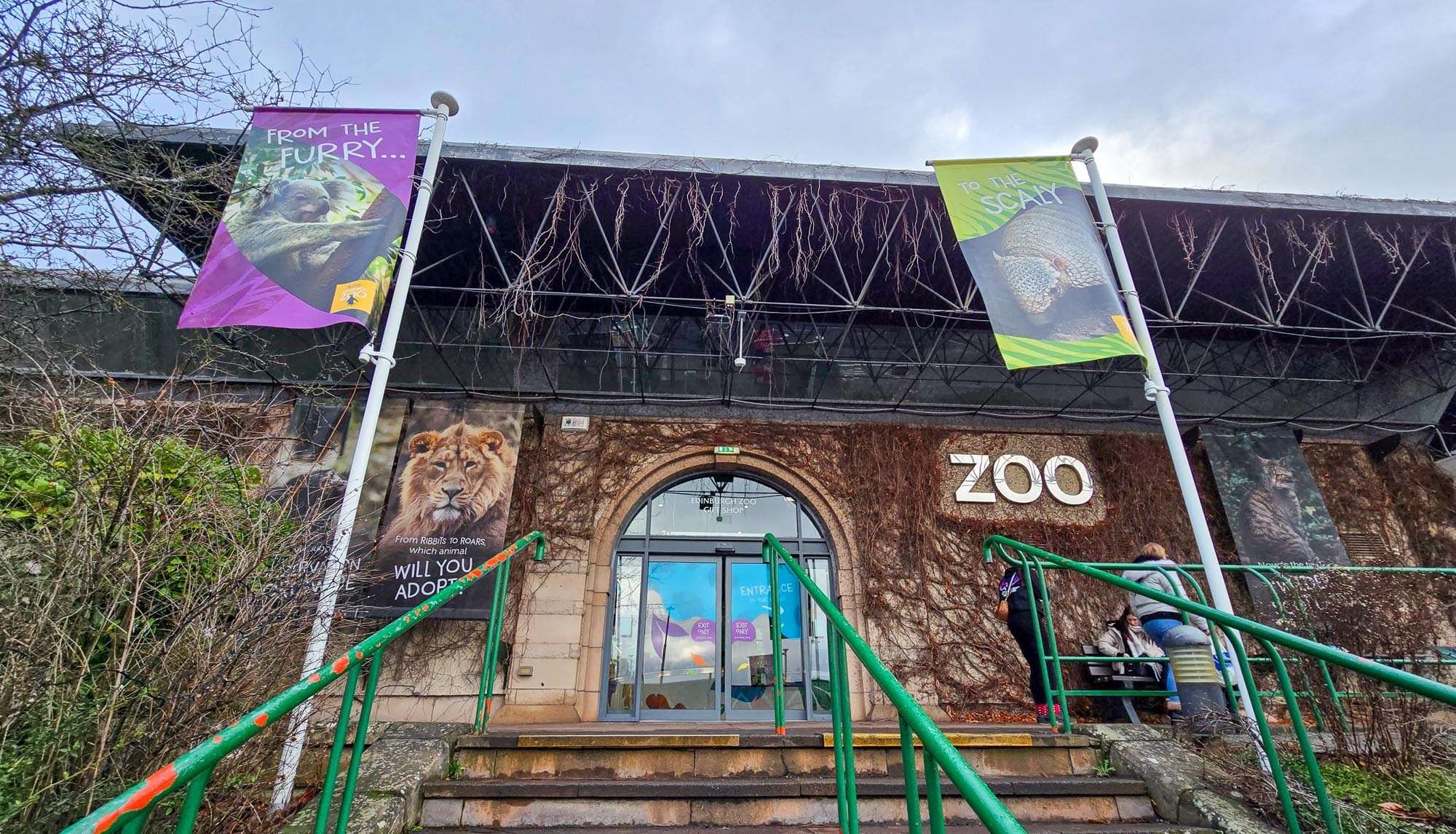
The entrance building sits just back from the main road, up a short flight of stone steps flanked by colourful banners advertising the zoo’s residents. We’d pre-booked our tickets online, which saved a few pounds compared to the walk-up price. After scanning our tickets, we headed through and up the first set of steps into the zoo itself.

The first thing that struck us was the scale of the place. Edinburgh Zoo is built on a hillside, and the paths wind upwards through three distinct zones. You start at the lower park near Corstorphine Road, climb through the middle section (home to the penguins, restaurants, and the Budongo Trail), and eventually reach the upper park where the giraffes, big cats, and African Plains enclosures offer stunning views across the city. Comfortable footwear is definitely recommended – there are some serious inclines to tackle.
The Giant Lanterns
During our visit, the zoo was hosting its spectacular Giant Lanterns event. Although this is primarily an evening illuminated trail, the installations were scattered throughout the park during the day too, and they were genuinely impressive even without the lights switched on. Massive ocean-themed sculptures lined the pathways – a towering wave topped with a shark and sea turtle, a giant octopus archway over the entrance steps, tunnels of colourful shell-shaped arches with translucent jellyfish hanging overhead, and an entire underwater wonderland of coral, seaweed, and tropical fish.


The craftsmanship was superb, and the installations made for great photo opportunities. I can only imagine how stunning they must look illuminated at night. The Giant Lanterns trail runs seasonally, so check the zoo’s website for dates if you’d like to experience it during your visit.
Penguins Rock
No visit to Edinburgh Zoo would be complete without spending time at Penguins Rock, and it was one of the highlights of our day. This is Europe’s largest outdoor penguin pool – 65 metres long, 3.5 metres deep at its deepest point, and holding an incredible 1.2 million litres of water. The enclosure is home to colonies of gentoo, king, and northern rockhopper penguins.


We could have watched them for hours. The gentoos were particularly entertaining – zipping through the water at impressive speeds before launching themselves onto the rocks with a splash, or standing by the waterfall seemingly enjoying the cascade of water over their backs. We also got a wonderful close-up view of the king penguins, easily distinguished by their larger size and striking yellow-orange ear patches. Edinburgh Zoo was the first zoo in the world to breed king penguins, and seeing them up close in person, you really appreciate what magnificent birds they are.


The Giraffe House
The giraffe house is one of the zoo’s newer additions and it’s genuinely impressive. The towering indoor enclosure allows visitors to view the giraffes from an elevated walkway, putting you almost at eye level with these gentle giants as they feed. A height chart on one of the pillars marks measurements up to 5,000mm, giving you a sense of just how tall these animals really are.


We spent a good while watching the giraffes from the viewing gallery, and the elevated perspective made for some fantastic photographs. The decorative green leaf-patterned panels along the viewing barriers are a nice touch, and the whole building feels modern and well-designed.

The Budongo Trail
Named after the Budongo Forest in Uganda, the Budongo Trail is Edinburgh Zoo’s award-winning chimpanzee facility and one of Europe’s finest primate enclosures. It houses a troop of chimpanzees in a series of interconnected indoor and outdoor spaces designed to mimic their natural forest habitat, with multiple levels of climbing structures, ropes, and platforms.

The interior is brilliantly laid out for visitors, with large circular viewing windows that provide intimate views into the chimps’ living spaces. There’s also an excellent educational component – the “98% Human?” display compares human and chimpanzee skeletons side by side, highlighting the remarkable similarities and subtle differences between our species. Interactive games and information boards throughout the building teach visitors about chimpanzee social structure, communication, and the threats they face in the wild.


We were lucky enough to see one of the chimps resting in its nest – a bed of paper bags, cloths, and enrichment materials. Even at rest, these are powerful, expressive animals, and watching them is utterly captivating.

Living Links and the Monkeys
Adjacent to the Budongo Trail is Living Links, Britain’s first primate behaviour research centre. The outdoor enclosure is home to common squirrel monkeys and tufted capuchins, and it’s a delight to watch them swinging on ropes, chasing each other, and generally causing mayhem. We caught the capuchins in full action – one was running along a rope with an orange stuffed in its mouth while another scurried along a wire below.


The Magic Forest and Wee Beasties
One of our favourite indoor exhibits was the Magic Forest, a tropical building that houses several smaller rainforest species. This is where you’ll find Edinburgh Zoo’s sloths – the zoo is currently the only one in Scotland to house these creatures. When we visited, one was curled up in a ball fast asleep, hanging from a branch under a heat lamp. True to their name, they don’t do much, but they’re utterly adorable.

The Magic Forest is also home to cotton-top tamarins – tiny primates with dramatic flowing white crests of hair – and a beautiful Prevost’s squirrel with striking tricoloured fur of black, cream, and russet. The blue poison dart frog exhibit was another standout. These small but dazzlingly coloured frogs clung to the glass of their vivarium, their electric blue skin dotted with black spots making them look almost unreal.


Nearby, the charming Wee Beasties building – a characterful little stone structure with a terracotta tile roof – houses more small creatures, and the building itself is worth a look for its architectural character.

More Animal Highlights
There’s such a variety of animals at Edinburgh Zoo that it’s impossible to cover them all, but here are a few more highlights from our visit.
The red pandas were a real treat. These beautiful rust-coloured creatures were active during our visit, with one climbing nimbly along tree branches amid the bamboo, and another exploring down by the water’s edge. With their bushy ringed tails and distinctive white face markings, they’re a firm favourite with visitors of all ages.

The Sumatran tiger was breathtaking. We found it resting on straw in its indoor enclosure, fixing us with those piercing eyes. Even lying down, you can sense the raw power of these critically endangered big cats. There’s also a covered glass viewing tunnel that lets you get incredibly close to the enclosure.

The meerkats were entertaining as always, with one standing bolt upright on sentry duty atop a rock, scanning the horizon with that wonderfully alert expression. The ring-tailed lemurs had opted for a different strategy for the Scottish weather – huddling together for warmth on their wooden platform in an adorable furry pile.


We also enjoyed seeing the wallabies, who were sitting contentedly among the rocks and fallen leaves; the alpacas in their paddock; and a very handsome Bagot goat with flowing black and white hair and impressive curved horns resting on his wooden platform. Higher up the hill, we passed the deer enclosure and were rewarded with panoramic views across Edinburgh – even on an overcast day, the outlook over the city rooftops was quite something.


Facilities and Food
Edinburgh Zoo has good facilities for visitors. There are several restaurants and cafés to choose from – we had lunch at The Gannet, the fish bar restaurant near the penguin enclosure. It’s a modern, spacious place with a nice atmosphere, a large penguin underwater mural on one wall, and nautical-themed chalk illustrations on the dark green walls. The food was decent – I had a toasted panini with chips, and Janette had the same. Nothing fancy, but filling enough to keep us going for the afternoon’s exploring.


There are also multiple children’s play areas dotted around the zoo, accessible toilets throughout, baby changing facilities, a dedicated quiet space near the flamingos, and a well-stocked gift shop (“Zoovenirs”) at the exit where you can pick up all manner of cuddly animals and souvenirs.


Videos from Edinburgh Zoo
Frequently Asked Questions
How much does it cost to visit Edinburgh Zoo?
Online tickets are £30 for adults, £22.50 for children aged 3–15, and £27 for concessions. Children under 3 go free. Walk-up prices are slightly higher at £32.50, £24.50, and £29 respectively. Booking online in advance is recommended to both save money and guarantee entry, as tickets can sell out during busy periods.
Is Edinburgh Zoo accessible for wheelchair users?
Many paths around the zoo can be accessed by wheelchair, though some routes involve steep slopes and steps. The zoo offers a free mobility vehicle service year-round, as well as wheelchair and mobility scooter hire from the information desk. Sensory bags are also available for neurodiverse visitors. The zoo has partnered with AccessAble to provide detailed accessibility guides for each area of the park.
Are dogs allowed at Edinburgh Zoo?
No. Dogs are not permitted at Edinburgh Zoo as they can cause stress to the animals. Only trained and accredited assistance dogs are allowed, and owners should inform the admissions team on arrival.
What are the opening hours?
Edinburgh Zoo is open seven days a week, closed only on Christmas Day. Opening hours vary by season: typically 10am–6pm from April to September, 10am–5pm in October and March, and 10am–4pm from November to February. Some indoor enclosures may open later than the stated time and close 30 minutes before the zoo’s closing time.
Is there parking at Edinburgh Zoo?
Yes, there is an on-site car park costing £4 per visit, payable by card or contactless. However, spaces are limited and can fill up early, especially during school holidays. RZSS members and Blue Badge holders can park for free. On-street parking is available in the surrounding residential streets as an alternative.
How long does a visit to Edinburgh Zoo take?
Most visitors spend around 4–5 hours at the zoo, though you could easily spend a full day. The zoo covers 82 acres with a significant amount of uphill walking, so allow plenty of time and wear comfortable shoes.
Can I still see the penguin parade?
The famous daily penguin parade is currently suspended due to ongoing concerns about avian influenza. Check the zoo’s website for the latest updates on whether it has resumed.
Key Information
- Location: 134 Corstorphine Road, Edinburgh, EH12 6TS
- Grid Reference: NT 2077 7323
- Managed by: Royal Zoological Society of Scotland (RZSS)
- Entry: Paid – adults from £30 online, children from £22.50
- Parking: On-site car park £4 per visit (limited spaces). Street parking available nearby
- Facilities: Restaurants, cafés, kiosks, gift shop, play areas, picnic areas, baby changing, accessible toilets, quiet space
- Accessibility: Mostly accessible, though steep slopes in places. Free mobility vehicle, wheelchair and scooter hire available
- Dogs: Not permitted (assistance dogs only)
What Else is Nearby?
Corstorphine Hill & Clermiston Tower – Directly behind the zoo, Corstorphine Hill is Edinburgh’s largest public woodland and a wonderful place for a walk. Paths wind through the trees to the summit, where the Scott Tower (built in 1871) offers panoramic views. You can even spot zebras and antelopes through the zoo’s perimeter fence along the way.
Edinburgh Castle – Scotland’s most iconic landmark sits about three miles east in the city centre. Perched atop Castle Rock, this historic fortress houses the Honours of Scotland, the Stone of Destiny, and the National War Museum.
Lauriston Castle – A beautiful Edwardian home set in landscaped grounds overlooking the Firth of Forth, just a short drive north of the zoo. The castle offers guided tours of its remarkably preserved interiors.
Gorgie City Farm – A free, family-friendly farm in the nearby Gorgie area where children can meet and interact with goats, pigs, sheep, and rabbits.
Royal Botanic Garden Edinburgh – One of the world’s leading botanic gardens, located about three miles east of the zoo. Entry to the grounds is free, with a charge for the glasshouse experience.
Final Thoughts
Edinburgh Zoo thoroughly exceeded our expectations. We went in thinking we’d spend a couple of hours, and ended up staying for most of the day. The variety of animals is impressive, the enclosures are thoughtfully designed, and the hillside setting – while demanding on the legs – gives the zoo a character and atmosphere that flat, purpose-built parks simply can’t match. The Budongo Trail, Penguins Rock, and the giraffe house are genuine highlights, but we found something to enjoy around every corner.
It’s not the cheapest day out, particularly for a family, but the sheer scale of the place and the quality of the experience make it well worth the admission price. Just remember to wear comfortable shoes, budget for the hill, and book your tickets online in advance. We’ll definitely be back.
All information was correct at the time of writing. Please check the Edinburgh Zoo website for the latest prices, opening hours, and visitor information before your visit.


Leave a comment below