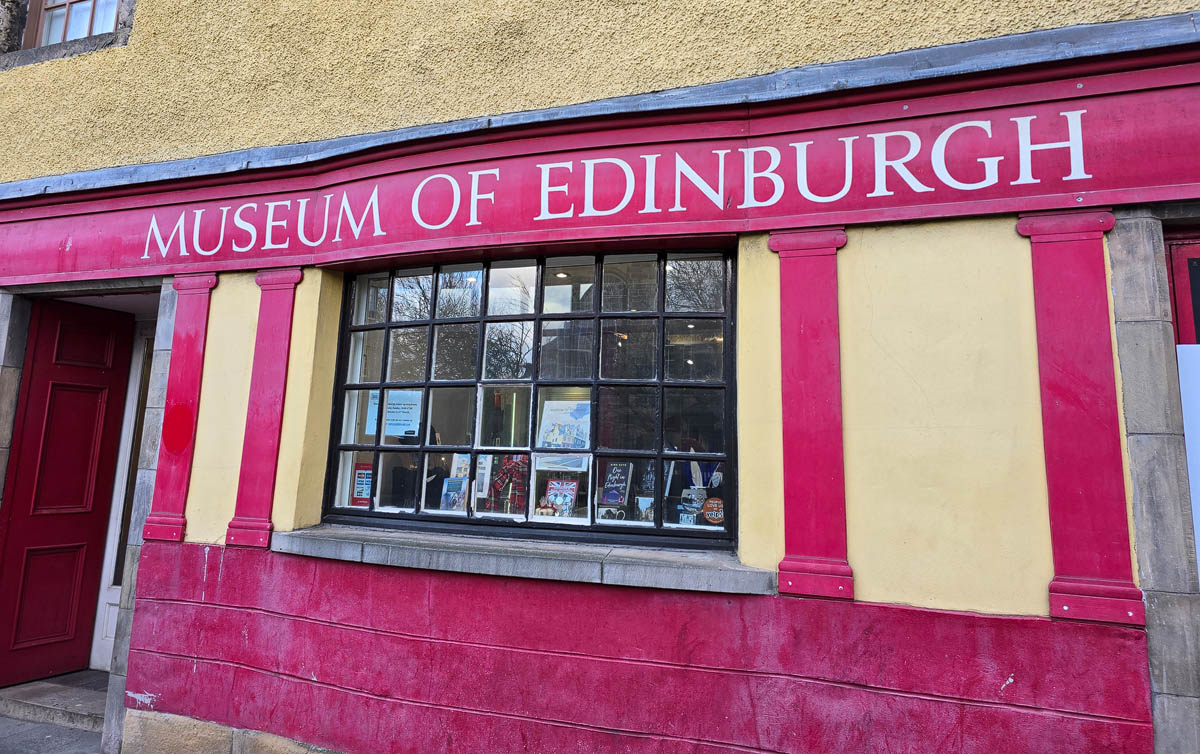
Discover Edinburgh’s Story at the Museum of Edinburgh
Tucked away on the lower stretch of the Royal Mile, the Museum of Edinburgh is one of those places that’s easy to walk past if you’re not looking for it – and that would be a real shame. Housed within the 16th-century Huntly House, this free museum tells the story of Scotland’s capital from its earliest days right through to the modern era, and it does so in a way that feels genuinely personal and absorbing. From an original copy of the National Covenant to Greyfriars Bobby’s collar, the collection here is packed with objects that bring Edinburgh’s past to life in the most tangible way. My wife Janette and I visited on a cold February afternoon and were completely drawn in by this remarkable little museum.

The History of Huntly House and the Museum of Edinburgh
The building that houses the Museum of Edinburgh has a story every bit as fascinating as the objects inside it. Huntly House is actually a consolidation of three separate early 16th-century dwellings, which were integrated and remodelled in 1570 by John Acheson to create a single, more spacious residence. The name “Huntly House” comes from George Gordon, 1st Marquess of Huntly, who is said to have briefly stayed in the building around 1636, though the Royal Commission on the Ancient and Historical Monuments of Scotland considers this connection to be erroneous.
In 1647, the Incorporation of Hammermen – a guild of metalsmiths – purchased the building as their new headquarters and commissioned the noted architect Robert Mylne to extend it. The Hammermen were one of the most important trade guilds in Edinburgh, and their ownership left a lasting mark on the building’s character. Over the centuries that followed, however, the building’s fortunes declined along with much of the Old Town. By 1851, Huntly House had been subdivided into cramped tenements, with an astonishing 323 tenants recorded as living within its walls.
By the early 20th century, the building was in a sorry state and under genuine threat of demolition. Fortunately, the City of Edinburgh stepped in and purchased it in 1924, saving it from destruction. After restoration work, it reopened as a museum – originally known as the Huntly House Museum – dedicated to the city’s history. It was later renamed the Museum of Edinburgh, though many locals still refer to it by its original name.
The building is also known as “The Speaking House” on account of five Latin inscriptions carved into the exterior stonework. Four of these date from the 16th century, with a fifth added during the restoration of 1932. Adjacent to Huntly House is Acheson House, built in 1633 for Sir Archibald Acheson, Secretary of State for King Charles I. Bakehouse Close, which runs between the two buildings, gained worldwide fame as the filming location for Jamie’s print shop in Season 3 of Outlander.
Our Visit to the Museum of Edinburgh
Getting There and First Impressions
The Museum of Edinburgh sits at 142–146 Canongate, on the lower section of the Royal Mile between the Scottish Parliament and St Giles’ Cathedral. You genuinely cannot miss the building – the bright yellow and red painted facade stands out wonderfully against the grey stone of the surrounding Old Town architecture. There is no dedicated car park, but several public car parks are available nearby, including at Dynamic Earth just a short walk away. If you’re using public transport, Lothian Buses run along the Canongate and Edinburgh Waverley station is around a 15-minute walk.
We arrived on a February afternoon and stepped through the entrance into a surprisingly bright and welcoming reception area with a small gift shop. Entry to the museum is completely free, though donations are welcomed. Right away, the building itself begins to impress – the original wooden floors, thick stone walls, and small windows give you an immediate sense of just how old this place is.

Exploring the Collections
The museum is arranged across several floors within a warren of interconnected rooms, each one leading to the next in ways that are sometimes unexpected. It’s a maze in the best possible sense – around every corner there’s something new to discover, and the building itself is as much of an exhibit as the objects it contains.
One of the first things to catch our attention was the sedan chair, displayed in a room with deep blue curtains alongside memorabilia from the Campaign for a Scottish Parliament. Edinburgh was once full of sedan chairs, used to carry the city’s wealthier residents through the narrow, often filthy streets of the Old Town. Seeing one up close, you appreciate just how ornate and solidly built they were.

Nearby we found the Covenanters section, which contains one of the museum’s most significant artefacts – an original copy of the National Covenant, signed at Greyfriars Kirk in 1638. This extraordinary document, now fragile and worn with age, was a pivotal moment in Scottish history. The Covenanters signed it as an act of resistance against King Charles I’s attempts to impose religious reforms on Scotland, and it ultimately played a role in the outbreak of the Civil War. The document is displayed behind glass in dim lighting to protect it, and you can see signatures and handwriting across the parchment. Janette and I stood looking at it for some time – it’s quite humbling to be so close to something so historically important.

Also in the Covenanters area is the Martyrs’ Monument stone, a powerful carved memorial to those who were executed for their beliefs between 1661 and 1688. The inscription, though worn, records the suffering of those who stood firm for the Covenant. With the text from the stone echoed on the wall behind it, the presentation is both moving and thought-provoking.

The Story of Old Edinburgh
Moving through into the rooms dedicated to Edinburgh’s urban development, we came across one of the museum’s real highlights – a beautifully detailed scale model of the medieval Royal Mile. This hand-crafted model shows the Old Town as it would have appeared centuries ago, with the tightly packed tenements, narrow closes, and distinctive rooflines that characterised the medieval burgh. It’s a wonderful way of visualising how densely populated and labyrinthine the Old Town once was, and it gives real context to the Edinburgh you see today.


The same room houses a framed print of Leith Harbour, Quay, Piers and Shipping in the 18th Century – a vivid depiction of Edinburgh’s vital port connection and the bustling trade that flowed through Leith. Nearby display cases contain a fascinating array of objects connected to Edinburgh’s trading past, including porcelain sugar bowls, a nutmeg grater, sugar tongs, and a snuff box, each accompanied by informative labels explaining their connection to the city’s involvement in global trade networks.


Among the more unusual objects on display were carved wooden figures salvaged from a fireplace in an Edinburgh house, shown alongside a pair of beautifully embroidered historical shoes with decorative buckles. These small, intimate objects give a wonderful sense of everyday life in Edinburgh across the centuries.

The Silver and Decorative Arts Collection
The museum’s silver collection is nothing short of spectacular. Displayed in a wood-panelled room with original timber beams and flooring, the cabinets are filled with Edinburgh and Canongate silver spanning several centuries. Teapots, candelabras, ewers, salvers, goblets, and elaborate table centrepieces showcase the extraordinary skill of Edinburgh’s silversmiths, who were among the finest in Britain.


One piece that particularly caught our eye was a silver bowl with coins embedded within it – a remarkable piece of craftsmanship that must have been quite the talking point at any dinner table. The level of detail in these pieces really is extraordinary, and the setting within Huntly House’s original interiors makes the displays feel all the more atmospheric.

In the same area, a stunning chinoiserie longcase clock stands against the wood panelling. Decorated with green and gold japanned lacquerwork depicting oriental scenes, it’s one of several Edinburgh-made longcase clocks in the collection and a fine example of the decorative arts that flourished in the city during the 18th century.

Pottery, Glass and the Building Itself
Climbing further into the upper reaches of the building, we entered a gallery space that reveals the full drama of Huntly House’s architecture. The exposed timber roof beams and mezzanine level are genuinely impressive – these beams are said to have been brought from Pinkie House in Musselburgh, while much of the wood panelling throughout the museum was salvaged from other old Canongate houses. Displays of Scottish pottery and porcelain dating from the 18th century fill the cabinets here, adding colour and interest to this characterful space.

The Edinburgh glass collection, housed in a strikingly atmospheric blue-walled gallery, was another real highlight. Janette was captivated by the cabinets of cut, engraved, and coloured glass, which include everything from delicate wine glasses to vibrant cranberry-coloured pieces. The centrepiece of this gallery is an absolutely jaw-dropping cut glass epergne – a multi-armed table centrepiece of extraordinary intricacy and scale. Information boards on the walls explain the history of Edinburgh and Leith’s glassworks, which once rivalled those anywhere in Britain.


Field Marshal Earl Haig and the Great War
One of the more poignant sections of the museum is the room dedicated to Field Marshal Earl Haig and the First World War. Haig, born in Edinburgh in 1861, became one of the most significant – and controversial – military figures of the 20th century as commander of the British Expeditionary Force on the Western Front. The museum holds items bequeathed from a reconstruction of his wartime headquarters, along with personal effects, photographs, and military memorabilia. Large black-and-white photographs of the Western Front line the walls, providing sobering context for the brass and gold items in the central display case.

Nearby, a collection of colourful ceramic character jugs caught our eye. These WWI-era Toby jugs depict caricatured military figures from the Allied forces, each one brightly painted and full of personality. They’re a lighter touch in an otherwise sombre section of the museum, and a fascinating example of wartime popular culture.

Videos from the Museum of Edinburgh
Frequently Asked Questions
Is the Museum of Edinburgh free?
Yes, the Museum of Edinburgh is completely free to enter. Donations are welcome and help to support the museum’s collections and exhibitions.
What are the opening hours of the Museum of Edinburgh?
The museum is generally open from 10am to 5pm, though the days of opening can vary seasonally. It is closed on Christmas Day, Boxing Day, and New Year’s Day. It’s always worth checking the Culture Edinburgh website before your visit for the most up-to-date opening times.
Is the Museum of Edinburgh accessible for wheelchair users?
There is level access from the entrance to the reception and ground floor areas, and accessible toilets are available. However, the upper floors of the museum are accessed by stairs and may not be accessible for wheelchair users or those with limited mobility. The historic nature of the building makes full accessibility challenging.
Is there parking at the Museum of Edinburgh?
There is no dedicated parking at the museum. The nearest public car parks include the Dynamic Earth car park on Holyrood Road, a short walk away. On-street parking in the Canongate area is extremely limited and mostly restricted.
Are dogs allowed in the Museum of Edinburgh?
Assistance dogs are welcome in the museum. It is advisable to check with the museum directly regarding other dogs, as policies may vary.
How long does a visit to the Museum of Edinburgh take?
Allow at least one to two hours to explore the museum properly. There are multiple rooms spread across several floors, and the sheer variety of exhibits means there’s a lot to take in. Those with a particular interest in Edinburgh’s history, silver, or glass could easily spend longer.
Was the Museum of Edinburgh used in Outlander?
Yes! Bakehouse Close, the historic close adjacent to the museum, was used as a filming location for Jamie’s print shop in Season 3 of Outlander. The close runs between Huntly House and the neighbouring Acheson House.
Key Information
- Location: 142–146 Canongate, Edinburgh EH8 8DD
- Grid Reference: NT 26435 73773
- Managed by: City of Edinburgh Council / Culture Edinburgh
- Entry: Free (donations welcome)
- Parking: No dedicated parking; public car parks nearby including Dynamic Earth
- Facilities: Gift shop, toilets, accessible toilets, hearing loop, courtyard, WiFi
- Accessibility: Level access at entrance and ground floor; upper floors via stairs only
- Dogs: Assistance dogs welcome
What Else is Nearby?
The People’s Story Museum – Directly opposite the Museum of Edinburgh in the Canongate Tolbooth, this free museum tells the story of Edinburgh’s working people from the 18th century to the present day through oral histories and reconstructed scenes.
Palace of Holyroodhouse – Just a few minutes’ walk down the Canongate, the King’s official Scottish residence offers a fascinating tour of royal apartments, the atmospheric ruined abbey, and beautiful gardens.
Scottish Parliament – The striking modern parliament building at the foot of the Royal Mile offers free guided tours and is well worth a visit for its remarkable architecture alone.
Calton Hill – A short walk from the museum, Calton Hill offers some of the finest panoramic views of Edinburgh, along with the National Monument, Nelson Monument, and the City Observatory.
Canongate Kirkyard – Right next to the museum, this atmospheric graveyard is the final resting place of economist Adam Smith, poet Robert Fergusson, and many other notable figures from Edinburgh’s past.
A Free Gem on the Royal Mile
The Museum of Edinburgh is one of those places that deserves far more attention than it sometimes gets. While many visitors to the Royal Mile make a beeline for Edinburgh Castle or the Palace of Holyroodhouse, this free museum tucked away in Huntly House offers something quite different – an intimate, absorbing, and wonderfully atmospheric journey through the story of Scotland’s capital. From the National Covenant to Edinburgh silver, from medieval city models to First World War memorabilia, every room holds something that makes you pause and look a little closer. Janette and I thoroughly enjoyed our visit and would recommend it to anyone with even a passing interest in Edinburgh’s rich history. Don’t walk past it.


Leave a comment below