Perched above the east end of Princes Street, Calton Hill is one of Edinburgh’s most rewarding viewpoints and a place that perfectly captures the city’s grand ambitions. This volcanic hill – standing 103 metres above sea level – is home to a remarkable collection of neoclassical monuments that helped earn Edinburgh its famous nickname, “The Athens of the North.” It’s part of the city’s UNESCO World Heritage Site, and one of the oldest public parks in Britain, having been purchased by Edinburgh Town Council back in 1724.
Whether you’re drawn by the iconic silhouette of the unfinished National Monument, the panoramic views across the city to the Firth of Forth, or simply looking for a green space to catch your breath amid the bustle of Edinburgh, Calton Hill delivers on every front. My wife Janette and I visited on a crisp February afternoon and were rewarded with stunning winter light and views that stretched for miles.
The History of Calton Hill
Calton Hill was formed by volcanic activity around 340 million years ago, the same geological forces that created Arthur’s Seat and Castle Rock. The name has ancient roots – it appeared as “Cragingalt” in a 1456 charter from James II and may derive from the Brittonic word Celdi, meaning a small wood, giving it the meaning “place of the small wood.” The spelling shifted from Caldtoun to Caltoun to the modern Calton over the centuries.
The hill’s recorded history stretches back to at least 1456, when James II granted the land between Calton Hill and Greenside to Edinburgh for hosting tournaments, sports, and military training. This was all part of his drive for military readiness – the same king who banned golf and football in favour of archery practice. The natural amphitheatre at Greenside was also used for open-air theatre, including performances of David Lyndsay’s A Satire of the Three Estates, one of the earliest Scots plays.
During the Siege of Leith in 1559, the Lords of the Congregation positioned cannons on the hill to bombard the French-held port – though the French mounted a sortie and captured one cannon while the other was destroyed. A Carmelite monastery that had stood at the foot of the hill since 1518 was converted into a leper hospital in 1591, with notoriously harsh regulations – any attempt to escape, or even opening the gate between sunset and sunrise, carried the death penalty.

The area was originally owned by the Logan family of Restalrig, but their lands were forfeited in 1609 following the posthumous treason conviction of Robert Logan. The lands passed to the Elphinstone family, who united Restalrig and Calton into a single barony in 1673. Edinburgh acquired the western side of the hill in 1725, while the eastern end was held by Heriot’s Trust.
The philosopher David Hume, one of the leading figures of the Scottish Enlightenment, was a strong advocate for creating a public space on Calton Hill. The wide footpath that climbs gradually to the summit, opened in 1775, is now named Hume Walk in his honour and has been called the first public footpath in Britain. Hume himself is buried in the Old Calton Burial Ground on the hill’s southwestern slope.
In 1787, the artist Robert Barker was walking on Calton Hill when he was inspired to create what became the world’s first panorama – an immersive 360-degree painting depicting Edinburgh from the summit. It was a ground-breaking invention that would go on to captivate audiences across Europe.
The Monuments
Calton Hill’s summit is crowned with a remarkable collection of monuments, each telling its own story of Edinburgh’s aspirations during the Scottish Enlightenment and beyond.

The National Monument
The most striking structure on Calton Hill is undoubtedly the National Monument, a grand Parthenon-inspired tribute to Scottish soldiers who fell during the Napoleonic Wars. Designed by William Henry Playfair and Charles Robert Cockerell, the foundation stone was laid on 27 August 1822 during George IV’s celebrated visit to Edinburgh. However, construction didn’t properly begin until 1826, and by 1829 the funds had dried up with only twelve columns completed.
The unfinished monument earned several less-than-flattering nicknames over the years – “Edinburgh’s Disgrace,” “Edinburgh’s Folly,” and “The Pride and Poverty of Scotland” among them. But two centuries on, it’s become one of the most iconic and photogenic structures in the city. There’s something wonderfully romantic about its incomplete grandeur, those mighty columns framing the sky and the Firth of Forth beyond.

The Nelson Monument
The tall, castellated tower that dominates the hilltop is the Nelson Monument, built between 1807 and 1816 to commemorate Admiral Lord Nelson and his victory at the Battle of Trafalgar in 1805. The original design by Alexander Nasmyth was rejected as too expensive, so the commission passed to Robert Burn, who created the distinctive inverted telescope-shaped tower we see today. It stands 32 metres tall and contains 143 steps leading to a public viewing gallery at the top.

In 1852, a mechanised time ball was added to the top of the monument. Each day at one o’clock, the ball drops in synchronisation with the famous One O’Clock Gun fired from Edinburgh Castle, providing a time signal to ships in the Firth of Forth. The base of the monument was enclosed in a five-sided structure between 1814 and 1816, and above the main door you can spot a carving of the San Josef – a Spanish warship that Nelson captured at the Battle of Cape St Vincent in 1797.

The Dugald Stewart Monument
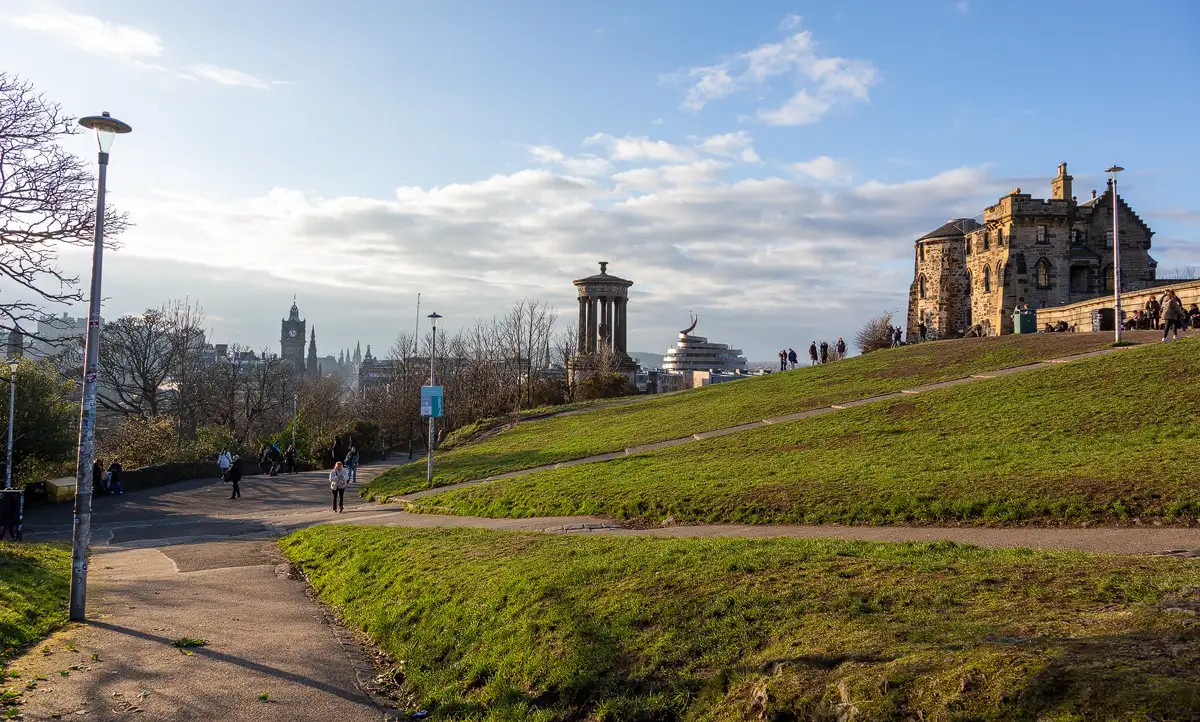
Perhaps the most photographed structure on Calton Hill – and one of the most recognisable images of Edinburgh – is the Dugald Stewart Monument. This elegant circular temple of nine fluted Corinthian columns was designed by William Henry Playfair and completed in 1831. It commemorates Dugald Stewart (1753–1828), a key figure of the Scottish Enlightenment who held the chair of moral philosophy at the University of Edinburgh from 1786 until his death.

Playfair’s design is based on the Choragic Monument of Lysicrates in Athens, a fitting choice given Calton Hill’s role in establishing Edinburgh’s “Athens of the North” identity. The Royal Society of Edinburgh commissioned the monument and selected the site in 1830. Standing beside it and looking west down Princes Street towards Edinburgh Castle, with the Balmoral Hotel clock tower in the foreground, you’re treated to one of the most celebrated views in all of Scotland.

The City Observatory
Calton Hill is home to two observatory buildings. The Old Observatory House was designed by New Town architect James Craig in 1792, while the grander City Observatory was built in 1818 to a design by William Henry Playfair. The observatory complex has been beautifully restored and is now home to Collective, a contemporary art gallery, along with The Lookout restaurant and Cafe Calton.


Our Visit
Getting There
Janette and I visited Calton Hill during a trip to Edinburgh in February. We approached from Regent Road, following the signposted “Steps to Calton Hill” opposite the imposing St Andrew’s House, the headquarters of the Scottish Government. The stone steps are well-worn and steep in places, with iron handrails to help you on your way, and the whole climb took us no more than five or ten minutes.

There’s no public car parking at the top of the hill, though blue badge holders can drive up via a service road off Regent Road. We’d parked at the Q-Park OMNI multi-storey nearby, which is just a few minutes’ walk from the base of the steps. An information board at the foot of the hill gives you a useful overview of the site’s history and a map showing the various monuments and paths.

Exploring the Summit
Reaching the top, the first thing that struck us was just how many people were here on a chilly February afternoon. It was clearly a popular spot, and it’s easy to see why. The hilltop is an open, grassy space dotted with monuments, and the views in every direction are spectacular.
We made our way first to the Dugald Stewart Monument, perched on the western edge of the hill with that famous view down Princes Street. Even on a cold day with a biting breeze, people were gathered here taking photographs – it’s the kind of view that stops you in your tracks. The Balmoral Hotel’s clock tower, the Scott Monument, and Edinburgh Castle all line up perfectly, and it’s easy to spend a good while just soaking it in.


From there, we wandered across to the National Monument. Even in its unfinished state, the twelve enormous columns are hugely impressive up close. People were sitting on the steps and clambering around the base, enjoying the sunshine. There were metal barriers set up around part of it – possibly in preparation for an event – but you could still get close enough to appreciate the sheer scale of the thing.
The Nelson Monument towers over everything on the hilltop, and we spent some time examining the memorial inscription at its base, which reads “To the Memory of Horatio Lord Viscount Nelson” and is dated A.D. MDCCCV (1805). The time ball cross at the very top is clearly visible – a reminder that this monument has been serving a practical as well as commemorative purpose for well over 170 years.

The Views
It’s the views from Calton Hill that really make a visit here unforgettable. On a clear day like we had, the panorama extends in every direction. To the south, the dramatic bulk of Arthur’s Seat and the ruddy cliffs of Salisbury Crags rise above the city, with the Scottish Parliament building and the Palace of Holyroodhouse visible below. The palace looked magnificent in the late afternoon sunlight, its turrets and courtyards picked out in golden light against the green backdrop of Holyrood Park.


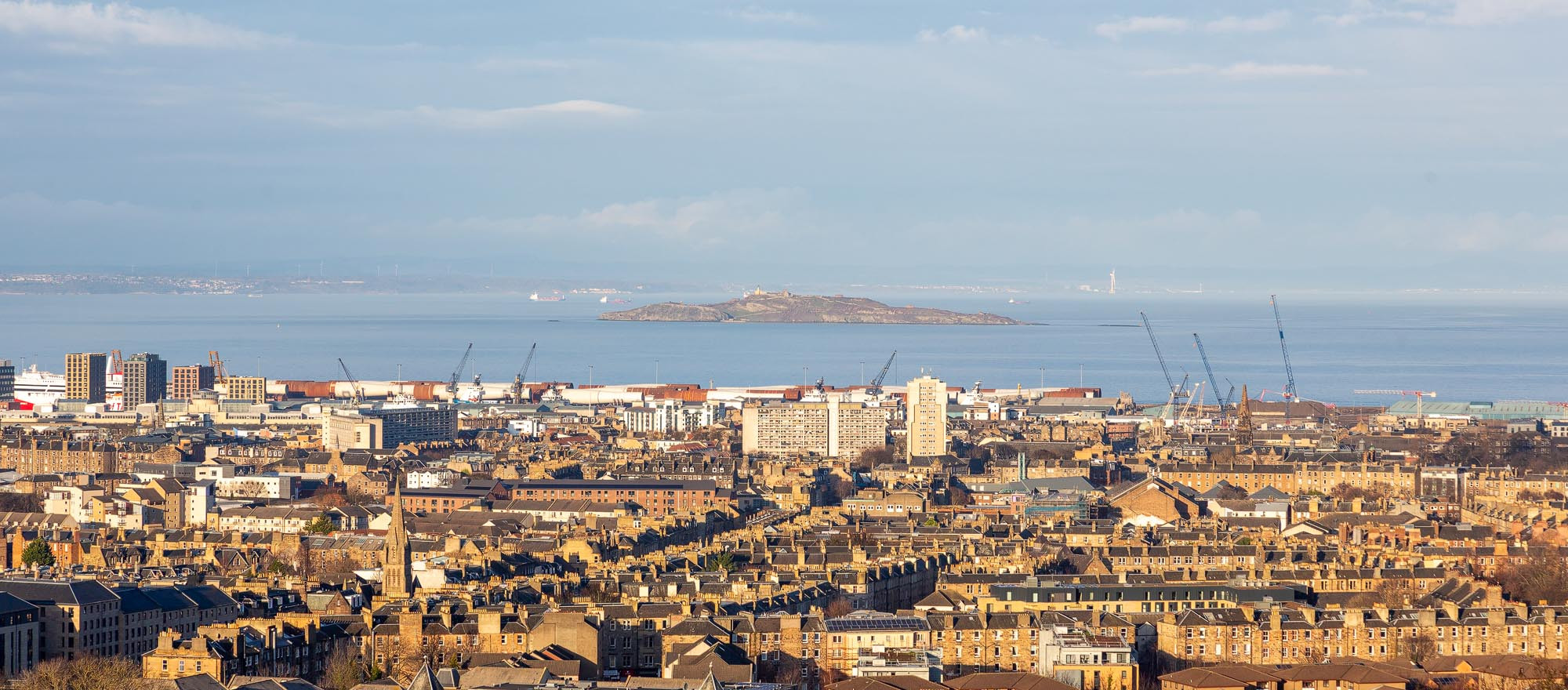
To the north, the view stretches across the rooftops of Leith and out over the Firth of Forth, with the island of Inchkeith clearly visible on the horizon and the coast of Fife beyond. To the west, the full length of Princes Street stretches away towards Edinburgh Castle, perched on its volcanic plug. It’s an absolute feast for the eyes, and for photographers, every direction offers a postcard-worthy composition.


The Collective and Cafe Calton
We also explored the Collective compound, which occupies the beautifully restored City Observatory buildings. The gallery itself is free to enter and hosts rotating contemporary art exhibitions. Outside, a modern viewing terrace offers panoramic views north towards the Firth of Forth, with benches where you can sit and take it all in. The Lookout restaurant occupies a striking modern building within the compound, and though we didn’t eat there, it looked busy and the terrace was packed with people enjoying coffees and the view. There’s also a smaller kiosk, Cafe Calton, for a quicker snack or hot drink.


Videos from Calton Hill
Calton Hill FAQs
Is Calton Hill free to visit?
Yes, Calton Hill is completely free to visit and is open 24 hours a day, 365 days a year. The only charge is a small fee to climb the Nelson Monument to its viewing gallery. The Collective gallery is also free to enter.
How long does it take to walk up Calton Hill?
The walk from the Regent Road entrance to the summit takes around 5–10 minutes via the stone steps, or slightly longer if you take the more gradual tarmacked path. Allow at least 30–45 minutes to explore the monuments and enjoy the views once you’re at the top.
Is Calton Hill accessible for wheelchairs and pushchairs?
The main stairway entrance from Regent Road is not step-free. However, blue badge holders can drive to the summit via a service road off Regent Road, and taxis can also use this road for drop-offs. Once at the top, the paths are mostly flat and manageable. The Collective has accessible toilets available on request.
Is there parking at Calton Hill?
There is no public car parking at the top of the hill, except for blue badge holders. The nearest paid parking is on Regent Road (pay-and-display) or at the Q-Park OMNI multi-storey car park, which is just a few minutes’ walk from the steps.
Are dogs allowed on Calton Hill?
Yes, dogs are welcome on Calton Hill. Assistance dogs are also welcome inside the Collective gallery. We’d recommend keeping dogs on a lead given the steep edges in some areas and the number of other visitors.
What is the best time to visit Calton Hill?
Calton Hill is beautiful at any time of day, but sunset is particularly magical when the city is bathed in golden light. Sunrise is equally stunning and much quieter. For photography, the golden hour light is unbeatable. The hill can be exposed and windy, so wrap up warmly in winter.
What events take place on Calton Hill?
The most famous event is the Beltane Fire Festival, held on the evening of 30 April each year. This spectacular celebration, revived in 1988, features fire performances, drumming, and ritual theatre. Calton Hill is also a popular spot for watching the Hogmanay and Edinburgh Festival fireworks displays.
Key Information
- Location: Calton Hill, Edinburgh, EH7 5AA
- Grid Reference: NT 2627 7424
- Managed by: City of Edinburgh Council / Collective (observatory compound)
- Entry: Free (small charge to climb Nelson Monument)
- Parking: No public parking at summit (blue badge holders only). Pay-and-display on Regent Road or Q-Park OMNI nearby.
- Facilities: Collective gallery (free, Wed–Sun), The Lookout restaurant, Cafe Calton kiosk, toilets within Collective compound
- Accessibility: Steps from Regent Road; blue badge holders can drive to summit. Mostly flat paths at the top.
- Dogs: Welcome on the hill. Assistance dogs welcome in Collective.
What Else is Nearby?
The Palace of Holyroodhouse – The official Scottish residence of the monarch sits at the foot of the Royal Mile, just a short walk from Calton Hill. Steeped in history, it’s most famously associated with Mary, Queen of Scots.
Arthur’s Seat and Holyrood Park – If Calton Hill has whetted your appetite for hilltop views, the extinct volcano of Arthur’s Seat (251m) offers an even more dramatic panorama. The walk up takes around 45 minutes from the palace.
The Scott Monument – This Gothic-style monument in Princes Street Gardens is dedicated to Sir Walter Scott and offers climbing platforms with views across the city. It’s about a 12-minute walk from Calton Hill.
The Royal Mile – Edinburgh’s historic spine, stretching from the Castle to Holyrood Palace, is packed with closes, museums, pubs, and centuries of history. It’s just a 10-minute walk from the base of Calton Hill.
Old Calton Burial Ground – Directly below Calton Hill on its southwestern side, this atmospheric graveyard is the resting place of philosopher David Hume and features the Political Martyrs’ Monument and the striking Lincoln Monument.
Final Thoughts
Calton Hill is one of those places that genuinely exceeds expectations. We’d walked past it on previous trips to Edinburgh without ever making the short climb to the top, and now we wonder why we waited so long. The combination of world-class views, fascinating monuments, and a real sense of Edinburgh’s history and ambition makes it an essential stop on any visit to the capital.
Even on a cold February afternoon, with a brisk wind whipping across the hilltop, the experience was magical. The winter light picked out the monuments beautifully, the Firth of Forth shimmered in the distance, and the city spread out below us in all its glory. Whether you’re a first-time visitor to Edinburgh or a regular, Calton Hill is one of those special places that rewards every visit. And at free entry with no time restrictions, there’s really no excuse not to make the climb.

Leave a comment below