
Pioneer of British Pop Art
Sir Eduardo Luigi Paolozzi was one of Scotland's most innovative and versatile artists, widely recognised as a founding father of the British Pop Art movement. Born in Leith on 7 March 1924 to Italian immigrant parents, Paolozzi's extraordinary six-decade career encompassed sculpture, collage, printmaking, ceramics, mosaics, and industrial design. His work bridged the worlds of high art and popular culture, transforming how we understand the relationship between humanity and technology in the modern age.
Throughout his life, Paolozzi maintained a deep connection to his Scottish roots whilst achieving international acclaim. His pioneering 1947 collage "I was a Rich Man's Plaything" - which actually featured the word "POP!" - predated the American Pop Art movement by nearly a decade. Today, visitors to Edinburgh can experience the recreation of his studio at Modern Two and view his monumental sculptures that stand as testament to his enduring legacy.
Early Life and Wartime Tragedy
Eduardo Luigi Paolozzi was born into an Italian-Scottish family in Leith, Edinburgh's historic port district. His parents, Rodolfo and Carmela Paolozzi, had emigrated from Viticuso in the Lazio region of Italy and ran an ice cream shop in Leith. As a child, Eduardo spent his summers with his grandparents in Monte Cassino, Italy, growing up bilingual and experiencing both Scottish and Italian cultures.
The outbreak of the Second World War brought devastating tragedy to the Paolozzi family. In June 1940, when Italy declared war on Britain, the teenage Eduardo was interned as an enemy alien at HM Prison Edinburgh (Saughton Prison) for three months, along with most Italian men living in Britain. During his internment, his father, grandfather, and uncle were placed aboard the SS Arandora Star, a ship transporting internees to Canada. On 2 July 1940, the vessel was torpedoed by German U-boat U-47 off the coast of Ireland, killing 446 Italian internees including Eduardo's three family members. This profound loss would haunt Paolozzi throughout his life and influence his artistic exploration of identity, displacement, and the fragmented nature of modern existence.
Education and Formative Years
After his release from internment, Paolozzi returned to work in the family shop before beginning evening classes at Edinburgh College of Art in 1941. He enrolled full-time in 1943, but his studies were interrupted when he was conscripted into the British Army. Desperate to return to his artistic pursuits, Paolozzi feigned mental illness to secure an early discharge - a decision that allowed him to resume his education.
In 1944, Paolozzi moved to London, briefly studying at St Martin's School of Art before transferring to the prestigious Slade School of Fine Art at University College London, where he studied until 1947. During his time at the Slade, he visited the Pitt Rivers Museum in Oxford, developing a fascination with anthropological collections and non-classical art forms that would inform his later work. He also encountered the work of Pablo Picasso, which had a profound influence on his developing artistic style.
Paolozzi held his first solo exhibition at London's Mayor Gallery in 1947, showcasing primitivist sculpture and Cubist-inspired collage. The exhibition was an immediate success, with every piece sold, providing him with the financial means to travel to Paris later that year.
Paris and the Birth of Pop Art
From 1947 to 1949, Paolozzi lived in Paris, enrolling at the École des Beaux-Arts and immersing himself in the city's vibrant artistic community. He met and befriended some of the era's most influential artists, including Alberto Giacometti, Jean Arp, Constantin Brâncuși, Georges Braque, and Fernand Léger. The influence of these encounters, particularly with Giacometti and the Surrealists, can be seen in the enigmatic bronze sculptures Paolozzi created throughout the 1950s, with their textured surfaces studded with found objects and machine parts.
It was during this Paris period that Paolozzi created what many consider the first work of British Pop Art. In 1947, he produced "I was a Rich Man's Plaything", a groundbreaking collage assembled from cuttings taken from American magazines given to him by ex-servicemen. The work featured a glamorous woman, a cherry, a Coca-Cola advertisement, and crucially, a speech bubble containing the word "POP!" - years before the term "Pop Art" was coined by critic Lawrence Alloway. This collage, along with nine others, formed part of his "BUNK!" series (1947-1952), named after Henry Ford's famous declaration that "History is more or less bunk".
The Independent Group and British Pop Art
After returning to London in 1949, Paolozzi established his studio in Chelsea, creating what would become a legendary workspace filled with hundreds of found objects, models, sculptures, tools, toys, and stacks of books. He quickly became acquainted with prominent British artists including Lucian Freud and Francis Bacon, whilst teaching at the Central School of Art and Design.
In 1952, Paolozzi became a founding member of the Independent Group, a collective of avant-garde artists, architects, writers, and critics associated with London's Institute of Contemporary Arts. The group, which included Richard Hamilton, Nigel Henderson, architects Alison and Peter Smithson, and critic Lawrence Alloway, challenged the prevailing Modernist aesthetic and celebrated popular culture, mass production, and American consumer imagery. At one of the group's first meetings, Paolozzi delivered his influential "BUNK!" lecture, projecting his collages in rapid succession to demonstrate how modern people were bombarded by an unprecedented array of images from advertisements, magazines, comics, and science journals.
In 1956, the Independent Group staged "This is Tomorrow" at the Whitechapel Gallery in London, a groundbreaking exhibition that gave the emerging Pop Art movement its first major platform. Paolozzi collaborated on one section of the exhibition, helping to establish the aesthetic vocabulary that would influence both British and American Pop Art throughout the 1960s.
Sculpture and the Machine Age
Whilst Paolozzi's collages laid the groundwork for Pop Art, he became increasingly renowned for his sculptural work. Throughout the 1950s and 1960s, he developed a distinctive style that explored the relationship between the human form and technology. His sculptures often featured largely lifelike human figures, but with geometric, rectilinear, or cubic elements added or removed, or with the body deconstructed in a Cubist manner. He incorporated actual machine parts - nuts, bolts, gears, and scrap metal - directly into his wax maquettes, which were then cast in bronze, creating what critics described as "totems for the technological age".
Unlike many artists who viewed industrialisation with suspicion or fear, Paolozzi embraced technology as a source of wonder and possibility. He was fascinated by the idea that machines could enhance rather than diminish human potential, and his sculptures embodied this optimistic vision of a human-machine synthesis. As he once explained: "I suppose I am interested, above all, in investigating the golden ability of the artist to achieve a metamorphosis of quite ordinary things into something wonderful and extraordinary."
International Teaching and German Connections
Throughout his career, Paolozzi balanced his artistic practice with teaching positions at prestigious institutions around the world. He taught at the Hochschule für bildende Künste Hamburg from 1960 to 1962, the University of California, Berkeley in 1968, and spent nearly two decades at the Royal College of Art from 1968 to 1989, where he served as Professor of Ceramics.
Paolozzi developed a particularly strong association with Germany. In 1974, he worked in Berlin as part of the Berlin Artist Programme of the German Academic Exchange Service, and from 1977 to 1981, he held a professorship at the Fachhochschule in Cologne. He later taught sculpture at the Akademie der Bildenden Künste in Munich and maintained a studio in the Bavarian capital, where he was fond of working and where many of his concepts were developed. His international teaching career, though sometimes challenging due to his gruff manner and combative personality, allowed him to influence generations of artists whilst continuing his own prolific output.
Major Public Commissions
In the latter decades of his career, Paolozzi became one of Britain's most sought-after public artists, creating large-scale works that transformed spaces across the UK and beyond. His most extensive and perhaps most famous commission was the mosaic decoration of Tottenham Court Road Underground Station in London. Completed between 1984 and 1986, this enormous project featured brightly coloured glass-tile mosaics covering the platforms, passages, and escalator entrances. The vibrant, geometric patterns incorporated motifs from music, technology, and everyday life, creating an immersive environment that millions of commuters encountered daily. Whilst some escalator entrance murals were removed during station renovations and donated to the University of Edinburgh, most of the mosaics remain in situ and were carefully restored in 2017.
In Edinburgh, several major Paolozzi sculptures have become iconic landmarks. "The Manuscript of Monte Cassino" (1991), installed outside St Mary's Cathedral on Picardy Place, features enormous bronze sculptures of a foot, an ankle, and a hand - monumental fragments that reference both classical sculpture and the artist's family connection to Monte Cassino. "The Wealth of Nations" (1993), located on Redheughs Avenue, stands as another testament to his ability to create powerful public art.
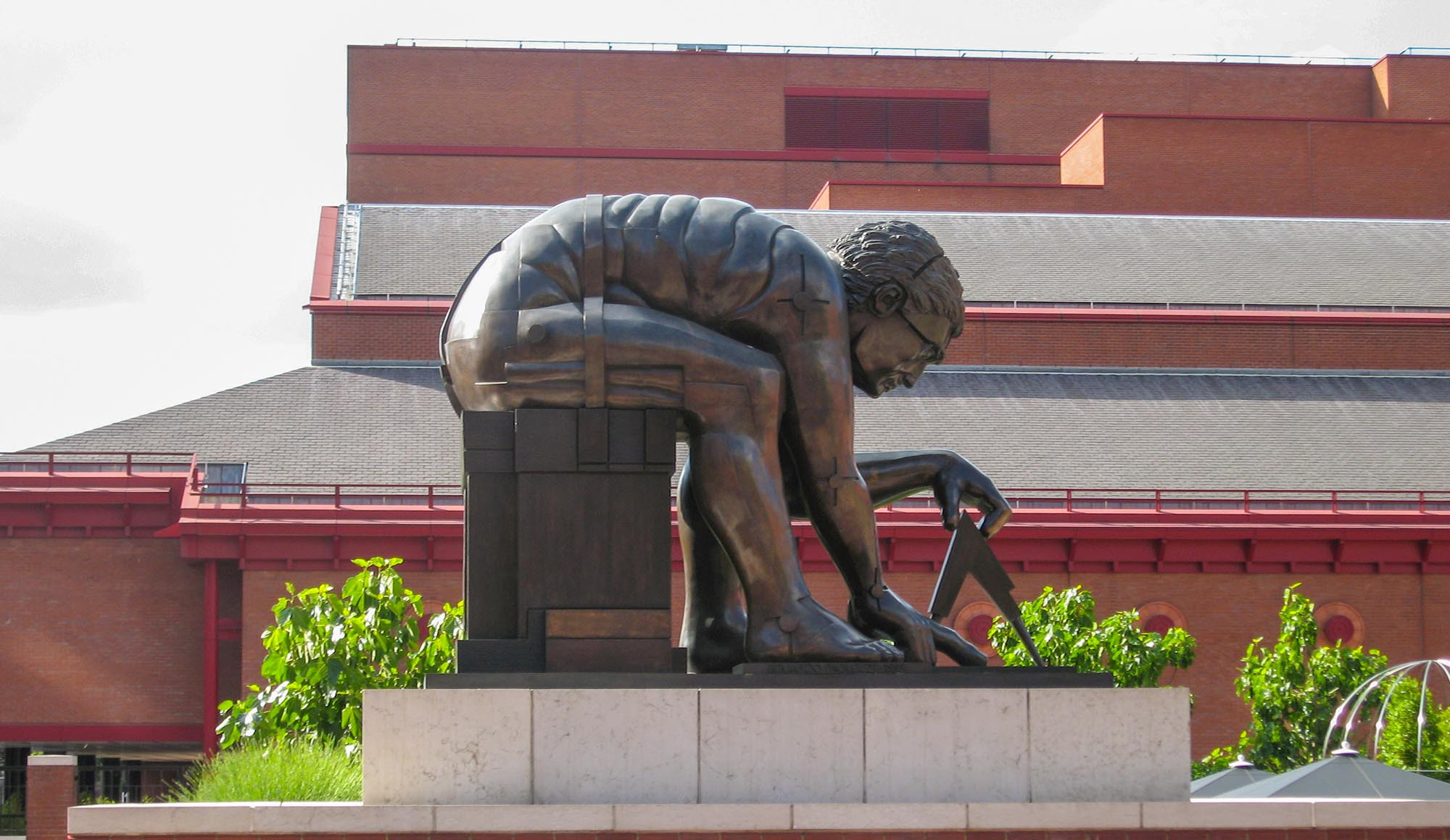
Perhaps his most celebrated sculpture is "Newton" (also known as "Newton After Blake"), created in 1995 for the forecourt of the British Library in London. This 12-foot bronze figure, inspired by William Blake's 18th-century depiction of Sir Isaac Newton measuring the universe with a compass, embodies Paolozzi's lifelong interest in the relationship between art and science. The sculpture's geometric, mechanistic rendering of the human form perfectly captures Paolozzi's vision of humanity's relationship with technology and rationality.
Other Creative Ventures
Paolozzi's creativity extended far beyond traditional sculpture and collage. In the 1970s, he ventured into industrial design, decorating a limited run of 500 pieces of high-end Suomi tableware by Finnish designer Timo Sarpaneva for the German Rosenthal porcelain company. He contributed to the album artwork for Paul McCartney and Wings' 1973 release "Red Rose Speedway", and designed textiles, tapestries, and ceramics.
Together with fellow artist Nigel Henderson, Paolozzi established Hammer Prints Limited, a design company producing wallpapers, textiles, and ceramics. His teaching at the Central School of Art and Design proved influential in unexpected ways - when Trinidadian graphics student Althea McNish attended his evening course in printed textile design, Paolozzi recognised her talent and helped point her towards her future career as an acclaimed textile designer.
He also created screenprints that became highly influential in the Pop Art movement, including the "As Is When" series (1965) inspired by philosopher Ludwig Wittgenstein, and works that processed images from German doctor Fritz Kahn's popular science books.
Recognition and Honours
Paolozzi's contributions to British art were recognised with numerous honours throughout his career. He was appointed Commander of the Order of the British Empire (CBE) in 1968 and elected to the Royal Academy in 1979, becoming a Royal Academician. In 1986, he received one of the most prestigious honours available to a Scottish artist when he was appointed Her Majesty's Sculptor in Ordinary for Scotland, a position originally created by Queen Victoria for Edinburgh artist John Steell in the 19th century. In 1989, Queen Elizabeth II knighted him for his services to art.
Major retrospective exhibitions celebrated his work during his lifetime, including shows at the Tate Gallery in 1971, the National Galerie in West Berlin in 1975, and a print retrospective at the Victoria and Albert Museum in 1977. The Royal Scottish Academy in Edinburgh mounted a major retrospective in 1984, which subsequently travelled to Germany, France, and Ireland.
The Paolozzi Gift and Legacy in Edinburgh
Despite achieving international fame and spending much of his working life in London and continental Europe, Paolozzi never forgot his Leith origins. In 1994, he made an extraordinarily generous gift to the National Galleries of Scotland, donating a large body of his works along with the entire contents of his Chelsea studio - thousands of items including sculptures, prints, drawings, plaster maquettes, moulds, found objects, toys, machine parts, and books that had inspired his work over decades.
To house this remarkable collection, the National Galleries of Scotland opened the Dean Gallery (now known as Modern Two) in 1999 in a beautiful building that was originally the Dean Orphan Hospital, designed by Thomas Hamilton in 1833. The gallery features a meticulous recreation of Paolozzi's studio, complete with sculptures, models, books, toys, and even a bed, offering visitors an intimate insight into how the artist worked and what inspired him. The gallery café is dominated by his towering 24-foot-high sculpture "Vulcan" (1999), created for the gallery's opening, whilst "Master of the Universe" (1989) - another monumental work featuring a geometric, mechanised human form - stands outside the building.
Final Years
Paolozzi continued working prolifically well into his 70s, maintaining his passion for discovering the extraordinary within the ordinary. In 2001, he suffered a near-fatal stroke that left him wheelchair-bound for the remainder of his life. An incorrect magazine report briefly announced his death at that time, but he survived for another four years, though his artistic output was severely curtailed by his condition.
Sir Eduardo Paolozzi died in a hospital in London on 22 April 2005, at the age of 81. His passing marked the end of a remarkable life dedicated to exploring the intersections of art, technology, popular culture, and human identity. His obituary in The Times noted his "gruff manner and combative personality" which sometimes hindered his teaching career, but there was no doubting the profound impact he had on generations of artists and on the broader cultural landscape.
Enduring Influence
Eduardo Paolozzi's legacy as a pioneer of British Pop Art and as one of the most versatile and innovative sculptors of the 20th century remains secure. His early collages influenced both British artists like Richard Hamilton and American Pop Art icons such as Andy Warhol and Roy Lichtenstein. His sculptural explorations of the human form in the machine age helped define how we visualise and understand our relationship with technology.
His influence can be seen not only in the world of fine art but also in graphic design, industrial design, and public art. The Tottenham Court Road mosaics continue to enliven millions of daily journeys, whilst his monumental sculptures in Edinburgh serve as beloved landmarks that connect the city to one of its most famous artistic sons.
Perhaps most importantly, Paolozzi's work embodied an optimistic, inclusive vision of art - one that embraced popular culture, mass production, and technological progress rather than rejecting them. His famous quote, "I like to make use of everything. I can't bear to throw things away - a nice wine bottle, a nice box. Sometimes I feel like a wizard in Toytown, transforming a bunch of carrots into pomegranates," captures his democratic approach to materials and his belief in art's transformative power.
Today, visitors to Modern Two in Edinburgh can explore the recreated studio where surrounded by the tools, toys, and treasures that fuelled his imagination, they can glimpse the mind of an artist who spent his life discovering wonder in the overlooked and beauty in the mechanical. From his tragic wartime experiences in Leith to his triumph as one of Britain's most celebrated artists, Sir Eduardo Paolozzi's journey embodies both the fragmentation and the creativity of the modern age.


