
A Pioneer of Women's Rights and Social Reform
Ishbel Hamilton-Gordon, Marchioness of Aberdeen and Temair, stands as one of Scotland's most remarkable champions of women's rights and social reform. Born into Victorian privilege, she devoted her life to improving the conditions of working-class women, establishing groundbreaking healthcare organisations, and fighting for women's equality in education, employment, and the church. Her influence stretched from the Scottish Highlands to the far reaches of Canada and Ireland, leaving a legacy that continues to inspire advocates for social justice today.
Early Life and Education
Ishbel Maria Marjoribanks was born on 15 March 1857 in London, the third daughter of Dudley Marjoribanks, 1st Baron Tweedmouth, and Isabella Weir-Hogg. Her surname, pronounced "Marshbanks", reflected her family's prominent position in Scottish society. The Marjoribanks family were wealthy landowners who claimed descent from King Robert the Bruce and had made their fortune in banking and finance. Her father was a successful businessman and Liberal Member of Parliament, whilst her mother's family were prosperous Irish merchants of Scottish descent and evangelical Protestant social reformers.
Young Ishbel was described as a precocious, curious child, sometimes anxious but full of spirit. She received a comprehensive education at home, studying English, French, mathematics, history, and geography. Her exceptional academic abilities prompted her teacher to recommend she attend university - a radical suggestion for a young woman in the 1870s. However, her father shared the prevailing Victorian view that university was no place for a woman, and Ishbel's formal education continued at home. Instead, she received an invaluable political education through her parents' social events, where she met the leading politicians and thinkers of the day. As a child, she also cherished time spent at the family's Highland estate in Glen Affric, where the rugged Scottish landscape made a lasting impression on her.
Marriage and Haddo House
Among the visitors to the Marjoribanks household was John Campbell Hamilton-Gordon, the 7th Earl of Aberdeen. After a six-year acquaintance during which the Earl, ten years her senior, wrestled with his feelings, the couple married on 7 November 1877 at St George's Church, Hanover Square, London. Ishbel later described her desire to marry him as "the one dream of my life". The marriage proved to be a true partnership, with both sharing a deep commitment to social reform and Liberal politics.
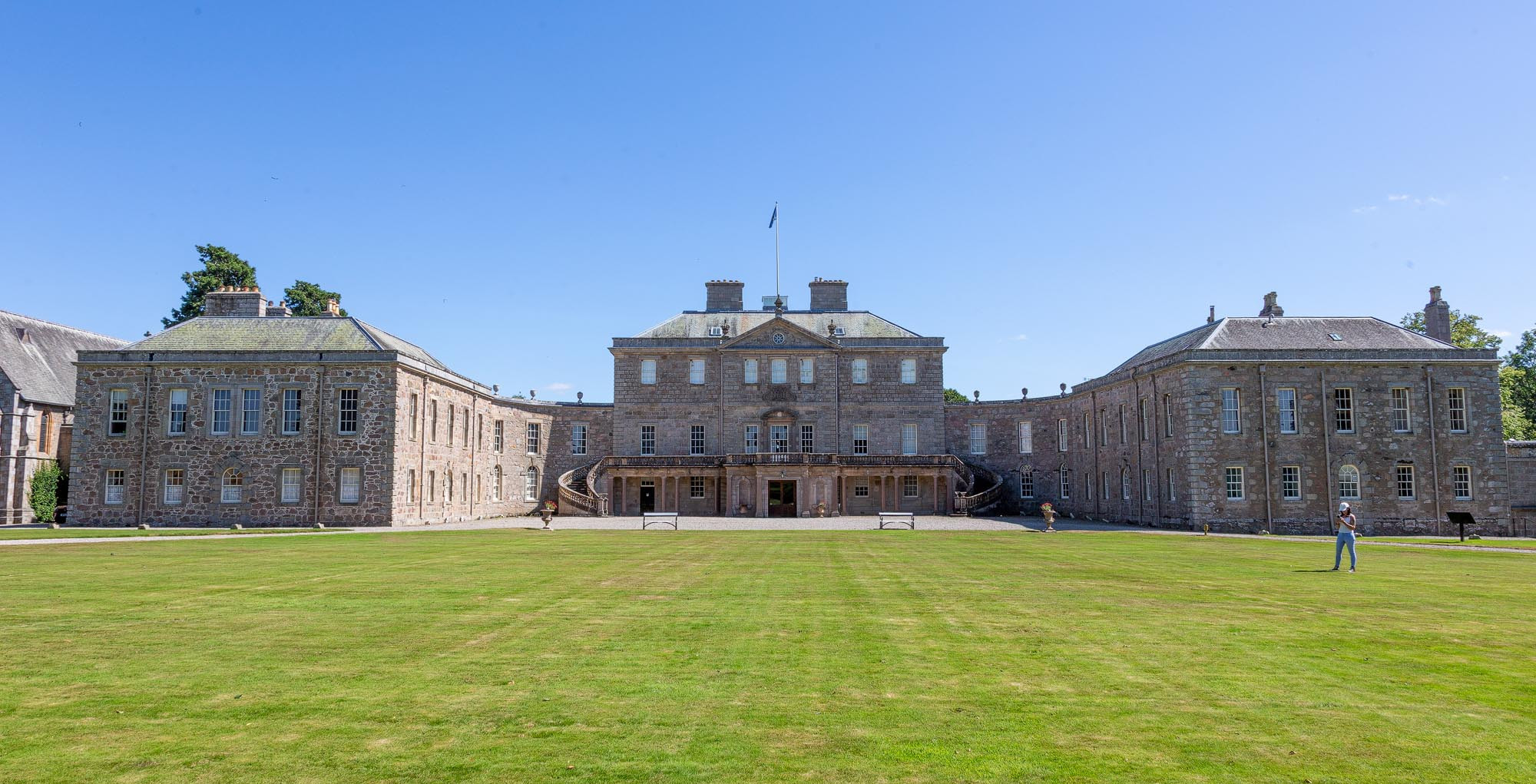
The Aberdeens' principal home was Haddo House, an expansive estate of 1,400 acres in Aberdeenshire in northeast Scotland. The estate encompassed several villages and was home to hundreds of workers and their families. The couple had four surviving children: George (born 1879), Marjorie (1880), Dudley (1883), and Archibald (1884). As their daughter Marjorie later wrote, Ishbel "interpreted the duty of wife as one who not only provided for her husband a serene background in private life, but as one who also thought and fought for him in all his affairs".
It was at Haddo House that Ishbel began her lifelong work of social reform. She extensively modernised and renovated the estate and established a Household Club offering classes for servants in singing, carving, reading, and other activities. The Aberdeens regularly attended their servants' evening socials and meetings - behaviour that scandalised London society, which spread rumours that they even dined together. The couple also funded a local school and hospital, beginning Ishbel's enduring commitment to healthcare reform.
Pioneering Work in Scotland
Lady Aberdeen's influence quickly extended beyond Haddo House. In 1883, she became the first president of the Aberdeen Ladies' Union, which helped working-class women in the cities and sponsored young women emigrating to Canada. She established the Onward and Upward Association, providing correspondence courses for domestic servants on subjects ranging from geography and literature to domestic science. This innovative programme proved remarkably popular, growing to encompass 8,280 members across Scotland. The association gave working women educational opportunities that would otherwise have been completely beyond their reach.
As a staunch Liberal and admirer of Prime Minister William Gladstone, Ishbel became head of the Women's Liberal Federation, which championed women's suffrage. Though she supported the suffrage movement, she preferred to work behind the scenes rather than take a prominent public role in the campaign.
The Canadian Years: 1893-1898
In 1890, the Aberdeens embarked on a world tour, visiting Australia, New Zealand, Tasmania, Ceylon, and India. Their extended visit to Canada left them enthralled with the country. When Lord Aberdeen was appointed Governor General of Canada in 1893, Ishbel threw herself into her new role with characteristic energy and determination.
Within a month of arriving in Canada, Ishbel helped found the National Council of Women of Canada and was named its first president, serving from 1893 to 1898. In the same year, she was elected president of the International Council of Women, a position she would hold for an extraordinary 43 years until 1936. She also became the first sponsor of the Women's Art Association of Canada, founded in 1892, and established the May Court Club, which enabled well-off young women to engage in charitable work.
Lady Aberdeen's most enduring contribution to Canada was the establishment of the Victorian Order of Nurses in 1898. After hearing heartbreaking stories of women and children dying in remote areas whilst their husbands travelled many weary miles seeking medical help, she was moved to action. She wrote of "cases where young mothers and children had died, whilst husbands and fathers were travelling many weary miles for the medical and nursing aid which might have saved them". The Victorian Order aimed to provide visiting nursing services and establish "cottage hospitals" in isolated areas, whilst also ensuring nurses received better training and higher salaries.
The establishment of the VON was far from easy. Lady Aberdeen faced fierce opposition from the predominantly male medical establishment, who resisted the idea of women operating independently in healthcare. Undeterred, she marshalled her considerable social connections, including securing an endorsement from Florence Nightingale herself, the founder of modern nursing. The organisation finally received its royal charter in 1898, the year the Aberdeens returned to Britain.
During her time in Canada, Lady Aberdeen achieved several notable firsts. She became the first woman to address the House of Commons and the first woman to receive an honorary degree in Canada, awarded by Queen's University. Her warmth and dedication to Canada endured throughout her life. Years later, she declared: "I have been a Canadian for many years. I shall always be a Canadian". The Canadian government recognised her devotion by presenting her with 18 decorative tea sets, and numerous streets, bridges, and places across Canada bear the Aberdeen name, including the Lady Aberdeen Bridge in Gatineau, Quebec.
Ireland and Public Health: 1906-1915
Lord Aberdeen had briefly served as Lord Lieutenant of Ireland in 1886. When the Liberal Party returned to power in 1906, he was appointed to the position again, serving until 1915. During this second, longer tenure, Ishbel focused her energies on healthcare and social well-being.
She founded the Women's National Health Association of Ireland, dedicated to treating and preventing tuberculosis and improving children's health. In 1911, she became the first president of the Housing and Town Planning Association of Ireland, advocating for better housing and public spaces to address the widespread poverty. Her work is commemorated in several Irish placenames, including Lady Aberdeen's Cottages in Mullingar and Lady Ishbel Avenue, part of the former Purdysburn Fever Hospital site in south Belfast.
However, the political climate in Ireland had changed dramatically since the Aberdeens' first appointment in 1886. By 1906, nationalist sentiment had increased significantly, and despite her genuine commitment to improving Irish lives, Ishbel's ties to the British establishment made her unpopular with Irish nationalists. Nevertheless, she persevered with her healthcare initiatives throughout their nine-year tenure.
In 1916, Lord Aberdeen was elevated within the peerage to become 1st Marquess of Aberdeen and Temair, with Ishbel becoming the Marchioness.
Later Years and the Fight for Women's Ordination
Following Lord Aberdeen's retirement from public office, the couple settled at their House of Cromar in Tarland, Aberdeenshire. Together they wrote a memoir, "We Twa", published in 1925 to positive reception and followed by several expanded editions. The Canadian Journal of Lady Aberdeen, 1893-1898, was later published posthumously in 1960, edited by John Saywell.
Even in her later years, Ishbel continued her advocacy work. In 1931, at the age of 74, she presented a petition to the General Assembly of the Church of Scotland. Signed by 336 women, it called for women to be ordained as ministers and to have access to all other positions in the Kirk. The resulting special commission recommended only that women should be ordained to the diaconate - a partial victory, but not the full equality Ishbel sought. It would take until 1968 for the Church of Scotland to allow women to become elders or ministers, and not until 1996 were all of her original demands finally met.
She remained president of the International Council of Women until 1936, when she was 79 years old. Following World War One, she had successfully convinced the League of Nations to open secretarial positions to women as well as men, demonstrating that her influence extended to the highest levels of international governance.
Honours and Legacy
Lady Aberdeen received numerous honours throughout her lifetime. In 1894, she was granted the Freedom of Limerick. The Freedom of Edinburgh followed in 1928, and in 1931 she was invested as a Dame Grand Cross in the Order of the British Empire (GBE).
Despite their wealth and privileged position, the Aberdeens had spent much of their fortune supporting charitable causes. By the time of retirement, the estates at Haddo and Cromar were effectively bankrupt. When Lord Aberdeen died in 1934, Ishbel faced financial difficulties, with Lady MacRobert taking possession of the House of Cromar with what many considered unseemly haste. Queen Mary intervened, purchasing a beloved secretaire from Lady MacRobert and returning it to Ishbel as a gesture of support and respect.
Ishbel Hamilton-Gordon died of a heart attack on 18 April 1939 at Gordon House in Rubislaw, Aberdeen, at the age of 82. She left behind an extraordinary legacy of social reform, women's empowerment, and healthcare innovation that spanned three nations and nearly seven decades of tireless work.
A Lasting Impact
Lady Aberdeen's life exemplifies the power of privilege used in service of others. Born into wealth and status, she could easily have lived a life of comfortable leisure. Instead, she chose to devote her formidable intelligence, energy, and social connections to improving the lives of working-class women, advancing healthcare for the poor, and fighting for women's equality in education, employment, and religious life.
Her practical achievements were remarkable: the Victorian Order of Nurses continues to provide vital healthcare services in Canada to this day; her advocacy helped pave the way for women in the professions; her petition to the Church of Scotland, though initially only partly successful, set in motion changes that eventually led to full equality for women in the Kirk. Streets, bridges, and buildings across Canada and Ireland bear her name, tangible reminders of her impact.
Perhaps most importantly, Ishbel Hamilton-Gordon demonstrated that social reform requires both vision and persistence. Whether facing down the medical establishment to create the Victorian Order of Nurses, or presenting her petition for women's ordination knowing it would take decades to bear full fruit, she combined idealism with practical determination. Her life stands as an inspiration to all who believe in using their advantages to advance justice and equality for others.


