Haddo House, Aberdeenshire – A Georgian Gem with Grounds to Match
Designed by the legendary architect William Adam and home to the Gordon family for over five centuries, Haddo has a history that spans prime ministers, wartime maternity hospitals, and one spectacularly wayward earl. My wife Janette and I visited on a gloriously sunny summer’s day, and although a wedding at the house meant we couldn’t explore the interior, the grounds alone proved more than worth the trip.

The History of Haddo House
The Gordons have been at Haddo since the fifteenth century, when James Gordon acquired the estates of Haddo and Meikle Methlick in 1469. The family’s original home was a fortified tower house known as the House of Kellie, but it met a fiery end at the hands of the Covenanters during the religious upheaval of the 1640s. For decades the Gordons made do with what remained, until the 2nd Earl of Aberdeen decided enough was enough.
In fairness, it wasn’t entirely his decision. When he married Anne, the daughter of the Duke of Huntly, in 1731, the Duke insisted as part of the marriage agreement that the Earl provide a proper house befitting his daughter’s status. There was perhaps good reason for the Duke’s concern – the Earl was fifty years old and his bride just nineteen. Whatever the motivation, the Earl commissioned the finest architect in Scotland, William Adam, to design a grand new mansion in the fashionable Palladian style.

Built between 1731 and 1736, Haddo House was a bold statement of Georgian elegance. The design features a three-storey central block connected to outlying kitchen and stable wings by sweeping curved arcades. It was ambitious architecture for the wilds of rural Aberdeenshire, and it certainly made the intended impression.
The Gordons who followed the 2nd Earl were a colourful bunch. The 3rd Earl, George, earned the nickname “the Wicked Earl” for very good reason. He maintained no fewer than four separate households – his legal wife and five children at Haddo, another family at Ellon Castle, a third at Cairnbulg near Fraserburgh, and a fourth in Devon. He seldom visited Haddo itself and died with his favourite mistress at Ellon. It’s the sort of behaviour that would make a cracking period drama.

By contrast, the 4th Earl, George Hamilton-Gordon, was a man of rather more substance. He inherited the estate in 1801 as a student at Cambridge, returned to find it in a poor state, and set about transforming both house and grounds. He commissioned a major rebuilding in the 1820s, encasing the curved arcades and raising the entrance to the first floor with the dramatic twin staircases you see today. He also planted thousands of trees across the estate, creating the parkland landscape that visitors still enjoy. Most notably, he served as Prime Minister of the United Kingdom from 1852 to 1855, making Haddo one of very few Scottish houses to have been home to a serving PM.
The 7th Earl, later the 1st Marquess of Aberdeen, brought further changes. He served as Governor General of Canada from 1893 to 1898, and his wife Ishbel was one of the foremost women’s rights campaigners of her era. In the 1880s, they commissioned the London firm of Wright and Mansfield to completely remodel the interiors in an opulent late Victorian style. The work reportedly cost £1.25 million – a staggering sum in the 1880s – and the results, by all accounts, are exceptional, with papier-mâché ceilings so detailed they look as though they were carved from stone.
During the Second World War, Haddo took on an entirely different role when it was converted into a maternity hospital for evacuated mothers from Glasgow. Nearly 1,200 babies were born at what was known as Haddo Emergency Hospital, and the Marquess of Aberdeen gave a shilling of his own money to each newborn. Many of these “Haddo Babies” – and their children and grandchildren – still return to visit.
The house was bequeathed to the National Trust for Scotland in 1979, while the surrounding country park is now managed by Aberdeenshire Council. The wider Haddo Estate, covering some 5,000 acres, remains in family ownership.
Our Visit to Haddo House
Getting There and First Impressions
Haddo sits about twenty miles north of Aberdeen, near the village of Methlick. A word of warning – many sat-nav systems will try to send you down private estate roads, so it’s best to use the postcode AB41 7LE, which takes you to the Raxton crossroads and the main public entrance. From there, you follow the estate drive for about a mile and a half to reach the car park. It’s a proper country drive with speed bumps and passing places, but it builds the anticipation nicely.

The car park is pay-and-display (managed by Aberdeenshire Council, not the NTS), so have some change ready or a card to hand. On the sunny summer’s day we visited, the car park was absolutely heaving – it’s clearly a hugely popular destination for families, dog walkers, and anyone wanting to enjoy the outdoors. From the car park, it’s a short walk to the visitor centre, gift shop, and Courtyard Café, all housed in the beautifully converted stable block.

The House and Courtyard
Walking from the stable courtyard towards the house, you get your first proper glimpse of Haddo through the archway, and it’s a real moment. The clock tower peeks above the roofline, and as you round the corner, the full scale of the façade reveals itself.

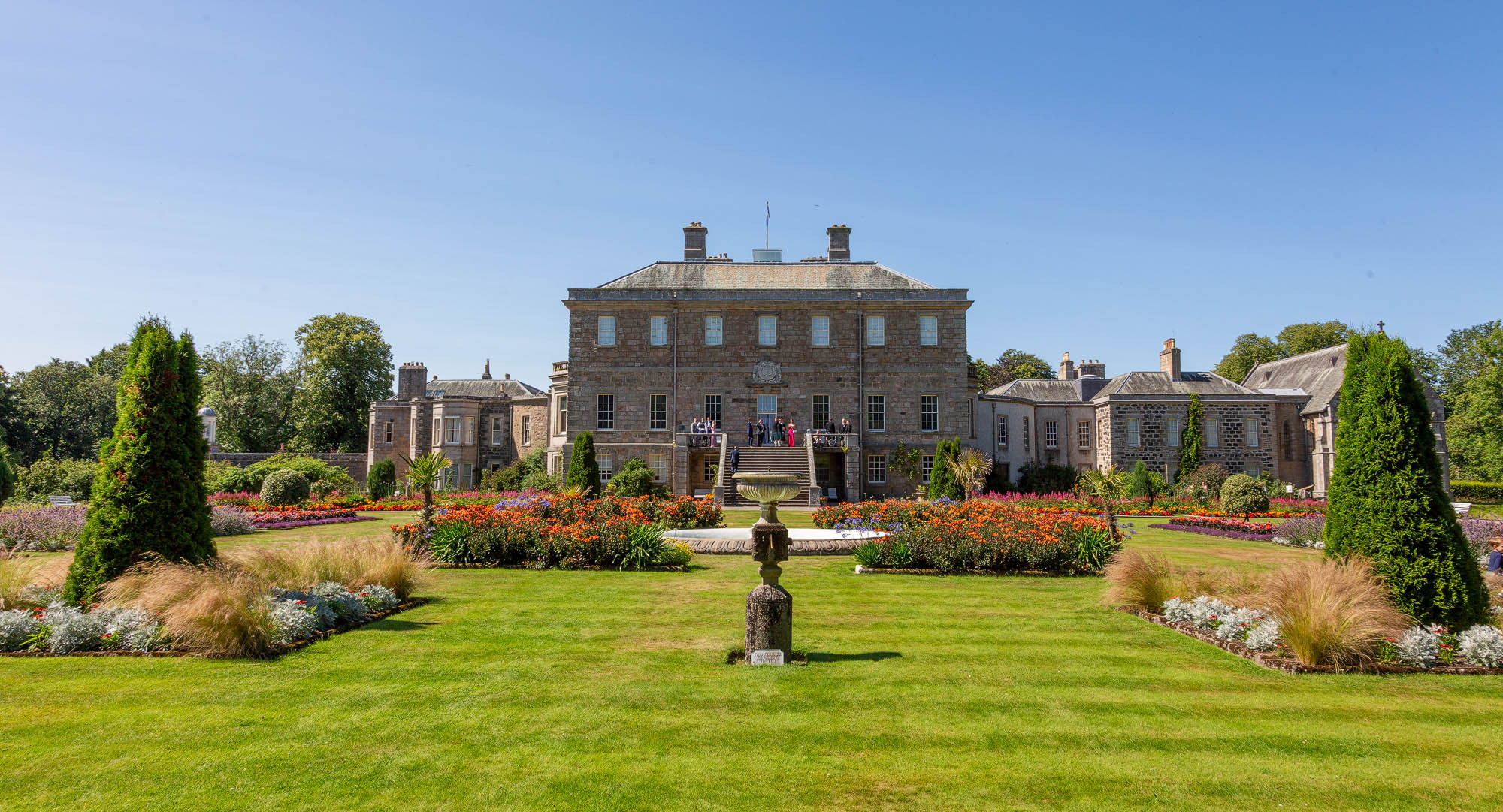
The front of the house is genuinely striking. The central block is flanked by those curved wings, creating a grand forecourt, and the twin sweeping staircases leading to the first-floor entrance give it real theatrical flair. When we visited, a wedding was taking place, so the house interior was closed to the public. We could see the wedding guests gathered on the upper terrace and staircase, and I have to say it looked like a spectacular setting for a celebration. It was slightly disappointing not to get inside, but it gave us all the more reason to explore every corner of the grounds.

The Terrace Gardens
If the front of the house is impressive, the rear is something else entirely. Walking around to the garden side, we were met with an absolute riot of colour. The formal terrace gardens were in full summer bloom, and they were breathtaking. Geometric flower beds burst with vibrant orange lilies, blue agapanthus, deep purple lavender, red dahlias, and every shade in between. Neatly clipped topiary and ornamental urns provided structure amid the exuberance.

These gardens have their origins in the designs of the 2nd Earl, who used the diggings from the house foundations to create the terraces. The 4th Earl later developed them further, and many of the features – the geometric rose beds, sundials, and even the commemorative trees planted by visiting dignitaries including Queen Victoria and Prince Albert – date from the early nineteenth century.


We spent a good while wandering through the different garden areas. There’s a lovely little formal rose garden tucked against the side of the house, and the herbaceous borders that run along the terraces are spectacular. I could have happily spent hours photographing the flower beds alone.


The Scots Mile and Golden Gates
From the rear terrace of the house, one of the most remarkable views in any Scottish estate opens up. The Scots Mile is a magnificent tree-lined avenue that stretches for over a mile (a traditional Scots mile is about ten per cent longer than a standard mile) from the house through the parkland. Standing at the top and looking down its entire length is one of those moments that makes you appreciate the sheer scale of ambition the 4th Earl had when he was developing the estate.

We walked the full length of the Scots Mile and it’s a delightful stroll, particularly on a warm day with the dappled shade of the mature trees overhead. Roughly halfway along, you pass through the magnificent Golden Gates, which were built by the 4th Earl around 1847. These have been beautifully restored to their former glory, with ornate gilded scrollwork and the Gordon coat of arms proudly displayed atop the ironwork. They’re a real highlight and well worth stopping to admire.


The Lakes and Country Park
Beyond the Scots Mile, the Haddo Country Park opens up with its network of walking trails, woodland paths, and two beautiful lakes. The lakes were created in the mid-1830s by damming the Kelly Burn. The Upper Lake, when frozen in winter, was once used to harvest blocks of ice that were stored in the estate’s ice house for preserving food. The Lower Lake was always given over to pleasure, with its boathouse, water lilies, and swans.


The lakes are a haven for wildlife. We spotted a large flock of greylag geese gathered on a small island and around the shallows, and there are bird hides dotted around for more serious birdwatchers. The whole area has a wonderfully peaceful feel, especially once you’ve walked beyond the busier areas closer to the car park.

The woodland walks through the country park are lovely, with wildflower meadows full of rosebay willowherb adding splashes of pink alongside the paths. It’s worth noting that Storm Arwen in 2021 devastated the estate, destroying around 100,000 trees. Evidence of this was still visible in places during our visit, but replanting is well under way and the estate is gradually recovering.

The Waterloo Monument
One of the more poignant features in the country park is the Waterloo Monument, a towering granite obelisk dedicated to Lieutenant-Colonel Sir Alexander Gordon KCB. Sir Alexander was the younger brother of the 4th Earl (the Prime Minister) and served as aide-de-camp to the Duke of Wellington throughout the Peninsular War. He was killed at the Battle of Waterloo on 18 June 1815, aged just twenty-nine. Wellington himself was said to be deeply distressed by his death.
The monument at Haddo is said to mirror the form of the memorial that marks the spot where Sir Alexander fell on the battlefield – which remains the only individual British memorial at Waterloo. Interpretive panels were added in 2015 to mark the bicentenary. It’s a moving tribute and a reminder that the history of Haddo extends well beyond the walls of the house itself.

Frequently Asked Questions
How much does it cost to visit Haddo House?
House tours are paid entry – adults approximately £17, with concessions available. National Trust for Scotland members enter free. The country park grounds are free to access, though parking is pay-and-display (managed by Aberdeenshire Council). Check the NTS website for the most up-to-date pricing.
Do I need to book a house tour in advance?
Yes, it’s recommended. Haddo House is open for guided tours only, lasting approximately 75 minutes. Tours run at set times (typically 11am, 1pm, and 3pm) on certain days. Phone 01651 851440 or book at the shop. Be aware that the house may close for private functions such as weddings.
Is Haddo House wheelchair accessible?
Yes, the ground and first floors of the house are fully accessible with a lift. Disabled visitors can enter through the front door. A wheelchair is available to borrow. The shop, tearoom, toilets, and much of the country park are also accessible. The second floor and chapel are only accessible via stairs.
Are dogs allowed at Haddo?
Dogs are welcome in the country park and must be kept under close control at all times (on a lead if they cannot be recalled). There is a dedicated, fenced dog park where they can run freely, plus an outdoor agility trail. Dogs are not permitted inside the house.
Is there parking at Haddo House?
Yes, there is a large pay-and-display car park in the country park. It can get very busy on sunny weekends, particularly between 1pm and 3pm on Sundays. Blue badge holders park free. NTS members visiting for a house tour receive free parking. Do not park on the road or verges.
What facilities are available?
The converted stable block houses the Courtyard Café (with indoor and outdoor seating), a well-stocked gift shop, and toilets. There is also an adventure playground for children in the country park, plus picnic areas and bird hides.
What are the opening times for Haddo House?
The house is currently open Friday to Monday for guided tours at 11am, 1pm, and 3pm. The country park, shop, and café have wider opening hours. Always check the NTS website or phone ahead before visiting, as the house may close for private events.
Key Information
- Location: Haddo House, Methlick, Ellon, Aberdeenshire, AB41 7EQ
- Grid Reference: NJ 868 347
- Managed by: National Trust for Scotland (house and gardens) / Aberdeenshire Council (Country Park)
- Entry: House tours paid (approx. £17 adult, NTS members free). Country park grounds free. Parking charges apply.
- Parking: Pay-and-display car park. Can be very busy on sunny weekends.
- Facilities: Courtyard Café, gift shop, toilets, adventure playground, bird hides, picnic areas
- Accessibility: House fully accessible on ground and first floors (lift available). Wheelchair provided. Most of the grounds and country park are accessible.
- Dogs: Welcome in the country park (under close control). Dedicated dog park available. Not allowed in the house.
What Else is Nearby?
Pitmedden Garden – Just fifteen minutes’ drive south, this National Trust for Scotland property features a spectacular recreation of a seventeenth-century walled garden with geometric floral designs, plus the Museum of Farming Life.
Tolquhon Castle – A hauntingly beautiful Renaissance castle ruin near Pitmedden, managed by Historic Environment Scotland. The intricate carved detailing is remarkable and it’s a wonderful spot for photography.
Fyvie Castle – Another NTS gem, this outstanding example of Scottish baronial architecture sits about twenty minutes north. With its magnificent sweeping staircase, portrait collection, and loch-side setting, it’s well worth combining with a visit to Haddo.
Gight Castle – The atmospheric ruins of this sixteenth-century castle sit above the River Ythan, just a few miles from Haddo. Once home to the Gordons of Gight and connected to the family of Lord Byron, it's a wonderfully evocative spot reached by a short woodland walk.
Prop of Ythsie – A short drive to the south-west, this hill offers easy walking with panoramic views across Aberdeenshire, and there’s a recumbent stone circle near the summit.
Final Thoughts
Even without getting inside Haddo House, Janette and I had a fantastic day out. The formal gardens alone are worth the visit – they were absolutely stunning in the summer sunshine, and the Scots Mile is one of the most impressive landscape features we’ve encountered at any Scottish estate. The country park adds a whole extra dimension, with the lakes, woodland walks, and wildlife making it easy to spend an entire afternoon here.
We’ll definitely be back to take the guided tour of the house itself – and next time, we’ll phone ahead to make sure there isn’t a wedding on! If you’re exploring Aberdeenshire, Haddo House and its grounds deserve a prominent place on your itinerary. Whether you come for the history, the gardens, or simply a peaceful walk by the lake, this place has something for everyone.


Leave a comment below