
Scotland's Universal Architect and Founder of an Architectural Dynasty
William Adam stands as one of the most influential figures in Scottish architectural history, a man whose vision and entrepreneurial spirit transformed the built landscape of 18th-century Scotland. Born in October 1689 in Linktown of Abbotshall, now a neighbourhood of Kirkcaldy in Fife, Adam would rise from humble origins as the son of a mason to become Scotland's pre-eminent architect, earning the title of "Universal Architect" for his remarkable versatility and prolific output. More than just a builder of grand houses, he was an entrepreneur, industrial pioneer, and the founder of an architectural dynasty that would influence design across Britain and beyond for generations to come.
Early Life and Training
William Adam was baptised on 24 October 1689, the only surviving child of John Adam, a mason, and Helen Cranstoun, daughter of William Cranstoun, 3rd Lord Cranstoun. This connection to minor nobility through his mother's line would prove advantageous, but it was his father's craft that shaped his early years. Young William attended Kirkcaldy Grammar School until 1704, when at the age of 15 he left formal education to apprentice as a mason, likely learning the trade from his father.
The details of Adam's architectural training remain somewhat mysterious, though it has often been suggested he apprenticed under the distinguished Sir William Bruce at Kinross House. However, the dates make this unlikely. More probable is that Adam gained exposure to Bruce's work at Hopetoun House, which Bruce was building between 1699 and 1703. By 1717, Adam had become a fully qualified member of the Kirkcaldy masons' guild, demonstrating his mastery of the craft. Before 1720, he undertook what would prove to be a formative journey to France and the Low Countries, visiting country houses and viewing the canal at Ostend, absorbing Continental architectural ideas that would later inform his distinctive style.
Business Ventures and Marriage
In 1714, Adam demonstrated the entrepreneurial acumen that would characterise his entire career by entering into partnership with William Robertson of Gladney, a local laird, to establish a brickworks at Linktown. This venture proved remarkably successful, and Adam is credited with introducing the manufacture of Dutch pantiles into Scotland, previously imported in huge numbers. This single innovation helped transform Scottish building practices and made Adam a wealthy man.
On 30 May 1716, Adam married his partner's daughter, Mary Robertson, and the couple moved into Gladney House at Abbotshall. The marriage would prove both personally happy and professionally advantageous, producing nine children, three of whom - John, Robert, and James - would follow their father into architecture and achieve even greater fame, particularly Robert, who would become one of the most celebrated architects of the 18th century.
The Rise of an Architect
Adam's political and religious affiliations played a crucial role in his architectural success. Unlike many of his predecessors, including Sir William Bruce and James Smith who were Episcopalians associated with Jacobitism, Adam was a Presbyterian Whig. In the post-1707 Scotland following the Act of Union, when Whig dominance was firmly established and Jacobite sympathisers faced suspicion and even imprisonment, Adam's political stance proved invaluable. It allowed him to acquire influential patrons such as John Dalrymple, 2nd Earl of Stair, and Sir John Clerk of Penicuik, who not only commissioned work from him but actively sought to secure government positions and contracts on his behalf.
Adam's breakthrough came in 1720 when he worked on a major expansion of Floors Castle, implementing designs by the renowned architect John Vanbrugh. The following year brought his defining commission - the transformation of Hopetoun House near Edinburgh for Charles Hope, 1st Earl of Hopetoun. Taking an already grand house designed by Sir William Bruce, Adam was tasked with making it grander still. He added magnificent Palladian wings, a monumental east facade with Ionic colonnades, and sweeping curved colonnades that connected the main house to flanking pavilions. The work would continue until Adam's death in 1748 and would then be completed by his sons John and Robert. Hopetoun House remains one of Scotland's finest stately homes and a testament to Adam's vision.
A Distinctive Architectural Style
William Adam developed a unique architectural voice that drew eclectically from multiple sources whilst maintaining a coherent and recognisable style. His chief influences came from English Palladianism, particularly designs featured in Colen Campbell's influential Vitruvius Britannicus, but Adam mixed these classical principles with English Baroque motifs borrowed from James Gibbs and John Vanbrugh. He relied heavily on French, Italian, and English pattern books, particularly Gibbs' Book of Architecture, from which he borrowed freely with little concern for stylistic purity.
What made Adam's work distinctive was his willingness to combine these diverse influences into something uniquely Scottish. He took inspiration from earlier Scottish Renaissance architecture and from his predecessors Bruce and Smith, whilst adding his own exuberant, sometimes theatrical flourishes. His buildings were always well constructed and carefully planned, with architectural splendour both inside and out. He worked closely with expert plasterers and artists to ensure that interior decoration matched the grandeur of his exteriors.
Major Works
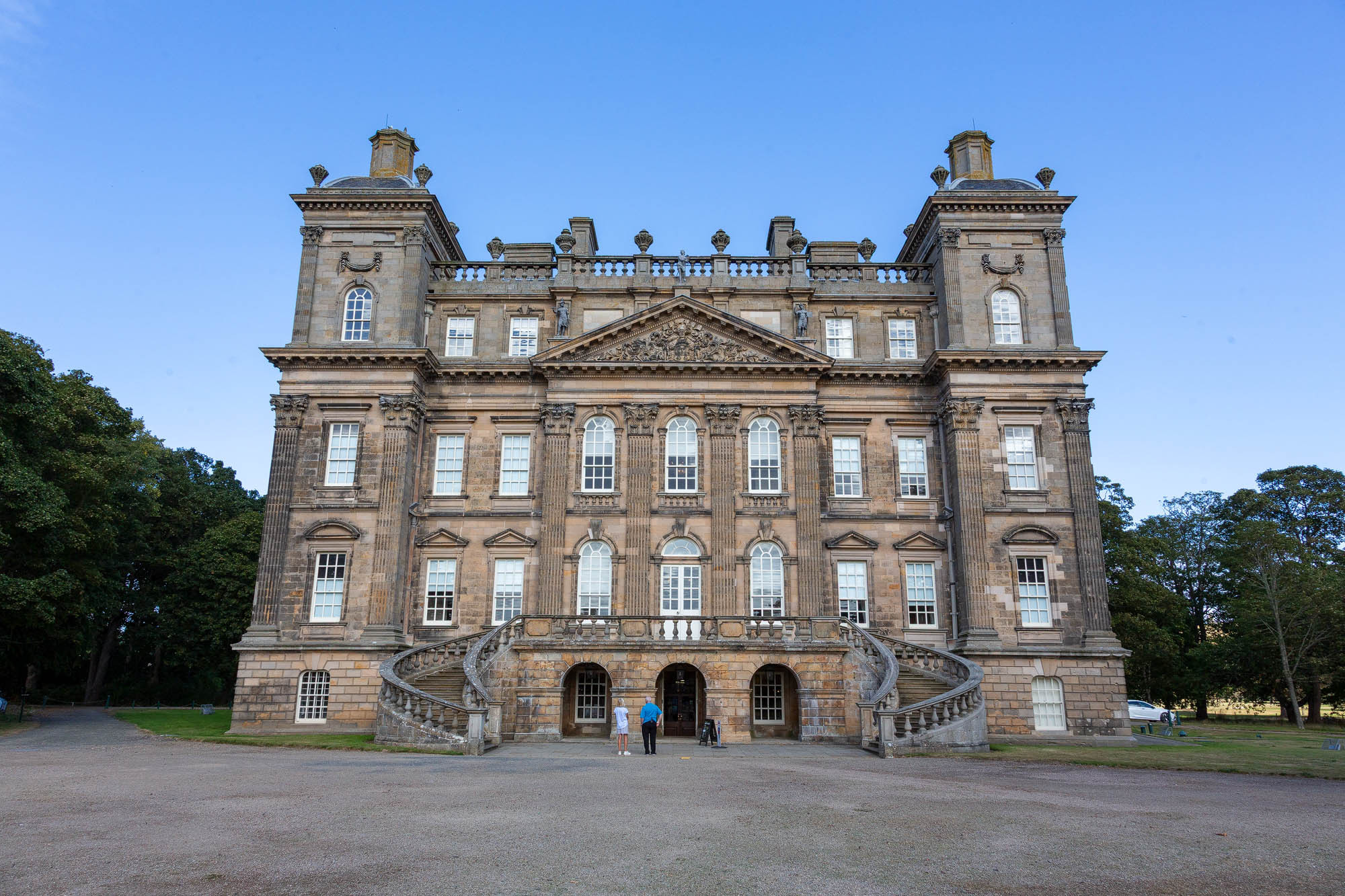
During his nearly 30-year career as an architect, William Adam designed, extended, or remodelled over 40 country houses and undertook numerous public contracts. Among his most celebrated works is Duff House in Banff, built between 1735 and 1739 for William, Lord Braco. This remarkable building has been described as "a medieval castle in baroque dress", combining vertical drama with baroque detailing. The main facade is notable for its impressive height and tall corner towers, creating a distinctly vertical composition that recalls earlier Scottish tower houses whilst embracing classical principles. Adam acted as both architect and contractor for this project, though it would end in a protracted legal dispute with Lord Braco over costs, a case that was not fully settled until just before Adam's death.
House of Dun in Angus, built in 1730, is perhaps the finest surviving example of a William Adam modest-sized country house. The design incorporated ideas from fellow architects Alexander McGill and the Earl of Mar, featuring a triumphal arch motif on the entrance front - the first use of this classical element on a villa facade in Britain. The elaborate interior decoration includes allegorical plasterwork by Joseph Enzer in the saloon, with statues of gods and goddesses and mythological scenes complementing Adam's elegant architectural proportions.
Other significant works included Arniston House near Gorebridge, begun in 1726, with its ambitious Vanbrugh-inspired baroque style and extensive grounds featuring a parterre, cascade, and main avenue centred on Arthur's Seat. The stucco work in the hall at Arniston represents one of Adam's finest Vanbrughian interiors. Haddo House in Aberdeenshire, Mavisbank House (a collaboration with Sir John Clerk of Penicuik that introduced Scotland's first suburban Palladian villa), and Chatelherault, the Duke of Hamilton's hunting lodge built between 1731 and 1743, all demonstrate Adam's versatility and skill.
Government Posts and Expanding Enterprises
On 21 February 1728, Adam was made a burgess of Edinburgh and moved with his family to a property on the Cowgate, where he later built a large tenement. In 1730, he was appointed to the government post of Principal Mason to the Board of Ordnance in North Britain, a position that brought lucrative building contracts for forts and other military structures, particularly after the Jacobite Rising of 1745.
Adam's business activities extended far beyond architecture. Since taking on the Hopetoun commission in 1721, he had leased quarries near Queensferry which provided stone for his building contracts. Starting in 1734, he leased lofts, granaries, and warehouses in Leith, and acquired coal mines and salt pans at Cockenzie. Later, at nearby Pinkie, he built a canal between 1742 and 1744 to serve the mines. He also pursued agricultural improvements and operated barley mills and marble works.
Blair Adam and Vitruvius Scoticus
In 1731, Adam purchased an estate in Kinross-shire called Blair Crambeth, which he renamed Blair Adam. This became his main focus in later years as he worked to improve the property, planting trees, fencing land, starting coal mines, and even creating a village called Maryburgh for the miners. The estate featured landscaped gardens and a substantial library that facilitated intellectual gatherings, making it a significant cultural centre in 18th-century Scotland. Blair Adam would remain in the family for generations, passing to his son John and then to subsequent descendants who would include notable politicians, soldiers, and civil servants.
Around 1727, Adam began an ambitious project to collect engravings of contemporary architectural masterpieces for publication. This work, intended to showcase the sophistication of Scottish architecture and counter English-focused publications like Campbell's Vitruvius Britannicus, would become Vitruvius Scoticus. The collection of 160 engraved plates presented plans, elevations, and sections primarily of Adam's own designs, drawing inspiration from the Roman architect Vitruvius and Andrea Palladio whilst promoting a distinctly Scottish classical tradition. Though Adam worked on it throughout the 1730s and 1740s, the work was not published until 1812, long after his death.
Final Years and Legacy
William Adam died in Edinburgh on 24 June 1748 and was buried in Greyfriars Kirkyard. His will was confirmed in Edinburgh Commissary Court on 8 August 1748. The Caledonian Mercury's obituary noted that "it is fortunate he has left behind him some promising young men to carry on what he has so happily begun" - a prescient observation, as his sons would indeed carry on and amplify his legacy.
Critical assessment of William Adam's work has varied over the centuries. In the 18th century, he was universally regarded as Scotland's "Universal Architect", a title that reflected both his versatility and his dominance of the architectural profession in Scotland. However, from the early 20th century onwards, architectural critics took a more measured view. Colin McWilliam, for instance, found the quality of his work "varied to an extreme degree", noting that whilst some buildings were masterpieces, others showed less consistent quality.
Modern scholarship, including The Architecture of Scotland, 1660-1750 published in 2021, has reaffirmed Adam's pivotal role in the classical revival in Scotland, analysing his stylistic synthesis through archival evidence. Key sites like Hopetoun House, now a Category A listed building, underscore this enduring impact, with heritage protections safeguarding his designs as exemplars of Scottish neoclassicism.
Yet William Adam's true legacy extends beyond his own buildings. Through his three architect sons - John, Robert, and James - he founded a dynasty that would transform British architecture. Robert and James Adam would develop the famous "Adam style" that became synonymous with refined neoclassical elegance throughout the English-speaking world. The Adams' work at houses like Kedleston Hall, Syon House, and Culzean Castle would make them the most celebrated architects of their age, but all were built on foundations laid by William.
William Adam left Scotland a richer place, both literally through his varied business enterprises and figuratively through his architectural contributions. His buildings, from the grandeur of Hopetoun to the compact elegance of House of Dun, continue to enhance Scotland's built heritage. As the patriarch of Scotland's greatest architectural dynasty, the entrepreneur who modernised Scottish building practices, and the visionary who adapted Continental classicism to Scottish traditions, William Adam truly earned his title as Scotland's "Universal Architect".


