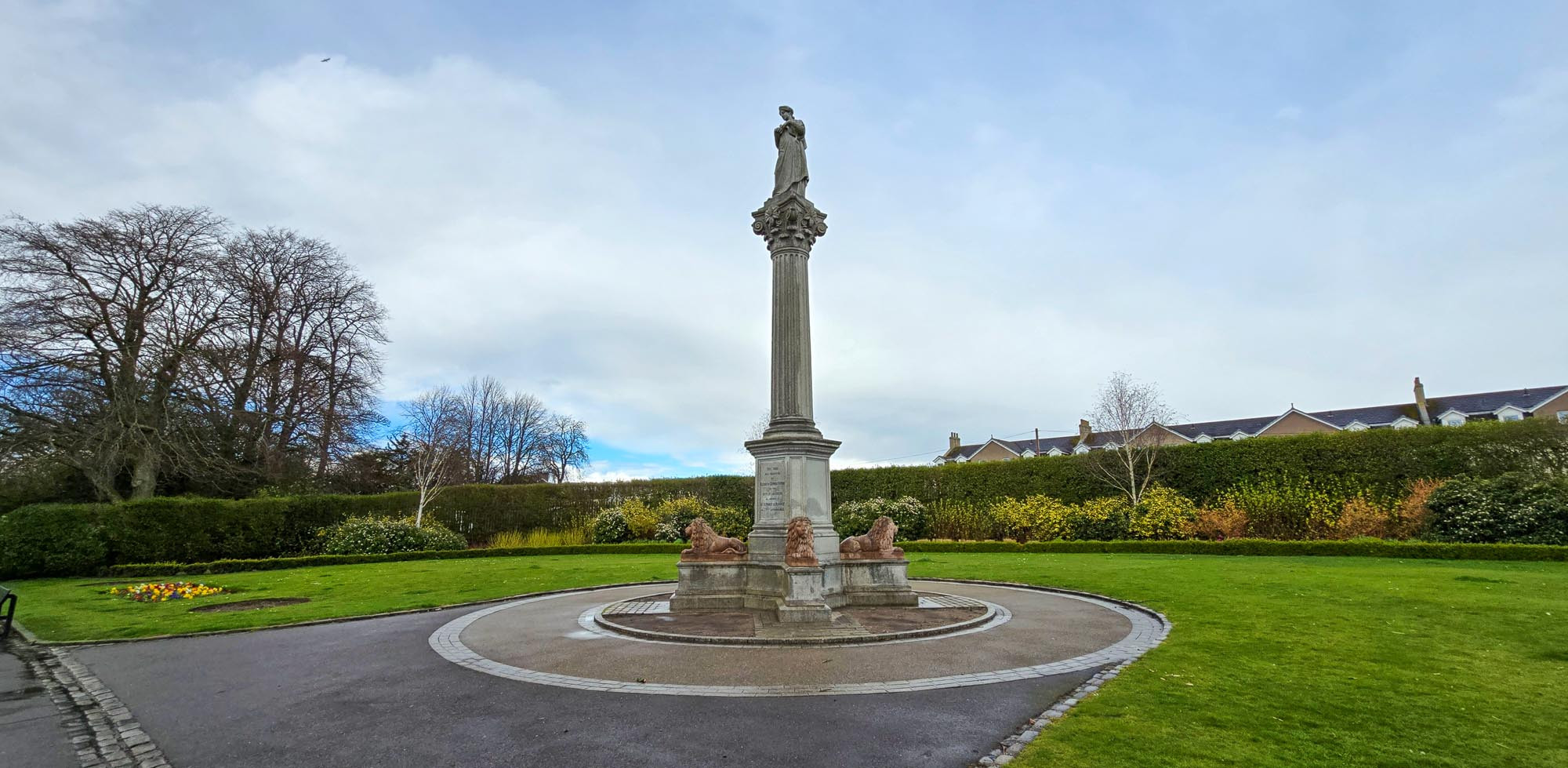
The Hygeia Monument – Aberdeen’s Tribute to a Generous Benefactor
Standing proudly on the eastern side of Duthie Park in Aberdeen, the Hygeia Monument is one of the Granite City’s most elegant and historically significant public memorials. Erected in 1898, this striking monument honours Miss Elizabeth Crombie Duthie of Ruthrieston – the remarkable woman who gifted the 44-acre park to the people of Aberdeen in 1880. Topped with a granite figure of the Greek goddess of health, the monument is a beautiful fusion of classical design and Victorian civic pride, and it remains a powerful reminder of one woman’s extraordinary generosity.
History of the Hygeia Monument
Elizabeth Crombie Duthie and Her Gift to Aberdeen
The story of the Hygeia Monument begins not with the monument itself, but with the extraordinary act of generosity that inspired it. In 1880, Miss Elizabeth Crombie Duthie of Ruthrieston purchased the 44-acre Arthurseat estate on the banks of the River Dee for £30,000. Her intention was to gift the land to the people of Aberdeen as a public park, in memory of her uncle Walter Duthie and her brother Alexander Duthie.
The park was designed by William R. McKelvie of Dundee – the same landscape architect who laid out Balgay Park in Dundee – and the first turf was cut on 27th August 1881 by the Earl of Aberdeen. Two years later, on 27th September 1883, Duthie Park was officially opened by Her Royal Highness Princess Beatrice, the youngest daughter of Queen Victoria. The occasion was declared a public holiday, and celebrations rang out across the city.
Miss Duthie’s deed of gift specified that the park was to be used for “the wellbeing and recreation of Aberdeen inhabitants” – a remarkably forward-thinking vision in the Victorian era, when public green spaces were increasingly recognised as essential oases amid the smoke and squalor of industrialised urban life.
The Monument Itself
The Hygeia memorial was erected in the park in 1898, some fifteen years after it opened, as a tribute to Miss Duthie’s contribution to the city. The monument was designed by John Cassidy, the well-known Irish-born sculptor based in Manchester, and was carved from granite by Arthur Taylor at his yard on Jute Street in Aberdeen.
Cassidy was a prolific and highly regarded sculptor of the late Victorian and Edwardian periods. Born in County Meath, Ireland, in 1860, he studied at the Manchester School of Art before establishing himself as one of the north of England’s leading sculptors. His works can be found across the United Kingdom, including several notable pieces in Manchester and the now-controversial statue of Edward Colston in Bristol, which was famously toppled in 2020.

The monument depicts the Greek goddess Hygeia – the goddess of good health and the prevention of sickness – standing in classical dress atop an elegant fluted Corinthian column. She holds a cup from which a serpent drinks, a traditional symbol of health and healing. In Greek mythology, Hygeia was the daughter of Asclepius, the god of medicine, and her name is the root of the English word “hygiene.” From the 18th century onwards, she came to be seen as a patron saint of fresh air and healthy living – making her a particularly apt choice for a monument in a park designed to improve the health and wellbeing of city dwellers.
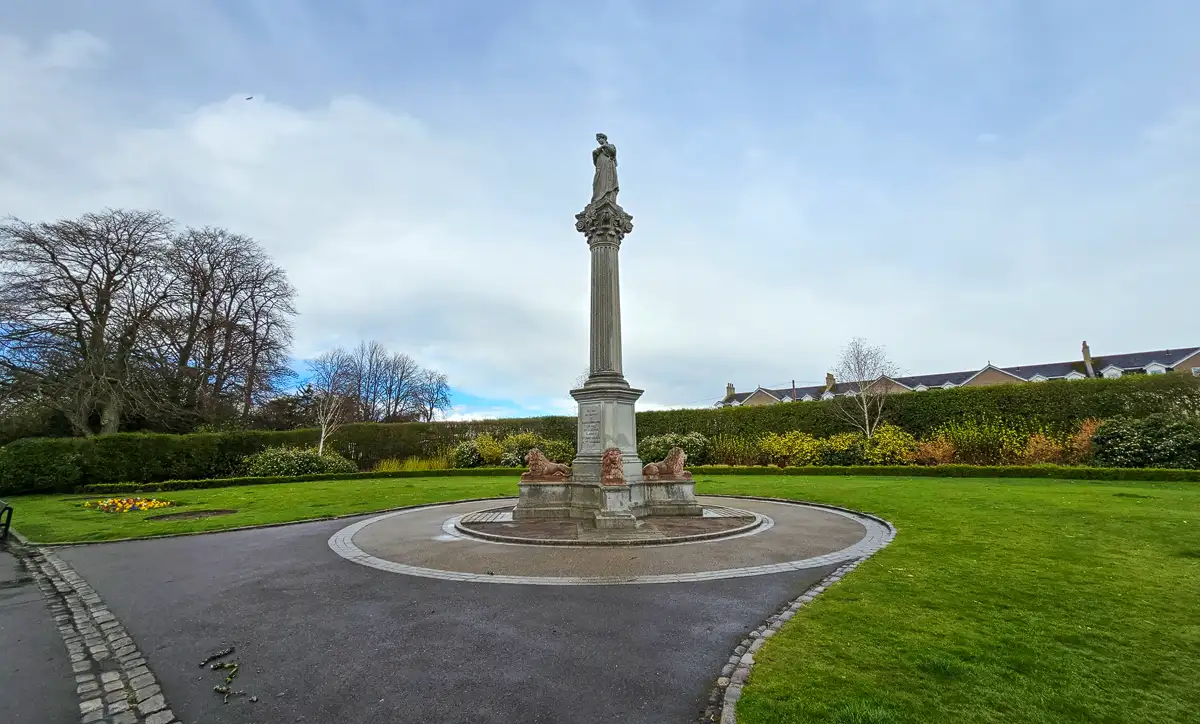
The design of the monument was influenced by Nelson’s Column in London, erected some sixty years earlier. Hygeia stands on a beautifully carved Corinthian capital adorned with scrollwork and acanthus leaves, which in turn sits atop the tall fluted column. At the base, four recumbent lions carved from distinctive pink granite guard the monument. These lions are reportedly among the first objects to have been carved by machine, and an old photograph on the nearby interpretation board shows stonemasons undertaking the final hand-finishing work in their workshop.

The chamfered plinth bears a carved inscription that reads: “This park was presented by Elizabeth Crombie Duthie to the City of Aberdeen and opened by H.R.H. Princess Beatrice on 27th September 1883.” It’s a fitting tribute to a woman whose generosity has benefited generations of Aberdonians. Miss Duthie’s own memorial can be found in the kirkyard at the Kirk of St Nicholas in Aberdeen, where the epitaph reads: “Her best and most enduring memorial is the park she gave to her fellow citizens.”
The Hygeia Monument was designated as a Category B Listed Building by Historic Environment Scotland on 19th March 1984 (reference LB20057), recognising its architectural and historic significance.
Restoration
In 2012, the monument underwent significant restoration as part of a wider £5 million refurbishment of Duthie Park, funded jointly by the Heritage Lottery Fund and Aberdeen City Council. The monument setting was restored close to its original Victorian design, with the planting bed surrounding the statue reinstated for colourful bedding displays. A new circular footpath was laid around the monument, and the whole area was framed by new arced planting displays and a large hedge to provide an attractive backdrop. The restoration was completed in late 2012, and the wider park officially reopened on 30th June 2013.
Our Visit
Getting There
Janette and I visited the Hygeia Monument on a bright but blustery day – fairly typical Aberdeen weather, in other words. Duthie Park is easy enough to find, located on Polmuir Road in the Ferryhill area of Aberdeen, just south of the city centre. We drove down and parked in the free car park off Riverside Drive, which has plenty of spaces. From there, it’s a pleasant two or three-minute walk through the park to reach the monument on its eastern side.
If you’re coming by bus, First Bus routes 17, 17A, and 18 all stop at Duthie Park on Great Southern Road, putting you within easy walking distance of the monument and the rest of the park.
Exploring the Monument
As we approached the monument along the park’s curving pathways, it was impossible not to be impressed by the scale and elegance of the thing. The fluted Corinthian column rises high into the sky, with the figure of Hygeia standing serenely at the top, gazing down over the park that bears her benefactor’s name. On a clear day, she makes quite a striking silhouette against the sky.

The level of craftsmanship in the carving is remarkable, particularly on the Corinthian capital where the scrollwork and acanthus leaf detailing are incredibly intricate for granite work. It’s worth taking a moment to appreciate the skill involved – granite is notoriously difficult to carve with such precision, and the fact that Arthur Taylor achieved this level of detail at his Jute Street yard is testament to Aberdeen’s proud tradition of granite masonry.
The four pink granite lions at the base are a real highlight. They lie recumbent on their plinths with wonderfully expressive faces, and the contrast between their warm pink stone and the pale grey of the column is very effective. I spent a good few minutes photographing them from various angles.
We also took time to read the inscription on the plinth and the nearby interpretation board, which provides excellent detail about the history of the monument, Miss Duthie, and the 2012 restoration. The board includes old photographs of the lions being finished in the stonemasons’ workshop, which is a fascinating glimpse into the craftsmanship of the era.

The Wider Park
Of course, the Hygeia Monument is just one of many things to see in Duthie Park, and we made a good afternoon of exploring the wider grounds. The park is a real gem – beautifully maintained with a Victorian bandstand, ornamental ponds, a rose mound, and the David Welch Winter Gardens, which house one of Europe’s largest indoor plant collections. There’s also a café, excellent play areas for children, and the McGrigor Obelisk and Gordon Highlanders Memorial to discover.
For those who enjoy longer walks, the Deeside Way – a long-distance path following the old Deeside Railway line – begins at Duthie Park, offering a traffic-free route out towards Royal Deeside.
Frequently Asked Questions
Is there an entry fee to see the Hygeia Monument?
No. The Hygeia Monument is in Duthie Park, which is free to enter and open to the public daily from 8am until one hour before dusk.
Is there parking at Duthie Park?
Yes. There is a free car park at Duthie Park off Riverside Drive, with ample spaces available.
Is the Hygeia Monument wheelchair accessible?
Yes. The monument is on level ground and surrounded by paved pathways. The wider park is generally accessible, with tarmac paths throughout.
Are dogs allowed at Duthie Park?
Yes, dogs are welcome in the park and around the monument area. However, only assistance dogs are permitted inside the David Welch Winter Gardens.
How old is the Hygeia Monument?
The monument was erected in 1898, making it over 125 years old. It commemorates Miss Elizabeth Crombie Duthie, who gifted the park to the city in 1880.
Is the Hygeia Monument a listed building?
Yes. The monument is Category B Listed by Historic Environment Scotland (reference LB20057), listed on 19th March 1984.
Are there toilets and a café nearby?
Yes. Duthie Park has public toilets and a popular park café. The David Welch Winter Gardens are also within the park and free to enter.
Key Information
- Location: Duthie Park, Polmuir Road, Aberdeen, AB11 7TH
- Grid Reference: NJ 93953 04493
- Managed by: Aberdeen City Council
- Entry: Free
- Parking: Free car park at Duthie Park off Riverside Drive
- Facilities: Café, toilets, David Welch Winter Gardens, play areas, boating pond
- Accessibility: Fully accessible – level ground with paved pathways
- Dogs: Welcome in the park (assistance dogs only in Winter Gardens)
What Else is Nearby?
David Welch Winter Gardens – Located within Duthie Park itself, the Winter Gardens house one of Europe’s largest indoor plant collections, including tropical and arid houses with one of Britain’s largest cacti collections. Free entry.
McGrigor Obelisk – Also within Duthie Park, this impressive 70-foot pink granite obelisk commemorates Sir James McGrigor, the military surgeon who reformed the Army Medical Service. Originally located at Marischal College, it was moved to the park in 1906.
Gordon Highlanders Memorial – A striking Celtic cross in grey granite within Duthie Park, honouring the famous northeast Scotland regiment and their service in the Egyptian Campaign.
The Deeside Way – This long-distance walking and cycling path begins at Duthie Park and follows the route of the old Deeside Railway for over 40 miles towards Ballater, passing through beautiful Royal Deeside scenery.
J.J.R. Macleod Memorial Statue – Unveiled in Duthie Park in October 2023, this statue celebrates the 100th anniversary of Professor Macleod’s Nobel Prize for his role in the discovery of insulin.
Final Thoughts
The Hygeia Monument is one of those lovely, often-overlooked treasures that rewards a closer look. It’s easy to walk past it on the way to the Winter Gardens or the play areas, but taking the time to stop and appreciate the craftsmanship of the carving, the history behind it, and the story of Elizabeth Crombie Duthie’s remarkable generosity makes it a genuinely rewarding visit. The 2012 restoration has returned the monument to something approaching its original Victorian splendour, and the surrounding planting and paving create a fitting setting for this elegant memorial.
If you’re visiting Duthie Park – and you really should, it’s one of Aberdeen’s finest green spaces – make sure you take a few minutes to visit Hygeia and pay your respects to the woman who made it all possible.


Leave a comment below