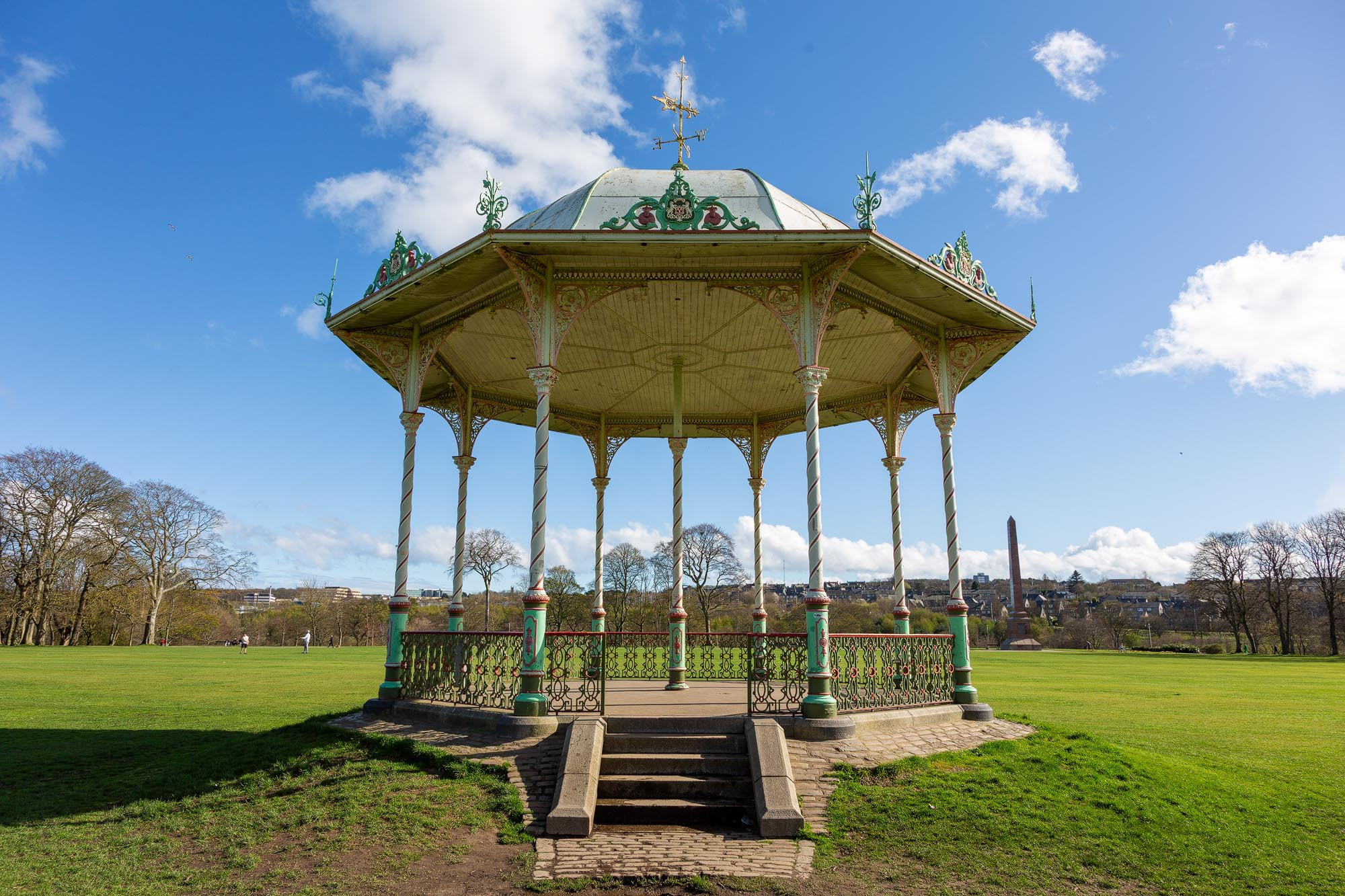
Standing proud in the centre of one of Aberdeen’s most beloved green spaces, the Duthie Park Bandstand is a gorgeous piece of Victorian craftsmanship that has been a focal point of this 44-acre park for well over a century. Built in 1893 by the Glasgow firm McDowall, Steven & Co, this octagonal cast-iron bandstand is a Category B listed structure and one of the finest surviving examples of its kind in Scotland. With its distinctive barley-sugar columns, copper ogee roof, and ornate cartouches bearing the Aberdeen coat of arms, it’s a structure that rewards a closer look – and one that sits within a park absolutely brimming with history and things to see.

A Gift to the Granite City
To understand the bandstand, you first need to know the story of Duthie Park itself. The land on which the park now stands was once barren ground known as Pulmoor, covered in gorse and whin bushes. In the 18th century, a Professor Thomas Maxwell bought several acres and built a large house, though he apparently planted very little. The land changed hands over the decades, and by 1850 the site – centred on a villa called Arthurseat – was being eyed up for development as a “Royal Garden” where visitors could watch the new trains crossing the viaduct at Ferryhill.
That plan never materialised. Instead, in 1880, Miss Elizabeth Crombie Duthie of Ruthrieston stepped forward with a far more generous vision. Elizabeth came from the wealthy Duthie family of merchants, shipowners, and shipbuilders. She had been left substantial sums following the deaths of her uncle Walter Duthie and her brother Alexander, and she wanted to create a lasting memorial to them. Her suggestion of a public park was enthusiastically accepted by Aberdeen Town Council on 5th July 1880, and she purchased the 44 acres of land for £30,000.
The park was designed by William R. McKelvie of Dundee – the same architect responsible for Balgay Park in that city – and the first turf was cut on 27th August 1881. By spring 1882, the old farmland was being transformed with new paths, trees, and shrubs. The park was officially opened on 27th September 1883 by Princess Beatrice, youngest daughter of Queen Victoria, and was intended to be “available for all classes of citizens” with “a broad expanse of grassy sward upon which the young might indulge in innocent frolic and play.”
The Bandstand – A Victorian Showpiece
The bandstand arrived a decade after the park opened, completed in 1893 at a cost of around £400. It was manufactured by McDowall, Steven & Co of Glasgow, one of the leading ironwork foundries of the Victorian era, and was designed by William McKelvie as part of his overall vision for the park.

It’s an octagonal structure, raised on a granite plinth with five steps leading up to the platform from the north side. Eight cast-iron columns ring the perimeter, linked by geometric railings, with a ninth column at the centre. The columns are stamped with the maker’s name and feature stylised Corinthian capitals with mullets (star shapes) inset into the design. Perhaps the most eye-catching feature of the columns is their distinctive barley-sugar twist pattern – a spiral design painted in cream and red that gives them a wonderfully ornamental quality.
The roof is a copper octagonal ogee dome with a boarded timber underside, supported on beautifully decorative ironwork brackets. At the apex sits a weathervane, and at each angle of the roof are decorative cast-iron finials. Between the finials, cartouches bear the Aberdeen coat of arms – a lovely civic touch that firmly roots this structure in the identity of the Granite City.

The bandstand was listed as a Category B building on 29th February 2000 by Historic Environment Scotland (reference LB46777), recognising its architectural and historic significance. It forms part of a B-Group listing alongside many other features within Duthie Park, including the bowling pavilion, east lodge, gates, footbridge, fountain, the Hygeia Statue, the McGrigor Obelisk, and several other monuments and memorials.
The Wider Park
Duthie Park has evolved considerably since its Victorian origins, though its essential character has been beautifully preserved. The David Welch Winter Gardens – one of Europe’s largest indoor gardens and Scotland’s third most visited – were originally built in the 1890s, though the current building dates from 1970 after the original was severely damaged by gales in 1969. The Winter Gardens house one of Britain’s biggest collections of cacti and succulents, along with tropical, temperate, and arid plant displays.
The park also features the Hygeia Monument, erected in memory of Miss Duthie after her death, depicting the Greek goddess of health with four lions guarding the base. The McGrigor Obelisk, which originally stood outside Marischal College, was relocated here in 1905 when the college was extended. There are linked lakes, a boating pond, a Japanese Garden designed by Takashi Sawano to commemorate the victims of Hiroshima and Nagasaki, multiple play areas, and the Mound – created from earth excavated during the construction of the lakes.
A major Heritage Lottery Fund restoration saw the park’s Victorian features lovingly restored, and Duthie Park has held the Green Flag award from Keep Scotland Beautiful since 2013. The park also connects directly to the Deeside Way, the former railway line that once carried passengers from Aberdeen to Ballater and now serves as a popular walking and cycling route.
Our Visit
Getting There
Janette and I visited Duthie Park on a gorgeous spring day – one of those rare Aberdeen days where the sky was a deep blue and the sun had genuine warmth to it. We drove in and used the Polmuir Road car park, which is the main parking area for the park. It’s free, but I’d heard it can fill up quickly on nice days, so we made sure to arrive reasonably early. There’s also parking available on the Riverside Drive side of the park, though that can have a time restriction of around three hours.
The park is well served by bus if you’d rather not drive – several routes including the 7, 7B, X6, 8, 8A, and 17 stop nearby, and you can be here from Aberdeen city centre in around seven minutes. Aberdeen railway station is about a mile and a half away.
Exploring the Bandstand
From the car park, it’s only a few minutes’ walk across to the central green where the bandstand sits. And what a sight it is. Even from a distance, the bandstand looks wonderful – its copper roof catching the light, the weathervane glinting, and that lovely patina of age giving it a character that no new build could ever replicate.

Up close, the level of detail in the ironwork is really impressive. I spent a good while photographing the barley-sugar columns, which have that lovely spiral twist painted in red and cream. The Corinthian-style capitals are beautifully detailed, and you can still make out the maker’s name – McDowall, Steven & Co – stamped into the castings. The geometric railings around the perimeter are intricate without being fussy, and the whole structure feels solid and purposeful despite being over 130 years old.
The real highlight for me was the cartouches between the roof finials. Each one bears the Aberdeen coat of arms with the city’s famous motto “Bon Accord” clearly visible. They’re painted in green, cream, and a rich red-pink, and they’re a wonderful piece of civic pride cast in iron. I got the drone up for a closer look and was glad I did – from ground level, you can see them, but the detail is best appreciated up close.

We climbed the steps and stood on the platform for a few minutes, just taking in the view. From here, you get a real sense of how prominent the bandstand is within the park – it sits right in the heart of the broad central green, with the McGrigor Obelisk visible to the south and the David Welch Winter Gardens off to the west. The granite houses of Ferryhill rise on the hillside beyond the park, and on a clear day like ours, the view was superb.
The Wider Park
After spending a good while at the bandstand, we wandered across to the Winter Gardens. Entry is free, and even on a chilly day, the glasshouses are a wonderful retreat. The tropical house is lush and warm, the arid house has an incredible collection of cacti, and the whole place is beautifully maintained. There’s even a talking cactus called Spike – a quirky touch that delights children and adults alike.

We finished up with a coffee at the Park Café, which has both indoor and outdoor seating and a decent selection of hot drinks, cakes, and light lunches. A very pleasant way to round off a visit.
Frequently Asked Questions
Is there an entry fee for Duthie Park and the bandstand?
No. Duthie Park is completely free to enter and open to the public at all times. The David Welch Winter Gardens are also free to visit.
Where can I park at Duthie Park?
There is a free car park at the Polmuir Road entrance and additional parking on Riverside Drive. The park is very popular on sunny days and parking can fill up quickly, so arriving early is recommended. Alternative parking options are signposted when the main car park is full.
Is the bandstand wheelchair accessible?
The paths throughout Duthie Park are paved and generally flat, making the park suitable for wheelchair users and pushchairs. However, the bandstand itself is raised on a granite plinth with steps, so access to the platform may be difficult for wheelchair users.
Can I bring my dog to Duthie Park?
Yes, dogs are welcome throughout the park. However, only assistance dogs are permitted inside the David Welch Winter Gardens.
Are there toilets at Duthie Park?
There is a chargeable automated public convenience in the park, available at all times. There are also toilet facilities within the Winter Gardens during opening hours.
What are the opening hours?
Duthie Park is open at all times. The David Welch Winter Gardens has seasonal opening hours – check the Aberdeen City Council website for current times. The Park Café also has its own opening hours.
Is the bandstand a listed building?
Yes. The Duthie Park Bandstand is a Category B listed building, designated on 29th February 2000 by Historic Environment Scotland (reference LB46777). It forms part of a B-Group listing with numerous other features within the park.
Key Information
- Location: Duthie Park, Polmuir Road, Aberdeen, AB11 7TH
- Grid Reference: NJ 93817 04395
- Managed by: Aberdeen City Council
- Entry: Free
- Parking: Free car parks at Polmuir Road and Riverside Drive
- Facilities: Park Café, automated public toilets, David Welch Winter Gardens (free), play areas, boating pond, bike stands
- Accessibility: Paved paths, mostly flat terrain; bandstand platform accessed via steps
- Dogs: Welcome in the park; assistance dogs only in Winter Gardens
What Else is Nearby?
David Welch Winter Gardens – Located right within Duthie Park, these are one of Europe’s largest indoor gardens and house an incredible collection of exotic plants, cacti, and succulents. Free entry and open year-round.
The Deeside Way – This former railway line starts at Duthie Park and stretches over 40 miles through Royal Deeside towards Ballater. It’s a fantastic traffic-free walking and cycling route.
Aberdeen Maritime Museum – Located on the city’s historic Shiprow overlooking the harbour, this free museum tells the story of Aberdeen’s long relationship with the sea, from fishing and shipbuilding to the North Sea oil industry.
Provost Skene’s House – One of Aberdeen’s oldest surviving buildings, this 16th-century townhouse in the city centre celebrates the pioneering people of Aberdeen who have shaped the city and the wider world.
Aberdeen Art Gallery – A recently refurbished gallery housing an impressive collection that includes works by Joan Eardley, Francis Bacon, and Claude Monet, along with applied art and design exhibitions.
Final Thoughts
The Duthie Park Bandstand is one of those structures that could easily be overlooked if you were just passing through the park on a quick walk. But take the time to stop, look up at the cartouches, admire the barley-sugar columns, and stand on the platform to take in the view, and you’ll find a beautifully preserved piece of Victorian civic pride. It’s a reminder of an era when public parks were designed with care and ambition, and when even a bandstand was crafted with artistry and attention to detail.
Combined with the Winter Gardens, the linked lakes, the memorials, and the park’s many other features, the bandstand is just one more reason why Duthie Park deserves its reputation as one of Aberdeen’s finest green spaces. We thoroughly enjoyed our visit, and if you find yourself in the Granite City, I’d strongly recommend making time for this wonderful park.


Leave a comment below