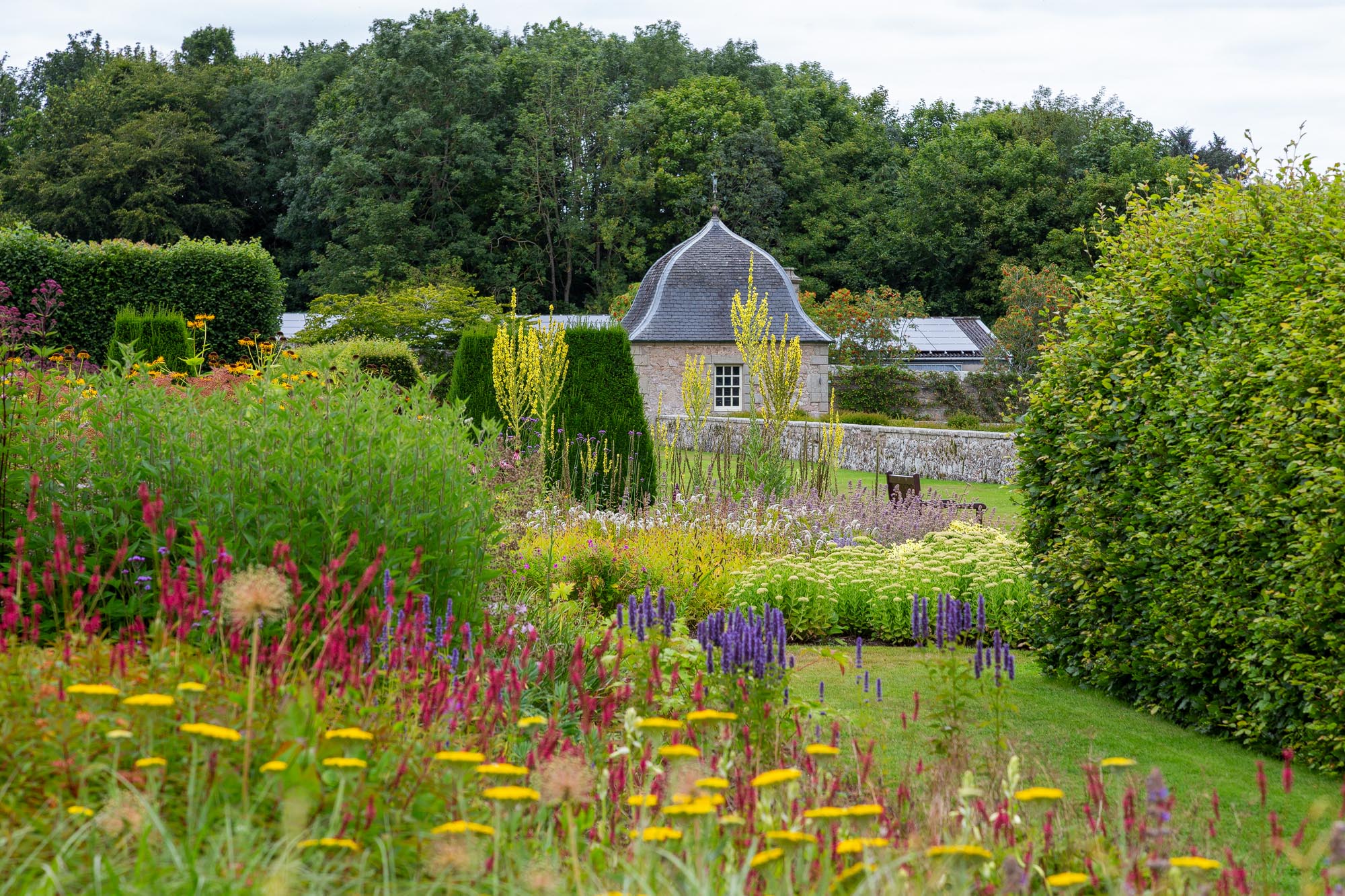
Set in the rural heart of Aberdeenshire, Pitmedden Garden sits just south of the village that shares its name, around two miles from Tarves and midway along the A920 between Oldmeldrum and Ellon. The property is cared for by the National Trust for Scotland (NTS). Although it lacks the imposing castle or stately home that often accompanies historic gardens in the region, it offers one of the most visually striking and carefully maintained formal landscapes in Scotland.

The History of Pitmedden Gardens
The garden seen today is a 20th-century reimagining of the “Great Garden” first created here in 1675 by Sir Alexander Seton. When Major James Keith gifted Pitmedden House and its grounds to the NTS in 1952, the Trust set out to recreate the spirit of that original design. The challenge was formidable: a fire in 1807 had destroyed much of the earlier house and obliterated any surviving plans of the garden. What remained was a largely untended space that had endured both changes in fashion and decades of neglect.

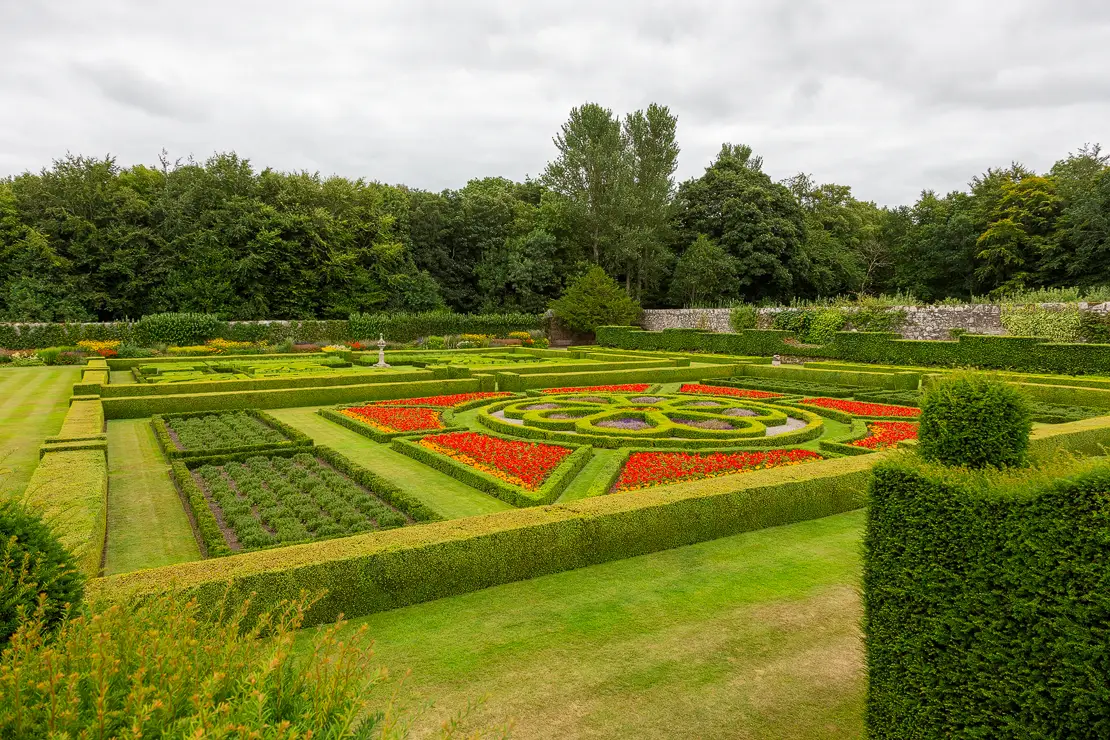
To guide their restoration, the NTS looked beyond Pitmedden itself, drawing inspiration from James Gordon of Rothiemay’s 1647 bird’s-eye view of Edinburgh, which included detailed depictions of the gardens at the Palace of Holyroodhouse. Three of these designs became the basis for parterres in the lower garden, while a fourth was created to honour Sir Alexander Seton. The result, though sometimes described as a 1950s pastiche rather than a pure restoration, blends historical forms with modern planting schemes and has become a showcase of horticultural precision.
When Major Keith transferred the property to the NTS, he also included the adjacent farm and a substantial collection of agricultural tools and machinery. This became the Museum of Farming Life, located just north of the house. Spread across a farmhouse, stables, and outbuildings, the museum presents rural life from the 19th century onwards. Rooms are furnished as they might have been in the 1800s, and the stables retain their fittings, complete with a groom and horse model for atmosphere. Nearby, the farm buildings display machinery, workshops, and a bothy once used by seasonal workers.
Our Visit to Pitmedden Gardens
My wife and I arrived via a private loop road from the A920, leading to a car park beside the south wing of Pitmedden House. This part of the building, home to the reception, shop, and tea room, is the only section open to the public. There are toilets at the car park, you don't need to go to reception first.


As usual with all NTS sites, everything is very well maintained and clean. Luckily, we were members, so we gained free entry and parking. After leaving the reception/shop, we made our way to the side of the building and decided to visit the gardens in an anticlockwise direction.


Farming Life Buildings
We were pleased to find that there was much more to see at Pitmedden Gardens than "just" the gardens. There are many buildings dedicated to the old farming life of rural Aberdeenshire.
These include rooms showing how people lived and worked in the 1800s. There was a wealth of museum-type areas packed with fascinating items, from old tools to threshing machines.
Janette loved the loft art display from "JaneKeenanDesign", it was packed with lovely pictures, homewares and hand creams. After thoroughly exploring all of the different outbuildings, we made our way to the gardens.


The Gardens
The garden itself is enclosed and initially reveals little more than clipped hedges and a sculpture of two boxing hares. Only when you pass to the rear of the house does the upper garden open out, revealing manicured lawns, shaped trees, and two formal parterres.
These upper parterres, installed in the 1990s, share the same geometric pattern but differ in surface treatment. The southern bed is planted with lavender, chives, and other herbs familiar to 17th-century gardeners, all edged in low box hedging. The northern bed mirrors the design but is filled with coloured gravel, providing a bold, historically accurate alternative. Smaller, more intimate gardens flank this area, still formally enclosed but less rigid in style.


From here, the garden’s central axis draws the eye along a tree-lined avenue towards a gateway. Stepping through, the view drops dramatically into the lower garden, a vast walled space terraced into the slope. Four large parterres occupy this level, demonstrating the evolution of formal garden design, and together with the upper beds, they demand an extraordinary level of upkeep. In total, the hedges here stretch for six miles, all kept in immaculate condition. Around 40,000 annual plants are raised in on-site glasshouses and planted each spring, ensuring seasonal colour within the rigid geometry.


The Perron Steps
One of the most striking and original features of the garden is the Perron Steps, which date back to 1675. These steps give access to the lower area of the gardens and are decorated with two stone pineapples!




FAQs on Pitmedden Gardens
How much does it cost to visit Pitmedden Gardens?
At the time of writing, £10.50 for adults, £23 for a family ticket. Concessions are £8.50, and for YoungScot card holders only £1. NTS members get free access.
When is the best time to visit the gardens?
Mid-July and early August are the best times to see the gardens at their best.
Is there anything else nearby worth visiting?
You are spoilt for choice in this area of Aberdeenshire! I highly recommend Fyvie Castle, Talquhon Castle and Haddo House.

Key Information
-
A beautiful garden with a tearoom in rural Aberdeenshire.
-
The site is also home to extensive outbuildings packed with slice-of-life displays and machinery - The Museum of Farming Life.
-
The gardens have many different zones, including herb gardens, wild zones, and more strict, vibrant floral designs.
-
There is an orchard with many types of fruit trees.
-
Celebrity gardener Chris Beardshaw designed parts of the garden.

Conclusion
Pitmedden Gardens may not have the grandeur of an attached castle or manor house, but it offers an extraordinary example of formal garden craft in Scotland. Whether seen as a careful homage to the 17th century or a distinctly mid-20th-century interpretation, it remains a meticulously maintained and rewarding destination, one that pairs horticultural beauty with an engaging insight into the region’s agricultural heritage.




Leave a comment below