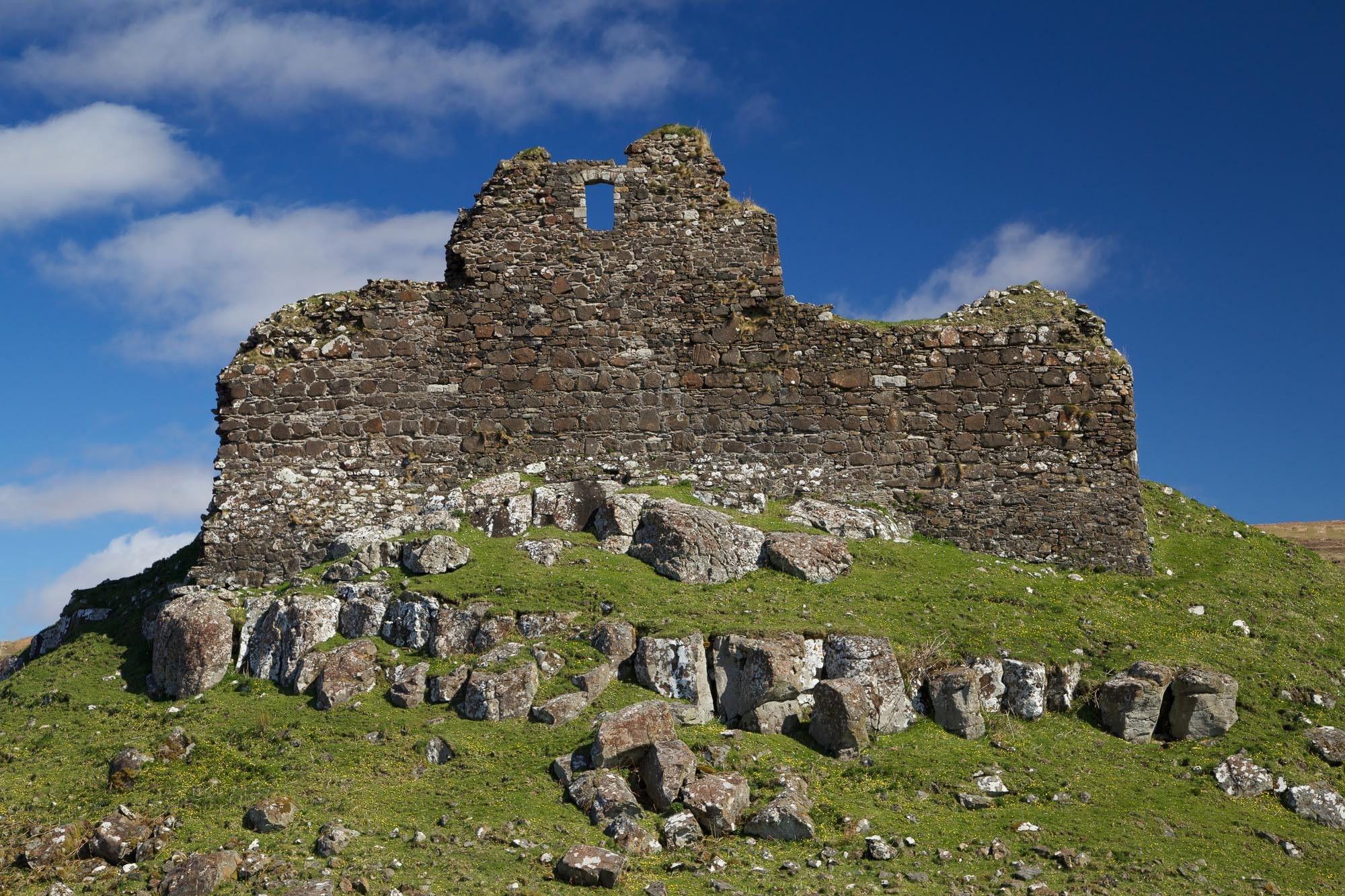

The Last Lord of the Isles - A Kingdom Lost
John MacDonald II, Lord of the Isles (1434-1503) was the fourth and final person to hold the title of Lord of the Isles in his own right. Also known as John of Islay, Earl of Ross, he inherited one of the most powerful semi-autonomous lordships in all of medieval Scotland - and, through a series of political miscalculations and personal failings, presided over its complete collapse. His story is one of the most dramatic falls from power in Scottish history.
A Vast Inheritance
When John succeeded his father Alexander of Islay as Lord of the Isles in 1449, he was just fifteen years old. The lordship he inherited was immense - stretching from Lewis in the north to Kintyre in the south, encompassing the entire Hebridean island chain and a long stretch of the western Scottish coastline, as well as the important Earldom of Ross on the mainland. The MacDonald lords had built this dominion over generations, tracing their line back to the great Somerled, and the lordship functioned almost as a state within a state, complete with its own council, laws, and system of governance.
A seventeenth-century MacDonald chronicler, Hugh Macdonald, described John as "a meek, modest man... and a scholar, more fit to be a churchman than to command so many irregular tribes of people." It is a characterisation that, with hindsight, feels prophetic. John appears to have possessed an odd mixture of qualities - at times assertive and ambitious, at others weak and vacillating - and it was this inconsistency that would ultimately undo him.
An Unhappy Marriage and Early Revolt
The seeds of John's downfall were sown almost immediately after he came to power. Shortly after inheriting his titles, he married Elizabeth Livingstone, daughter of Sir James Livingstone, reportedly in exchange for promises made to him by King James II. The promises were never honoured. Sir James Livingstone had been a powerful figure during the king's minority, but his influence was transient, and he fell from royal favour in the early 1450s, fleeing to seek refuge with his son-in-law on the islands.
Feeling cheated and aggrieved, John rose in open revolt against the Crown. He led an army that captured the royal castles at Inverness, Ruthven, and Urquhart, and formed a powerful alliance with William Douglas, 8th Earl of Douglas - at the time the most formidable nobleman in southern Scotland. The alliance placed John at the centre of Scottish politics, but it was an alliance built on dangerous ground. When the 8th Earl refused to dissolve his bond with John at a meeting with James II at Stirling Castle on 22 February 1452, the king personally murdered him on the spot. John stood by and watched as James II systematically destroyed the House of Douglas over the following years, even benefitting by acquiring some former Douglas lands in the Borders. When James II died in 1460, John found himself in a surprisingly strong position - having challenged the Crown and survived, with his estates extended and his influence intact.
The Treaty of Westminster-Ardtornish
It was in the context of the wider contest between the English and Scottish crowns that John made the most consequential - and catastrophic - decision of his life. In March 1461, Henry VI of England was deposed by Edward IV and fled into exile in Scotland, where James III offered him support. Seizing the opportunity to sow discord in Scotland, Edward IV sent an envoy to John MacDonald II. The result was the Treaty of Westminster-Ardtornish, concluded in February 1462.
Under the terms of this remarkable secret agreement, John pledged homage to the English king in exchange for English assistance in bringing all of Scotland north of the Forth under his control - a breathtaking vision that amounted to nothing less than the partition of Scotland. The pact also envisaged a tripartite division of Scotland between John, his cousin Donald Balloch, and the forfeited 9th Earl of Douglas. In effect, John had committed treason against the Scottish Crown on a grand scale.
The practical results were limited. John raised an army that marched on Inverness under the command of his illegitimate son Angus Og, but the campaign fizzled out. James III, unwilling to risk a full war with England, dropped his support for Henry VI, effectively neutralising Edward IV's incentive to support the MacDonalds. John, recognising how one-sided the treaty had been, retreated to his island strongholds. For a time, the existence of the treaty remained secret.
Exposure and Forfeitures
In the mid-1470s, the English revealed the full terms of the Treaty of Westminster-Ardtornish to James III. The political damage was devastating. In 1476, John was stripped of the Earldom of Ross, the Isle of Skye, Knapdale, and Kintyre. He was allowed to retain the title of Lord of the Isles, but crucially, the lordship would henceforth be granted by the Crown rather than self-assumed - a humiliation that struck at the very heart of MacDonald prestige and independence. Considering the full extent of what amounted to treason, many historians note that the punishment was relatively lenient. But the loss of prestige was incalculable.
Father Against Son - The Battle of Bloody Bay
The forfeiture triggered a crisis within Clan Donald itself. The Lordship had always depended on territorial expansion to sustain its warrior culture and reward its followers. Now that it was contracting, old tensions surfaced. John's illegitimate son Angus Og, who had led the army to Inverness back in 1462 and was the tanist - heir designate - of the clan, moved to seize power from his father. According to clan tradition, Angus ejected John from both the leadership and his own home, reportedly forcing the former lord to shelter under an upturned boat.
John gathered his remaining supporters - men from Clan MacLean, Clan MacLeod, and Clan MacNeil - and met Angus Og's fleet in a naval battle off the northern coast of Mull, near the present town of Tobermory, sometime in the early 1480s. The clash, known ever afterwards as the Battle of Bloody Bay (Blàr Bàgh na Fala in Scottish Gaelic), ended in a decisive victory for Angus. Hector Odhar Maclean, John's naval commander and chief of Clan MacLean, was taken prisoner. William Dubh MacLeod, chief of Clan MacLeod, was killed along with many of his men. Half of the lordship's galley fleet was destroyed. It was a pyrrhic victory for Angus - the losses had grievously weakened the power of the Lords of the Isles - but for John it was the end of any meaningful authority.
Final Years and the End of the Lordship
Angus Og held power over Clan Donald for a decade, but was murdered in 1490. John attempted to reassert himself in the aftermath, seeking to recover the Earldom of Ross, but was resisted by the Mackenzies and found little support. James IV, who had come to the throne in 1488, finally concluded that John was incapable of providing the stable governance that the western Highlands and Islands required. In 1493, the king stripped John of the title of Lord of the Isles entirely, ending the lordship that had endured since the days of John of Islay, the first lord, in the mid-fourteenth century.
John spent his final years in lowland Scotland, living on a modest royal pension - a poignant end for the man who had once claimed dominion over half of Scotland. He died in Dundee in 1503 and was probably buried at Scone. The Lordship of the Isles was never restored as an independent entity. James IV would later grant the title to his son, the future James V, and it has been held by the heir to the Scottish - and later British - throne ever since.
Legacy
John MacDonald II is remembered chiefly as the man who squandered one of the great inheritances of medieval Scotland. Whether through personal weakness, poor political judgement, or simply the relentless pressure of an increasingly centralised Scottish monarchy, he failed to preserve what his predecessors had built. The Treaty of Westminster-Ardtornish stands as perhaps the defining act of his rule - a gamble that promised everything and delivered nothing, while handing his enemies the evidence they needed to strip him of his power.
And yet there is something almost tragic about the figure that emerges from the historical record. A scholar by temperament, thrown into a world that demanded the qualities of a warrior-king; a man who could be bold but not consistent, ambitious but not ruthless. The western Highlands and Islands he once ruled remain some of the most beautiful and atmospheric landscapes in Scotland, and the castles and island fortresses associated with the Lords of the Isles - from Finlaggan on Islay to Duart on Mull - still draw visitors eager to understand the world John MacDonald II both inherited and lost.


