
Scotland's Master of Neoclassical Design
Robert Adam stands as one of the most influential architects in British history, a visionary who transformed the appearance of Georgian Britain with his distinctive interpretation of classical design. Born into Scotland's foremost architectural family, he not only revolutionised interior decoration but created a style so distinctive that it bore his own name - the Adam style, or Adamesque - which became the height of fashion across Britain and beyond.
Early Life and Education
Robert Adam was born on 3 July 1728 at Gladney House in Kirkcaldy, Fife, the second son of William Adam, Scotland's leading architect of the time, and Mary Robertson. As a child, he was noted as having a "feeble constitution", yet this physical frailty never dampened his creative ambitions or his determination to surpass even his accomplished father's reputation.
From the age of six, young Robert attended the Royal High School in Edinburgh, where he immersed himself in Latin and the culture of Ancient Rome - an education that would profoundly shape his architectural vision. His lessons were conducted entirely in Latin from the second year onwards, and he studied the works of Virgil, Horace and Sallust. This classical education planted the seeds for his later fascination with Roman architecture and design.
In 1743, at the age of fifteen, Adam entered Edinburgh University to continue his studies. However, his academic pursuits were disrupted twice - first by recurring illness, and then by the dramatic events of the 1745 Jacobite Rising, which brought warfare to Scotland's doorstep. Despite these interruptions, his education in Edinburgh's intellectual circles exposed him to Enlightenment ideas that would characterise his approach to architecture: reason, independence, inquisitiveness, practicality and an innovative spirit.
Joining the Family Business
In 1746, still only eighteen years old, Robert joined his elder brother John Adam as an assistant to their father. The young apprentice learned the practical aspects of architecture and building, gaining invaluable experience on major projects. When William Adam died suddenly in 1748, the brothers faced a crucial decision. Rather than abandoning the family business, Robert and John formed a partnership, taking on the name "Adam Brothers" and inheriting their father's prestigious client list and ongoing commissions.
Their first major commission was to complete the reconstruction and remodelling of Hopetoun House near Queensferry, a grand project their father had begun. This spectacular country house would not be completed until 1767, but it gave the brothers the opportunity to introduce a new, lighter style of interior decoration to Scotland, moving away from their father's more conservative Palladian approach. The elegant state rooms at Hopetoun House showcased the brothers' emerging talent for creating harmonious interior schemes that would become their hallmark.
The Grand Tour: A Transformative Journey
By 1754, having saved £5,000 from the family business, Robert Adam realised a dream he had harboured since his father's death. He embarked on the Grand Tour - that essential rite of passage for aspiring architects and gentlemen. Crucially, he travelled as the companion of the Honourable Charles Hope, the younger brother of the Earl of Hopetoun, which provided him with invaluable social connections and introductions to influential patrons across Europe.
For nearly four years, Adam travelled through France and Italy, studying classical architecture and refining his drawing skills under prestigious tutors. In Rome, he studied under the French architect Charles-Louis Clérisseau, a master of architectural draughtsmanship, and befriended the renowned artist and archaeologist Giovanni Battista Piranesi, whose dramatic engravings of Roman ruins had captivated Europe. These connections proved instrumental in shaping Adam's mature style.
The pivotal moment of Adam's Grand Tour came in 1755 when he travelled to Split (then called Spalato) in Dalmatia to study the ruins of the Roman Emperor Diocletian's palace. Unlike other ancient sites, the palace had not been thoroughly documented by scholars, presenting Adam with a golden opportunity. He spent weeks carefully measuring and drawing every detail of the magnificent ruins, recognising that publishing his research could establish his reputation as a leading authority on classical architecture.
The project became an obsession. Working with his brother James and teams of artists in both Venice and London, Adam devoted years to producing detailed illustrations and descriptions. When "The Ruins of the Palace of the Emperor Diocletian at Spalatro in Dalmatia" was finally published in 1764, its 61 exquisite illustrations combined picturesque views with precise architectural drawings. The book was more than a scholarly work - it was a manifesto declaring Adam's deep understanding of Roman design and his ability to adapt ancient principles to modern needs.
London Success and the Adam Style
Robert returned to Britain in January 1758 and immediately established his practice in London, soon joined by his brothers James and William. His timing could not have been better. Georgian Britain was experiencing a building boom, and wealthy patrons sought architects who could create fashionable, elegant homes that reflected their status and taste.
Adam's breakthrough came at Kedleston Hall in Derbyshire, where Lord Scarsdale had commissioned James Stuart, a pioneer of Neoclassicism, to design the interiors. Through a combination of Scottish connections and confident self-promotion, Adam managed to have Stuart dismissed from the project - he dismissed Stuart's Neoclassical designs as "so excessively and ridiculously bad they beggared all description" - and took over the commission himself. The result was a triumph that established his reputation.
In 1758, Adam was elected to the Royal Society of Arts. Three years later, in 1761, he achieved two significant honours: he was appointed Architect of the King's Works (jointly with his rival Sir William Chambers) and became a member of the Society of Antiquaries. These positions gave him prestige and access to the highest levels of society, though Chambers remained the leading official architect whilst Adam dominated private commissions.
What set Adam apart was his revolutionary approach to interior design. While other architects of the period designed buildings and left the interior decoration to others, Adam insisted on designing every element - from the ceiling plasterwork and wall decorations to the carpets, furniture and even doorknobs. His goal was to create a unified aesthetic where every component worked together in harmony. This "total design" concept was revolutionary and became the defining characteristic of the Adam style.
The Adam style combined classical motifs - urns, swags, medallions, griffins and acanthus leaves - with a lightness and delicacy that distinguished it from the heavier Palladian tradition his father had followed. He favoured pastel colour schemes of pale greens, blues, pinks and lilacs, combined with white plasterwork and gilding. His ceilings became works of art in themselves, covered with intricate patterns of small-scale ornament, often incorporating painted panels by leading artists of the day.
Major Commissions and the Height of Fashion
Throughout the 1760s and 1770s, commissions poured in. Adam remodelled some of England's finest country houses, creating interiors that are still considered masterpieces of Georgian design. At Syon House in Middlesex (now in west London), he transformed the Tudor house into a showcase of Neoclassical splendour, with rooms that flowed in a carefully orchestrated sequence of colours and moods. The entrance hall, with its screen of Doric columns and black-and-white floor, led to an ante-room lined with scagliola columns in green and gold - a space of such jewel-like richness that it left visitors breathless.
At Kenwood House on Hampstead Heath, Adam created one of his finest interiors - the great library, with its curved ends, delicate ceiling decoration and perfect proportions. At Osterley Park in Middlesex, he designed everything from the grand portico to the Etruscan Dressing Room, a small chamber decorated in terracotta and black in imitation of ancient Greek pottery.
Adam's reputation grew to such heights that his style became the defining aesthetic of fashionable Britain. Manufacturers produced furniture, ceramics, metalwork and textiles in the Adam style. The famous potter Josiah Wedgwood created jasperware specifically to complement Adam interiors. Thomas Chippendale, Britain's leading furniture maker, collaborated with Adam and produced some of his most expensive pieces for Adam's clients.
Between 1768 and 1774, Adam also served as Member of Parliament for Kinross-shire in Scotland, though his heart remained in architecture rather than politics.
The Adelphi: Ambition and Near Ruin
In 1768, at the height of his success, Robert and his brothers embarked on their most ambitious project - the Adelphi, a massive speculative development on the banks of the Thames in London. The name "Adelphi", from the Greek word for "brothers", was a bold act of self-promotion that typified Adam's confidence.
The site was a challenge: a steeply sloping, derelict stretch of riverside ground that flooded at high tide. Adam's solution was audacious. He would build a series of massive brick vaults and arches rising up from the riverbank, creating a level platform above on which he would construct elegant terraced houses. The vaults below would be rented as warehouses and storage, generating income to offset the construction costs.
The design drew direct inspiration from Diocletian's Palace at Split, with its great arched undercroft supporting palatial apartments above. Adam envisioned the riverside terrace as a monumental classical composition, with the central Royal Terrace flanked by side streets named after the brothers - Adam Street, John Adam Street, Robert Street. It was town planning on a grand scale, incorporating not just houses but shops, taverns, a hotel and a new headquarters for the Royal Society of Arts.
However, the project's financial planning was dangerously optimistic. The brothers began construction in 1768 before securing the lease from the Duke of St Albans (signed in 1769) and without parliamentary approval for reclaiming land from the Thames (granted in 1771). They assumed the government would rent the valuable vault space for ordnance stores, but no such contract materialised. Costs spiralled wildly beyond their estimates.
By 1772, the brothers were badly overstretched, forced to mortgage properties and sell houses at reduced prices just to continue construction. Then disaster struck. A Scottish banking crash in the summer of 1772 pushed the Adam Brothers to the verge of bankruptcy. In a desperate move, they petitioned Parliament for permission to dispose of the unsold properties through a public lottery - 4,370 tickets at £50 each, with houses and vault spaces as prizes.
The lottery saved them from complete ruin, but the damage to their reputation was severe. The Adelphi, intended to immortalise the Adam brothers' genius, became instead a byword for overreaching ambition. Horace Walpole, the acerbic social commentator, dismissed the lottery as a "bubble" and ridiculed Parliament for supporting it. Though the brothers eventually completed the development and it attracted prestigious residents including Dr Samuel Johnson, actor David Garrick and Lady Hamilton, they never fully recovered the heights of their earlier success.
Return to Scotland and Late Career
The Adelphi experience, though financially damaging, did not break Adam's creative spirit. To rebuild their reputation, Robert and James published "Works in Architecture of Robert and James Adam" in instalments from 1773, a lavish volume showcasing their finest designs. The book's boastful text credited the Adam brothers with a complete transformation of British taste, declaring that Graeco-Roman examples should "serve as models which we should imitate, and as standards by which we ought to judge."
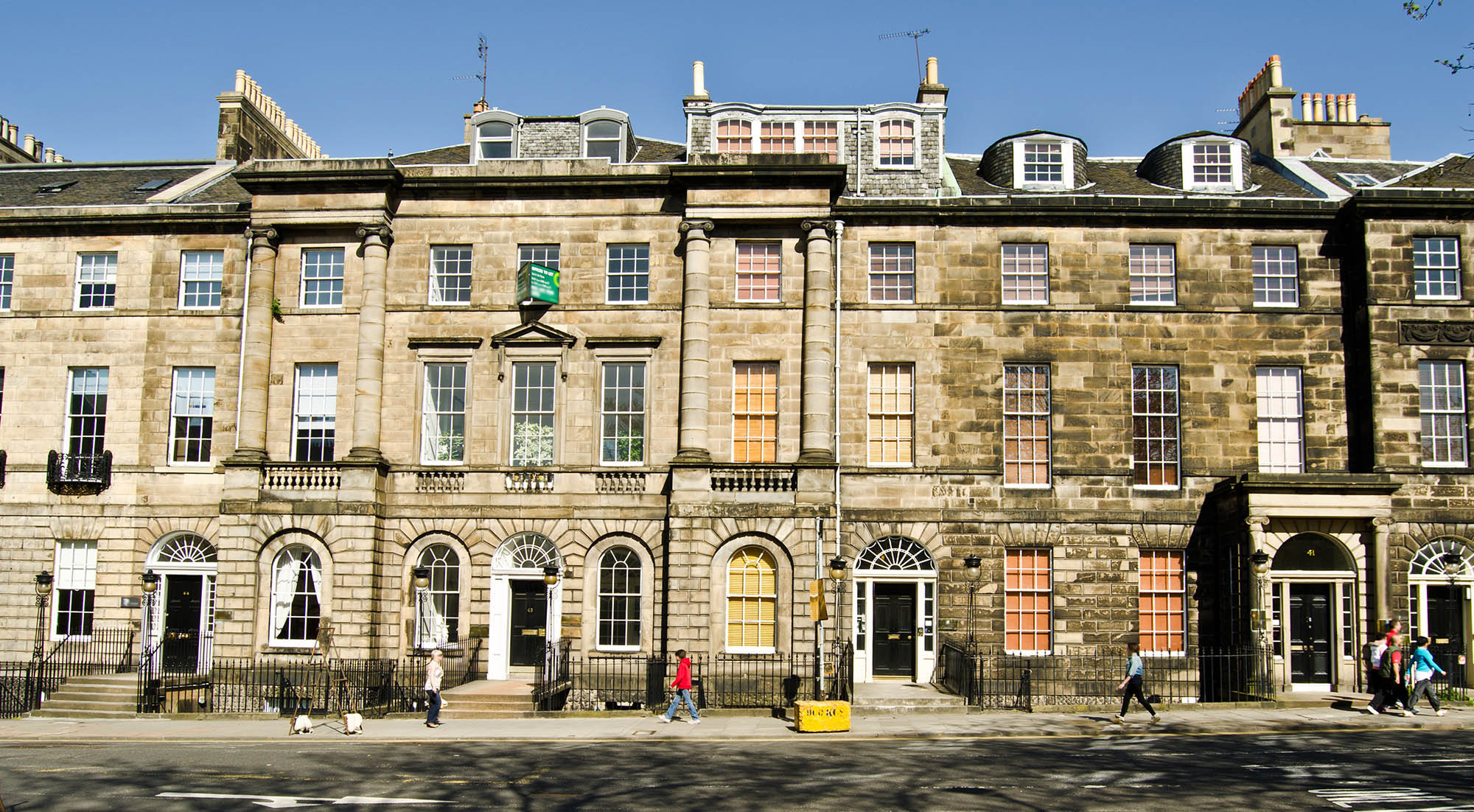
By the 1780s, much of Adam's work shifted back to Scotland. His account book for 1791-92 shows projects scattered across the country, which he largely managed himself despite his base in London. In Edinburgh, he finally achieved the grand urban composition that had eluded him at the Adelphi. His designs for the north side of Charlotte Square in the New Town created a masterpiece of unified architecture - a terrace of individual houses fronted by a symmetrical palace facade that remains one of Edinburgh's finest streetscapes.
Other major Scottish commissions included Register House in Edinburgh, housing the National Archives of Scotland; the Old College of the University of Edinburgh (completed after his death to an amended design); and Culzean Castle in Ayrshire, a dramatic clifftop fortress that combined Adam's neoclassical interiors with a romantic, medievalising exterior - the "castle style" that would influence country house design for decades to come.
In Glasgow, he designed the Royal Infirmary. Across Scotland, his work included Mellerstain House near Kelso, Gosford House in East Lothian, and numerous other country houses and estate buildings. His impact on Scotland's architectural heritage was immense, helping to define the elegant Georgian character of Edinburgh and other Scottish cities.
Death and Legacy
Robert Adam had long suffered from stomach and bowel problems, likely caused by a peptic ulcer and irritable bowel syndrome. He experienced severe attacks in 1787 and 1789, but continued working with undiminished energy. In the year before his death, he designed eight major public works and twenty-five private buildings, demonstrating what his obituary called "an increasing vigour of genius and refinement of taste."
On 1 March 1792, whilst at his home at 13 Albemarle Street in London, one of his stomach ulcers burst. Two days later, on 3 March 1792, Robert Adam died at the age of 64. He never married, and left his estate to his two unmarried sisters, Elizabeth and Margaret.
Adam was given a private funeral and interred in Westminster Abbey's south aisle - a rare honour that reflected his standing as one of Britain's greatest architects. His pallbearers were a roll call of the nobility: the Duke of Buccleuch, the Earl of Coventry, the Earl of Lauderdale, Viscount Stormont and other distinguished peers. The March 1792 edition of The Gentleman's Magazine published an eloquent obituary that compared him to the recently deceased Sir Joshua Reynolds, noting: "Mr Adam produced a total change in the architecture of this country: and his fertile genius in elegant ornament was not confined to the decoration of buildings, but has been diffused to every branch of manufacture."
Left behind were nearly 9,000 architectural drawings and designs, meticulously catalogued and preserved. In 1833, these were purchased for £200 by the architect Sir John Soane, who housed them in his museum in London, where they remain today - an extraordinary archive that continues to inspire architects and designers.
The Adam Revolution
Robert Adam's influence on Western architecture cannot be overstated. He fundamentally changed how architects approached interior design, pioneering the concept of coordinated, total design that extended from the building's facade to the smallest decorative detail. His lighter, more elegant interpretation of Neoclassicism became the dominant style of the late Georgian period, and the Adam style was widely imitated not just in Britain but across Europe and America.
What Adam termed "a kind of revolution in the whole system" of architecture was based on his ability to absorb influences from ancient Rome, Renaissance Italy and contemporary France, then synthesise them into something entirely new and distinctly his own. His genius lay not in slavish copying of classical models, but in capturing what he called "the beautiful spirit of antiquity" and transfusing it "with novelty and variety" through all his works.
Though his style fell out of fashion after his death - eclipsed by a more austere Greek Revival - the Adam legacy endured. Today, his buildings are treasured as masterpieces of Georgian architecture, his interiors are studied and admired, and the term "Adam style" remains instantly recognisable to anyone interested in architecture or decorative arts. From the sublime ceilings of Syon House to the romantic battlements of Culzean Castle, from Edinburgh's elegant Charlotte Square to the architectural drawings preserved at the Soane Museum, Robert Adam's vision continues to captivate and inspire more than two centuries after his death.


