
The Man Who Built Modern Glasgow
When Queen Victoria visited Glasgow in 1888 to open the city's first International Exhibition, she performed a ceremony that had never happened before in Scotland's history - she knighted a municipal officer. The man who received that honour, Sir James David Marwick, had spent fifteen years remaking Glasgow from the inside out, and there were still sixteen more years of work ahead of him. By the time he retired in 1904, the city he had helped shape was widely celebrated as the "Second City of the Empire." Few individuals in Victorian Scotland wielded such quiet and lasting influence.
From Orkney Roots to Edinburgh Law
James David Marwick was born on 15 July 1826 at 95 Kirkgate in Leith, where his father William Marwick - a merchant originally from Kirkwall in Orkney - was then working as a baker. His Orcadian heritage would remain important to him throughout his life. He was sent back to his father's home island to be educated at Kirkwall Grammar School before returning south to Edinburgh, where he began studying law at the University of Edinburgh in the early 1840s.
His legal apprenticeship was served with James B. Watt, a solicitor based at 9 York Place in Edinburgh - a connection that would prove personally as well as professionally significant. In 1852, Marwick was admitted as a procurator at Dundee, initially going into partnership with William Barry, the son of the town clerk there. By 1855, he had returned to Edinburgh and co-founded the firm of Watt and Marwick with J. B. Watt's son - and that same year he married Jane, the third daughter of his former employer, James B. Watt. The marriage produced two sons and five daughters.
His public career accelerated rapidly. In 1857, Marwick joined the Edinburgh Town Council. By 1860, he was Town Clerk of Edinburgh, and in 1861 he also took on the role of Clerk to the Convention of Royal Burghs - a position he would hold until 1876. Throughout the 1860s he built a formidable reputation, not just as an administrator, but as a historian and scholar. His election as a Fellow of the Royal Society of Edinburgh in 1864 reflected his standing in both fields.
The Move to Glasgow
The Edinburgh Town Clerk who arrived in Glasgow in 1873 did so under unusual circumstances. His predecessor, Angus Turner, had become deeply unpopular - described in The Bailie magazine as "cantankerous" and accused of showing "contemptuous disdain" towards the city's elected councillors. Turner was eventually persuaded to retire, and Glasgow's civic leaders went looking for someone who could restore confidence in the office.
Marwick was their man, and they paid handsomely for him. The salary offered was £2,500 per year - three times what he had been earning in Edinburgh - with a retiring allowance built in after fifteen years of service. There was a widely held view at the time that the driving force behind Marwick's recruitment was Councillor William Walls, a fellow Orcadian from Kirkwall who had befriended Marwick years earlier. Whatever the behind-the-scenes negotiations, Marwick accepted the post on 11 March 1873, and the citizens of Edinburgh were sufficiently sorry to lose him that they held a great public dinner in his honour and presented his wife with a full-length portrait of him painted by Robert Herdman, RSA.
Marwick's first act as Glasgow Town Clerk was to professionalise the role itself. He made it a full-time, salaried post with no scope for outside legal work - a clean break from the older arrangement that had allowed the conflicts of interest which had dogged his predecessor's tenure. He then set out a detailed plan establishing a clear administrative structure for the office and its responsibilities. The transformation was immediate.
Remaking a City
The Glasgow that Marwick inherited in 1873 was a city bursting at its seams. Industrial prosperity had drawn hundreds of thousands of people into its boundaries, but the infrastructure had not kept pace. Slum housing, an inadequate water supply, a polluted river, and no reliable public transport all threatened to undermine Glasgow's ambitions. Over the next three decades, Marwick's office became the engine room through which the city addressed each of these challenges in turn.
His most significant administrative achievement was the expansion of Glasgow's boundaries. Beginning in 1881, he oversaw the annexation of fourteen suburban burghs into the city over a decade of complex negotiations and legislation - a process completed in 1891. In 1893, he drafted the legislation by which Glasgow was formally constituted as a county in its own right. These boundary changes more than doubled the city's administrative area and gave Glasgow's council the powers it needed to plan and invest at scale.
The physical transformation of the city during Marwick's tenure was remarkable. The water supply was duplicated and expanded to meet growing demand. The River Clyde, long used as an open sewer, was cleaned up and its harbour improved. Municipal tramways were introduced, giving working people affordable access to transport across the city. An electricity supply was established. And slum areas that had existed since the medieval period were cleared and rebuilt. As one observer put it, Marwick had "the task of framing and carrying out many of the greatest city enterprises of his time."
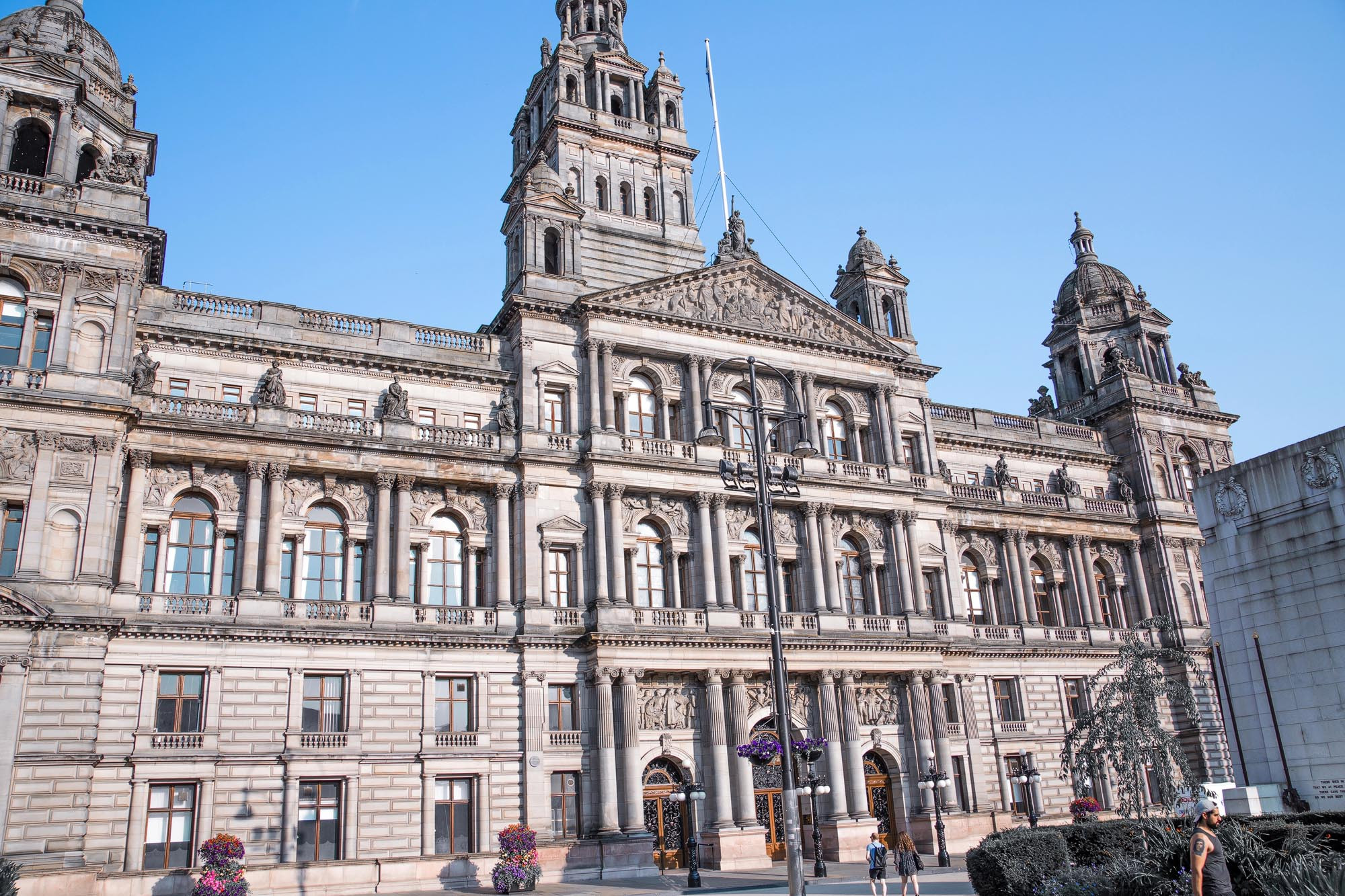
The civic confidence of this era found perhaps its most enduring expression in the City Chambers on George Square, constructed between 1882 and 1888. This grand building - its ornate facade and lavish marble interiors rivalling anything in London - was built during Marwick's tenure and stood as a statement of Glasgow's pride in its own municipal government. Marwick played a central role in overseeing its construction.
His reputation as the leading authority on municipal law in Scotland grew steadily throughout these years. Successive Lord Advocates sought his knowledge. Town clerks from across Scotland sought his opinion. And according to those who recorded his career, not one of those opinions was ever overturned by the courts - a record of legal judgement that was, by any measure, remarkable.
Scholar and Historian
Throughout his long administrative career, Marwick maintained an equally productive life as a historian and writer. It was on his initiative that the Scottish Burgh Record Society was founded, and he edited many of its publications from 1868 to 1897. The scope of his published work was wide, ranging from medieval Edinburgh to the history of Glasgow and its river.
His principal works included the four-volume Records of the City and Royal Burgh of Edinburgh (1869-92), the Records of the Burgh of Peebles (1872), the two-volume Records of the City and Royal Burgh of Glasgow (1876-82), Observations on the Law and Practice of Municipal Corporations in Scotland (1879), and The River Clyde and the Harbour of Glasgow (1898). His posthumously published Early Glasgow, edited by Robert Renwick and released in 1911, traced the city's history from its earliest origins to 1611.
The University of Glasgow recognised his scholarly contributions with an honorary LLD degree in 1878, eighteen years before his knighthood would add further distinction to his name. He was also awarded the Freedom of the Burgh of Kirkwall in 1893 - a tribute that must have carried particular meaning for a man who never forgot his Orcadian roots. Throughout his Glasgow years he was known for his generosity to young Orcadians arriving in the city, offering them advice and practical help as they found their feet.
Honour and Legacy
The knighthood conferred by Queen Victoria in 1888 was more than a personal recognition - it was a historic first. No municipal officer in Scotland had ever previously been knighted, and the distinction reflected both the importance of the office Marwick held and the exceptional manner in which he had exercised it. He spent his final years at 19 Woodside Terrace in Glasgow before his death on 24 March 1908. He was buried at Warriston Cemetery in Edinburgh.
The tributes that followed his retirement in 1904 give some sense of the esteem in which Marwick was held. The Corporation presented him with an address and a valuable gift. The citizens of Glasgow subscribed publicly for two busts of him by the sculptor George Frampton - one in marble, placed in the city's art galleries, and one in bronze, given to Lady Marwick and the family.
Sir James David Marwick served Glasgow for 31 years and left it unrecognisably changed - larger, cleaner, better lit, better connected, and far better governed than he had found it. The Victorian city that Scots and visitors admire today, with its grand municipal buildings and its tradition of ambitious civic enterprise, owes a great deal to the quiet, methodical Orcadian lawyer who ran its affairs from 1873 to 1904.


