
Crathes Castle is one of the finest and most complete tower houses in Scotland, and it's easy to see why it's one of the most popular visitor attractions in Aberdeenshire. With its pink-harled walls, fairytale turrets, famous painted ceilings, and spectacular walled gardens, this is a castle that has something for everyone. My wife and I visited on a beautiful spring day and spent several happy hours exploring both the castle and the extensive grounds.

The History of Crathes Castle
The story of Crathes is really the story of the Burnett family, who lived here for almost 400 years. Their connection to the area dates back to 1323 when King Robert the Bruce granted Alexander Burnard the lands of Leys and appointed him Royal Forester of Drum. As a symbol of this honour, Bruce gave Burnard the Horn of Leys – a beautifully carved ivory horn decorated with jewels that still hangs in the castle's Great Hall today.
For the first 250 years, the Burnetts lived on a crannog – an artificial island – in the now-drained Loch of Leys north of Banchory. It was a secure but presumably rather damp existence. Their fortunes changed dramatically in 1543 when Alexander Burnett married Janet Hamilton, whose dowry included wealth acquired from church lands during the turbulent years before the Reformation.

In 1553, the Burnetts began construction of their new castle on drier ground. It took over 40 years to complete, with work delayed by the political turmoil during the reign of Mary, Queen of Scots. The castle was finally finished in 1596 by Alexander Burnett's great-grandson, another Alexander, who added the distinctive turreted upper floors and the remarkable painted ceilings that make Crathes so special today.
The Burnetts had a talent for staying out of trouble during Scotland's many religious and political conflicts. When the Marquis of Montrose arrived with his Royalist army in 1644, Sir Thomas Burnett simply invited his old friend in for dinner. Montrose moved on the next day, leaving the castle – and the Burnetts – unharmed. This knack for diplomacy meant the family kept their estates intact through centuries of upheaval.
In 1951, Major-General Sir James Burnett, 13th Baronet of Leys, gave Crathes Castle to the National Trust for Scotland, though the family continued to live on the estate. A devastating fire in 1966 destroyed the Queen Anne wing and much of the Victorian additions, but the original tower house survived largely intact. Today, Crathes is the only NTS property in Aberdeenshire that remains open year-round, a testament to its enduring popularity.
Our Visit
Arrival and First Impressions

Crathes Castle is located about 15 miles west of Aberdeen and 3 miles east of Banchory, just off the A93 on the north bank of the River Dee. The estate is well signposted, and there's a large car park near the visitor centre. Parking is free for National Trust members.

We arrived on a gorgeous spring morning with blue skies and sunshine – perfect weather for exploring the gardens. After picking up our tickets from the gift shop (which doubles as the ticket office), we followed the tree-lined path towards the castle.


The approach is wonderful, with the pink tower gradually coming into view through the spring foliage. Daffodils carpeted the lawns, and the famous yew topiary was already visible, adding to the fairytale atmosphere.


Inside the Castle
Entry to the castle interior is on a first-come, first-served basis, with visitors admitted in small groups at regular intervals. The tour follows a one-way route that takes you up through the building and back down again, giving you time to appreciate each room without feeling rushed.
The tour begins in the vaulted basement, where the original kitchen displays an impressive collection of copper pans and period cooking implements.


From here, you climb the narrow turnpike staircase – watch out for the deliberately irregular 'trip step' designed to unbalance any attackers storming the castle. A rope handrail helps modern visitors navigate the worn stone steps.


The Great Hall (or High Hall) is dominated by an enormous fireplace where the Horn of Leys takes pride of place. The room contains family portraits, period furniture, and brass chandeliers. Look up to see fragments of the original painted ceiling, which gives you a hint of what's to come in the rooms above.

The painted ceilings are what really set Crathes apart from other Scottish castles. The Room of the Nine Worthies (also called the Room of the Nine Nobles) features colourful painted beams depicting the nine historical and legendary heroes of classical and medieval tradition, along with Scots text describing their deeds.


The Chamber of the Muses shows the nine daughters of Zeus who presided over the arts and sciences. These remarkable tempera paintings date from the late 16th century and were rediscovered in 1913 after being hidden beneath Georgian plasterwork.


Perhaps the most atmospheric room is the Green Lady's Room, which has its own painted ceiling and a reputation for being haunted. Legend has it that a young woman – possibly a servant or ward of the laird – became pregnant and subsequently disappeared along with her baby. When renovations were carried out in the 19th century, workmen reportedly found the skeleton of an infant beneath the hearthstone. The ghost of a woman in green, carrying a baby, has been spotted here many times over the centuries – even, some say, by Queen Victoria.

The bedrooms contain magnificent carved oak furniture, including a four-poster bed dated 1594 that was apparently made for the wedding of Alexander Burnett and Katherine Gordon.


The intricate crewelwork embroidery on some of the bedspreads is exquisite.

The Long Gallery on the top floor has an impressive oak-panelled ceiling with carved decorations including the Burnett coat of arms.


The room contains period furniture, a grandfather clock, and wonderful views out over the estate. We also found a beautiful blue study room filled with family portraits and illuminated bookcases.

Among the castle's treasures is a remarkable 16th-century book dated 1583 and an antique square piano.


The Walled Garden
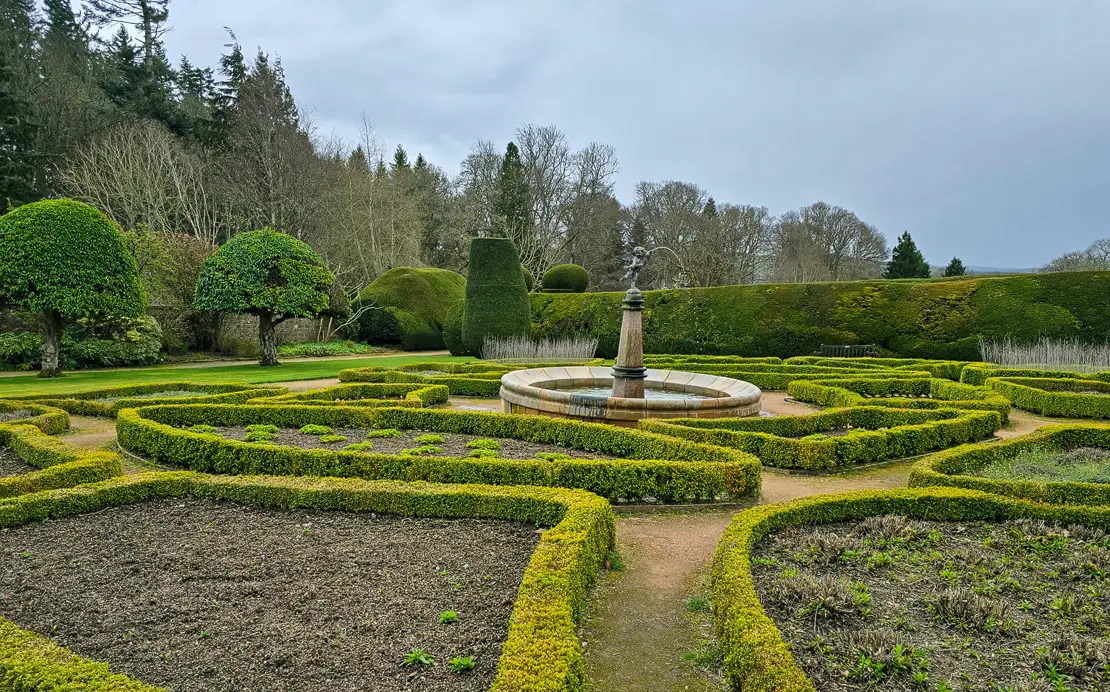
The gardens at Crathes are almost as famous as the castle itself, and they're worth the visit alone. The walled garden covers nearly four acres and is divided into eight distinct 'rooms' by the massive yew hedges that were planted in 1702 – making them over 300 years old. These ancient hedges have grown into extraordinary organic shapes, quite unlike the neat geometric topiary you might expect.

Each garden room has its own character and planting scheme. There's a formal parterre with a central fountain, herbaceous borders bursting with colour, a croquet lawn, and areas dedicated to specific colours and themes.

Victorian glasshouses have been restored and provide sheltered growing space.

We particularly enjoyed the path that winds through the gardens with the castle tower visible above the hedges – it's wonderfully photogenic from every angle.


Look out for the charming stone doocot (dovecote) at the corner of the garden, and the various sculptures dotted around the grounds, including a striking bronze dragonfly.


Estate Trails and Facilities
Beyond the walled garden, the 595-acre estate offers six waymarked trails through woodland and along the Coy Burn. Keep your eyes open for red squirrels, roe deer, woodpeckers, buzzards, and herons. The Wild Wood Adventure Playground is a hit with families – inspired by the castle's stories, it features the 'Green Lady's Tower', a zip wire, rock climbing wall, slides, and sandpits.

Café 1702 (named after the year the yew hedges were planted) is located in converted outbuildings in the courtyard area. We stopped here for cake and a drink after our explorations, and the carrot cake was excellent.


The gift shop is well-stocked with Scottish souvenirs, woolens, books, and plenty of Highland cow merchandise.

FAQs
How much does it cost to visit Crathes Castle?
Adult admission is approximately £16 for the castle and gardens. Entry to the gardens only is around £7. National Trust for Scotland members get free entry. There are also 2-for-1 deals available through ScotRail if you travel by train to Aberdeen.
Can I pre-book tickets?
No, pre-booking is not possible. Entry to the castle is on a first-come, first-served basis, with visitors admitted in small groups at regular intervals.
Is Crathes Castle accessible for wheelchairs?
The gardens and café have wheelchair access, but unfortunately the castle itself is only accessible on the ground floor due to narrow spiral staircases. Disabled parking is available near the courtyard café by arrangement. Accessible toilets are available.
Are dogs allowed?
Dogs are welcome on the estate and in the café and shop, but only assistance dogs are permitted inside the castle, the walled garden, and the Wild Wood Play Area.
What are the opening times?
Crathes is open year-round, unlike many other NTS castles in Aberdeenshire. Summer hours (April–October) are typically 10:00–17:00 daily. Winter hours (November–March) are reduced, usually Thursday–Sunday 10:00–16:00. The castle is closed for approximately two weeks over Christmas and New Year. Always check the NTS website for current opening times before visiting.
How do I get there by public transport?
Stagecoach Bluebird buses 201, 202, and 203 from Aberdeen bus station stop at the entrance to the Crathes estate. However, it's about a 1-mile walk from the bus stop to the ticket office and castle. There is no railway station nearby.
Key Information
- Location: Crathes Castle, Banchory, Aberdeenshire AB31 5QJ
- Grid Reference: NO 735 968
- Managed by: National Trust for Scotland
- Entry: Paid admission (free for NTS members)
- Parking: Free for NTS members; charges apply for non-members
- Facilities: Café, gift shop, toilets, adventure playground
- Accessibility: Gardens and café accessible; castle has limited access due to stairs
- Dogs: Welcome on estate, café and shop; assistance dogs only in castle and walled garden
- Website: www.nts.org.uk/visit/places/crathes-castle
What Else is Nearby?
Crathes is in the heart of castle country, and there are plenty of other historic sites within easy reach:
- Drum Castle – Another NTS property just a few miles east, with a medieval tower and Victorian mansion
- Castle Fraser – One of Scotland's largest tower houses, about 20 minutes north
- Craigievar Castle – The quintessential Scottish tower house, often called the inspiration for Disney's Cinderella castle
- Banchory – A pleasant town on the River Dee with shops, cafés, and the historic Bridge of Feugh where you can watch salmon leaping
- Muchalls Castle – Built by the same Alexander Burnett who completed Crathes, located near the coast
Conclusion
Crathes Castle is one of those places where you can easily spend half a day or more. The castle interior is fascinating – those painted ceilings really are remarkable – and the gardens are among the finest in Scotland. Add in the woodland trails, the adventure playground, and an excellent café, and you have a day out that caters for all ages and interests.
If you're visiting Aberdeenshire and can only see one castle, Crathes should be high on your list. It perfectly captures the romance and history of Scotland's tower house tradition, while also being a beautifully preserved family home filled with centuries of stories. We left feeling that we'd had a genuinely special experience – and we're already planning our return visit.


Leave a comment below