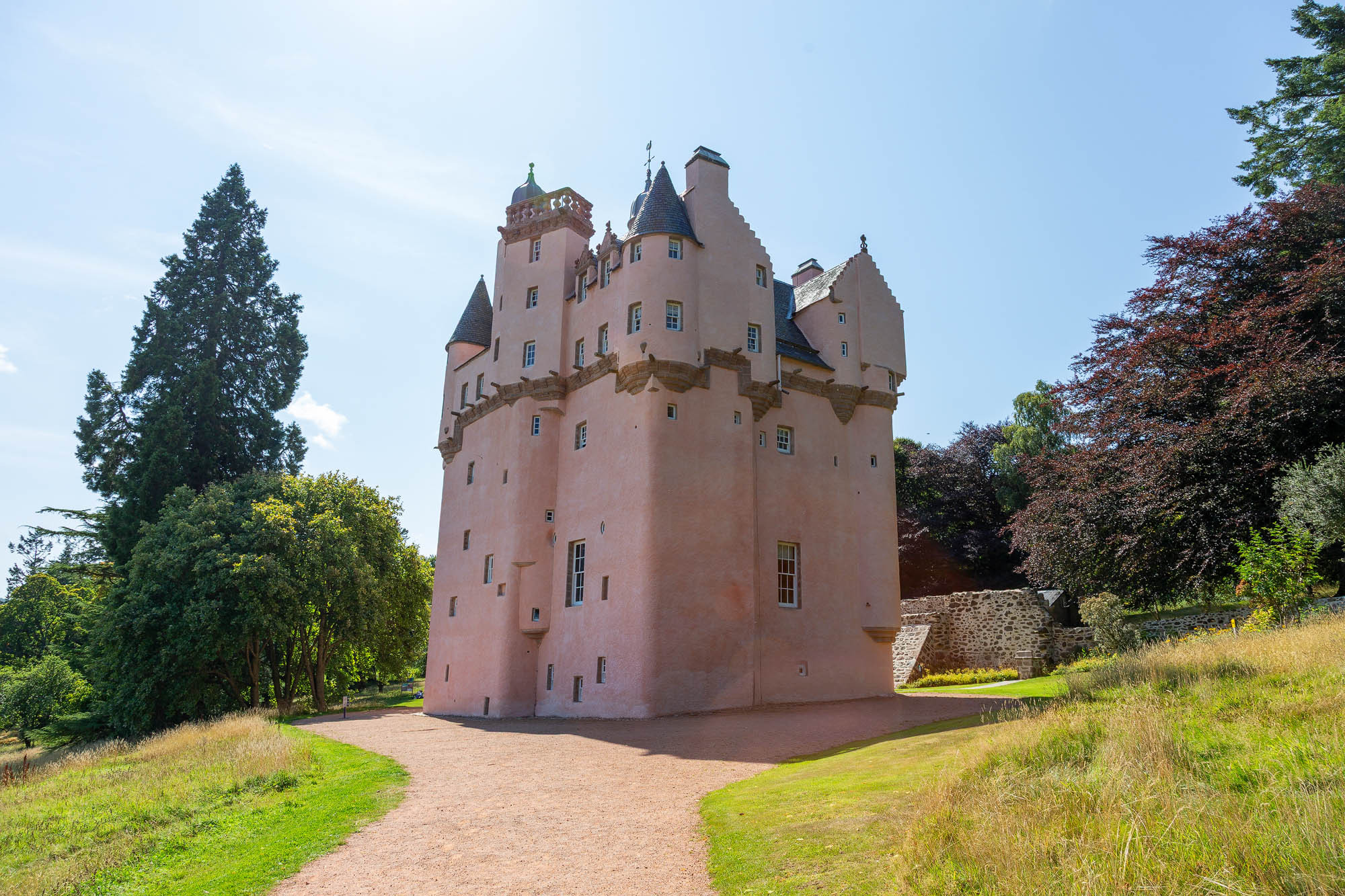
If ever a Scottish castle deserved to be called a fairytale, it’s Craigievar. Rising seven storeys from the rolling Aberdeenshire countryside, its pink-harled walls and cluster of conical turrets look like something plucked straight from a storybook – and indeed, it’s widely claimed that Walt Disney himself drew inspiration from this very tower house. Whether or not that’s true, there’s no denying that Craigievar Castle is one of the most enchanting buildings in Scotland, and my wife Janette and I had been wanting to visit for years.

The History of Craigievar Castle
The story of Craigievar stretches back to the late fourteenth century, when the Mortimer family held the estate from around 1376. It wasn’t until sometime between 1575 and 1595 that Sir John Mortimer began building a traditional L-plan tower house here, rising four storeys in plain, unadorned stone. It was functional and defensive, surrounded by a walled courtyard – or barmkin – with additional buildings within. But the Mortimers’ fortunes declined during the upheaval of the Reformation, and by 1610 they were forced to sell.
Enter William Forbes of Menie – better known as “Danzig Willie” – a young Aberdonian merchant who had made a fortune trading timber and other goods around the Baltic Sea, particularly through the port of Danzig (modern-day Gdańsk). Forbes purchased the half-finished castle and set about transforming it into the building we see today. He stripped the upper storeys back to the fourth floor and rebuilt them on a grander scale, adding three new levels crowned with an extraordinary array of turrets, balustraded viewing platforms and corbelled projections. The architect-builders are thought to have been the Bel family, and the effect they achieved – both inside and out – is a masterful blend of Scottish tradition and Renaissance flair.

The castle was completed around 1626, and Danzig Willie’s initials – along with those of his wife Margaret Woodward – can still be found throughout the building. Inside, Forbes commissioned some of the finest plasterwork ceilings in Scotland, created by a team of Italian-trained plasterers from Bromley-by-Bow in London – the same craftsmen who had worked at Glamis Castle and Kellie Castle. These extraordinary ceilings feature figures from the Bible and classical mythology, winged cherubs, coats of arms and intricate geometric patterns. Craigievar, Glamis and nearby Muchalls Castle are generally considered to have the three finest plaster ceilings in the country.
Forbes’s son was created a Baronet of Nova Scotia by Charles I in 1630, and the family continued to live at Craigievar for an astonishing 350 years. Among the more colourful characters was “Red” Sir John, Danzig Willie’s grandson, named for both his red hair and his fiery temperament. According to castle legend, Red Sir John’s daughter fell in love with a young man from the rival Gordon clan. When the suitor came calling and climbed to the Blue Bedroom on the fourth floor, he was met not by his sweetheart but by her furious father, who put a sword to his throat and forced him to leap from the window. The fall proved fatal, and to this day ghostly footsteps are said to cross the Blue Room towards the window.

By the early nineteenth century, the castle had begun to show its age. When Sir John Forbes inherited in 1823, he considered demolishing the tower entirely and consulted Aberdeen architect John Smith. Fortunately, Smith advised strongly against it, noting that Craigievar was one of the finest examples of its age and style in the country. Instead, Smith oversaw a programme of repairs including a new roof and fresh harling. It was during this work, around 1826, that pigments were added to the limewash to match the colour of the granite detailing – giving Craigievar its now-famous pink appearance for the first time. Before that, the castle had been cream or off-white.
One notable visitor was Queen Victoria, who turned up unannounced on 18 June 1879. Finding nobody at home, she simply let herself in and wandered around what she described in her journal as a “strange and curious old castle.” In 1963, William Forbes-Sempill, the 19th Lord Sempill, sold the castle and its estate of over 200 acres to the National Trust for Scotland, with the specific stipulation that no artificial lighting should be installed above the ground floor. This means that to this day, visitors experience the castle’s rooms by natural light alone – just as the Forbes family did for three centuries.
Most recently, the castle underwent a major conservation project. Between 2007 and 2009, the old cement-based harling was removed and replaced with a traditional lime-based alternative, and a further extensive restoration – the “Pink Again” project – saw the castle closed from 2022 until it reopened at the end of May 2024, looking absolutely stunning in its refreshed pink limewash.
Our Visit to Craigievar Castle
Getting There
We visited on a gorgeous summer’s day, heading south from Alford on the A980. The castle is well signposted with brown National Trust for Scotland signs – and it’s worth stressing that you should follow these signs rather than trusting your sat-nav, as some navigation systems try to direct you to the south drive, which is privately owned and has no vehicle access or parking.

The single-track access road climbs for about half a mile from the A980 to the car park, which is a decent size but can fill up on busy days. Take it slowly on this road – there’s only one way in and out, and you may well meet another car coming the other way. From the car park, it’s a short and very pleasant walk to the castle itself, following a beautiful tree-lined avenue of mature beech trees that frames the approach perfectly.

Exploring the Castle and Grounds
That first glimpse of Craigievar as you emerge from the tree canopy is genuinely special. The pink tower seems to materialise from the landscape, rising above the green lawns and the remnants of the old barmkin wall. It’s the kind of sight that makes you stop and just take it all in for a moment.

Access to the castle interior is by guided tour only, operating on a first-come, first-served basis with a maximum of ten people per tour. You can’t book in advance, so on busy days there may be a wait – we’d recommend arriving early to be safe. The tours run at roughly 30 to 45 minute intervals and last around 45 minutes to an hour, depending on how many questions the group asks.
Our guide was absolutely brilliant – knowledgeable, enthusiastic and full of wonderful stories about the Forbes family and the castle’s history. The tour takes you through all five accessible floors, from the vaulted ground floor up through the Great Hall with its Stuart Arms over the fireplace, the musicians’ gallery, the Queen’s Bedroom, the Blue Room (where the ghost story originates) and various other chambers. One quirky detail I loved was the little salt cupboard beside the fire in the Great Hall, which in more recent times was apparently used by the family’s Jack Russell as a warm sleeping spot.

The plasterwork ceilings are genuinely breathtaking. Dating from around 1624, they feature the Nine Worthies, mythological figures, cherubs and an array of heraldic devices including the Forbes coat of arms with its three muzzled bears. The rooms are illuminated only by natural light from the windows – there’s no electricity above the ground floor – which gives the interior an incredibly atmospheric, authentic quality. You really do feel as though you’ve stepped back in time. Photography inside the castle is not permitted, which is a shame, but it does encourage you to simply soak up the atmosphere rather than viewing everything through a lens.
The castle also houses a collection of Forbes family portraits, original Henry Raeburn paintings complete with their original receipts, seventeenth and eighteenth-century furnishings, and an interesting collection of twentieth-century studio pottery including pieces by Lucy Rie and Bernard Leach. A secret staircase connects the high tower to the Great Hall, and there’s even a box bed that was converted into a tiny bathroom at some point – one of many charming touches that remind you this was a family home, not a museum.
Do be warned that the spiral stone staircases are steep and narrow, especially as you climb higher in the tower. Sensible footwear is a must, and anyone with mobility difficulties will find the upper floors challenging.
The Barmkin Wall and Grounds

Outside, the remains of the sixteenth-century barmkin wall are still clearly visible, giving a sense of the original defensive layout. The Barmkin Kiosk just beside the wall sells hot and cold drinks, pre-wrapped cakes and ice creams – there’s no full tearoom, but on a sunny day it’s perfectly pleasant to sit out on the grass with a coffee and admire the castle.
We spent a good while wandering the grounds after our tour. The estate covers over 200 acres of woodland, parkland and farmland, and there are two waymarked trails – the Woodland Trail and the Hill Trail – the latter offering lovely views towards Bennachie. The grounds are also home to some magnificent specimen trees, and we noticed a swift nesting tower that had been erected to encourage these wonderful birds to take up residence.


The Pink Again Conservation Project
One of the information boards in the grounds explains the fascinating story behind Craigievar’s conservation. The traditional lime harling – a mixture of lime, aggregates and water that is hand-cast onto the building – is a permeable coating that allows moisture to pass through, keeping the walls dry. When this was previously replaced with a cement-based alternative, it trapped moisture inside the walls, causing serious problems including mould and damage to the irreplaceable plaster ceilings. The 2007–2009 project removed the cement harling and restored the traditional lime-based coating, while the more recent Pink Again project has refreshed the colour and further improved conditions to protect the castle for generations to come.

Frequently Asked Questions
How much does it cost to visit Craigievar Castle?
Adult admission is around £12.50–£14, with reduced rates for children, seniors and families. National Trust for Scotland members get free entry. The grounds are free to access at any time.
Can I visit Craigievar Castle without a guided tour?
No – the castle interior is accessible by guided tour only. Tours are first-come, first-served with a maximum of ten people per group, running at approximately 30–45 minute intervals. You cannot book in advance, so arrive early on busy days.
Is Craigievar Castle wheelchair accessible?
The castle interior is not wheelchair accessible. There are stone steps at the entrance and steep, narrow spiral staircases throughout. The grounds are accessible, though the walking trails are on unsurfaced paths and can be steep in places.
Are dogs allowed at Craigievar Castle?
Dogs are welcome in the grounds but must be kept on a short lead near the castle and close to fields with livestock. Dogs are not permitted inside the castle.
Can I take photographs inside the castle?
No – photography is not permitted inside the castle. You are welcome to photograph the exterior and grounds.
Is there a café at Craigievar Castle?
There is no full tearoom, but the Barmkin Kiosk in the grounds sells hot and cold drinks, pre-wrapped cakes, crisps and ice creams. You are welcome to bring a picnic – there are benches available.
When is Craigievar Castle open?
Opening times vary throughout the season. Generally, the castle opens from April to October, with daily opening in summer (June–August) and reduced days in spring and autumn. The grounds are open year-round. Check the National Trust for Scotland website for current times before visiting.
Key Information
- Location: Craigievar Castle, Alford, Aberdeenshire, AB33 8JF
- Grid Reference: NJ 5667 0948
- Managed by: National Trust for Scotland
- Entry: Paid (approx. £12.50–£14 adult; free for NTS members). Grounds free.
- Parking: Car park off the single-track drive from the A980 (small charge applies)
- Facilities: Kiosk (drinks & snacks), toilets at car park, small gift shop, cycle racks, picnic benches
- Accessibility: Castle interior not accessible – stone steps and steep spiral stairs. Grounds accessible but paths unsurfaced and steep in places.
- Dogs: Allowed in grounds on a short lead; not permitted inside the castle
What Else is Nearby?
Castle Fraser – Another stunning National Trust for Scotland castle just 12 miles to the east. One of the grandest Castles of Mar, with beautiful gardens and a tearoom.
Crathes Castle – Around 20 miles south-east, this magnificent tower house is renowned for its painted ceilings and spectacular walled gardens. Another NTS gem well worth combining with a Craigievar visit.
Kildrummy Castle – The atmospheric ruins of a thirteenth-century fortress about 15 miles to the north-west. Managed by Historic Environment Scotland, it’s a dramatic contrast to Craigievar’s fairy-tale tower.
Grampian Transport Museum, Alford – Just six miles north in the village of Alford, this excellent museum houses a fascinating collection of vehicles and transport history. Great for all ages.
Bennachie – The prominent hill visible from Craigievar’s grounds offers several excellent walking routes, including the popular path to the Mither Tap summit with its ancient hillfort and panoramic views across Aberdeenshire.
Final Thoughts
Craigievar Castle is one of those places that genuinely lives up to its reputation. The combination of the fairy-tale exterior, the atmospheric candlelit-quality interiors, the exceptional plasterwork ceilings and the engaging guided tours make it one of the finest castle visits in Scotland. It’s a testament to both the Forbes family, who preserved it so faithfully for 350 years, and to the National Trust for Scotland, whose careful conservation work has ensured this extraordinary building will enchant visitors for centuries to come. If you’re anywhere in Aberdeenshire, don’t miss it.


Leave a comment below