
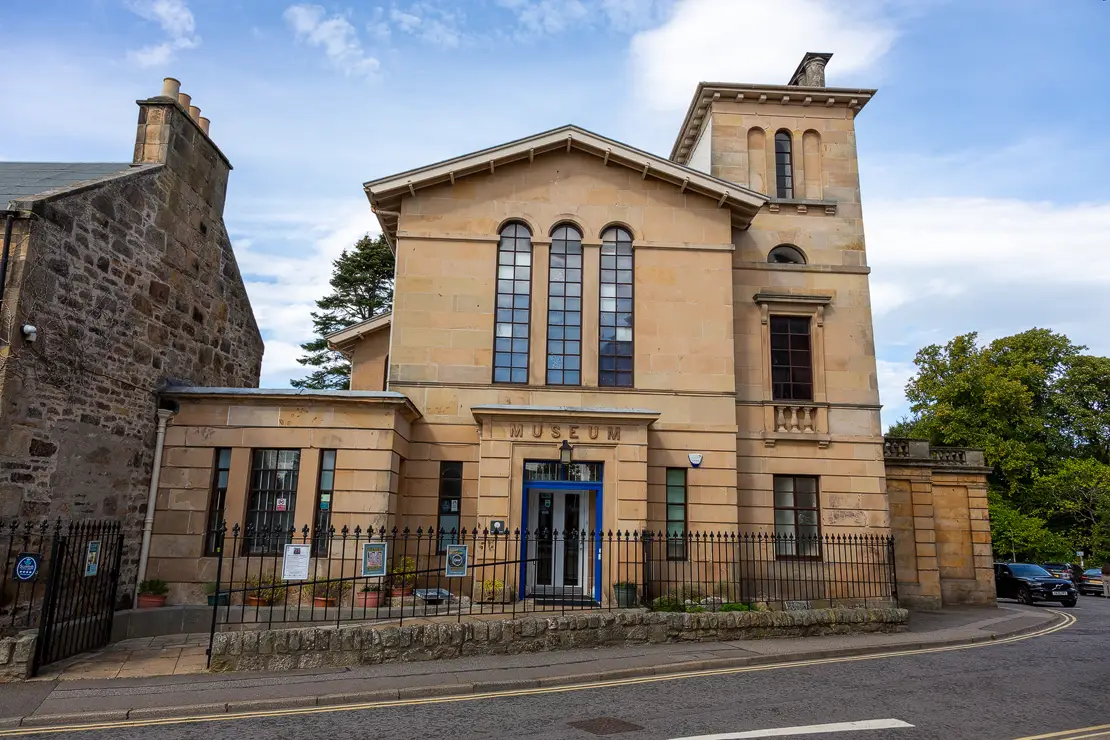
Tucked away at the east end of Elgin’s High Street sits a building that has quietly stood guard over Moray’s history for nearly two centuries. Elgin Museum is Scotland’s oldest continuously independent museum, first opening its doors to the public in 1843. Housed in a stunning Category A listed Italianate building, it holds a remarkable collection of over 36,000 objects – from fish fossils dating back more than 450 million years to artefacts that tell the story of Moray’s people right up to the present day. It’s a real hidden gem, and one that our whole family thoroughly enjoyed exploring.
The History of Elgin Museum
The story of Elgin Museum begins on an October evening in 1836, when a group of Elgin men gathered to discuss an ambitious idea. Among them were Rear-Admiral Duff, banker John Lawson, Town Clerk Patrick Duff, and bookseller Isaac Forsyth. Their aim was nothing less than “instituting in Elgin a Museum for the collection and preservation of objects of Science and Virtue.” Together they formed the Elgin and Morayshire Scientific Association, a forerunner of today’s Moray Society.
Isaac Forsyth, the association’s deaf secretary, wasted no time in purchasing a plot of land at the east end of Elgin’s High Street. A design competition was held, and the winning entry came from a young architect named Thomas Mackenzie. Born in Perthshire in 1814, Mackenzie was just 25 years old when his design was selected. He had trained in Aberdeen under the celebrated Archibald Simpson, and his detailed notes survive explaining why he chose the Italianate style for the museum. He wanted something distinctive, reasoning that since all of Elgin’s other public buildings were designed in the Grecian style, yet another classical building might lead strangers and connoisseurs to say they had “too much of a good thing.”
The building was completed in 1842, but there was a problem – it wasn’t fully paid for. The all-male association had run out of fundraising steam, so they turned to the ladies of Elgin, who organised a hugely successful bazaar that raised enough money to settle the debt. The museum opened to the public on 25th October 1843, and it has remained independent ever since.
The museum’s first curator was John Martin, an art master at Anderson’s Institute, while its first keeper was William Ingram. Though poorly paid, Ingram was given two rooms in the tower to live in. He was apparently a stickler for propriety – legend has it he once insisted on charging the great geologist Thomas Huxley the full sixpence entrance fee.
Over the decades, the museum grew. A rear extension was added in 1896 to cope with overcrowding, and in 1921 the Pennycuick sisters donated funds for the addition of the hall. More recently, the building underwent a major refurbishment between 1988 and 1990, and the main gallery was redesigned with Heritage Lottery funding in 2003. Intriguingly, the architect chosen for the 1920 alterations was A. Marshall Mackenzie – Thomas Mackenzie’s own son, who went on to become one of Scotland’s most distinguished architects, responsible for the frontage of Marischal College in Aberdeen and even Australia House in London. Sadly, Thomas Mackenzie himself died in 1854, aged just 40, reportedly from brain fever brought on by an accident.
Today, Elgin Museum is owned and managed by The Moray Society and is run almost entirely by volunteers. It remains a fiercely independent institution – it receives no council funding and relies on donations, grants, and the dedication of its volunteers. Entry is free, though donations are warmly welcomed.
Our Visit to Elgin Museum
Getting There
We visited Elgin Museum as a full family outing – myself, my wife Janette, and our three daughters Ellie, Olivia and Lauren. Elgin is our nearest town, so the museum has always been on our doorstep, but we hadn’t visited in some time and the girls were keen to explore.
We parked at one of the nearby car parks just off the High Street. Elgin has several pay-and-display options within easy walking distance of the museum, including the Moray Street car park and the Ladyhill Road car park. From the car park, it was barely a minute’s walk to the museum entrance at the eastern end of the High Street.

First Impressions
The exterior of Elgin Museum is immediately striking. The warm sandstone Italianate façade, with “MUSEUM” carved boldly above the entrance, the distinctive tower to one side, and the iron railings fronting the building all give it real presence on the High Street. Stepping through the blue door and into the main gallery, we were genuinely taken aback. The soaring double-height interior, with its elegant arched galleries, hanging lantern lights, and a magnificent mounted stag head gazing down from the mezzanine level, is absolutely stunning. It feels far grander and more spacious than you’d expect from the outside.
The main hall is the “People and Place” gallery, which tells the story of the last thousand years of Moray. At its centre sat a wonderful Lego model of Elgin Cathedral, surrounded by carved Pictish stones, colourful banners, and display cases filled with centuries of local history. We were greeted warmly by the volunteers, who were clearly passionate about the museum and happy to chat about the collections.

The Fossil Collection
One of the undoubted highlights of Elgin Museum is its fossil collection, which is officially recognised as a Nationally Significant Collection by Museums Galleries Scotland. The rear gallery houses an extraordinary display of geological specimens spanning hundreds of millions of years, and it’s where we spent a good chunk of our visit.

The “Fishes of the Middle Old Red Sandstone” display is particularly impressive. Between 385 and 375 million years ago, the Moray Firth region was occupied by a vast lake called Lake Orcadie, and the fossils of the many fish species that lived in its waters have been preserved in remarkable detail. The display includes actual fossil specimens alongside painted models, bringing these ancient creatures vividly to life. Lauren, our youngest, was fascinated by the fish models and spent ages comparing them to the actual fossils in the cases.

Equally compelling is “The Elgin Reptiles” display. The sandstones around Elgin have yielded fossil reptiles of great historical and evolutionary importance, representing two distinct communities from different geological ages. The older group, found at Cutties Hillock and Quarry Wood near Elgin, dates from the late Permian period (around 250 million years ago), while the younger group from Lossiemouth, Spynie and Findrassie is late Triassic (approximately 220 million years old). The display includes fossils alongside artist’s illustrations of creatures like Gordonia and the famous Elginia – a small, horned reptile unique to the Elgin area that gives its name to the walking trail at Quarry Wood.


The geological displays also include a stunning collection of rock specimens from across Moray, displayed beneath a colourful cross-section chart showing the region’s underlying geology. Portraits of the early Victorian collectors – enthusiastic amateur geologists like Patrick Duff – who gathered many of these specimens remind you that this museum was born from a genuine passion for science and discovery.


Pictish Stones and Archaeology
Moving from the geology section, we came to what is arguably the museum’s most visually striking display: the Pictish and early medieval carved stone collection. Elgin Museum holds the largest collection of Pictish and early medieval carved stones in Moray, and seeing them all together is genuinely awe-inspiring.

The centrepiece is the display of the Burghead Bulls – carved stone slabs depicting bulls that were found at the Pictish fort of Burghead on the Moray coast. These powerful, simple images are among the most iconic examples of Pictish art anywhere in Scotland. Alongside them sit the Kinneddar Stones and dozens of fragments of cross-slabs, each bearing intricate knotwork, interlace patterns and mysterious Pictish symbols that have fascinated historians for centuries.

The archaeological displays don’t stop at the Picts. One of the most memorable exhibits in the entire museum is a short cist burial – a prehistoric stone coffin containing the skeleton of an individual laid to rest on a bed of smooth pebbles. It’s a haunting and deeply moving display that really brings home the human stories behind the artefacts. All three girls were captivated by this, though Lauren found it a wee bit spooky!

We also spotted a remarkable hoard of ancient Roman silver coins – evidence that Moray’s connections with the wider world go back far further than you might expect. The sheer number of coins in the display is impressive, and it’s a reminder that even this far north of the Roman frontier, trade and contact with the empire were very real.

The Rear Gallery and Local History

The rear gallery is where you’ll find the permanent geology and archaeology displays alongside objects relating to the everyday lives of ordinary people through the centuries. There’s a wonderful Victoriana collection, with domestic items like cast iron kettles, flat irons, copper jelly moulds, horn cups and all manner of household implements that paint a vivid picture of daily life in historic Moray.

The museum also celebrates Moray’s famous local industries. A set of beautifully presented display cases features items from some of the region’s best-known businesses, including Walkers Shortbread from Aberlour-on-Spey, Gordon & MacPhail the renowned Elgin whisky merchants, and the local textile trade. For anyone who knows and loves the Moray area, these displays are a wonderful trip down memory lane.

The Upper Gallery
A grand staircase leads up to the upper mezzanine gallery, and I’d strongly recommend making the climb. The views back down over the main hall are spectacular – you really appreciate the scale and beauty of Mackenzie’s Italianate design from up here, with its elegant arches, hanging lanterns and the tall windows flooding the space with natural light.


The upper floor houses additional displays, including world cultures artefacts brought back to Moray by travellers over the centuries, a model sailing ship, and a large map of the Moray coast. The museum’s archive also includes correspondence with some remarkable figures, including Charles Darwin and Thomas Huxley.

The Side Hall
Before leaving, we popped into the side hall, which houses the museum shop and a series of informative exhibition banners about “Fossilised Life in Moray.” These panels cover the full sweep of Moray’s geological story, from the Middle Devonian period (around 375 million years ago) through to the Triassic. There’s also fascinating material about some of the region’s notable collectors and explorers. It’s well worth taking the time to read through these before you head off.

Frequently Asked Questions
How much does it cost to visit Elgin Museum?
Entry to Elgin Museum is completely free, though donations are very much welcomed and appreciated. The museum is run almost entirely by volunteers and receives no council funding, so your contribution makes a real difference.
Is Elgin Museum currently open?
Due to ongoing issues with the historic building, Elgin Museum is currently operating with limited opening. Visits are possible by appointment, with at least three days’ notice required. Check the museum’s website or social media channels for the latest information on opening times.
Is Elgin Museum wheelchair accessible?
The main entrance is accessed via a kerb ramp and sloped path with no steps. Most displays are on the ground floor, which has sloped access to the rear gallery. There is a wheelchair-accessible toilet on the ground floor. However, there is no lift, so the upper gallery is not accessible to wheelchair users. The ground floor has thin pile carpet which may present difficulties for manual wheelchair users.
Is there parking near Elgin Museum?
There is no dedicated museum car park, but several pay-and-display car parks are within a short walk, including Moray Street (102 spaces) and Ladyhill Road (40 spaces). On-street parking is also available along the High Street. Parking is free on Sundays in all council car parks.
Are there toilets at Elgin Museum?
Yes, there are two public toilets in the museum. The downstairs toilet in the main gallery is adapted for wheelchair users. A second toilet is located in the shop area in the side hall, though this one is not wheelchair accessible.
Can I take photographs inside Elgin Museum?
Yes, photography for personal use is generally permitted throughout the museum. The staff and volunteers are very welcoming and happy to help with any queries.
How long does a visit to Elgin Museum take?
We spent around an hour and a half exploring the museum, which allowed us to see everything at a comfortable pace. You could do it more quickly, but there’s plenty to see and read, so allow at least an hour.
Key Information
- Location: 1 High Street, Elgin, Moray, IV30 1EQ
- Grid Reference: NJ 2220 6290
- Managed by: The Moray Society
- Entry: Free (donations welcome)
- Parking: Pay-and-display car parks nearby (Moray Street, Ladyhill Road, St Giles Multi-Storey). Free on Sundays.
- Facilities: Museum shop, free Wi-Fi, public toilets (including wheelchair-accessible), contactless payment
- Accessibility: Ground floor accessible via ramp and sloped path. No lift to upper floor. Hearing loop at reception.
- Dogs: Assistance dogs only
What Else is Nearby?
Elgin Cathedral – Known as the “Lantern of the North,” the atmospheric ruins of Elgin Cathedral are just a few minutes’ walk from the museum along the High Street. Managed by Historic Environment Scotland, it’s one of the finest medieval cathedral ruins in Scotland.
Spynie Palace – A short drive north of Elgin, Spynie Palace was once the residence of the Bishops of Moray. The massive David’s Tower offers stunning views over Spynie Loch and the surrounding countryside.
Quarry Wood, Elgin – A beautiful three-mile forest walk just west of Elgin, known for its dinosaur fossil quarries and an impressive neolithic henge. The Elginia Trail is named after the fossil reptile found nearby and displayed in the museum.
Pluscarden Abbey – About six miles south-west of Elgin, Pluscarden is one of only a handful of medieval monasteries in Britain still used for its original purpose. The Benedictine monks welcome visitors to this peaceful and atmospheric site.
Glen Moray Distillery – Located at the west end of Elgin, Glen Moray offers tours and tastings in a welcoming setting. A great option if you want to pair your museum visit with a wee dram.
Final Thoughts
Elgin Museum is an absolute treasure. It’s the kind of place that could easily be overlooked – a small independent museum on a High Street – but step inside and you’ll discover something truly special. The nationally significant fossil collection alone would justify a visit, but add in the Pictish carved stones, the archaeological displays, the local history, and that magnificent Italianate building, and you have one of the best small museums in Scotland.
What makes it even more impressive is that it’s run entirely by volunteers. The passion and knowledge of the people who keep this museum going is evident in every display, every conversation, and every carefully curated exhibit. Our whole family came away having learned something new, and the girls are already asking when we can go back.
If you’re visiting Elgin or anywhere in Moray, Elgin Museum is an absolute must. It’s free, it’s fascinating, and it deserves every bit of support it can get. Don’t miss it.


Leave a comment below