
Tucked beneath towering red sandstone cliffs on the north Aberdeenshire coast, Pennan is one of Scotland’s most enchanting and photogenic villages. This tiny fishing hamlet – little more than a single row of whitewashed cottages clinging to the shoreline – would be remarkable enough on its own merits. But it was the 1983 film Local Hero that catapulted Pennan into the international spotlight, and visitors have been making the pilgrimage to its famous red telephone box ever since. My family and I visited on a gorgeous spring day to explore this wonderful little corner of coastal Scotland, and it didn’t disappoint.
The History of Pennan
The name Pennan was first recorded in 1587 as “Pennand” and is thought to derive from the Brittonic word pen, meaning “head” or “headland” – a fitting description for a village perched on a modest promontory along this dramatic coastline. Before it became known as Pennan, the settlement was referred to as St Magnus Haven or Auchmedden, reflecting its connection to the powerful Baird family whose palace once stood nearby before being demolished in the late 18th century.
Although no direct archaeological evidence of settlement exists within the village itself, the surrounding area tells a much older story. Human activity in the region dates back to Mesolithic times, around 6,000 years ago. A burial cist and Beaker artefacts have been found nearby, along with an Iron Age promontory fort at Cullykhan Bay, roughly a kilometre to the west. Pennan first appears on maps drawn by Timothy Pont around 1580–1600, where it is shown as a little line of houses beside the sea.

The village as we know it today came into being as a fishing settlement in the 18th century. Harbour rights were granted in 1699, and the first harbour was built in 1704. It fell into disuse by the end of that century, and a replacement was constructed in 1799. By 1840, this harbour too was no longer usable, and a bigger and better one was built in 1845. This third harbour lasted until a ferocious winter storm in 1889/1890 destroyed the west pier, which was replaced in 1903 and further improved in 1909.
By the mid-19th century, Pennan was a thriving community. A book published in 1930 by Peter Anson paints a vivid picture of life in 1855, describing 129 men and boys all engaged in herring or line fisheries, with a fleet of 40 boats employing around 240 people. The village was also well known for the millstones quarried from the cliffs to the east, which were shipped out from the harbour or simply rolled on their edge to more local destinations – a remarkable feat when you consider the terrain.
Until the 1930s, the village population revolved around three main surnames – Watt, Gatt and West. The shift to mechanised steam drifters, vessels far too large for Pennan’s small harbour, saw fishermen relocate to bigger ports like Fraserburgh and Peterhead. The population, which had stood at nearly 300 by 1900, declined sharply. A devastating storm on 31st January 1953 swept away all the buildings and sheds on the seaward side of the road to the west of the Pennan Inn. The then laird, David Watt, gave permission to Aberdeen County Council to build the concrete seawall that still protects the village today.
Local Hero and Hollywood Fame
Pennan’s greatest claim to fame arrived in 1983 when director Bill Forsyth chose the village as the primary filming location for Local Hero. The film, produced by David Puttnam and starring Burt Lancaster, Peter Riegert and a young Peter Capaldi, tells the story of an American oil company executive sent to a remote Scottish village to buy it for a refinery. Pennan doubled as the fictional village of Ferness, and the red telephone box from which Mac calls his boss in Houston became one of the most iconic images in British cinema.
Here’s an interesting detail that many visitors don’t know: the phone box that appeared in the film was actually a prop. The genuine telephone box, which stood a few yards away, was hidden from view during filming by a prop shed. After the film’s release, fans began arriving in droves looking for the phone box, so in 1989 the village installed a real one and it was given listed building status to protect it. The film’s emotive soundtrack by Mark Knopfler of Dire Straits has only added to its enduring appeal – Knopfler still plays the haunting theme “Going Home” as an encore at his concerts.
Pennan returned to the silver screen in 2016 when the remake of Whisky Galore!, starring Eddie Izzard, Gregor Fisher and James Cosmo, used the village as one of its principal filming locations alongside nearby Portsoy.
In more recent years, landslips have posed a serious threat to the village. A mudslide in August 2007 damaged parts of the west end including the village hall, and in 2009 a 25-foot crack appeared on the cliff side, sparking calls for evacuation. The community continues to work with Aberdeenshire Council on coastal defence measures to protect this special place for future generations.

Our Visit to Pennan
Getting There
I’ll be honest – getting to Pennan is an adventure in itself. The village sits on the north-facing coast between Fraserburgh and Macduff, just off the B9031. After turning off the main road, you descend a narrow, steep single-track road that drops sharply down the cliff face. It’s not for the faint-hearted, and I’d strongly recommend first gear and keeping your wits about you, especially if you meet something coming up. The road emerges into the village at a tight junction beside the Pennan Inn.

Before we headed down, we stopped at the clifftop car park above the village. This is a small informal parking area at the top with room for a handful of cars, recycling bins and a truly spectacular view out over the North Sea. It’s worth pausing here even if you’re driving down to the village, just to take in the scale of where Pennan sits in the landscape.

There is a small car park at the western end of the village, signposted as you arrive. It’s free, though limited in size. On a busy summer day you might struggle for a space, so arriving early is wise. We visited on a beautiful spring afternoon and found space easily enough.
Exploring the Village
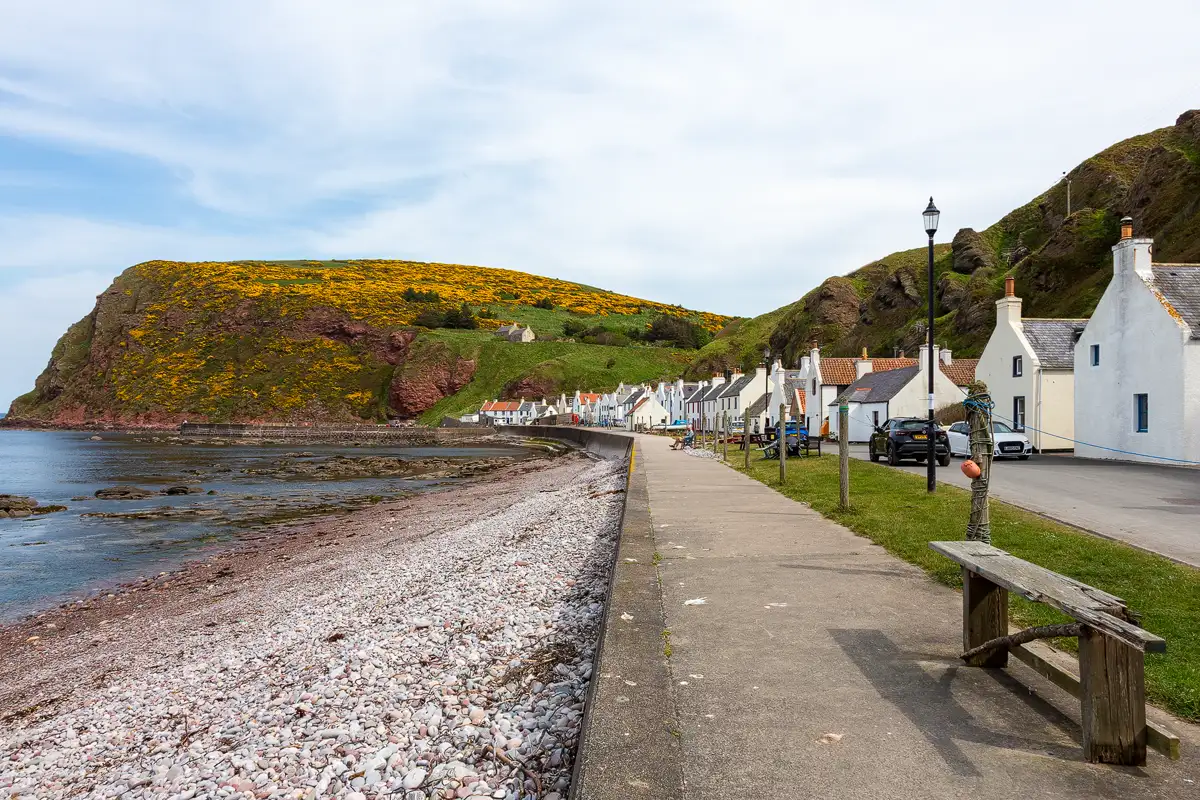
Stepping out of the car onto the seafront is a bit like stepping into a film set - which, of course, it literally was. The village consists of a single row of roughly 35 whitewashed and pastel-coloured cottages running along the shore, many placed gable-end to the sea to reduce their exposure to the elements. Behind them, dramatic red sandstone cliffs rise steeply, carpeted in bright yellow gorse when we visited. It’s genuinely one of the most picturesque settings I’ve seen anywhere in Scotland.

Janette and the girls found a picnic bench on the seafront and we sat for a while just soaking it all in. The pebble beach stretches the length of the village, protected by a concrete seawall, and the sound of the waves on the stones is wonderfully relaxing. Even on a calm day like ours, you can sense the raw power of the sea here - and imagine just how wild it must get in winter.

The Famous Red Phone Box
Of course, no visit to Pennan is complete without a photograph at the famous red telephone box. It sits at the eastern end of the village near the harbour, and it’s still a fully working phone box – you can actually pick up the receiver and make a call, just as Mac did in the film. Visitors come from all over the world to stand where Burt Lancaster’s character would call his boss in Houston, dropping his coins in when he heard the pipes. The kids were brilliant sports about posing for photos, even though I suspect the film’s 1983 release date made it ancient history to them.

The Harbour and Pennan Inn
At the eastern end of the village lies Pennan Harbour, a sturdy stone-walled affair that has been rebuilt and repaired multiple times over the centuries. When we visited at low tide, the harbour was mostly exposed, with a single small boat sitting on the shingle. It’s a lovely spot to explore, and the views back along the village from the harbour wall are superb.


The Pennan Inn sits right at the junction where the road enters the village. It featured as the “Macaskill Arms” hotel in Local Hero, though fans should know that the interior bar scenes were actually filmed at The Ship Inn in Banff. The inn now operates as a B&B and gallery run by the Focht family, who also offer aurora-watching tours during the darker months – this stretch of coast is one of the best places in mainland Britain to see the Northern Lights.

Down by the harbour, we were delighted to discover the Coastal Cuppie, a charming little coffee kiosk run by local Shona Stephen. It’s the perfect spot to grab a hot drink or an ice cream while watching the world go by. There’s a scattering of colourful chairs and benches outside, and it felt like exactly the kind of place you’d happily while away an hour.

One last thing that gave us a good laugh – we spotted a blue Jaguar E-Pace in the village sporting the personalised number plate “PE11 NAN”. Now that’s commitment to village life!

Frequently Asked Questions
Is there an entry fee to visit Pennan?
No. Pennan is a public village and there is no charge to visit. The car park at the western end of the village is also free.
Is Pennan accessible for wheelchairs and pushchairs?
The seafront path is relatively flat and paved, so it’s manageable for wheelchairs and pushchairs once you’re in the village. However, the steep access road and the lack of dropped kerbs in places could present challenges. The harbour area has uneven surfaces. There are no accessible public toilets in the village.
Are dogs welcome in Pennan?
Yes, dogs are welcome in the village and on the beach. Please keep them on a lead around the cottages and clean up after them, as this is a residential area.
Are there toilets at Pennan?
There are public toilets near the car park at the western end of the village, signposted from the seafront.
Can you still use the red phone box?
Yes! The famous red telephone box is still a working payphone. You can pick up the receiver and make a call, just as Mac did in Local Hero. The phone number is +44 (0)1346 6210.
Is the Pennan Inn open to visitors?
The Pennan Inn operates as a B&B and gallery. It has a small pub where visitors can enjoy a drink. Opening hours can vary, especially in winter, so it’s worth checking their website at www.thepennaninn.co.uk before visiting.
When is the best time to visit Pennan?
Late spring through early autumn offers the best weather and longest daylight hours. The gorse on the cliffs is spectacular in May and June. Winter visits can be dramatic but the access road may be challenging in icy conditions, and facilities are limited.
Key Information
- Location: Pennan, Fraserburgh, Aberdeenshire, AB43 6JB
- Grid Reference: NJ 8447 6521
- Managed by: Aberdeenshire Council / private residents
- Entry: Free
- Parking: Free car park at the western end of the village (limited spaces)
- Facilities: Public toilets, Pennan Inn (B&B/pub/gallery), Coastal Cuppie (seasonal coffee kiosk), picnic benches
- Accessibility: Seafront path is paved and relatively flat; steep access road; harbour area uneven
- Dogs: Welcome on leads
- Website: www.pennanharbour.com
What Else is Nearby?
Crovie – Just a few miles west along the coast, Crovie (pronounced “Crivie”) is another impossibly picturesque fishing village where the houses are so tightly packed against the cliff that cars cannot enter. It’s even more dramatically situated than Pennan and well worth the short detour.
Gardenstown – On the other side of Troup Head from Pennan, Gardenstown (locally known as “the Gamrie”) is a larger village with a fascinating maze of alleyways and cottages tumbling down to the harbour. The ruins of St John’s Church above the village contain skulls of Danish chiefs killed in the Battle of the Bloody Pits in 1004.
Aberdour Bay - A lovely beach, a short distance east of Pennan. Amazing seacaves can be explored here.
RSPB Troup Head – Home to Scotland’s only mainland gannet colony, Troup Head is a spectacular nature reserve on the cliffs between Pennan and Crovie. Over 50,000 seabirds nest here in summer, including gannets, puffins, guillemots and razorbills. Access is via Northfield Farm.
Cullykhan Bay – A beautiful sandy beach to the west of Pennan, overlooked by the remains of the Bronze Age Fort Fiddes, described as one of the earliest industrial sites in Europe. There are also collapsed sea caves and natural arches to explore.
Macduff Marine Aquarium – Around 15 miles west of Pennan, the aquarium in Macduff features a living kelp reef and marine life from the Moray Firth. It’s a great option for families, particularly if the weather turns.

Final Thoughts
Pennan is one of those places that stays with you long after you leave. There’s something almost dreamlike about standing in this tiny village, hemmed in between the cliffs and the sea, knowing that the outside world feels a million miles away. Whether you’re a Local Hero fan making a pilgrimage to the phone box, a photographer drawn by the extraordinary light and landscape, or simply someone looking for a quiet corner of Scotland to explore, Pennan delivers in abundance. We absolutely loved our visit and would happily return – perhaps next time to stay at the Pennan Inn and watch the Northern Lights dance over the North Sea.


Leave a comment below