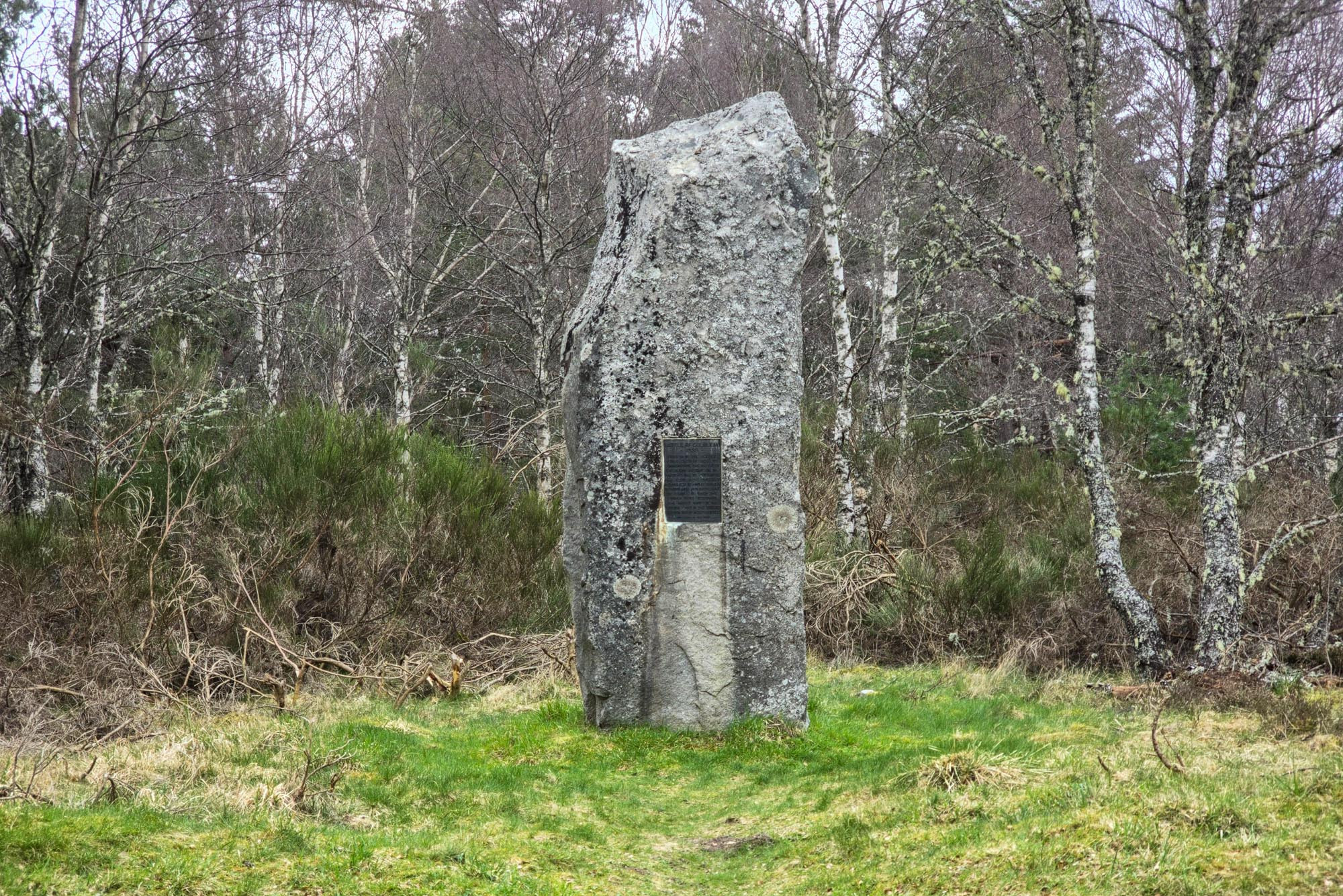
Tucked away on the edge of a quiet single-track road in the heart of Deeside, a tall granite monolith stands watch over one of Scotland’s most important – yet least remembered – battlefields. The Battle of Culblean Monument commemorates an engagement fought on St Andrew’s Day 1335 that proved to be the turning point in the Second War of Scottish Independence. It’s the kind of place you could easily drive past without a second glance, but stop for a moment, read the plaque, and you’ll discover a story of courage, cunning tactics, and a nation’s fight for survival.

The History Behind the Battle of Culblean
Most people are familiar with Bannockburn and the First War of Scottish Independence, but the story didn’t end there. Robert the Bruce’s great victory in 1314 may have secured Scotland’s freedom for a generation, but his death in 1329 left the throne in the hands of his infant son, David II. It was an opportunity that Scotland’s enemies were quick to exploit.
Edward Balliol, son of the former King John, launched an invasion in 1332 with the backing of England’s Edward III, hoping to claim the Scottish crown for himself. After a devastating defeat at the Battle of Halidon Hill in 1333, things looked bleak for the Scots. The young King David II and his queen fled to France, and much of the country fell under English-backed control. The task of holding Scotland together fell to a series of Guardians, the most capable of whom was Sir Andrew Murray.
Murray was the son of Sir Andrew de Moray, the very same man who had fought alongside William Wallace at the Battle of Stirling Bridge in 1297 and had been mortally wounded in the fighting. The younger Murray was every bit as determined as his father. By the autumn of 1335, he faced a crisis in the northeast. David de Strathbogie, the titular Earl of Atholl, had been appointed commander of the English forces in the north and had laid siege to Kildrummy Castle in Aberdeenshire with an army of around 3,000 men.
This was deeply personal for Murray. Kildrummy was being held in the name of King David II by Lady Christina Bruce – the king’s aunt and, crucially, Murray’s own wife. From southern Scotland, the Guardian raced north with a force of roughly 800 men, gathering additional support along the way. It was a risky move. Since the disaster at Halidon Hill, Scottish commanders had carefully avoided pitched battle, preferring guerrilla tactics. But Murray had no choice – the fall of Kildrummy would have been catastrophic for the Scottish cause in the north.
The Battle – St Andrew’s Day, 30 November 1335
By the evening of 29 November, Murray’s army had camped at the “Hall of Logy Rothwayne” on the northeast shore of Loch Davan. His force had been bolstered by the arrival of 300 men from Kildrummy, led by a man named John of the Craig, who brought vital intelligence about the terrain and a possible route to outflank the enemy.
Warned of Murray’s approach, Strathbogie had abandoned the siege and moved south with his 3,000 men, positioning himself at the eastern end of Culblean Hill. Murray devised a bold plan. He split his army into two groups: Sir William Douglas of Liddesdale would lead a frontal force to engage Strathbogie head-on, while Murray himself would swing around with the rest of his men to strike the enemy’s exposed flank.
On St Andrew’s Day, the plan was executed with devastating effect. Douglas’s men drew Strathbogie’s forces into a fight, and once they were fully committed, Murray’s flanking force struck. Surprised and overwhelmed, the English-backed army broke and scattered. Strathbogie himself was killed in the fighting – according to the 16th-century historian Hector Boece, he fell at the hands of Alexander Gordon.

The Significance of Culblean
Compared with the great set-piece battles of the Wars of Independence, Culblean was a relatively small affair. But its impact was enormous. The historian Dr W. Douglas Simpson described it as “the turning point in the second war of Scottish Independence, and therefore an event of great national importance.” In a single afternoon, Murray had nullified the effects of Edward III’s summer invasion and effectively ended any realistic hope that Balliol would ever sit securely on the Scottish throne.
The consequences were felt immediately. Edward Balliol spent the winter of 1335–36, as the Lanercost Chronicle recorded, “with his people at Elande, in England, because he does not yet possess in Scotland any castle or town where he could dwell in safety.” Northern Scotland had been swept clean of English influence, and the long road to full Scottish recovery had begun.
The Monument
The battlefield lay largely forgotten for centuries until 1956, when the Deeside Field Club erected the monument that stands here today. The 13-foot-high granite monolith was unveiled on 16 September 1956, positioned just off the Tarland–Burn o’ Vat road (the B9119) near the hill where the battle was fought.
A bronze plaque on the front of the stone bears the inscription: “Erected by the Deeside Field Club in 1956 to commemorate the Battle of Culblean fought on St. Andrew’s Day, 30th November 1335, between the forces of Sir Andrew de Moray, Warden of Scotland, and David, Earl of Atholl, in which the former were victorious. The battle marked the turning point in the second Scottish War of Independence.” Below this, in smaller text, are the words: “Add glory to the past.”

Our Visit to the Battle of Culblean Monument
Getting There
Janette and I visited the Battle of Culblean Monument during a spring drive through upper Deeside. The monument sits right beside the B9119, the minor road that connects Tarland with the Burn o’ Vat and the A97. It’s an easy spot to find if you know where to look, but there’s no brown tourist sign or any other roadside indication that it’s there – you simply have to know about it.
Coming from the Dinnet direction, we drove north on the B9119 and the monument appeared on our left, standing just a few metres back from the road in a clearing of birch trees and heather. There’s no formal car park, but there’s a wide grass verge and a small layby right beside the stone where we were able to pull in easily. On the day we visited, ours was the only car there.
Exploring the Monument
The monument is visible from the road, so you can’t really miss it once you’re in the right area. It’s a striking sight – a tall, rough-hewn granite monolith, mottled with lichen and standing alone in a small clearing. Behind it, silver birch trees stretch back into dense woodland and heather moorland. It’s a wonderfully atmospheric spot, peaceful and remote, and it’s easy to imagine this same landscape covered in forest nearly 700 years ago when the battle took place.
Walking up to the stone, we could see the bronze plaque mounted on the front face. The inscription is clear and legible, giving a concise account of the battle and its significance. I found the final line – “Add glory to the past” – particularly evocative, especially given that the monument was erected in 1956, just eleven years after the end of the Second World War. It’s a fitting tribute to a battle that deserves to be far better known.

What struck us both was just how quiet and unvisited the site felt. There are no information boards, no paths, no benches – just the stone, the trees, and the moorland. It’s the kind of place where you can stand in silence and reflect on the events that shaped a nation. For anyone with an interest in Scottish history, this is well worth a detour.
The visit itself only takes a few minutes – it’s essentially a single monument with a plaque – but I’d recommend combining it with a trip to the nearby Burn o’ Vat or Tomnaverie Stone Circle to make a full half-day out on Deeside.
Frequently Asked Questions
Where is the Battle of Culblean Monument?
The monument is located just off the B9119 road between Tarland and the Burn o’ Vat, approximately 4 miles north of Aboyne in Aberdeenshire. It sits within the Cairngorms National Park. The nearest postcode is AB34 5PQ (Logie Coldstone area).
Is there an entry fee to visit the monument?
No. The monument stands on open ground beside the road and can be visited free of charge at any time of day or night. There are no barriers, gates, or restricted opening hours.
Is there parking at the Battle of Culblean Monument?
There is no formal car park, but there is a wide grass verge and an informal layby on the B9119 directly beside the monument. There is space for two or three cars comfortably. Parking is free.
Is the monument accessible for wheelchairs or pushchairs?
The monument stands on uneven grass a few metres from the roadside. There is no surfaced path or formal access route. The ground can be soft and uneven, particularly after rain, which may make access difficult for wheelchair users or those with limited mobility.
Can I bring my dog to the Battle of Culblean Monument?
Yes. The monument is on open ground beside the road and dogs are welcome. Please keep dogs under control, as the surrounding area is used for livestock grazing and there is wildlife in the woodland and heather.
Are there any facilities at the monument?
No. There are no toilets, bins, or other facilities at the monument itself. The nearest public toilets and visitor facilities are at the Burn o’ Vat Visitor Centre, approximately 1.5 miles south on the B9119, or in the villages of Tarland or Aboyne.
When did the Battle of Culblean take place?
The battle was fought on St Andrew’s Day, 30 November 1335, during the Second War of Scottish Independence. The Scots, led by Guardian Sir Andrew Murray, defeated an Anglo-Scottish force under David de Strathbogie, Earl of Atholl.
Key Information
- Location: B9119, near Logie Coldstone, Aboyne, Aberdeenshire AB34 5PQ
- Grid Reference: NJ 4344 0021
- Managed by: Not formally managed – erected by the Deeside Field Club in 1956
- Entry: Free, open at all times
- Parking: Informal layby/grass verge on the B9119 (free)
- Facilities: None – nearest at Burn o’ Vat Visitor Centre (1.5 miles) or Aboyne
- Accessibility: Uneven grass, no surfaced path – not wheelchair accessible
- Dogs: Welcome, but keep under control
- National Park: Cairngorms National Park
What Else is Nearby?
The Battle of Culblean Monument is perfectly placed for exploring the wider Deeside area. Here are some nearby attractions worth combining with your visit:
- Burn o’ Vat & Muir of Dinnet National Nature Reserve – Just 1.5 miles south on the B9119, this spectacular glacial pothole is one of Aberdeenshire’s most remarkable natural features. The nature reserve also offers lovely walks around Loch Kinord and through birch woodland. Free entry with a visitor centre and toilets.
- Tomnaverie Stone Circle – Around 3 miles northwest near Tarland, this beautifully restored recumbent stone circle dates back some 4,500 years. The hilltop setting offers stunning views towards Lochnagar. Free entry, managed by Historic Environment Scotland.
- Loch Kinord & the Kinord Cross Pictish Stone – Within the Muir of Dinnet reserve, a pleasant circular walk takes you around this glacial loch and past a fine early medieval Pictish cross-slab on its shore.
- The Queen’s View, Tarland – A few miles north on the B9119, this panoramic viewpoint across the Howe of Cromar was reputedly a favourite of both Queen Victoria and King Charles III.
- Kildrummy Castle – Around 12 miles north, the atmospheric ruins of the very castle whose siege triggered the Battle of Culblean. A wonderful way to bring the full story to life.
Final Thoughts
The Battle of Culblean Monument is one of those quietly powerful places that rewards the curious visitor. There are no visitor centres, no gift shops, no audio guides – just a stone, a plaque, and the Deeside woodland that witnessed one of the most important moments in Scotland’s long struggle for independence. It’s a reminder that not all of Scotland’s great stories are told at Stirling or Bannockburn. Some of them are tucked away on a moorland road in Aberdeenshire, waiting to be discovered.
If you’re in the area, take the five-minute detour. Read the plaque, look out across the heather, and spare a thought for the men who fought here on that cold November day in 1335. It’s a visit that stays with you.


Leave a comment below