
Standing nearly four metres tall in a field above the village of Latheron, the Buldoo Standing Stone is the tallest standing stone in Caithness and one of the most impressive prehistoric monoliths in the north of Scotland. This ancient menhir has stood on this gentle rise for an estimated 5,000 years, a silent witness to millennia of change in the Caithness landscape. It’s a remarkable survival – and one that we were keen to see for ourselves on a trip up the east coast of Caithness in April.
The History of Buldoo Standing Stone
The Buldoo Standing Stone is believed to date from the Neolithic period, roughly 3000 BC, making it around 5,000 years old. It’s a massive slab of local sandstone, quadrangular in cross-section, standing approximately 3.87 metres (12 feet 8 inches) tall. The Royal Commission on the Ancient and Historical Monuments of Scotland (RCAHMS) recorded its circumference as over 3.6 metres at the base, widening to about 4.3 metres at a height of around two metres before tapering to a pointed top. It’s bedded into natural rock which outcrops nearby, and several packing stones are still visible around its base.
Buldoo is actually one of a pair of standing stones. The second stone, known as the Latheron Standing Stone, stands roughly 100 metres to the west-northwest. The two are aligned on a roughly WNW–ESE axis. The Latheron stone has suffered over the centuries – it’s been split almost in two from top to bottom, likely by ice action, and stands at a reduced height of around 1.8 metres (6 feet). A large recumbent slab also lies nearby on the field edge, though its relationship to the standing stones isn’t entirely clear. There may once have been a more extensive stone setting here.
The purpose of standing stones like these remains a subject of much debate among archaeologists. Some researchers believe they were astronomically aligned, perhaps marking the rising or setting points of the sun or moon at key dates in the year. Others interpret them as objects of ritual veneration, boundary markers, or gathering points within the landscape. Whatever their original function, erecting a stone of this size would have required a significant communal effort from the Neolithic inhabitants of Caithness – a testament to the importance these monuments held for the people who raised them.
The stones were first formally recorded in the RCAHMS Third Report and Inventory of Monuments in the County of Caithness, published in 1911. They were scheduled as a protected monument in November 1933 under the designation “Latheron, two standing stones” (SM461), with the scheduling extended in October 2000 to include a protective area around both stones. The Ordnance Survey visited the site in March 1968 and confirmed the RCAHMS description.
The area around the standing stone is rich in other historical features. Just to the northeast stands the Buldoo Bell Tower, a rectangular stone tower dating from the late 17th century. At around 7 metres tall with a pyramidal roof, the bell tower was used to summon the scattered congregation of Latheron to the parish church below in the village. Its bell was removed in around 1822 when a new belfry was added to the parish church itself. The old parish church, built in 1734, now serves as the Clan Gunn Heritage Centre.
Our Visit to Buldoo Standing Stone
Getting There
Janette and I visited Buldoo Standing Stone in April while driving the A9 through Caithness. The stone sits in a field just off the A9, on the rise immediately to the right as you head north from the junction with the A99 at Latheron. It’s actually visible from the road if you know where to look – a dark, tall shape standing in the field above the village – but you could easily pass it at speed without noticing.
There’s no formal car park. We pulled over at the roadside on the A9, which is far from ideal as it can be a busy road. The Caithness Broch Project recommends parking at Latheron Community Hall at the A9/A99 junction and walking from there, which is probably the safer option. From the community hall it would be a short walk of a few minutes along the A9 before you reach the field where the stone stands.
Viewing the Stone
Here’s the honest reality of visiting Buldoo – there is no formal access to the stone. The field is separated from the road by a wire fence, and while the land is technically covered by Scotland’s right to roam legislation, you would need to climb the fence to reach the stone. On the day we visited, there were sheep grazing in the field, which meant we didn’t want to disturb them by entering. It’s always worth being mindful of livestock, particularly during lambing season.

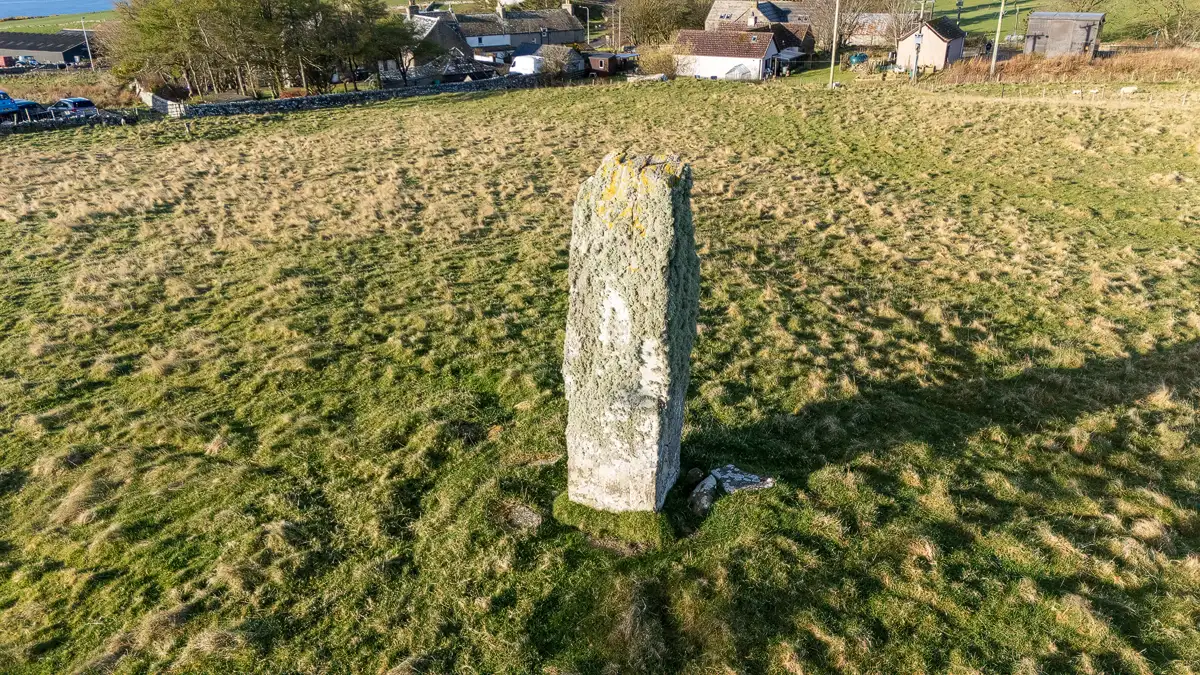
Fortunately, I had my drone with me, which turned out to be the perfect way to appreciate the stone. From the air, the sheer scale of it becomes clear – this is a genuinely massive monolith standing alone in a green field, and the aerial perspective really emphasises how dominant it is in the landscape. The drone also let me get close enough to see the detail of the stone’s surface, which is heavily coated in grey-green lichen. This fruticose lichen, sometimes called oak moss, is apparently a good indicator of clean air quality – something Caithness certainly isn’t short of.
From different angles you can appreciate the stone’s quadrangular shape. One face is relatively bare, showing the pale sandstone underneath, while others are thickly covered in lichen with patches of bright yellow and green. The packing stones around the base are clearly visible from above, and the pointed top gives the whole thing an almost obelisk-like quality. It’s an incredibly impressive piece of prehistoric engineering.

From the drone I could also see the wider setting – the village of Latheron below, the field stretching away to the coast, the stone walls dividing the grazing land, and the gorse blazing yellow in the April sunshine. It’s a beautiful spot. I didn’t manage to photograph the second, split standing stone about 100 metres to the west, as I wasn’t aware of it at the time – something to look out for if you visit.
Frequently Asked Questions
Where is Buldoo Standing Stone?
Buldoo Standing Stone stands in a field just off the A9 at Latheron in Caithness, Highland. It’s on the rise above the village, immediately to the right of the road as you head north from the A9/A99 junction. The OS Grid Reference is ND 2000 3369.
How tall is Buldoo Standing Stone?
The stone stands approximately 3.87 metres (12 feet 8 inches) tall, making it the tallest standing stone in Caithness and one of the tallest in the north of Scotland.
How old is Buldoo Standing Stone?
The stone is believed to date from the Neolithic period, around 3000 BC, making it approximately 5,000 years old.
Is there an entry fee to visit Buldoo Standing Stone?
No. The stone stands in an open field and there is no entry fee. However, there is no formal access path – a wire fence separates the field from the road, and livestock may be present.
Is Buldoo Standing Stone accessible for wheelchairs?
No. There is no formal path to the stone, and access involves crossing a wire fence and walking over rough, uneven grazing land. The site is not wheelchair accessible.
Can I take dogs to Buldoo Standing Stone?
Dogs should be kept on a lead if you do access the field, as sheep and other livestock are often present. There is no formal path or dog-friendly infrastructure at the site.
Where can I park to visit Buldoo Standing Stone?
There is no dedicated car park. You can park at Latheron Community Hall at the A9/A99 junction and walk the short distance along the A9 to the field, or carefully pull over on the roadside – though the A9 can be busy.
Key Information
- Location: Latheron, Caithness, Highland, KW5 6DG
- Grid Reference: ND 2000 3369
- Managed by: Historic Environment Scotland (Scheduled Monument SM461)
- Entry: Free (open site, no formal access)
- Parking: Roadside on A9 or Latheron Community Hall
- Facilities: None at the stone itself
- Accessibility: Not wheelchair accessible – rough grazing land with a fence to cross
- Dogs: Keep on a lead due to livestock
What Else is Nearby?
Latheron Standing Stone – The second of the pair of scheduled standing stones, this split menhir stands approximately 100 metres to the west-northwest of Buldoo. It’s a smaller stone, split almost in two by ice action, and is hidden by gorse but within sight of the main stone.
Clan Gunn Heritage Centre – Housed in the old Latheron Parish Church (built 1734), this fascinating museum tells the story of Clan Gunn from its Norse origins to the present day. It contains one of the best clan archives in Scotland. Open June to September, Monday to Saturday.
Laidhay Croft Museum – A beautifully preserved traditional Caithness longhouse and croft, just a short drive from Latheron on the A9. It offers a glimpse into how local people lived and worked in centuries past.
Latheronwheel Fairy Glen – A charming short walk through woodland near Latheronwheel Harbour featuring miniature fairy houses. Great for families and a lovely contrast to the ancient stones above.
Wag of Forse – An impressive Iron Age broch and settlement site around 1.6 kilometres to the north-northeast of Buldoo. The remains include a wag (a long, low drystone building unique to Caithness) and offer views across the surrounding countryside.
Final Thoughts
Buldoo Standing Stone is one of those sites that rewards the detour. It’s not the most accessible or well-signposted ancient monument in Scotland, and the lack of formal access means you need to be prepared to view it from the roadside or, as we did, send a drone up for a closer look. But the stone itself is magnificent – nearly four metres of sandstone that has stood in this field for five millennia, quietly overlooking the village of Latheron and the Caithness coast beyond. If you’re driving the A9 through this part of the Highlands, it’s well worth a stop.


Leave a comment below