
Tucked away in woodland just off the A832 on Scotland’s Black Isle, the Clootie Well near Munlochy is one of the strangest and most atmospheric places my wife and I have ever visited. This ancient sacred spring, dedicated to the Pictish saint Curetán, has drawn pilgrims seeking healing for well over a thousand years – and the tradition of tying cloth offerings to the surrounding trees continues to this day. It’s eerie, fascinating, and utterly unlike anywhere else in Scotland.
A History Steeped in Belief
The word “clootie” (or “cloot”) is Scots for a strip of cloth or rag, and clootie wells are holy wells or sacred springs where visitors tie pieces of fabric to nearby trees as part of an ancient healing ritual. The practice is rooted in pre-Christian Celtic belief, when wells and springs were considered gateways to the Otherworld – places where gods, spirits, or nature deities could be communed with. Offerings were left in the water or on surrounding trees as prayers for healing, and the tradition is thought to be a continuation of the ancient Celtic custom of leaving votive offerings.
The well at Munlochy is known in Scottish Gaelic as Tobar Churadain and is dedicated to Saint Curetán (also known as Boniface), a Pictish bishop who was active in the late 7th and early 8th century. Curetán is believed to have been the Bishop of Ross, with his seat at Rosemarkie further along the Black Isle coast. His influence stretched across Glen Urquhart, Strathglass, and as far as Loch Ness and the Cromarty Firth. It is said that there was once a chapel on this very site, and prayers to the saint here were considered particularly effective in healing sick children – who were sometimes even left at the well overnight in the hope of a cure.

The ritual itself varies from place to place, but the core tradition is beautifully simple: a piece of cloth, ideally one that has been in contact with the sick person, is dipped in the sacred water of the well and then tied to a branch of a nearby tree. As the cloth slowly rots away, the illness or affliction is believed to fade with it. It’s a form of sympathetic magic – and crucially, this is why offerings really should be made from natural, biodegradable materials like cotton or wool. Synthetic fabrics that never decay rather defeat the purpose.
At the Munlochy well, there is also a tradition of circling the well three times in a sunwise (clockwise) direction, drinking from or splashing the water, and making a silent wish or prayer before leaving the offering. Coins are sometimes left in the stone trough of the well, too. And it is considered very bad luck to remove a clootie – doing so, according to tradition, means you will take on the illness or misfortune of the person who left it.
When early Christianity arrived in Scotland, it absorbed many of these older practices rather than stamping them out entirely. Wells that had been sacred to local nature spirits were rededicated to saints, and the Munlochy well became associated with St Curetán around 620–710 AD. However, the Protestant Reformation was far less tolerant. In 1581, an Act of Parliament in Scotland made pilgrimage to holy wells illegal. Despite this, the practice at Munlochy seems never to have fully died out. When the Welsh traveller Thomas Pennant toured Scotland in 1769, he recorded seeing holy wells “tapestried with rags”, confirming that the tradition had endured through nearly two centuries of official prohibition.
The Clootie Well has also found its way into popular culture. Crime writer Ian Rankin visited the Munlochy well before creating a fictional clootie well at Auchterarder in his 2006 novel The Naming of the Dead. The site also features in the 2018 film The Party’s Just Beginning, written and directed by Inverness-born actress Karen Gillan.
In January 2022, the well made headlines when an unknown individual cleared virtually all of the offerings from the trees without permission from Forestry and Land Scotland, who manage the site. The act caused considerable upset locally, with many seeing it as an erasure of centuries of heritage. Since then, offerings have gradually been returning, and Forestry and Land Scotland continue to support the tradition while encouraging visitors to leave only small, biodegradable items.
Our Visit to the Clootie Well
Getting There
Janette and I were exploring the Black Isle – the fertile peninsula that lies north of Inverness between the Moray Firth and the Cromarty Firth – and the Clootie Well had been on our list for some time. It’s easy to find: from the Tore roundabout on the A9, you take the A832 towards Munlochy and Fortrose. After about two and a quarter miles, you’ll see a green Forestry and Land Scotland sign for the Clootie Well, and the car park is immediately on your right. Even before you pull in, you can catch glimpses of the colourful rags hanging in the trees right beside the road.
The car park is free, has space for several cars and coaches, and includes a disabled parking bay. There are no facilities here – no toilets, no cafe – so bear that in mind. The nearest village, Munlochy, is about a mile further along the road.
Exploring the Well
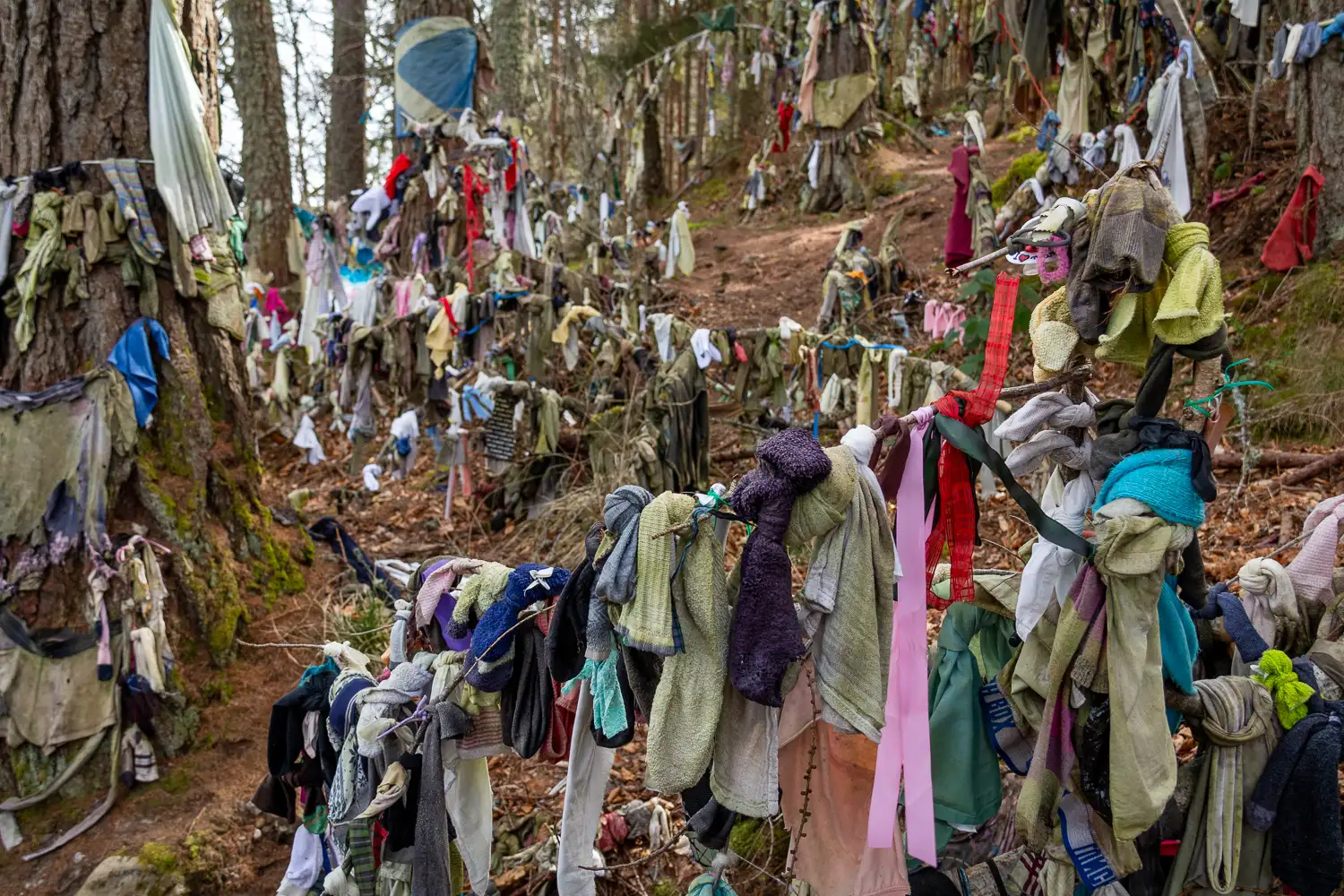
Nothing quite prepares you for the Clootie Well. From the car park, a short path leads you into the woodland, and within moments you’re surrounded by trees absolutely laden with cloth. Rags, ribbons, socks, towels, scarves, baby clothes – every branch and trunk is draped in fabric of every colour and state of decay. Some offerings are clearly fresh, tied neatly with care. Others have been here for years, faded and weathered to ghostly grey strips that flutter in the breeze.
The effect is extraordinary. There’s a hush in the woodland that feels almost reverential, broken only by birdsong and the occasional distant hum of a car on the A832. Janette described it as equal parts beautiful and unsettling, and I know exactly what she meant. There’s a real weight to the place – an awareness that so many of these scraps of cloth represent someone’s hope, someone’s prayer for healing. Some of the more recent offerings had handwritten messages on them, which we chose not to read too closely. These felt deeply personal.

The well itself is small - don’t expect a grand stone structure. The spring emerges from the hillside and trickles into a modest stone trough. Stone steps lead up and around it, and the trees pressing in on all sides are so thick with clooties that they create an almost canopy-like effect. We could see a few coins glinting at the bottom of the trough. It’s a simple thing, really, but the centuries of accumulated belief and tradition make it feel significant.

Near the car park, there’s an information board put up by Forestry Commission Scotland (now Forestry and Land Scotland) with the lovely title “Hope Hangs in the Branches.” It provides helpful context about the tradition and even outlines the ritual for anyone who wishes to leave an offering: walk round the well three times going sunwise, drink some of the water or splash it on the ground, make a silent wish or prayer, and leave a small, biodegradable gift. It’s a nice touch – respectful of the tradition while gently reminding visitors that the Celtic spirits probably wouldn’t know what to do with nylon and polyester.
We spent about twenty minutes at the Clootie Well, walking the paths and taking photographs. It’s not a large site, but it’s one of those places that stays with you long after you leave. Whether you see it as a powerful relic of ancient Celtic spirituality or simply as a curious folk tradition, the Clootie Well is genuinely unlike anything else we’ve encountered in Scotland.
Frequently Asked Questions
Is the Clootie Well free to visit?
Yes, the Clootie Well is completely free to visit and is open at all times throughout the year. There are no entry fees or restricted opening hours.
Is there parking at the Clootie Well?
Yes, there is a free car park directly off the A832, signposted with a green Forestry and Land Scotland sign. It has space for several vehicles including coaches and has a disabled parking bay. The well is approximately a 2-minute walk from the car park.
Is the Clootie Well accessible for wheelchairs?
The path from the car park is initially on firm gravel, but it becomes narrow and uneven with some rocky steps and potentially muddy patches closer to the well. Wheelchair users may find the approach to the well itself difficult, though the first section of path and some of the nearer offerings can be seen from the more accessible areas.
Can I leave an offering at the Clootie Well?
Yes, and you are very welcome to do so. Forestry and Land Scotland actively encourages the continuation of this ancient tradition. However, they ask that any offering you leave is small, appropriate, and made from biodegradable material – pure cotton or wool is ideal. Synthetic materials like nylon and polyester will not decay and will eventually be removed during periodic clean-ups.
Are dogs allowed at the Clootie Well?
Yes, dogs are welcome but should be kept under close control, particularly as the site is right beside the A832 main road.
Are there toilets or a cafe at the Clootie Well?
No, there are no facilities at the site. The nearest village is Munlochy, approximately 1 mile along the A832, where you’ll find basic amenities.
How long does a visit to the Clootie Well take?
Most visitors spend between 15 and 30 minutes at the Clootie Well. It’s a small site, so it doesn’t require a long visit, but you may find yourself lingering to take in the atmosphere. There are also woodland walks in the surrounding area managed by Forestry and Land Scotland if you wish to extend your visit.
Key Information
- Location: A832, near Munlochy, Black Isle, Ross-shire, IV8 8PE
- Managed by: Forestry and Land Scotland
- Entry: Free, open at all times
- Parking: Free car park on the A832, including disabled bay. Space for coaches.
- Facilities: Information board only. No toilets, cafe, or shop. Nearest facilities in Munlochy (1 mile).
- Accessibility: Initial path is firm gravel. Becomes uneven with steps near the well. Limited wheelchair access.
- Dogs: Allowed, keep under close control near the road.

What Else is Nearby?
The Black Isle is a wonderful area to explore, and there are several other interesting places within easy reach of the Clootie Well:
- Chanonry Point, Fortrose – One of the best places in the UK to spot bottlenose dolphins in the Moray Firth. Just a few miles further along the A832, the shingle spit at Chanonry Point is a magical spot, particularly around an incoming tide.
- Fortrose Cathedral – The beautiful red sandstone ruins of this 13th-century cathedral are free to visit and well worth a stop. Managed by Historic Environment Scotland.
- Cromarty – The charming town at the tip of the Black Isle has Hugh Miller’s Birthplace Cottage and Museum (National Trust for Scotland), the East Church, and wonderful views across the Cromarty Firth to the Sutors.
- Groam House Museum, Rosemarkie – A small but excellent museum dedicated to Pictish heritage, featuring an impressive collection of carved Pictish stones including the famous Rosemarkie Cross-slab.
- Fairy Glen, Rosemarkie – A lovely short walk through a wooded gorge to two picturesque waterfalls. A great companion stop if you’re visiting the Clootie Well and enjoy short woodland walks.
- Redcastle - a picturesque ruined castle on the shores of the Beauly Firth.
- Glen Ord Distillery - Not far from Munlochy, worth a detour if you're interested in Whisky making in the Highlands.
Final Thoughts
The Clootie Well near Munlochy is one of those places that defies easy categorisation. It’s a little bit eerie, a little bit beautiful, and wholly unique. Whatever you make of the tradition – whether you see the hanging rags as an ancient act of faith or simply as a curious remnant of a bygone age – there’s something undeniably powerful about standing in this quiet woodland surrounded by so many expressions of hope. It costs nothing, takes barely twenty minutes, and sits right beside the road. If you’re on the Black Isle, don’t drive past without stopping. Janette and I are glad we didn’t.


Leave a comment below