
From Humble Beginnings to Industrial Pioneer
David Dale stands as one of the most remarkable figures of Scotland's industrial revolution - a self-made man who rose from herding cattle as a boy to become the greatest cotton magnate of his time. Born on 6 January 1739 in Stewarton, Ayrshire, Dale was the son of William Dale, a modest general dealer in the village, and Martha Dunlop. His early life was shaped by hardship and humble circumstances, working as a "herd laddie" tending livestock in basic conditions that were typical of rural Ayrshire during this period.
Despite these inauspicious beginnings, Dale possessed an entrepreneurial spirit and determination that would carry him far beyond the limitations of his birth. His father apprenticed him to a handloom weaver in Paisley, where the young Dale learned the textile trade that would eventually make his fortune. After his apprenticeship, he worked as a weaver in Hamilton and Cambuslang, gaining valuable experience in Scotland's emerging textile industry. Around the age of 24, Dale made the pivotal decision to move to Glasgow, where he took a position as a clerk to a silk merchant near Glasgow Cross.
In 1763, at just 24 years old, Dale took the bold step of establishing his own business as an importer of fine linen yarns from France and the Netherlands. This venture proved extraordinarily successful, capitalising on Glasgow's growing importance as a commercial centre. The business expanded rapidly, and Dale diversified his interests throughout the late 1760s, becoming involved in weaving and establishing an inkle factory. By 1769, his success was formally recognised when he became a burgher of Glasgow and a member of the prestigious Merchant Guild and Trades House.
Dale's business acumen and growing wealth enabled him to make an advantageous marriage in 1777, when at 38 years old, he wed 24-year-old Anne Caroline Campbell. Her late father, John Campbell of Jura, had been cashier (chief executive) of the Royal Bank of Scotland from 1745 until his death earlier that year. This connection to Scotland's banking establishment would prove instrumental in Dale's next career advancement. The couple enjoyed 14 years of marriage until Anne Caroline's death, during which time they had nine children, though tragically four died in infancy, including their only son.
By 1783, Dale had established himself as one of Glasgow's most prominent businessmen. That year marked a turning point in his career when he joined Edinburgh businessman Robert Scott Moncrieff in establishing the Royal Bank of Scotland's first Glasgow agency - a venture undoubtedly assisted by his wife's family connections. The agency was housed in part of Dale's own shop premises on Glasgow's High Street. While Scott Moncrieff carried most of the day-to-day management burden, Dale's status in Glasgow and his intimate knowledge of its business community made him an invaluable advisor and guide for this successful new venture, which he would continue to serve until his death in 1806.
Dale's ascent into Glasgow's commercial elite was reflected in his lifestyle. By 1785, he and his wife lived in an impressive mansion on Charlotte Street, designed by renowned architect Robert Adam. As one contemporary observer noted, Dale had become "the prosperous Glasgow merchant who, by virtue of pure force of character and intelligence, had fairly broken down that wall of distinction which once separated him from the great tobacco and sugar lords and could now wear his cocked hat jauntily, display his silver knee buckles showily and take the place of honour on the crown of the causeway with the proudest of them all."
The Partnership with Richard Arkwright
In 1784, a meeting took place that would change Dale's life and the industrial landscape of Scotland. Richard Arkwright, the English inventor and cotton industrialist who had revolutionised cotton spinning with his water-frame technology, visited Scotland at the invitation of George Dempster, a Perthshire Member of Parliament and landowner. Arkwright, by this time one of the richest men in Britain and acknowledged as the father of the cotton industry, was persuaded to visit Lanarkshire with a view to establishing cotton mills in Scotland.
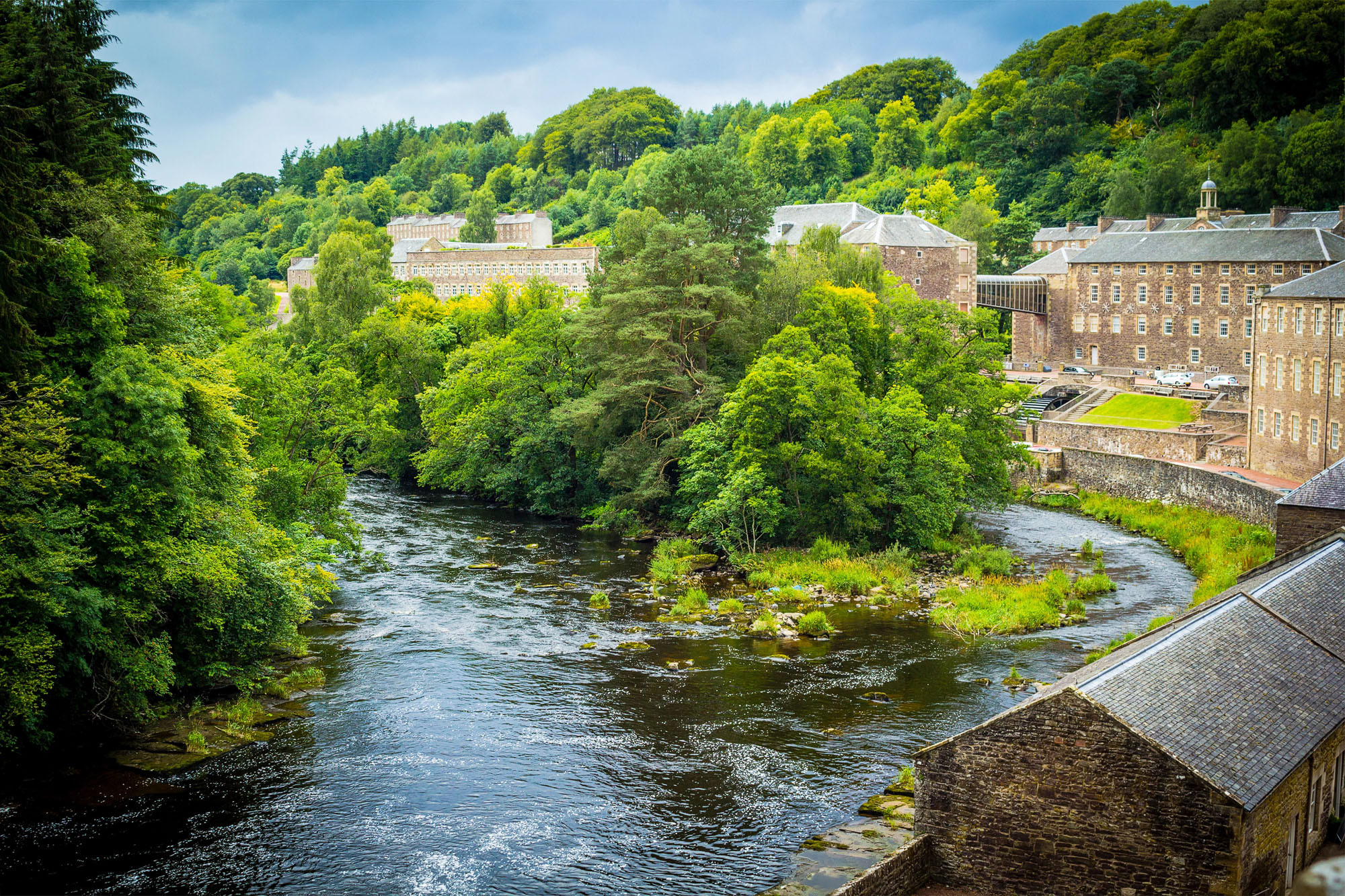
Dale, Dempster, and Arkwright walked down the steep valley from Lanark to view a potential site on the fast-flowing River Clyde. The location, with its powerful waterfalls and reliable water source, was considered ideal for powering spinning machinery. A partnership was quickly agreed between the three men, and construction work began immediately. The mill buildings were based on Arkwright's successful mills at Cromford in Derbyshire, and men and boys were sent from the new site to Cromford for training.
However, the partnership proved short-lived. In 1785, just as construction work was underway, both Dempster and Arkwright withdrew from the partnership, leaving Dale as the sole owner of what would become New Lanark. The mills began spinning in early 1786, marking the beginning of one of Scotland's most famous industrial communities.
New Lanark - A Model Industrial Community
Under Dale's ownership, New Lanark grew rapidly into one of the largest and most successful cotton spinning operations in Britain. By the early 1790s, Dale had four mills in full operation, employing nearly 1,400 people and producing yarn that was sold across Britain and exported abroad. The business was enormously profitable, but what truly set New Lanark apart was Dale's approach to managing his workforce and the community he built to house them.
Dale's workforce was drawn from two main sources. The first comprised "pauper apprentices" - children from the poorhouses and orphanages of Edinburgh and Glasgow. By 1793, out of a total workforce of around 1,150 people, over 800 were children, with approximately 300 being pauper apprentices. These children, often orphans looked after by the parish authorities who were keen to reduce costs, were not paid wages but were provided with board and lodging in No. 4 Mill. They worked as reelers and pickers initially, later learning various skills that they could use when they left the mills - some joining the army and navy, others becoming joiners or smiths, and some remaining at New Lanark.
The second major source of workers came from the Highlands. Dale was deeply concerned about the Highland Clearances and the mass emigration they were causing. He saw his mills as offering an alternative to forced emigration, providing employment and stability for displaced Highlanders. To house these workers, Dale built much of the New Lanark village, starting with Caithness Row - a name deliberately chosen to reflect the origin of many of the first Highland residents. On one notable occasion in 1791, Dale heard that a ship called "The Fortune" bound for North Carolina from Skye had been forced into Greenock by storms. He immediately sent a representative to offer employment to the would-be migrants, and over 100 accepted, choosing to work at New Lanark rather than emigrate.
A Remarkably Enlightened Employer
By the brutal standards of late 18th-century industrial Britain, David Dale was a remarkably enlightened and progressive employer. The working day at New Lanark was long - beginning at 6am and finishing at 7pm, with only half an hour for breakfast and an hour for dinner. Children worked 13-hour days in the mills. However, Dale ensured that conditions were far superior to those in comparable establishments elsewhere in Britain.
The food provided to workers was of excellent quality and nutritious. The housing Dale built was clean, well-maintained, and superior to that available to most industrial workers of the period. Most importantly for Dale, who was deeply religious and committed to education, all children were required to attend school. While village children attended a day school for under-sixes, older children - including those working in the mills - attended an evening school from 7pm to 9pm after their long working day. The curriculum comprised the "three Rs" (reading, writing, and arithmetic), sewing, church music, and religious study.
At its peak, the school roll totalled more than 500 pupils, and Dale employed 16 trained teachers to teach across eight classes. The pupils were grouped according to their ability and promoted to the next class after suitable tests, with teachers receiving a bonus for each pupil promoted. This was a groundbreaking development in the evolution of factory communities. While English mill owners like Arkwright offered Sunday schools, Dale's provision of daily schooling for young children and evening classes for older workers was unprecedented in Britain.
Dale summed up his philosophy in his own words: "It gives me great pleasure to say, that by proper management and attention, much good instead of evil may be done at cotton mills." He believed that a healthy, well-educated workforce was not only morally right but also led to greater productivity. This progressive approach attracted widespread attention, and by the late 1790s, New Lanark's visitors' book recorded approximately 750 tourists each year, including notable figures such as William and Dorothy Wordsworth and Samuel Taylor Coleridge, all coming to witness this remarkable experiment in industrial philanthropy.
Religious Conviction and Social Reform
Dale's progressive approach to business was deeply rooted in his religious convictions. A strongly evangelical Christian, Dale had left the Church of Scotland in the 1760s in protest at the system of ecclesiastical patronage. He became a founder member of the Old Scotch Independent church, a dissenting Congregational-type denomination with a strong missionary focus. Dale served as a pastor in this church, preaching on Sundays in meeting houses all over Glasgow. According to his obituarist, he was capable of reading the Holy Scriptures in both Hebrew and Greek, testament to his considerable self-education despite his humble origins.
His faith translated into extensive philanthropic activity throughout Glasgow and beyond. Dale provided financial support to numerous causes, including the British and Foreign Bible Society, the Town Hospital, the Royal Infirmary, Bridewell prisoners, Calton charity school, the Andersonian Institution (which later became Strathclyde University), and the Humane Society. When Scotland suffered food shortages in the 1790s, Dale chartered ships to bring supplies from overseas to help lower local prices, demonstrating his concern for the welfare of ordinary people.
Perhaps most remarkably, given his business connections, Dale was a vocal opponent of the transatlantic slave trade. In 1791, he became chairman of the Glasgow Society for the Abolition of the Slave Trade. This was an extraordinarily brave position to take, as many of his friends, colleagues, and business associates in Glasgow were heavily involved in businesses dependent on slave labour - coffee, sugar, rum, tobacco, and even the cotton Dale himself imported all relied on slavery. The Society circulated widely a paper calling for the abolition of the slave trade, detailing the sufferings that enslaved people endured and arguing that all trade dependent on slavery should be abandoned whatever the short-term consequences for Glasgow businesses.
While Dale advocated for the abolition of the slave trade itself, he took a more gradual approach to the abolition of slavery, possibly to maintain support for his abolitionist work and avoid alienating the Glasgow business community entirely. He never lived to see his goal achieved - the Abolition of the Slave Trade Act was passed in 1807, just one year after his death.
Expanding the Industrial Vision
New Lanark was not Dale's only industrial venture. Concerned about continuing emigration from Scotland, particularly from the Highlands, Dale established cotton mills in diverse locations across the country. In partnership with others, he founded mills at Catrine in Ayrshire, Blantyre in Lanarkshire, Newton Stewart in Dumfries and Galloway, Oban on the west coast, and Spinningdale in Sutherland. The latter was particularly conspicuous in its philanthropic intent - established specifically to create industry, wealth, and employment in the Highlands to stem the tide of emigration.
Dale also invested in other textile-related industries. He established a Turkey-red dyeworks at Dalmarnock in partnership with George Macintosh (father of Charles Macintosh, inventor of the waterproof raincoat), bringing this valued dyeing technique to Scotland. In 1801, though he had already sold New Lanark, Dale helped Glasgow manufacturer James Craig purchase Stanley Mills in Perthshire, ensuring his legacy of industrial development continued.
Beyond manufacturing, Dale was active in Glasgow's civic and commercial life. He was a founder and director of the Glasgow Chamber of Commerce in 1783, serving two periods as chairman and helping to establish the institutional framework that would support Glasgow's industrial expansion. He was elected a magistrate of the city in both 1791 and 1794, serving his community in an official capacity. Dale also invested in insurance, becoming a director of the Glasgow Fire Insurance Company, which sold life insurance and annuities.
The Owen Connection and Later Years
In 1798, New Lanark received a visitor who would ultimately carry forward Dale's vision - Robert Owen, a 27-year-old Welsh industrialist and social reformer. Owen had met Dale's daughter Caroline quite by chance in Glasgow, and she suggested he visit the mills. The meeting proved fateful. Within a year, Owen was negotiating with Dale to purchase New Lanark, and on 30 September 1799, he married Caroline Dale. On 1 January 1800, Owen and his business partners took control of New Lanark for £60,000, payable over 20 years.
The sale of New Lanark marked the beginning of Dale's retirement from active business life. In 1799, he had purchased the Rosebank estate near Cambuslang, and he gradually divested himself of his other mills - selling Spinningdale in 1804 and Dalmarnock in 1805. However, he retained his position as joint agent for the Royal Bank of Scotland in Glasgow until the end of his life.
David Dale died at his home at 43 Charlotte Street, Glasgow, on 7 March 1806, at the age of 67. Huge crowds of mourners lined the streets of Glasgow for his funeral, testament to the respect and affection in which he was held by the city's residents. He was buried in the Ramshorn Churchyard in Ingram Street, where his grave carries the simple, modest inscription: "David Dale, Merchant." This understated memorial belied the extraordinary impact Dale had made on Scotland's industrial development and social progress.
Legacy and Historical Significance
David Dale's legacy extends far beyond his considerable business achievements. While Robert Owen would later gain greater fame for his progressive social experiments at New Lanark, it was Dale who established the foundations of the community and set the precedent for enlightened industrial management. As Scottish historian Tom Devine noted, Dale was "the greatest cotton magnate of his time in Scotland," but his significance went well beyond mere commercial success.
Dale demonstrated that industrial success and social responsibility were not mutually exclusive. At a time when child labour, dangerous working conditions, and exploitative practices were the norm in Britain's rapidly growing industrial sector, Dale proved that providing decent housing, nutritious food, education, and humane treatment could coexist with profitable business operations. His approach influenced not only his son-in-law Robert Owen but also broader debates about factory reform and workers' welfare that would continue throughout the 19th century.
His grandson, Robert Dale Owen, described both Dale and Arkwright as "men of strong, untrained energy" whose success was due to the unique opportunities of their time. However, this assessment seems inadequate when applied to Dale. While he undoubtedly seized the opportunities presented by Scotland's industrial revolution and died a wealthy man, his broader concerns for Scotland's economic development, his commitment to education and philanthropy, his religious convictions, and his public stance against the slave trade suggest a man of vision and principle who would have made his mark in any era.
Despite his considerable achievements and wealth, Dale remained grounded, remembered by contemporaries for his genial and humorous nature. He never forgot his humble origins in Stewarton, and his concern for displaced Highlanders and orphaned children reflected a genuine empathy for those facing hardship similar to what he had known in his youth.
Today, New Lanark stands as a UNESCO World Heritage Site, attracting visitors from around the world who come to learn about early industrial history and social reform. While Robert Owen's name is more closely associated with the site, the community exists because of David Dale's vision, investment, and commitment to proving that industrial capitalism could have a human face. His life story - from cattle herder to industrial pioneer, from poverty to prosperity, from exclusion to influence - remains a quintessentially Scottish tale of determination, enterprise, and social conscience that helped shape the modern world.


