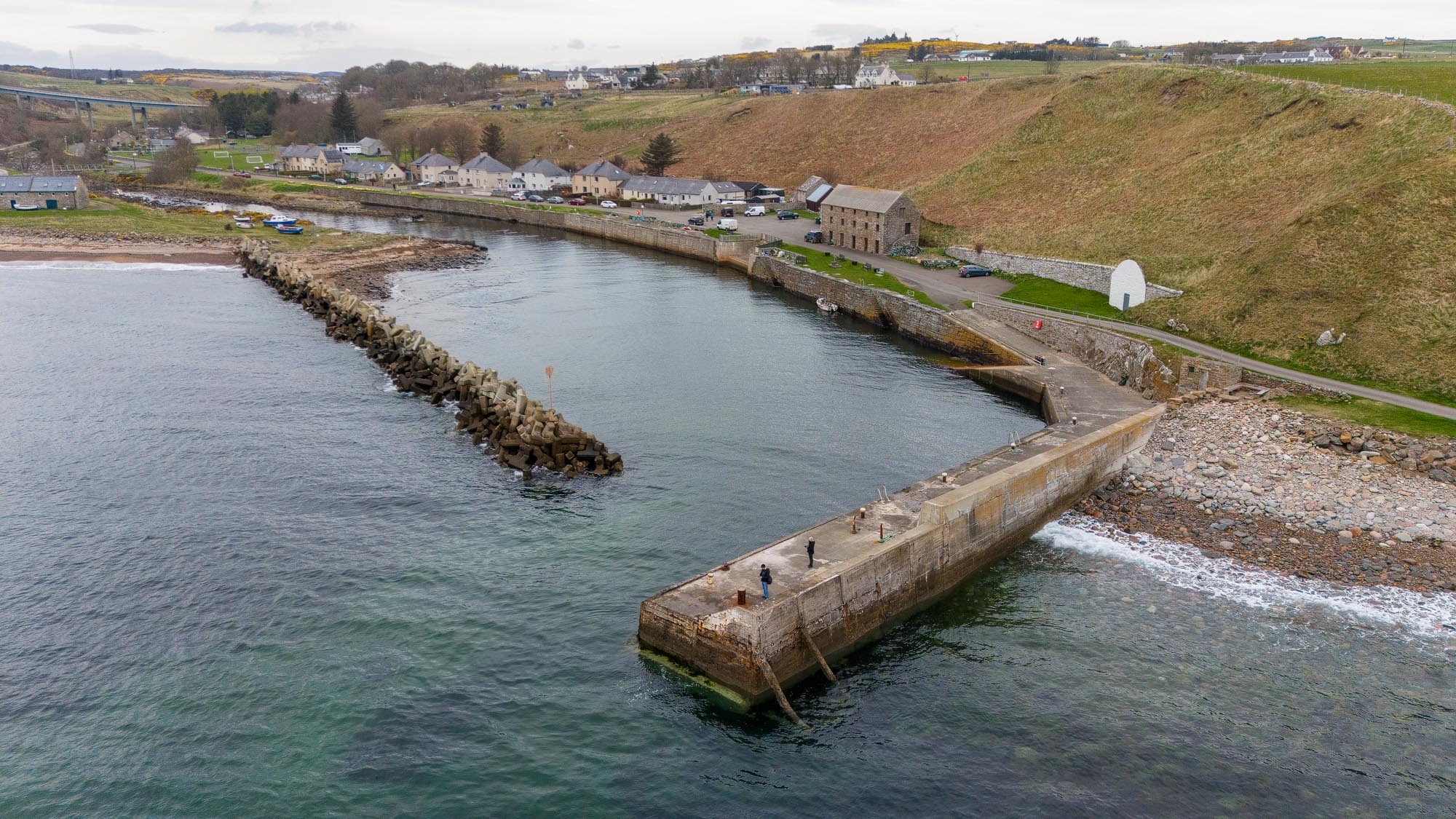
On the North Coast 500, Dunbeath Harbour is a lovely little place to stop for a break from driving. We discovered this little gem after visiting Dunbeath Broch, located a short distance away, further up the Dunbeath Water.
Our main reason for stopping here was to find the public toilets, which are directly next to the harbour. These toilets were very clean and well-maintained.


There is ample parking at the harbour, and a lot to see from the fishing buildings and the harbour wall. Dunbeath Heritage Centre have placed a lovely hexagonal plaque packed with information about the harbour and local area. There is a short walk past a lovely whitewashed cottage to a grassy/beach area with picnic tables.


Dunbeath Castle
Dunbeath Harbour is one of the best places to view the very private Dunbeath Castle, perched on a rocky promontory to the south. This rather romantic-looking castle recently sold for £25 million to a secret buyer.
Although much of the current structure dates from the 17th century, a castle has stood on this site since the 1400s. While the castle remains a private residence, its gardens have long drawn admiration. With over 1,600 plant varieties, they are considered among the finest in Scotland.
Two impressive walled gardens frame the approach, created during 19th-century renovations by architect David Bryce, who introduced the castle’s sweeping driveway. In 1999, the Southern Garden was redesigned by Xa Tollemache, a Chelsea Flower Show Gold Medal winner, adding a modern flourish to this historic estate.

The Wreck of the SS Gretafield
Just off the coast of Dunbeath Castle lies the poignant wreck site of the SS Gretafield, a British steam tanker sunk during World War II. On the night of February 14, 1940, while carrying 13,000 tons of fuel oil from Curaçao to Invergordon, the Gretafield was torpedoed by German U-boat U-57 near Noss Head. The attack ignited her cargo, engulfing the ship in flames visible from the shore.
Despite the inferno, 27 of the 40 crew members survived, rescued by the armed trawlers HMT Peggy Nutten and HMT Strathalladale. The burning vessel drifted into Dunbeath Bay, where she ran aground on February 15. The wreck continued to burn for several days before breaking in two on March 19, rendering her a total loss.
Today, the remains of the Gretafield rest in 10 to 15 meters of water just south of Dunbeath. The wreckage is scattered, with six massive boilers still visible among the debris, offering a somber dive site for experienced divers.
A memorial plaque at Dunbeath Harbour commemorates the 12 men who lost their lives in the tragedy, serving as a lasting tribute to their memory.
Dunbeath Strath Path
For those looking to explore the area on foot, the Dunbeath Strath Path offers one of the most scenic and historically rich walks in Caithness. The trail follows the tranquil Dunbeath Water as it winds inland through a sheltered valley, flanked by trees, ancient ruins, and dramatic cliffs.
The path begins near the harbour and leads walkers past the remnants of old crofting settlements, a striking 19th-century stone bridge, and even a broch — a reminder of the area’s deep Iron Age roots. Along the way, you’ll find interpretive signs telling the story of the land and its people, including the life of author Neil M. Gunn, who grew up in the village and drew heavily on Dunbeath in his writing.
It’s a gentle yet rewarding route, rich with wildlife and natural beauty, perfect for a reflective stroll or a longer ramble into the heart of the strath.

The Old and New Bridges of Dunbeath
Dunbeath is home to two notable bridges, each marking a different era in the village’s history.
The old stone bridge, built in the early 19th century by Thomas Telford, spans the Dunbeath Water just inland from the harbour. With its elegant single arch and traditional masonry, it’s a fine example of period engineering and craftsmanship. Once part of the main route north, it carried traffic until the mid-20th century and still stands as a picturesque reminder of days gone by.
Today, traffic flows over the modern A9 bridge, constructed in the 1980s to improve transport links through Caithness. Standing higher and built for efficiency, the new bridge contrasts sharply with its historic predecessor — yet both structures play a part in Dunbeath’s evolving story, connecting the past with the present in this scenic Highland setting.

Staying Overnight at Dunbeath Harbour
Overnight stays are welcome at Dunbeath Harbour despite it being private land, making it a peaceful stopover for campervans and motorhomes exploring the NC500 route. The cost is just £7 per night, with payment made via donation to the Dunbeath Preservation Trust.
There are two clearly marked donation boxes—one located at the public toilets and the other down by the beach. Both display the Trust’s registered charity number (SC003175), and all contributions go toward maintaining and preserving this beautiful spot for future visitors.
Dunbeath Heritage Centre and Museum
The harbour itself is home to a fascinating cluster of attractions cared for by the Dunbeath Preservation Trust – an accredited museum and registered charity dedicated to preserving the area’s heritage and culture. The Salmon Bothy is an early 19th century dwelling, complete with bunk-beds and a foreman’s office, offering a glimpse into the lives of the seasonal salmon fishers who once worked these waters. Just along from it, the recently refurbished boatshed is now open to visitors, with the lovingly restored fishing yole ‘Fulmar’ WK102 taking pride of place inside. Nearby, the two-chambered 19th century icehouse stands as a reminder of just how vital the fishing trade once was to this small Caithness community.
Only a few minutes from the harbour side, at the top of the Brae, you’ll find the Dunbeath Heritage Centre and Museum itself – a real gem that shouldn’t be missed if you’re passing through. More than just a museum, it acts as custodian of a wide range of artefacts, documents and information spanning prehistory right through to the 20th century. The Trust also offers genealogy assistance, with a library of documents available for those wishing to research their Caithness ancestry.

The displays cover an impressive sweep of Caithness archaeology, from Neolithic tools and Bronze Age swords and pottery to Iron Age finds, Viking burial goods, Pictish artefacts and even a Medieval coin hoard. As Dunbeath was the birthplace of celebrated Scottish writer Neil M Gunn, the centre also houses permanent displays and memorabilia dedicated to his life and work, alongside a selection of new and used books for sale.
For more information, visit dunbeath-heritage.org.uk or call 01593 731233.
Key Information
-
Location: Dunbeath Harbour, Caithness, on the North Coast 500
-
Parking: Free and spacious, suitable for cars and campervans
-
Toilets: Clean public toilets located beside the harbour
-
Overnight Stay: £7 per night (via donation to the Dunbeath Preservation Trust – SC003175)
-
Donation Boxes: Located at the toilets and the beach
-
Nearby Attractions:
-
Dunbeath Castle (view from harbour only)
-
Dunbeath Strath Path – scenic walk with historical sites
-
SS Gretafield Wreck – offshore dive site and memorial plaque
-
Old Telford Bridge & modern A9 bridge
-
Dunbeath Broch (short drive inland)
-
Dunbeath Heritage Centre and Museum (top of the Brae)
-
-
Accessibility: Easy, flat paths around the harbour; gentle terrain along Strath walk

Conclusion
Dunbeath Harbour may be small, but it offers a rich blend of history, scenery, and quiet charm. Whether you’re stopping for a picnic, walking the Strath path, or spending the night in your campervan, this coastal gem rewards visitors who take the time to explore. With dramatic views of Dunbeath Castle, tales of wartime tragedy, and peaceful paths that trace centuries of Highland life, it’s a memorable highlight of the NC500 that’s well worth pausing for.


Leave a comment below