
Tucked behind an unassuming gate on King Street in Elgin, just yards from the ruins of one of Scotland’s most magnificent medieval cathedrals, lies a three-acre garden that is equal parts botanical collection, biblical showcase and community treasure. The Biblical Garden is free to visit, beautifully maintained and full of surprises. Whether you have an interest in scripture, a love of gardening, or simply want somewhere peaceful to spend half an hour, this is one of the best free attractions in Moray.

History of the Biblical Garden
The idea for the Biblical Garden came from Donald McBean, then Senior Horticultural Officer with Moray District Council. Planning began in the early 1990s with an ambition to create a beautiful garden, open to all, where well-known Bible stories could be brought to life through statues and where plants mentioned in scripture would be grown together in one place.
Central to the project was what McBean called “The Four Cs” – Community, Church, Commerce and Council – and the vision was always for a people’s garden, built by and for the folk of Moray. The project was funded entirely through public subscription, with generous donations coming in from local businesses, churches, schools, organisations and individuals across the region. Local schoolchildren even created the mosaic panels that can still be seen on the walls near the entrance.
The garden opened to the public in June 1996, making it the first biblical garden of its kind in Scotland. Its location could hardly be more fitting. Moray has played an important role in the story of Christianity in Scotland for well over fourteen centuries, and the garden sits literally across the wall from Elgin Cathedral – the “Lantern of the North” – which was founded in 1224 and famously burned by the Wolf of Badenoch in 1390.
Today, the garden is maintained through a partnership between the Friends of the Biblical Garden, Moray Council and UHI Moray. Horticulture students from UHI Moray care for the garden as part of their studies, and it continues to evolve and develop year on year. Around 90 trees and shrubs have been added over its lifetime, many donated by school groups from across Moray.

Our Visit to the Biblical Garden
Arriving at the Garden
My wife Janette, our daughter Olivia and I visited the Biblical Garden on a glorious sunny day. We had been to Elgin Cathedral just beforehand, and the garden is quite literally around the corner – you follow King Street past the Bishop’s House and the entrance is through a gate in the wall on your left.
We found roadside parking on King Street itself without any trouble, though it’s worth noting there’s a two-hour no-return restriction. If the street is busy, there’s a car park on Lodge Lane a short walk away, or you can use the Cooper Park car park.
The gate itself sets the tone immediately. It’s topped with a white dove – a reference to Noah’s Ark – and has the word “Garden” worked into the ironwork. An information board on the gatepost explains a little about what you’ll find inside.
The Central Walkway
Stepping through the gate, the first thing that strikes you is the view straight ahead down the main walkway. It’s a wide, paved path stretching into the distance, and on the day we visited, it was bordered on both sides by the most spectacular display of red and purple tulips rising from carpets of blue forget-me-nots. The effect was stunning – almost impossibly colourful against the bright green lawns and the deep reds of the Japanese maples flanking the borders.
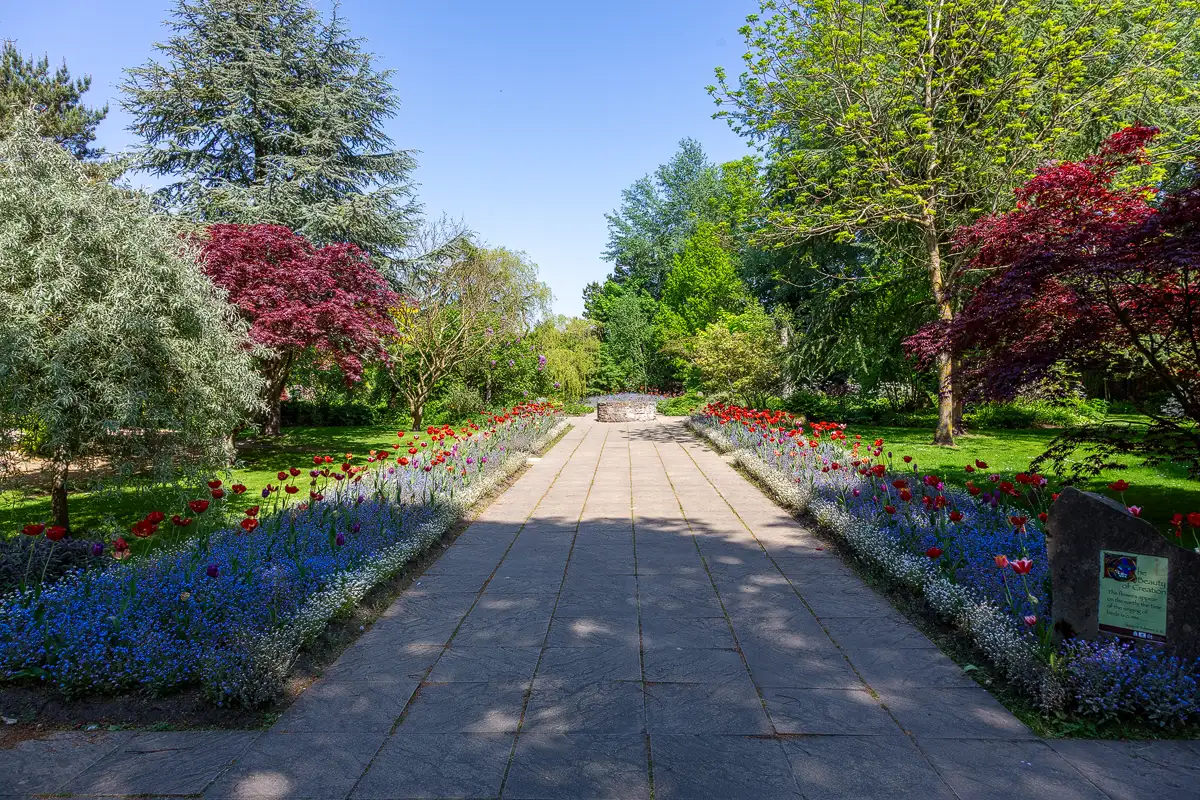
What you might not realise from ground level is that this walkway, laid with over 1,000 textured paving slabs, forms the shaft of a Celtic cross when viewed from above. The cross shape extends into the surrounding borders and paths, giving the entire garden a meaningful structure.

At the centre of the walkway sits a stone plinth topped with a carved granite Bible, open to show quotations from Genesis 1:11 on the left page and Isaiah 40:6–8 on the right. A small emblem sits in the centre between the two pages. It’s a beautiful piece of craftsmanship and really captures the spirit of the whole garden.

Jacob’s Well and the Flower Borders
Continuing along the walkway, we came to a stone well structure. This represents Jacob’s Well in Samaria, where, according to the Gospel of John, Jesus met the Samaritan woman. The garden once had sculptures around the well depicting this scene, though these have unfortunately been removed due to weather damage over the years.

Even without the sculptures, the area around the well is gorgeous. The flower borders here were packed with colour, and I spent quite a while photographing the tulips from every angle. Backlit by the afternoon sun, the orange and red petals glowed above the soft blue carpet of forget-me-nots beneath them.

The Cathedral Trellis
One of the garden’s most striking features is the large cathedral-shaped trellis at the far end. This impressive metal structure mirrors the gothic architecture of Elgin Cathedral just across the wall, complete with pointed arches, a rose window design and tall towers. In summer, it would be covered in climbing roses – yellow, white and red – but even during our visit, with clematis and other climbers beginning to weave their way up the framework, it was a remarkable sight.


Janette and Olivia posed for a photo in front of the trellis, and it made for a lovely shot with the greenery climbing up behind them.

The Rock Garden, Woodland Paths and Hidden Corners
Beyond the main walkway, the garden opens up into several distinct areas, each with its own character. There’s a rock garden that represents Mount Sinai, with a path winding up and around it, and on the far side you’ll find the Cave of the Resurrection. Janette and Olivia led the way up the path here, past beds packed with alpine plants, ferns and flowering shrubs.

Tucked away at the back of the garden, we found a quiet woodland path shaded by a thick canopy of trees. A bird table stood beside the path, and pink rhododendrons added a splash of colour among the green. It felt miles away from Elgin town centre, despite being right in the middle of it.

The Planting
The garden contains over 110 species of plant mentioned in the Bible, and each one carries a label with a cross-reference to its place in scripture. But even if you’re not following the biblical trail, the sheer variety and quality of the planting is impressive. The garden also features a woodland garden, an oriental-themed garden, a winter border and a herbaceous border, so there is interest throughout the seasons.

On the day we visited, the garden was at its late spring best. The tulips and forget-me-nots dominated the main borders, but there was colour everywhere you looked – yellow climbing roses tumbling over the old stone boundary wall, golden globe flowers glowing among the undergrowth, and dense, jungle-like pockets of mixed planting where Japanese maples, white umbels, purple flowers and every shade of green imaginable competed for your attention.


Frequently Asked Questions
Is the Biblical Garden in Elgin free to visit?
Yes, admission to the Biblical Garden is completely free. There is a donation box at the entrance, and contributions are very welcome as they help with the ongoing maintenance of the garden.
When is the Biblical Garden open?
The garden’s official season runs from May to September, when it is open daily. However, the garden’s own website states it is open to the public all year round, and visitors have reported accessing it outside the main season. Opening hours during the season are generally 10:00am to 7:30pm.
Is the Biblical Garden wheelchair accessible?
The main Celtic cross walkway and the central areas of the garden are flat, paved and accessible for wheelchairs and pushchairs. Some of the outer paths, such as those around the rock garden, are narrower and on uneven ground, so may not be suitable for all users.
Is there parking at the Biblical Garden?
There is no dedicated car park, but there is free roadside parking on King Street directly outside the garden. Be aware of the two-hour no-return restriction. Additional parking is available at the Lodge Lane car park and the Cooper Park car park, both a short walk away.
Are dogs allowed in the Biblical Garden?
Yes, dogs are welcome in the garden, though they should be kept on a lead to protect the planting.
How long does a visit to the Biblical Garden take?
You could walk around the garden in 20 to 30 minutes, but if you take your time reading the plant labels, enjoying the sculptures and sitting on one of the many benches, you could easily spend an hour here. It pairs perfectly with a visit to Elgin Cathedral next door.
Are there toilets at the Biblical Garden?
There are no toilet facilities within the garden itself. The nearest public toilets are in Cooper Park, a short walk away.
Key Information
- Location: King Street, Elgin, Moray, IV30 1HU
- Grid Reference: NJ 2210 6297
- Managed by: Friends of the Biblical Garden, Moray Council and UHI Moray
- Entry: Free (donations welcome)
- Parking: Free roadside parking on King Street (2-hour no-return); Lodge Lane and Cooper Park car parks nearby
- Facilities: Benches and seating throughout; information boards; no toilets or cafe on site
- Accessibility: Main walkway and central areas are flat and paved; outer paths less accessible
- Dogs: Welcome on leads
What Else is Nearby?
Elgin Cathedral – Literally just across the wall from the garden, the ruins of the “Lantern of the North” are among the finest medieval cathedral remains in Scotland. Managed by Historic Environment Scotland, there is an entry charge.
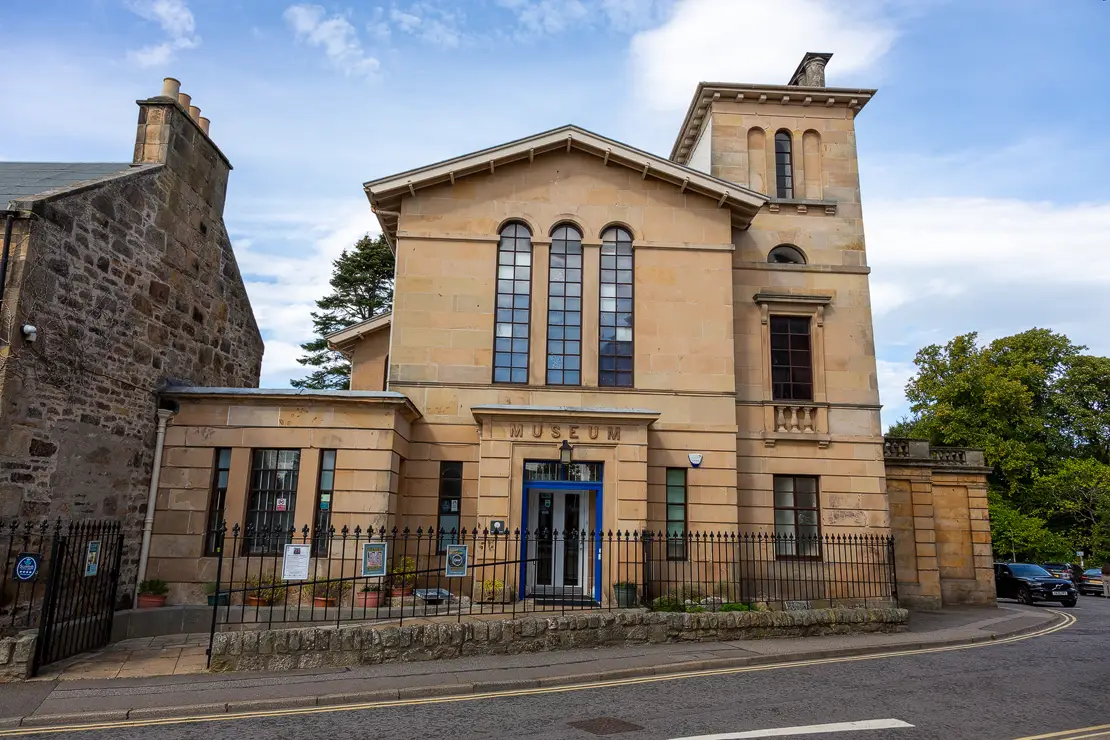
Elgin Museum – One of Scotland’s oldest independent museums, located a short walk away on the High Street. Free admission and a fascinating collection spanning local history, archaeology and geology.
Cooper Park – Elgin’s main public park, gifted to the town by Colonel George Cooper in 1903. A lovely spot for a walk with a boating pond, play areas and woodland paths.
Spynie Palace – The fortified seat of the Bishops of Moray for around 500 years, located just north of Elgin. A substantial and atmospheric ruin managed by Historic Environment Scotland.
Pluscarden Abbey – A beautifully preserved 13th-century Benedictine monastery set in a peaceful valley around six miles southwest of Elgin, still home to a community of monks today.
Final Thoughts
We spent about 45 minutes in the Biblical Garden and could easily have stayed longer. It’s one of those places that catches you off guard – you don’t expect to find something this beautiful and this carefully tended behind a modest gate on a quiet Elgin street. The combination of the colourful planting, the thoughtful biblical references, the cathedral trellis and the peaceful woodland paths makes for a visit that works on several levels. You don’t need to have any particular interest in the Bible to appreciate it, though those who do will get an extra layer from the experience.
For a free attraction, the quality is outstanding, and the fact that it’s maintained largely by students and volunteers makes it all the more impressive. If you’re visiting Elgin Cathedral, the Biblical Garden is an essential companion stop. Don’t miss it.


Leave a comment below