
There’s something almost prehistoric about a grey heron. That stillness. The slow, deliberate way it lifts one foot and places it back down, as though time has no particular claim on it. I’ve lost count of the times I’ve been walking along a riverbank in Moray and nearly jumped out of my skin when one of these enormous birds erupted from the reeds with a throaty “fraaank” and lumbered off into the sky. It never gets old.
The grey heron is one of Scotland’s most recognisable birds, found on almost every body of water from garden ponds to wild Highland lochs to tidal estuaries. Despite being so common, they’re endlessly fascinating – patient hunters, surprisingly fierce parents, and the subject of one of the longest-running bird surveys anywhere in the world. Here’s everything you need to know about herons in Scotland, from how to spot them to where they breed and why their numbers have been on a bit of a rollercoaster.
How to Identify a Grey Heron
If you see a tall, long-legged bird standing motionless by the water, there’s a very good chance it’s a grey heron (Ardea cinerea). They are large birds – standing up to a metre tall with a wingspan of 155 to 195 centimetres – but surprisingly light, weighing only around 1 to 2 kilograms. That’s roughly half the weight of a greylag goose, which gives you some idea of how much of a heron is legs, neck, and air.

The plumage is predominantly grey on the back and wings, with a greyish-white underside and some black along the flanks. The head and neck are white, marked by a broad black stripe that runs from above the eye to the back of the head, where it ends in a slender, trailing crest – a fine bit of natural styling. The front of the neck is streaked with black, and in breeding adults, the elongated feathers at the breast and back give the bird a slightly shaggy, distinguished look.
The beak is long, straight, and dagger-shaped – pinkish-yellow in colour and a formidable tool for spearing and grabbing prey. The legs are long and brownish, well suited for wading through shallow water. Immature herons are duller in appearance, lacking the bold black head stripe and crest of the adults, with a more uniform greyish head and neck.
Where Grey Herons Live in Scotland
The short answer is almost everywhere. Grey herons are widely distributed across Scotland, from the Borders to the far north. The main exceptions are Shetland and Orkney, where they are notably rarer. They’re at home in almost any habitat with shallow water – lochs, rivers, burns, estuaries, coastal mudflats, marshes, ditches, and yes, garden ponds stocked with expensive koi.
Although most common in the lowlands, they do turn up at higher altitudes as well. A BTO study found that around 57% of Scotland’s breeding herons were near the coast, with only about 17% in genuinely upland environments. Breeding density varied hugely – from less than 0.3 pairs per 100 square kilometres in inland Caithness and Sutherland to over 15 pairs per 100 square kilometres in North Uist and Benbecula.
Unlike many species, grey herons in Scotland and England are largely non-migratory. They tend to stay put through the winter, though British herons have occasionally been recovered as far away as Spain and even The Gambia. In the colder months, some birds from Scandinavia move south and join the resident Scottish population, boosting wintering numbers along the coast and in fertile lowland areas.
What Do Herons Eat?
Fish make up the bulk of the diet, but grey herons are ruthless opportunists. If it fits in the beak and moves, it’s fair game. Their typical approach is to stand absolutely still in or beside shallow water, waiting for something to pass within striking range, then snapping it up with a lightning-fast lunge of that powerful bill. They also wade slowly through the shallows, and will occasionally break into a run when chasing prey.
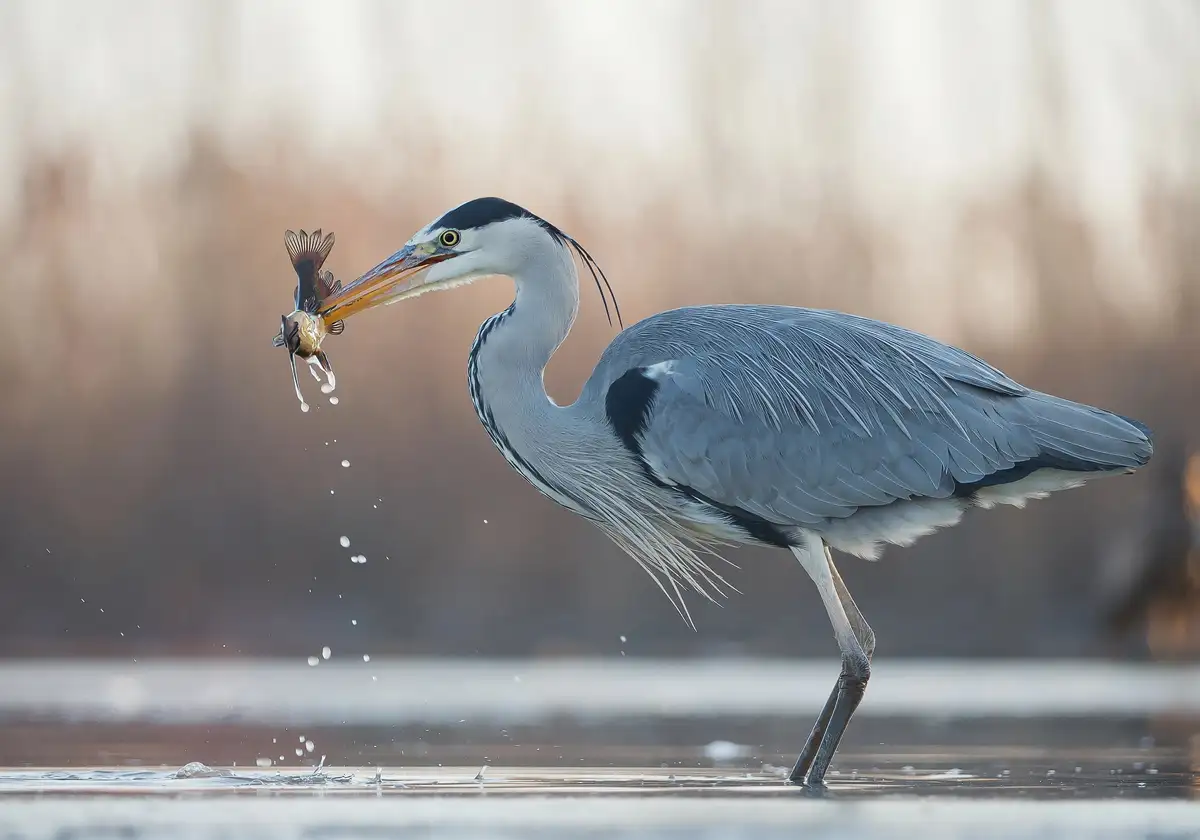
An adult heron needs roughly 330 to 500 grams of food per day. Beyond fish, the menu includes frogs, newts, water voles, rats, mice, young rabbits, and even ducklings. A study at Loch Leven in Scotland found that breeding herons there fed their chicks primarily on perch and brown trout, but as the season progressed, ducklings – mainly mallard and tufted duck – became an increasingly important part of the diet. It sounds brutal, but the research concluded that heron predation accounted for only a small fraction of overall duckling losses.
Grey herons have also been observed eating eels, crustaceans, beetles, small birds up to the size of a water rail, and even the occasional cockatiel (a documented case from a sewage works, which is quite something). They’ve been seen using an interesting technique with newts – repeatedly dunking them in water to flush toxins from their skin before swallowing them.
One thing herons are not, despite their reputation with anglers and fish farmers, is a serious threat to fish stocks. Research has consistently shown that they take only around 6 to 8 percent of available fish in most habitats, and that their impact on commercial fish farming is manageable. Despite this, an estimated 800 herons were being killed annually at Scottish fish farms during the 1990s – a problem that has since seen better understanding and non-lethal management approaches.
Breeding and Heronries
Grey herons are among the earliest nesting birds in Scotland. Some pairs in the south of the country may lay their first eggs as early as February, with the main breeding season peaking in March. Further north, nesting tends to start a little later – on the Hebrides, herons may still be actively breeding well into May.

They breed colonially in groups known as heronries, building large flat nests of sticks high in trees – typically at least 25 metres above the ground. These colonies can persist at the same location for many decades and are often well known to local birdwatchers. Males choose the nest site first and perform elaborate courtship displays to attract a mate, including powerful wing beats, raised neck and head plumes, and bill-snapping. Pairs stay together for the breeding season, though they usually form new bonds the following year.
A typical clutch consists of three to five pale bluish-green eggs, incubated by both parents for around 25 to 26 days. The chicks hatch at different times because incubation begins with the first egg, which means younger, smaller chicks are at a disadvantage. Both parents feed the young, and one adult stays at the nest for the first 20 days. Chicks can fly at about 50 days old, but often hang around the nest for another 10 to 20 days before dispersing.
Between 1976 and 1985, records showed 349 different heronry sites across Scotland. The most common heronry size was just a single nest – large colonies of 25 or more pairs were rare and tended to be associated with extensive areas of suitable habitat. Many juveniles don’t survive their first winter, but those that make it through can expect to live around five years on average, though some individuals have reached 25.
The Grey Heron in Flight
If you’ve ever watched a grey heron take to the air, you’ll know it looks like it’s doing so under mild protest. There’s none of the explosive launch of a duck or the swift, sharp movements of a raptor. A heron heaves itself upward with slow, deep wingbeats, dangling its long legs until it gains enough height to tuck them neatly behind. The whole performance has a slightly weary elegance to it.

Once airborne, though, they are unmistakable. The neck retracts into a distinctive S-shape – pulled back against the body rather than stretched out ahead. This is one of the key things that separates herons and bitterns from storks, cranes, and spoonbills, all of which fly with their necks extended. Combined with those trailing legs and the broad, bowed wings, it creates a silhouette you can identify from a considerable distance.

Their flight is graceful but not fast, with measured wingbeats and a kind of stately purpose. They are perfectly capable of soaring on thermals and can cover significant distances – foraging birds may fly up to 20 kilometres from their nesting site in search of food, though most stick much closer to home.
Herons in Scottish Culture and Folklore
The grey heron has a long and tangled history in Scottish and Gaelic culture, closely intertwined with the now-returned crane. In Scottish Gaelic, the heron is known as corra-ghritheach (roughly pronounced “kor-uh GHREE-uch”). The word corra is shared with the crane (corra-mhonaidh, meaning “upland corra”), and distinguishing between the two species in older Gaelic texts can be genuinely tricky. Other Gaelic names for the heron include corra-ghlas (“grey corra”) and corra-riabhach (“brindled corra”).
In Celtic mythology, herons and cranes were treated almost interchangeably as birds connected to the Otherworld. The Irish god of the sea, Manannán Mac Lir, was said to keep his treasures in a corrbolg – a “crane bag” – made from the skin of a woman who had been transformed into a crane. Herons were seen as guardians of liminal places, standing between land and water, patience and action, the everyday and the mystical.
In medieval Scotland, the heron was prized as quarry for falconry – its ability to evade the pursuing falcon through powerful, evasive flight was much admired. It was also a prized dish at medieval banquets. Poaching a heron in Scotland could carry a particularly severe penalty – amputation of the right hand. Anglers in older times believed that herons’ feet attracted fish, and it was common practice to carry a heron’s foot for luck or to coat fishing lines with rendered heron fat.
Place names across Scotland bear witness to the heron’s presence. Bealach nan Corr in Easter Ross, for instance, has been variously translated as “pass of the herons” or “cranes’ pass”, depending on which scholar you consult – a neat illustration of the blurred line between the two species in Scotland’s cultural memory.
Population, Conservation, and Threats
The grey heron is classified as Green on the UK Birds of Conservation Concern list and is listed as Least Concern by the IUCN, with a global population estimated at somewhere between 790,000 and 3.7 million individuals. In Scotland and across the UK, it is protected under the Wildlife and Countryside Act 1981 – it is illegal to kill, injure, or take a grey heron, or to damage or destroy an active nest.
The UK population is tracked through the BTO’s Heronries Census, which has been running continuously since 1928, making it the longest-running breeding bird monitoring programme anywhere in the world. The most recent UK estimate, from 2024, puts the population at around 9,557 apparently occupied nests. That represents a modest recovery from a low point around 2010 to 2013, but still sits well below the peak of over 13,000 nests recorded in 2003.
The biggest single factor affecting heron numbers is winter severity. Because they rely on access to shallow, unfrozen water for feeding, prolonged cold spells can be devastating. The severe winters of 1946/47 and 1962/63 caused major population crashes, though recovery followed within a few years each time. A run of cold winters around 2010 is thought to have contributed to the most recent decline, alongside possible impacts from spring gales during the breeding season.
On the positive side, milder winters in recent decades, reduced persecution, improvements in water quality, and the creation of new wetland habitats through flooded gravel pits and nature reserves have all helped the long-term trend. Historically, rather few heronries have been counted in Scotland and Northern Ireland compared with England, but coverage has been improving in recent years – the BTO is particularly keen to hear from anyone who spots nesting herons in remote parts of the Highlands or the Scottish islands.
Egrets in Scotland – The New Arrivals
If you think grey herons are impressive, keep your eyes open for their increasingly common relatives. Little egrets – smaller, bright white birds with black bills and striking yellow feet – have been pushing steadily northward into Scotland in recent years, almost certainly as a result of climate change. At the Scottish Wildlife Trust’s Montrose Basin reserve, little egrets have gone from occasional rarities to an almost daily sighting, with birds present year-round.
Great white egrets have also been spotted in Scotland with growing regularity. These are large birds – almost the size of a grey heron – with all-white plumage, a yellow bill, and black legs. They remain much scarcer than little egrets, but their range is expanding. First confirmed breeding in the UK occurred in 2012, and it seems only a matter of time before they become a regular feature of Scottish wetlands too.
Cattle egrets – compact little birds often found among livestock rather than by water – have been breeding continuously in England since 2017 and could conceivably turn up in Scotland before long. Herons and egrets all belong to the same family, Ardeidae, and the gradual arrival of these new species is one of the more visible signs of how Scotland’s wildlife is shifting in response to a warming climate.
Frequently Asked Questions
Are grey herons common in Scotland?
Yes. Grey herons are widespread across mainland Scotland and most of the islands, though they are rarer in Shetland and Orkney. You can find them beside almost any body of water, from garden ponds to Highland lochs to coastal estuaries. They are resident year-round, with numbers boosted in winter by birds arriving from Scandinavia.
What do grey herons eat?
Fish are the main part of the diet, but grey herons are highly opportunistic. They also eat frogs, newts, water voles, rats, young rabbits, ducklings, eels, crustaceans, and insects. An adult heron needs roughly 330 to 500 grams of food per day.
Where do grey herons nest in Scotland?
Grey herons breed in colonies called heronries, typically building large stick nests high in trees, often at least 25 metres above the ground. Heronries tend to be located near water and can persist at the same site for decades. Around 57% of Scottish herons breed near the coast.
When do grey herons breed?
Grey herons are among the earliest nesting birds in Scotland. Some pairs in southern Scotland may begin laying eggs as early as February, with the peak in March. Further north and on the islands, breeding may continue well into May.
Are grey herons protected in Scotland?
Yes. Grey herons are protected under the Wildlife and Countryside Act 1981. It is illegal to kill, injure, or take a grey heron, or to damage or destroy an active nest. They are classified as Green on the UK’s Birds of Conservation Concern list.
How long do grey herons live?
The average lifespan is around 5 years, with many juveniles not surviving their first winter. However, herons that make it past their first year can live much longer – the oldest recorded wild grey heron reached around 25 years of age.
What is the difference between a heron and an egret?
Herons and egrets both belong to the same family, Ardeidae, and the distinction between them is largely based on appearance rather than biology. Egrets tend to be white-plumed and were historically named separately because of their decorative breeding feathers. In Scotland, the grey heron is the most common species, but little egrets and great white egrets are increasingly being seen.
Where to See Herons in Scotland
You honestly don’t need to go far. Grey herons are common enough that a walk along almost any river, loch shore, or estuary in Scotland gives you a reasonable chance of spotting one. That said, some locations are particularly reliable.
Montrose Basin (Angus) – This Scottish Wildlife Trust reserve is outstanding for heron watching. Surveys have recorded up to 70 grey herons around the basin at peak times, and it’s also one of the best spots in Scotland for seeing little egrets and the occasional great white egret.
Loch Leven (Perth & Kinross) – A National Nature Reserve with a rich history of heron research. The diet studies conducted here during the 1980s provided some of the most detailed data ever collected on grey heron feeding behaviour in Scotland.
Caerlaverock (Dumfries & Galloway) – The WWT reserve at Caerlaverock is excellent wetland habitat and herons are regularly seen here alongside a huge variety of other waterfowl and waders.
Loch Ardinning (East Dunbartonshire) – Another Scottish Wildlife Trust reserve where grey herons are regularly spotted, with good loch-edge habitat for feeding.
The Moray Coast – Living up here, I see herons frequently along the Spey, along burns near Buckie, and on the coastal stretches. The estuaries around the Moray Firth are productive feeding grounds, particularly around low tide.
For a truly memorable experience, try to locate a heronry in spring. The noise alone is extraordinary – a cacophony of guttural croaking and bill-clattering. Just be sure to watch from a respectful distance; these are sensitive nesting sites and disturbance should be avoided.
A Bird Worth Watching
I think part of the reason I’m so fond of grey herons is their sheer, unapologetic patience. In a world that moves at an increasingly frantic pace, there’s something reassuring about a bird that will stand in the same spot for an hour, not moving a muscle, simply waiting. They’ve been doing it for millions of years, and if the BTO’s Heronries Census is anything to go by, they’ll be doing it for millions more. Next time you’re near water in Scotland, take a moment to stand still yourself. Chances are, there’s a heron doing exactly the same thing somewhere nearby.
All information was correct at the time of writing, please check things like entry costs and opening times before you arrive.


Leave a comment below