John o’ Groats – Scotland’s Iconic ‘End of the Road’
There are certain places in Scotland that carry a weight far beyond their size, and John o’ Groats is one of them. This small Caithness village – perched on the north-eastern tip of the British mainland – has become one of the most recognisable place names in the entire country, despite having a population of only around 300. For generations, the phrase “Land’s End to John o’ Groats” has been shorthand for travelling the full length of Britain, and every year thousands of walkers, cyclists, and adventurers make the pilgrimage to stand beside its famous signpost. My wife Janette and I finally made it here during our North Coast 500 road trip, and while John o’ Groats may divide opinion among visitors, we found it to be a genuinely enjoyable stop with more to see and do than we’d expected.

The History of John o’ Groats
The name John o’ Groats comes not from a Scotsman, but from a Dutchman – Jan de Groot – who arrived in Caithness around 1489 during the reign of King James IV. The Orkney Islands had only recently been acquired by Scotland from Norway in 1472, as part of an unpaid dowry arrangement, and Jan de Groot was granted the franchise to operate a ferry service between the mainland and the islands. Despite popular legend, the name “o’ Groats” doesn’t refer to the groat coin he supposedly charged for the crossing – it actually derives from the Dutch de groot, meaning “the large.”
The most famous story attached to Jan de Groot concerns the house he reportedly built here. As his family grew and prospered, eight branches of the de Groot clan began to argue over matters of precedence – specifically, who should sit at the head of the table and walk through the door first. Jan’s ingenious solution was to build an octagonal house with eight doors and an eight-sided table, so that every member of the family could enter by their own door and sit at the table without anyone claiming the chief position. Whether this tale is entirely true is debatable, but it’s become central to John o’ Groats’ identity. The site of Jan’s original house is marked by a mound near the present hotel, and his tombstone can still be seen in Canisbay churchyard, a short drive away.

The John o’ Groats House Hotel was built on or near the site of Jan de Groot’s house in 1875, and for over a century it served as the focal point of the settlement. The iconic ‘Journey’s End’ signpost was installed in 1964 on private land, originally operated as a paid visitor attraction by the same company that runs the counterpart signpost at Land’s End in Cornwall. Visitors would pay a fee to have a photograph taken with a customisable sign showing the distance to a destination of their choice.
The village went through a difficult period in the early 2000s. Lonely Planet described it as a “seedy tourist trap” in 2005, and in 2010 it received the dubious honour of a Carbuncle Award from Urban Realm magazine for being Scotland’s most dismal town. But a major transformation came in 2013 when the hotel was radically redeveloped by Edinburgh-based architects GLM for self-catering specialists Natural Retreats. The colourful lodges that now stand alongside the original white-painted hotel have become one of the village’s most photographed features. The signpost was relocated and made free to access, and new shops, cafés, and visitor facilities were developed around the harbour area.
More recently, the 8 Doors Distillery opened its doors – Scotland’s most northerly mainland whisky distillery, named in tribute to Jan de Groot’s legendary eight-doored house. A brewery also operates from the ‘Last House,’ and the village now sits proudly on the North Coast 500, Scotland’s most famous driving route.
Our Visit to John o’ Groats
Getting There and Parking
We arrived at John o’ Groats on a gloriously sunny spring morning, having driven up the A99 from Wick. The road takes you through rolling Caithness farmland – noticeably treeless compared to other parts of the Highlands – before the sea appears ahead and the road delivers you to a large, well-surfaced car park. Parking is £3.50 per vehicle per day, payable by card or cash at the machine. All funds go to the non-profit John o’ Groats Development Fund, which works to improve the village and surrounding areas, so you can feel good about paying it. There’s no time limit – once you’ve paid, you can stay all day.


The Famous Signpost
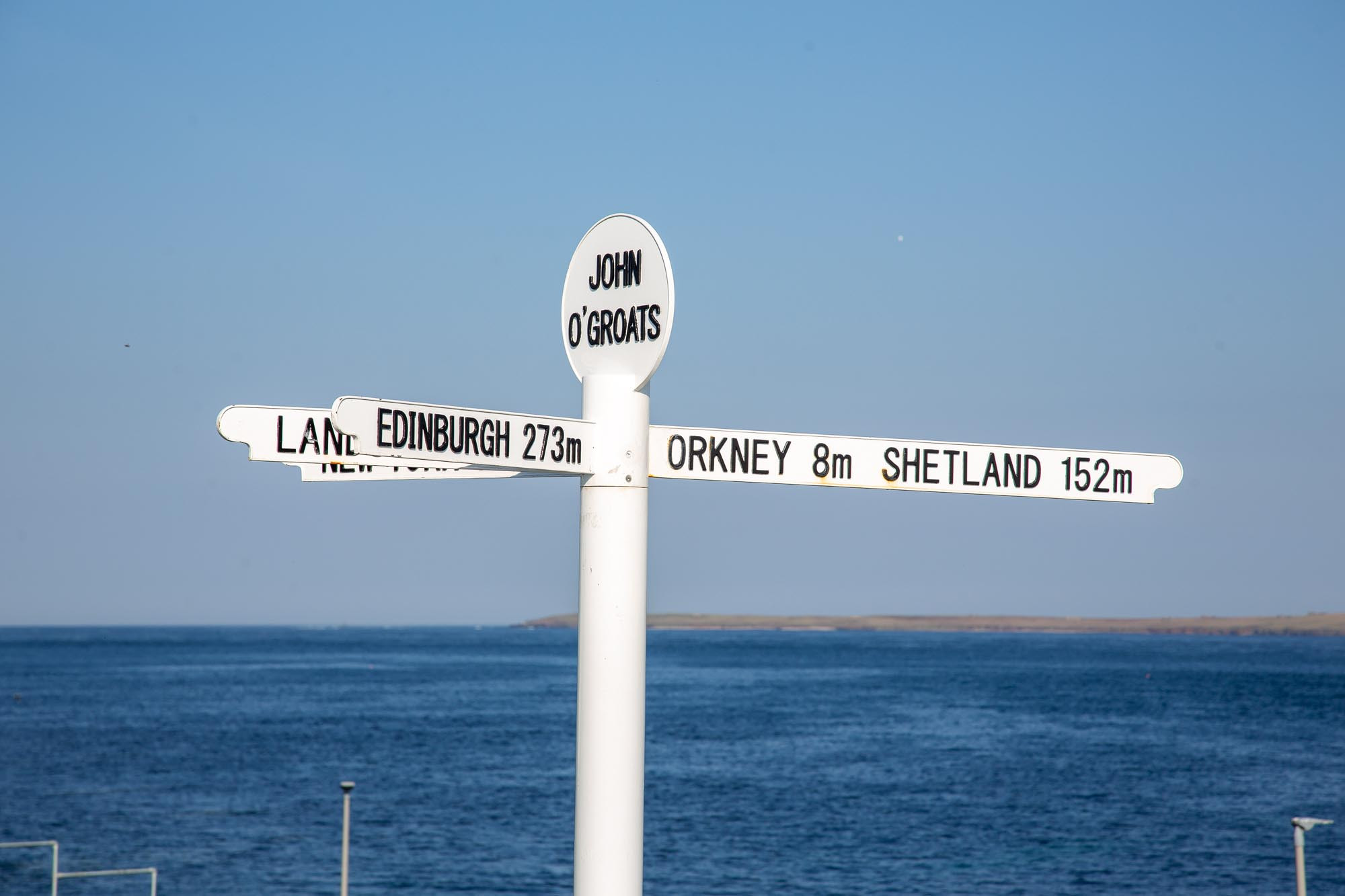
Of course, the first thing we did was head straight for the signpost. It’s positioned on the grassy area between the hotel and the harbour, flanked by two impressive Caithness slate standing stones inscribed with the words “In every end, a new beginning” and “Every mile a memory, every step a story.” Even on a weekday morning, there was a small queue of visitors waiting for their turn – but it moved quickly and everyone was friendly, offering to take photos for each other.

The signpost itself shows distances to Lands End (874 miles), New York (3,230 miles), Edinburgh (273 miles), Orkney (6 miles), and Shetland (52 miles). Unlike Land’s End, there’s no charge to take a photograph here, which feels like a nice touch. I took my obligatory tourist photo and then Janette had hers – it’s one of those things you simply have to do when you visit.

It’s worth noting that John o’ Groats is not actually the most northerly point on the British mainland – that honour belongs to Dunnet Head, a few miles to the west. Nor is it the most north-easterly point, which is nearby Duncansby Head. But none of that matters – it’s the symbolism and the tradition that draws people here, and standing beside that signpost with the Pentland Firth stretching out behind you and Orkney visible on the horizon, there’s a genuine sense of having reached the end of the road.
Exploring the Harbour Area
From the signpost, we wandered down to the harbour, which is a lovely little sheltered inlet with stone piers reaching out into the Pentland Firth. In summer months, this is where the foot passenger ferry to Orkney departs, and wildlife cruise boats also operate from here. During our visit the harbour was quiet, with just a few lobster creels stacked along the quayside and the calm, impossibly blue water reflecting the sky.


Near the harbour we found the maritime memorial area, which is well worth pausing at. Caithness flagstone memorials commemorate the lives lost in two tragedies: the sinking of the trawler George Robb near the Stacks of Duncansby in 1959, which claimed twelve fishermen from Aberdeenshire, and the loss of the cargo ship MV Cemfjord in the Pentland Firth in January 2015, when eight sailors perished. A large red foghorn – the original working foghorn from Duncansby Head Lighthouse, saved by a local when the lighthouse was automated in 2000 – stands as a centrepiece and serves as a powerful reminder of the dangers of these waters.


The Shops, Cafés, and Craft Village
John o’ Groats has a surprisingly good selection of shops for such a small place. The ‘First & Last in Scotland’ souvenir shop by the harbour has been going since 1957 and is packed to the rafters with Scottish gifts, NC500 merchandise, Highland coo teddies, and Nessie toys. Janette had a great time rummaging through its shelves.


We also spent time in the John o’ Groats Bookshop, which doubles as a tourist information point. It has an excellent range of Scottish literature, walking guides, maps, and clan gifts. Janette found a few NC500 guides and could have spent even longer browsing the shelves.


The craft village sits just behind the car park and is centred around a courtyard with an octagonal-roofed shelter – a lovely nod to Jan de Groot’s legendary house. Here you’ll find the Groatie Buckie gift shop, which has quality Scottish knitwear, cable-knit jumpers, and an extensive range of NC500 branded clothing, alongside the usual souvenirs. There’s also a modern café with a glass frontage and outdoor sculptures, perfect for warming up with a coffee after braving the wind.


The Inn and Colourful Lodges
The most eye-catching feature of modern John o’ Groats has to be the colourful self-catering lodges that sit alongside the original white-painted hotel. Clad in bold blue, green, yellow, and red, they’ve become almost as photographed as the signpost itself. The hotel – now called the Inn at John o’ Groats – was built in 1875 with its distinctive turret designed with eight sides in a Victorian nod to the de Groot legend. The 2013 redevelopment transformed the entire site, and alongside the colourful lodges, a collection of modern grey self-catering pods are set into the landscape behind the hotel.


8 Doors Distillery and the Brewery
One of the newest additions to John o’ Groats is the 8 Doors Distillery, which sits at the edge of the car park in a modern dark-grey building emblazoned with an octagonal logo – once again referencing Jan de Groot’s legendary house. It’s mainland Scotland’s most northerly whisky distillery and offers tours, tastings, and a whisky lounge and café bar. We didn’t have time for a full tour on this visit, but it’s firmly on the list for next time. The John o’ Groats Brewery also operates nearby, producing craft ales from soft Caithness water sourced from Loch Calder.

The Coastline and Views
What really surprised us about John o’ Groats was the quality of the coastal scenery. Looking out across the Pentland Firth – one of the most treacherous stretches of water in Britain – you can see the Orkney Islands just six miles away, and on a clear day like ours the outlines of buildings on the uninhabited Island of Stroma were perfectly visible. The rocky Caithness coastline stretches away to the east towards Duncansby Head, and a wonderful coastal walk connects the two. We walked a section of it and the views were stunning.

The John o’ Groats Trail starts from the harbour – marked by a lovely wrought iron arch featuring Celtic knotwork and the local brewery’s logo – and follows the coastline eastwards. Even if you don’t walk the full route, a short stroll along the shore is a wonderful way to escape the bustle of the car park and take in the views.

Paddington and Other Surprises
One thing we hadn’t expected to find at the end of the road was a Paddington Bear statue. Sitting on a bench near the signpost, the little bear in his blue coat and red hat has become one of the most popular photo spots in the village. Janette couldn’t resist sitting down for a photo with him, and she wasn’t the only one – we saw several families queuing up for their turn.


Frequently Asked Questions
Is there an entry fee to visit John o’ Groats?
No, there is no entry fee to visit the village or the signpost. The only cost is the car park charge of £3.50 per vehicle per day, which supports the local development fund. Photographing the signpost is completely free, unlike its counterpart at Land’s End.
Is John o’ Groats the most northerly point on the British mainland?
No. The most northerly point on the British mainland is actually Dunnet Head, which lies a few miles to the west. The most north-easterly point is Duncansby Head, about two miles to the east. However, John o’ Groats is the traditional symbolic ‘end of the road’ and the most well-known of the three.
Is John o’ Groats accessible for wheelchair users?
The car park, signpost area, and harbour are on relatively flat ground and accessible for wheelchair users and those with mobility difficulties. The shops and cafés around the car park are also accessible. A free mobility scooter is available for hire from Café Groats. The coastal walks beyond the village, however, are on uneven grassy ground and would be challenging for wheelchairs.
Are dogs allowed at John o’ Groats?
Yes, dogs are welcome in the outdoor areas and on the coastal walks. Some of the shops and cafés may not permit dogs inside, so check individual signage. If walking the coastal paths, keep dogs on leads near cliff edges and around livestock.
What are the opening hours for the shops and cafés?
Most shops and cafés at John o’ Groats are open daily during the tourist season (roughly April to October), typically from around 9am to 5pm or 6pm. Hours may be reduced in winter. The 8 Doors Distillery has its own tour schedule which varies throughout the year. It’s worth checking individual websites before visiting.
Can I get a ferry to Orkney from John o’ Groats?
Yes. The John o’ Groats ferry runs foot passenger services to Burwick on South Ronaldsay, Orkney, from May to September. The crossing takes around 40 minutes. Day trips to Orkney are also available. For car ferries, you would need to use Pentland Ferries from nearby Gills Bay or the NorthLink ferry from Scrabster near Thurso.
How long should I allow for a visit?
If you just want to see the signpost and have a quick look around, an hour is sufficient. However, if you want to explore the shops, have a coffee, visit the distillery or brewery, and walk part of the coastal path, allow two to three hours. If you’re also visiting Duncansby Head and the Stacks of Duncansby (which you absolutely should), add another hour or two.
Key Information
- Location: John o’ Groats, Wick, Caithness, KW1 4YR
- Grid Reference: ND 383 726
- Managed by: John o’ Groats Development Trust / Various private businesses
- Entry: Free (parking £3.50 per day)
- Parking: Large pay-and-display car park, £3.50 per vehicle per day (card or cash)
- Facilities: Public toilets, cafés, gift shops, bookshop, tourist information, brewery, distillery
- Accessibility: Car park and signpost area mostly flat and accessible. Free mobility scooter available from Café Groats. Coastal walks on uneven ground.
- Dogs: Allowed on leads in outdoor areas
- Website: www.visitjohnogroats.com
What Else is Nearby?
Duncansby Head and the Stacks of Duncansby – Just two miles east of John o’ Groats, Duncansby Head is the true most north-easterly point of mainland Britain. A short walk from the lighthouse car park leads to the spectacular Stacks of Duncansby – dramatic sea stacks rising from the waves with huge seabird colonies nesting on their faces. This is an absolute must-visit.
The Castle and Gardens of Mey – About six miles west of John o’ Groats, this 16th-century castle was the beloved holiday home of the late Queen Mother. The castle interior is full of personal touches and the grounds feature beautiful walled gardens. Open from mid-May to the end of September.
Canisbay Kirk – A five-minute drive from John o’ Groats, this is the most northerly church on the Scottish mainland. Jan de Groot’s tombstone has been moved inside the entrance porch for protection. The Queen Mother also worshipped here during her visits to the Castle of Mey.
Castle Sinclair Girnigoe – About 15 miles south near Wick, this dramatic clifftop ruin sits in one of the most spectacular settings of any Scottish castle. Steeped in the turbulent history of the Sinclair clan, it’s a photographer’s dream.
Dunnet Head – The true most northerly point on the British mainland, about 15 miles west. The lighthouse here offers breathtaking views across the Pentland Firth to Orkney, and the cliffs are home to nesting seabirds including puffins during the summer months.
Final Thoughts
John o’ Groats has had its critics over the years, and I can understand why. If you drive the length of Britain expecting a spectacular natural wonder at the finish, you might be underwhelmed to find a car park and a signpost. But approaching it with the right expectations, as we did, it’s a genuinely enjoyable place to visit. The village has been transformed since its darker days, and there’s a real sense of community pride in the improvements that have been made. The signpost is iconic, the views across to Orkney are magnificent, the maritime history is moving, and the shops and cafés are better than you’d expect. Combine it with a walk to Duncansby Head and you have a brilliant half-day out. We’re glad we made it to the end of the road.


Leave a comment below