If you’re looking for a day out in Edinburgh that’s completely free, endlessly fascinating, and guaranteed to keep you entertained for hours, the National Museum of Scotland on Chambers Street is almost impossible to beat. Spanning everything from prehistoric Scotland to particle physics, world cultures to natural history, this extraordinary museum is one of the finest in the UK – and it won’t cost you a penny.
My wife Janette and I visited on a cold December day, and what was meant to be a couple of hours turned into an entire afternoon. There’s simply so much to see that you could easily fill two or three visits and still discover something new.

A Brief History of the National Museum of Scotland
The National Museum of Scotland as we know it today is the result of two museums merging into one in 2006, but the story behind it stretches back much further than that. The roots of the museum lie in two quite different institutions: the Royal Scottish Museum and the Museum of Scotland.
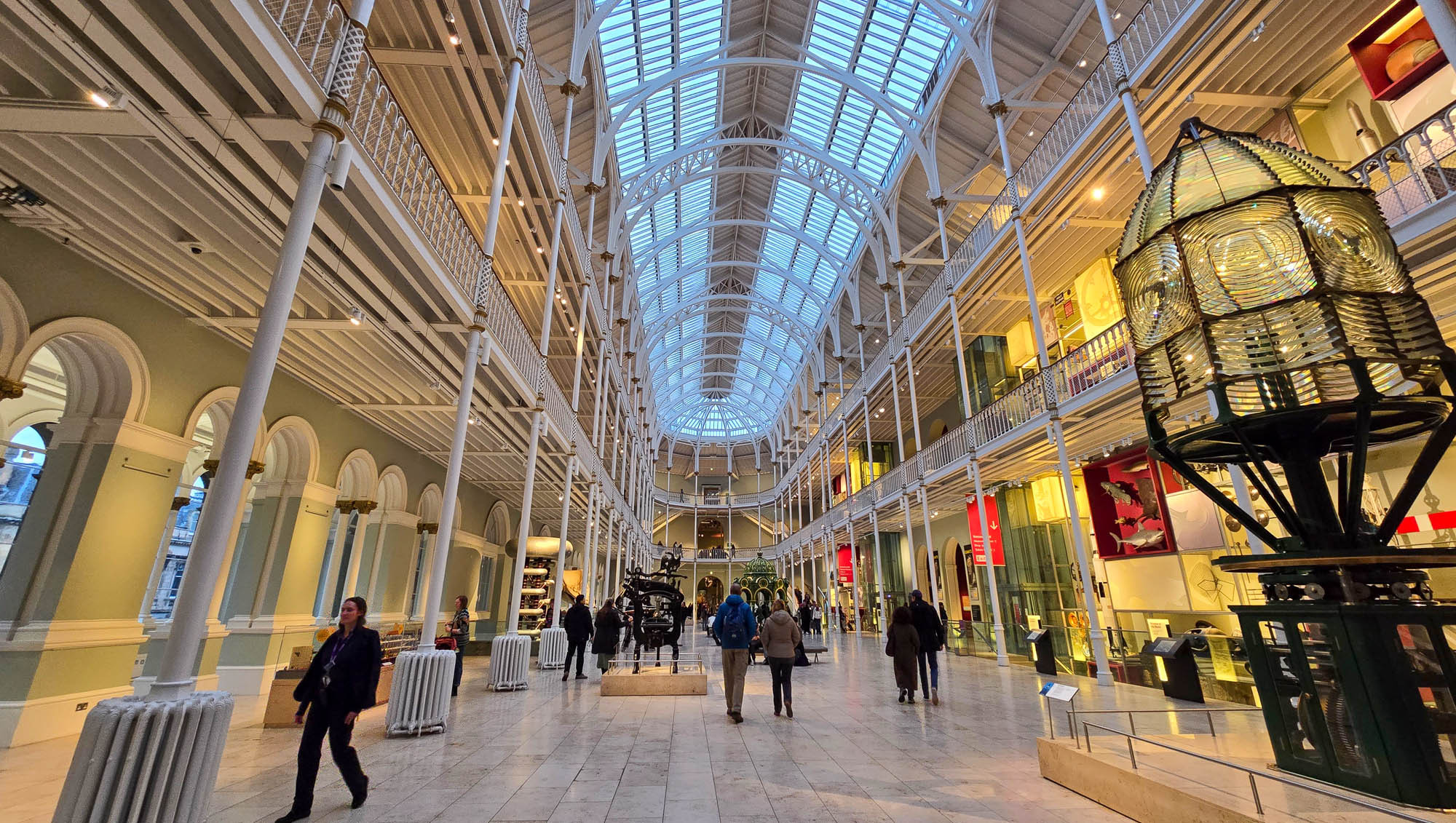
The older of the two, the Royal Scottish Museum, began life in 1854 as the Industrial Museum of Scotland, founded during the height of Victorian enthusiasm for education and scientific progress. It was renamed the Edinburgh Museum of Science and Art and opened in its purpose-built home on Chambers Street in 1866. The stunning building was designed by Captain Francis Fowke – the same engineer behind the Royal Albert Hall in London – along with local architect Robert Matheson. Its centrepiece is the magnificent Grand Gallery, a soaring hall of white-painted cast iron and glass that was inspired by the Crystal Palace. It took thirty years to complete the full building, with the west wing finally opening in 1890.
The museum was renamed the Royal Scottish Museum in 1904, and the building itself earned a Category A listing, recognising its importance as Scotland’s first major national public building. It became part of the newly formed National Museums Scotland in 1985 when it merged with the National Museum of Antiquities of Scotland, which had previously been housed on Queen Street.

The newer half of the museum – the Museum of Scotland – opened in 1998 in a striking modern building designed by Benson & Forsyth. Clad in golden Moray sandstone (which the architects described as the oldest exhibit in the building, a nod to Scottish geology), the design draws on Scotland’s architectural heritage with references to brochs and castle architecture. It was nominated for the prestigious Stirling Prize in 1999.
In 2006, the two museums officially merged to form the National Museum of Scotland. The Victorian building then closed in 2008 for a major £47.4 million refurbishment, reopening on 29 July 2011 with sixteen new galleries showcasing some 8,000 objects, around 80% of which had never been on public display before. Further galleries were added in 2016. Today, the museum holds over 12 million items in its collections and is Scotland’s most visited attraction, welcoming over two million visitors a year.
Our Visit to the National Museum of Scotland
Getting There and First Impressions
We drove into Edinburgh for the day, which is always a bit of an adventure when it comes to parking. There’s no dedicated car park at the museum itself, so you’re relying on pay-and-display on-street parking along Chambers Street (which fills up fast) or one of the nearby multi-storey car parks. The NCP at Castle Terrace is about a 10–15 minute walk away and is probably the most reliable option. Edinburgh Waverley station is just a few minutes’ walk if you’re coming by train, and several bus routes stop right on Chambers Street.
The museum sits on the south side of the city centre, just off the Royal Mile. From the outside, you can immediately appreciate the contrast between the two buildings: the ornate Victorian façade of the original Royal Museum and the angular modern stonework of the Museum of Scotland next door. We entered through the main Chambers Street entrance and were hit straight away by that incredible Grand Gallery. Even if you never looked at a single exhibit, the architecture alone is worth the visit. The soaring white ironwork and glass roof feel more like a Victorian railway station or a grand conservatory – it’s utterly stunning and floods the hall with natural light.
Exploring Scotland’s Story
We started in the Scottish galleries housed in the modern wing, which take you on a chronological journey through the nation’s history. The earliest galleries begin in the basement with prehistoric and early medieval Scotland – the low ceilings and intimate layout giving the space an almost cave-like atmosphere that suits the ancient artefacts perfectly.

One of the highlights for us was the Lewis Chessmen – the museum holds ten pieces from this famous hoard of walrus ivory chess figures, discovered on the Isle of Lewis in 1831 and thought to have been carved in Norway around 1200 AD. The detail in each piece is remarkable, from the expressions on the kings’ and queens’ faces to the shield-biting berserker warriors. They’re surprisingly small in person but absolutely captivating.

Moving upward through the levels, you pass through the Kingdom of the Scots galleries, which cover medieval Scotland with displays of silverware, Saltire flags, ornate communion ware, and historical documents. An impressive glass case houses a collection of medieval swords including a formidable two-handed claymore, and there’s a stunning display of Scottish coinage spanning centuries, from tiny silver pennies to large gold pieces bearing the likenesses of Scottish monarchs.


The religious artefacts are particularly beautiful, including an ornate golden monstrance with a sunburst design topped by a cross, alongside a silver ciborium. These pieces give a real sense of the wealth and devotion that characterised Scotland’s medieval church.


One display that really stopped us in our tracks was the section on ‘The Killing Times’ – the period of Covenanter persecution in the 17th century. The centrepiece is the disguise mask worn by Alexander Peden, a leading Covenanter minister who lived in constant danger of arrest. The mask is genuinely eerie – made of leather with a wig of human hair – and seeing it up close brings that turbulent period of Scottish history vividly to life.

Nearby, carved tombstones from the post-Reformation period make for sobering viewing. The tombstone of Katharine Carstairs from the 1640s, originally from St Andrews, features a skull and crossbones motif that was characteristic of the era’s churchyard monuments.

The Millennium Clock and Grand Gallery
Back in the Victorian building, one exhibit that absolutely demands your attention is the Millennium Clock. Standing around 10 metres tall in its own red-walled alcove, this extraordinary mechanical sculpture is part clock, part artwork, and entirely mesmerising. Created by Eduard Bersudsky, it’s packed with animated figures, dancing skeletons, cogs, wheels, and all manner of surreal and symbolic elements that reflect on both the triumphs and tragedies of the 20th century. It puts on a five-minute performance on the hour every hour, and it’s well worth timing your visit to catch it in action.

Natural History and Animal World
The Animal World gallery was probably our favourite section of the entire museum. It’s absolutely spectacular. Occupying a huge multi-level hall, it features an incredible collection of taxidermied animals and skeletons from across the globe. A life-size elephant dominates the ground floor alongside a giraffe, while above your head, suspended marine creatures including whales, dolphins, and other sea life create a jaw-dropping overhead display. But the real showstopper is the full-size Tyrannosaurus rex skeleton cast, towering over visitors with its enormous skull and terrifying teeth. It really puts into perspective the sheer scale of these creatures.


A massive sperm whale skull with its jaw open wide sits near the entrance hall, its rows of conical teeth a reminder of the power of these ocean giants. Elsewhere, a pair of whale jawbones sit in a glass case, some bearing the delicate etchings of scrimshaw work – a folk art tradition practised by whalers during long voyages at sea.


Earth and the Natural World
The geology galleries are another real highlight. Janette was particularly taken with the giant amethyst geode – a colossal purple crystal formation that’s genuinely stunning in person. The mineral collections are beautifully displayed, with cases full of pyrite cubes, fluorite in various colours, garnets, and all manner of extraordinary geological specimens from around the world. A close-up view of a crocoite specimen reveals impossibly delicate orange-red crystal needles that look almost too perfect to be natural.


World Cultures
The World Cultures galleries are spread across several multi-level halls and cover an impressive range of civilisations and traditions from around the globe. We particularly enjoyed the South Pacific section, with its model canoes and displays about Polynesian navigation and culture. The East Asian and South Asian galleries are vibrant and colourful, with Tibetan prayer flags strung across the space and a wealth of artefacts from China, Japan, India, and beyond.


Science and Technology
The Science and Technology galleries are a wonderland of innovation and engineering. One of the most impressive spaces houses suspended aircraft overhead – including a Spitfire – while below, massive industrial machinery, vintage vehicles, and scientific instruments chart Scotland’s significant contributions to global innovation. A huge steam engine with enormous iron gears dominates one corner, while nearby you’ll find a glowing plasma discharge tube that pulses with vivid blue light – one of those exhibits that stops everyone in their tracks.


For anyone with an interest in particle physics, there’s a remarkable display featuring equipment related to CERN’s research, complete with an enormous copper apparatus set against a vibrant backdrop showing particle collisions. It’s a powerful reminder of Scotland’s ongoing contribution to cutting-edge science. And in a lovely bit of nostalgia, we spotted a Sinclair ZX Spectrum in the computing displays – a machine that will bring a smile to anyone who grew up in the 1980s.


Art, Design and Fashion
Among the art and design collections, we were drawn to an exquisitely crafted travelling vanity case – a beautifully fitted wooden box containing gold and silver implements, mother-of-pearl tools, and crystal bottles, all arranged with extraordinary precision. It’s the kind of object that makes you appreciate the craftsmanship of a bygone era.

Videos from the National Museum of Scotland
Frequently Asked Questions
Is the National Museum of Scotland free to visit?
Yes, entry to the National Museum of Scotland is completely free. Some special temporary exhibitions may carry a separate charge, but the permanent collections – which are vast – are all free to enjoy.
How long do you need at the National Museum of Scotland?
You could easily spend 3–4 hours here, and many visitors stay longer. If you want to see everything in depth, you might need two visits. We spent around four hours and still didn’t see it all.
What are the opening hours of the National Museum of Scotland?
The museum is open daily from 10:00 to 17:00. It’s closed on Christmas Day. On Boxing Day and New Year’s Day it opens from 12:00 to 17:00.
Is the National Museum of Scotland accessible for wheelchair users?
Yes, the museum is fully accessible. All galleries can be reached via lifts and ramps. Manual wheelchairs are available to borrow from the information desk, and there are Blue Badge parking bays on Chambers Street.
Is there parking at the National Museum of Scotland?
There’s no dedicated car park, but pay-and-display on-street parking is available on Chambers Street. Blue Badge holders can park for free in designated bays outside the museum. The nearest multi-storey car park is NCP Castle Terrace, about a 10–15 minute walk away.
Are dogs allowed in the National Museum of Scotland?
Only assistance dogs are permitted inside the museum.
Is there a café or restaurant at the National Museum of Scotland?
Yes, there are several options. The Balcony Café on Level 3 offers great views over the Grand Gallery, the Hawthornden Café is on Level 1, and the Museum Kitchen is on Level 0. There’s also a lunch space in the Entrance Hall if you’ve brought your own food.
Key Information
- Location: Chambers Street, Edinburgh, EH1 1JF
- Grid Reference: NT 2582 7329
- Managed by: National Museums Scotland
- Entry: Free (some special exhibitions may have a charge)
- Parking: On-street pay-and-display on Chambers Street; Blue Badge bays available; NCP Castle Terrace nearby
- Facilities: Cafés, gift shops, toilets on all levels, lockers, free WiFi
- Accessibility: Fully accessible via lifts and ramps; wheelchairs available on loan; hearing loops; large print labels
- Dogs: Assistance dogs only
What Else is Nearby?
Edinburgh Castle – Scotland’s most iconic fortress sits just a short walk up the Royal Mile from the museum. The castle dominates the Edinburgh skyline and is packed with history, including the Scottish Crown Jewels and the Stone of Destiny.
Greyfriars Bobby – The statue of Edinburgh’s most famous dog is just 150 metres away on the corner of Candlemaker Row and George IV Bridge. The story of Bobby’s loyalty to his master is one of the most touching tales in Scottish history.
St Giles’ Cathedral – Just a few minutes’ walk along the Royal Mile, this magnificent cathedral has been at the heart of Edinburgh’s religious life for over 900 years. The Thistle Chapel inside is a masterpiece of Gothic Revival architecture.
The Real Mary King’s Close – Hidden beneath the Royal Mile, this network of underground streets and spaces offers a fascinating glimpse into Edinburgh’s past. Guided tours take you below the city to explore the preserved 17th-century closes.
Surgeons’ Hall Museums – Just 300 metres from the National Museum, this collection tells the story of surgery and medicine in Edinburgh. It’s not for the squeamish, but it’s fascinating.
Final Thoughts
The National Museum of Scotland is one of those rare attractions that genuinely has something for everyone. Whether you’re fascinated by Scottish history, drawn to natural history, curious about world cultures, or interested in science and technology, you’ll find it here – and it’s all completely free. The building itself is worth the visit, from the soaring Victorian Grand Gallery to the atmospheric modern Scottish galleries.
Janette and I had a wonderful afternoon exploring the museum in December, and we both agreed we could easily have spent another full day working our way through galleries we didn’t have time to reach. It’s a world-class museum that Scotland should be immensely proud of, and we’d wholeheartedly recommend it to anyone visiting Edinburgh.



Leave a comment below