
A Life of Courage, Devotion and Literary Legacy
Lady Grisell Baillie stands as one of Scotland's most remarkable women of the late 17th and early 18th centuries. Born into an era of religious persecution and political turmoil, she demonstrated extraordinary courage as a young girl, became a devoted wife and capable estate manager, and left behind a literary and historical legacy that continues to fascinate scholars today. Her life story reads like a dramatic novel, yet every remarkable chapter is true.
Early Life and Dangerous Times
Grisell Hume was born on 25 December 1665 at Redbraes Castle in Berwickshire, in the heart of the Scottish Borders. She was the eldest daughter of Sir Patrick Hume of Polwarth and his wife Grisell Ker. Her father was a prominent Covenanter, a strict Presbyterian who opposed the religious policies of King Charles II, and this commitment to principle would soon place the entire family in grave danger.
The Scotland of Grisell's childhood was a place of religious conflict. The Covenanters believed in the independence of the Presbyterian Church from royal interference, whilst the Stuart monarchs sought to impose bishops and control over Scottish worship. Those who resisted faced imprisonment, fines, and even execution.
A Twelve-Year-Old Courier
In 1676, when Grisell was barely eleven years old, she was entrusted with a mission that would have daunted many adults. Her father's close friend Robert Baillie of Jerviswood had been imprisoned in Edinburgh Tolbooth for helping his Covenanting brother-in-law escape the authorities. Sir Patrick desperately needed to communicate with his friend but dared not visit himself, as he was already under suspicion.
He turned to his eldest daughter. Young Grisell was given a letter and charged with delivering it personally to the prisoner, then bringing back as much intelligence as possible. The task required remarkable maturity and courage. She would have to navigate the streets of Edinburgh, gain admission to the notorious Tolbooth prison, deliver the letter without arousing suspicion, and return home safely.
Grisell succeeded brilliantly. During this visit, she met Robert Baillie's son George for the first time. Neither could have imagined that years later, after exile, revolution, and the restoration of their families' fortunes, they would marry.
Hiding in the Church Vault
The situation for the Hume family deteriorated further in 1683. When Robert Baillie was arrested again, this time accused of involvement in the Rye House Plot against King Charles II, Sir Patrick Hume boldly defended his friend in court. This public support made him a marked man. After Baillie's execution in 1684, royal troops occupied Redbraes Castle, and Sir Patrick was forced into hiding.
For several weeks, he concealed himself in the family vault beneath Polwarth Church, a cold, damp, and eerie refuge. Once again, young Grisell proved her mettle. Night after night, she crept from the castle to the church, carrying food to her father. She later used a wooden handheld lantern for these perilous nocturnal visits, an artefact that is now preserved in the collections of the National Museums of Scotland as a poignant reminder of her courage.
Eventually, the situation became too dangerous even for this desperate arrangement. Sir Patrick fled to Holland, and his family soon joined him in exile. The Humes had lost everything - their castle, their estates, their position in Scottish society - all because of their commitment to their Presbyterian principles.
Exile and Reunion in Holland
In Holland, the Hume family lived as refugees, dependent on the charity of fellow exiles and sympathetic supporters of the Protestant cause. It was during this period of exile that Grisell once again encountered George Baillie, who had also fled Scotland after his father's execution. Both young people had been shaped by loss and hardship, and they formed a deep attachment.
Living in the Dutch Republic, they would have been part of a community of Scottish exiles who were plotting and planning for the day when they might return home. That opportunity came in 1688 with the Glorious Revolution, when William of Orange was invited to take the British throne. Sir Patrick Hume and George Baillie both accompanied William to England, and their gamble paid off. The new monarchs, William and Mary, restored their Scottish estates.
Marriage and a New Beginning
On 17 September 1692, Grisell Hume married George Baillie. By this time, her father had been created Lord Polwarth, and the family's fortunes had been restored. George Baillie was beginning what would become a distinguished political career, serving in the Scottish Parliament and later in the British Parliament after the Union of 1707. He held various government positions, including Lord of the Admiralty and member of the Treasury Board.
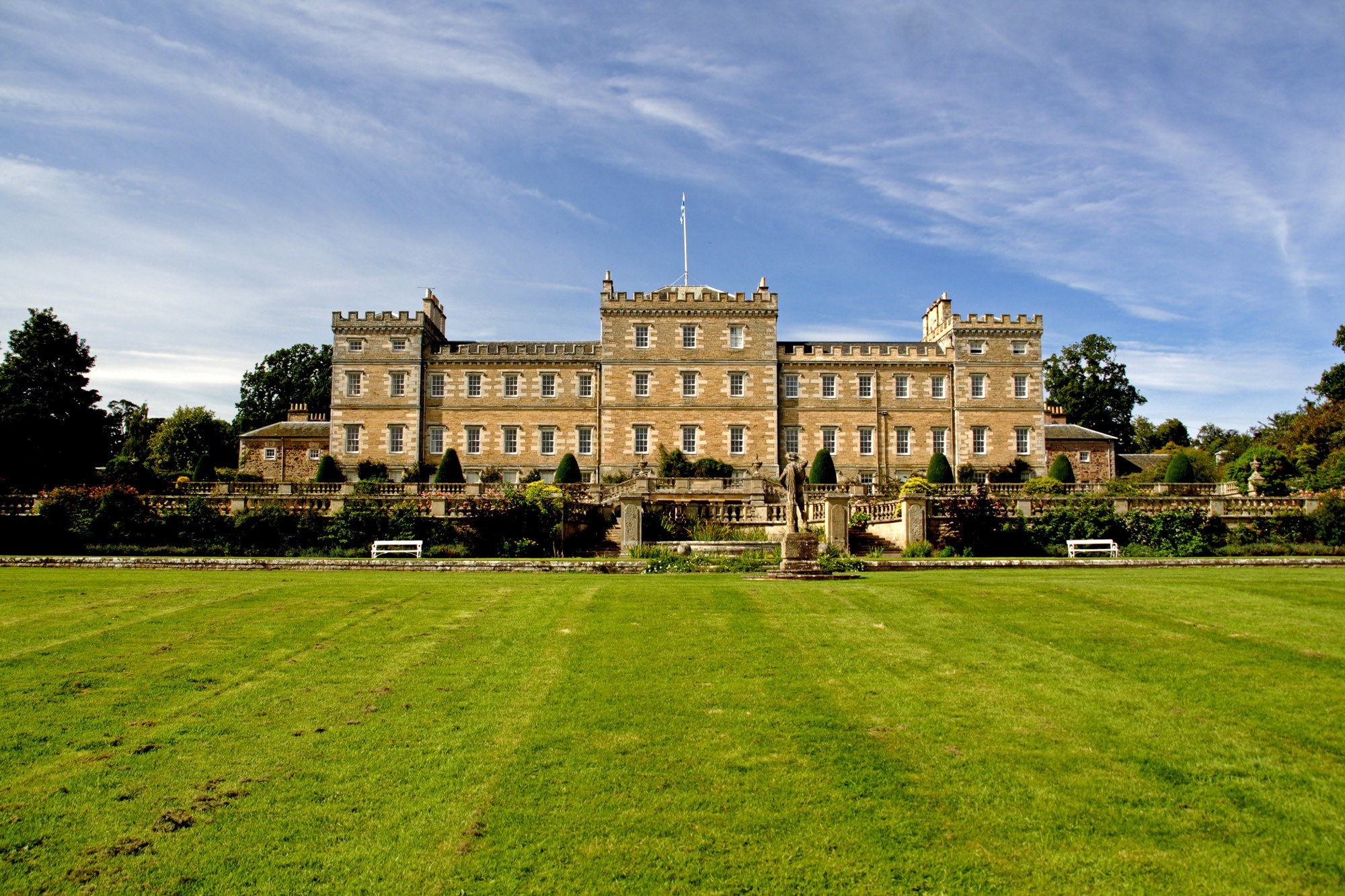
The couple settled at Mellerstain House in the Scottish Borders, the Baillie family's ancestral estate. Theirs was, by all accounts, a remarkably happy marriage, characterised by deep affection and mutual confidence. When George was absent in London on parliamentary business, Grisell served as his trusted correspondent, relaying sensitive political information to his associates in Scotland.
Mistress of Mellerstain
At Mellerstain, Grisell proved herself to be far more than a typical aristocratic wife. She took complete charge of the household accounts and managed all the business affairs of the estate. Her organisational abilities and attention to detail were exceptional, and she maintained meticulous records of every aspect of household management.
In 1725, the Baillies commissioned the prominent Scottish architect William Adam to design a grand new mansion to replace the old peel tower at Mellerstain. The design called for two wings connected by a central block, but only the wings were completed before George Baillie's death in 1738. The family lived in the east wing, whilst the west wing housed servants and stables. It would not be until 1770 that William Adam's son, the famous Robert Adam, was commissioned to complete the house by designing and building the magnificent central block that makes Mellerstain one of Scotland's architectural treasures today.
A Poet and Songwriter
Beyond her considerable administrative abilities, Grisell possessed genuine literary talent. She wrote poetry and songs, though most of her work has been lost to time. Only two of her songs have survived, but both have become part of Scotland's cultural heritage.
"The Ewe-Buchtin's Bonnie" may have been inspired by her father's ordeal hiding in Polwarth Church. The title refers to the practice of penning sheep, and the song captures both the pastoral life of the Borders and the sorrows of exile and separation.
Her most famous work is "Werena My Heart Licht I Wad Dee" (If My Heart Were Not Light, I Would Die), which first appeared in the influential Scottish folk song collection Orpheus Caledonius in 1725 and was later included in Allan Ramsay's Tea Table Miscellany. This haunting song tells the story of a young woman whose lover's family opposes their marriage because she lacks wealth. Despite the disappointment and heartbreak, she maintains that if her heart were not light, she would die. The refrain captures the resilience and optimism that seemed to characterise Grisell herself: "And werena my heart licht, I wad dee."
The song's popularity has endured for nearly three centuries, and it remains a beloved part of the Scottish folk tradition. It has been recorded by numerous artists and continues to be performed today.
The Household Books
Perhaps Grisell's most significant contribution to history was entirely unintentional. From 1692, the year of her marriage, until 1746, the year of her death, she kept extraordinarily detailed household account books. These records, spanning more than fifty years, document every aspect of life at Mellerstain - from major expenses to the smallest purchases, from the wages of servants to the cost of candles, from the education of her children to the food served at meals.
These accounts were never intended for publication. They were simply Grisell's method of managing the estate efficiently. However, they have become an invaluable resource for social historians. In 1911, the Scottish Historical Society published a scholarly edition of the accounts, focusing on the years 1692 to 1718. The 400-page volume provides an unparalleled window into daily life in an 18th-century Scottish country house.
Historians have used Grisell's meticulous records to understand everything from the cost of goods to the caloric intake of servants during this period. The accounts reveal details about clothing, food preparation, medical treatments, entertainment, travel, and countless other aspects of Georgian life. They show us not just how the wealthy lived, but how their households functioned, how servants were treated, and how resources were managed.
Family Life
Grisell and George Baillie had three children, though only two daughters survived to adulthood. Their elder daughter, also named Grisell, married Sir Alexander Murray of Stanhope and became Lady Murray. She inherited her mother's literary talents and wrote a biography of her parents that was eventually published in 1822 as "Memoirs of the Lives and Characters of the Right Hon. George Baillie of Jerviswood and Lady Grisell Baillie." Though not originally intended for publication, this memoir first appeared in 1809 within a larger work and provides touching insights into her parents' characters and their devoted marriage.
The younger daughter, Rachel, married Charles Hamilton, Lord Binning, the eldest son of the Earl of Haddington. Through this marriage, the Mellerstain estate would eventually pass to the Hamilton family, who adopted the surname Baillie-Hamilton. Lord Binning died in Naples in 1732, a loss that deeply affected the family.
Final Years and Legacy
Grisell outlived her husband by eight years. George Baillie died in 1738, but Grisell continued to manage the estate and maintain her detailed household accounts until shortly before her own death. She died on 6 December 1746, just weeks before what would have been her 81st birthday, and was buried at Mellerstain House.
Her father, Sir Patrick Hume, had risen to become Earl of Marchmont and Lord Chancellor of Scotland, vindication for the persecuted Covenanter who had once hidden in a church vault. Her husband had played an important role in the Union of Scotland and England and had served in various high government positions. But perhaps Grisell's own achievements were even more remarkable.
Without ever seeking fame or recognition, she left behind a literary legacy through her songs and a historical legacy through her household accounts. She demonstrated that women in her era could combine literary creativity with administrative competence, that they could manage complex estates whilst raising families, and that ordinary domestic records, if detailed enough, could become extraordinary historical documents.
In 1821, the Scottish poet Joanna Baillie, who claimed to be a distant relative, memorialised Lady Grisell in a poem published in "Metrical Legends of Exalted Characters," ensuring that her name would not be forgotten.
Today, visitors to Mellerstain House can walk through the magnificent rooms designed by Robert Adam and admire the paintings, furniture, and treasures accumulated by the Baillie family over centuries. But the spirit of the house - its combination of elegance and practicality, beauty and efficiency - owes much to Lady Grisell Baillie, the remarkable woman who turned a childhood of danger and exile into a life of accomplishment and legacy.
From the brave twelve-year-old carrying letters through Edinburgh's dangerous streets, to the faithful daughter bringing food to her father in the church vault, to the exile in Holland who never lost hope, to the devoted wife and capable estate manager, to the poet whose songs still echo through the centuries - Lady Grisell Baillie's life story reminds us that history is made not just by kings and generals, but by individuals of courage, competence, and character.


