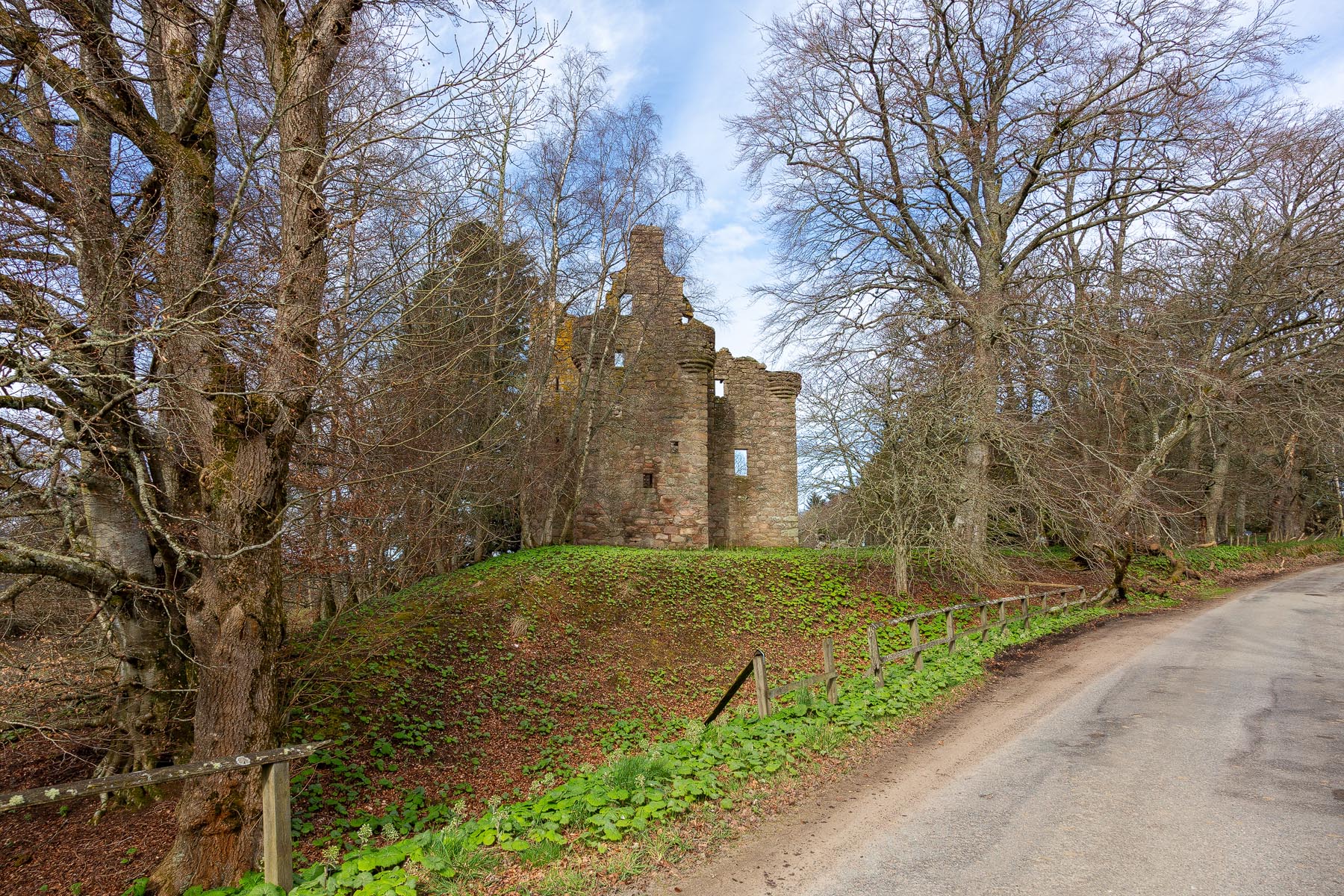
Corse Castle is a fascinating ruin found tucked away in the Aberdeenshire countryside, around 3 miles north-west of Lumphanan. Although I’ve explored many castles across Scotland, this particular castle had somehow escaped my attention… perhaps overshadowed by its more famous neighbour, the fairy-tale Craigievar Castle. Built in 1581, Corse Castle is a remarkable example of a compact 16th-century Z-plan tower house and is well worth seeking out while touring Aberdeenshire.

History of Corse Castle
The story of Corse begins in the 15th century when the land was granted to Patrick Forbes, son of the 1st Lord Forbes, by King James III. Patrick served as the king’s armour bearer, and the royal grant established a Forbes presence at Corse that would endure for centuries.
The original house on the site met a violent end when brigands raided and destroyed it. The laird of the day, Sir William Forbes, is famously reputed to have said of his planned replacement: “Please God I will build me such a house as thieves will need to knock at ere they enter.” True to his word, he erected the present castle in 1581, a fortified tower house bristling with gunloops and shot-holes designed to deter unwanted visitors.

Our first view of Corse Castle from the roadside.
William Forbes had seven sons, and the family’s influence spread far and wide. His eldest son, Patrick Forbes (1564-1635), was born at the castle before the rebuilding and went on to become the Bishop of Aberdeen in 1618, serving until his death. The second son, William, made his fortune as a merchant in the Baltic trade and purchased the nearby Craigievar Castle in 1610, completing its construction in 1626. This connection explains why the two castles share a family history.
Despite Sir William’s defensive intentions, the castle’s defences were tested in 1638 when Highlanders raided the property and carried off the laird’s cousin for ransom. Such was the turbulent nature of life in 17th-century Aberdeenshire.
By the mid-19th century, the castle had become redundant. A more modern mansion house, Corse House, was built nearby, and the old tower was left to the elements. Today, it stands as a roofless but atmospheric ruin, described by Historic Environment Scotland as “a remarkable survival of the compact 16th-century Scottish Z-plan castle.”
Our Visit to Corse Castle
My wife and I visited Corse Castle on a bright spring morning, having spotted a small brown tourism sign while exploring the area around Lumphanan. We were intrigued by what we might find, as this castle rarely appears on the usual tourist itineraries.
Getting There
To reach Corse Castle, we turned north off the B9119 onto a minor road. If you pass a mansion on your right just off the road, you’ve gone too far! There’s no dedicated car park, so we parked carefully on the verge near the access point.

The quiet country road leading to Corse Castle – we parked on the verge near the access point.
The castle can be accessed via a stile, and from there it’s a short walk across uneven ground to reach the ruins. The setting is wonderfully peaceful – the castle stands overlooking the glen of the Corse Burn, with rolling Aberdeenshire farmland stretching in every direction.

The narrow single-track road near Corse Castle – take care when parking.
Exploring the Ruins
As we approached, the distinctive shape of the Z-plan castle became clear. The central block lies north to south, with a square tower projecting to the south-east and the remains of a round tower to the north-west. A tall circular stair tower on the south side once provided access between floors.

Looking up at the tower with both corbelled turrets visible against the sky.
Walking around the exterior, we could still make out the gunloops and shot-holes that Sir William Forbes had installed to protect his family. These narrow openings would have allowed defenders to fire upon attackers while remaining relatively safe behind the thick stone walls.

Decorative window surround with a gunloop visible above – combining comfort with defence.
One of the highlights of our visit was finding the historic datestone above the entrance, bearing William Forbes’ initials and the date 1581. It’s always special to see such tangible evidence of a castle’s origins.

The historic datestone above the entrance bearing William Forbes’ initials and the date 1581.
The corbelled turrets are particularly impressive – fine examples of 16th-century Scottish craftsmanship that have survived remarkably well despite centuries of exposure to the elements.

Detail of one of the magnificent corbelled turrets – fine 16th-century craftsmanship.

The decorative corbelling that once supported an angle turret.
Inside the Castle
The interior of the castle is largely overgrown – and let me assure you, there are nettles everywhere! Exploring requires sturdy footwear and long trousers. Despite the vegetation, you can still appreciate the scale of the building and imagine how the various rooms might have been laid out.

The multi-storey interior with its numerous window openings and architectural details.

Looking up inside the castle – the scale of the building becomes apparent from within.

The interior corner showing window openings at different floor levels.
The circular stair tower is one of the most atmospheric parts of the castle. Looking up through its moss-covered stones to the open sky above is quite a sight.

Looking up inside the circular stair tower – once the main route between floors.

A dramatic view looking up through the stair tower to the open sky.

The moss-covered remains of a stone spiral staircase – tread carefully!
From within the ruined walls, you get lovely views out to the surrounding Aberdeenshire countryside.

Views through the castle walls to the Aberdeenshire countryside beyond.

The castle seen from the exterior – the full height of the surviving walls is impressive.
Drone Photography
I took the opportunity to fly my drone and capture some aerial shots of the castle. From above, the Z-plan layout is clearly visible, and you can also see where the Corse Burn once formed a defensive lochan along the south side of the castle.

Drone view directly above the castle showing the distinctive Z-plan layout.

Aerial view of Corse Castle with a visitor for scale – the Corse Burn is visible to the right.

Aerial view showing the castle and the Corse Burn which once formed a defensive lochan.

Drone photo showing Corse Castle nestled in its woodland setting with Aberdeenshire farmland beyond.
FAQs on Corse Castle
Is Corse Castle safe to visit?
The castle is a ruin and should be explored with care. There are no safety barriers or maintained paths, so visit at your own risk. Watch your footing on uneven ground and be aware of loose masonry. Keep children supervised at all times.
Are there facilities at Corse Castle?
No, there are no facilities whatsoever – no toilets, café, or visitor centre. This is a remote ruin with no formal management. Bring everything you need with you, including water and snacks.
Is Corse Castle suitable for wheelchairs or pushchairs?
Unfortunately not. Access requires crossing a stile and walking over rough, uneven ground. The site is not accessible for wheelchairs or pushchairs.
Who are the families associated with Corse Castle?
The Forbes family has been associated with Corse since the 15th century. Notable family members include Patrick Forbes, Bishop of Aberdeen, and William Forbes, who purchased and completed Craigievar Castle. The estate remained in Forbes hands until recent times.
What else is nearby to visit?
Here are a few suggestions:
- Craigievar Castle – A stunning pink tower house just 2 miles away, completed by William Forbes in 1626. Now managed by the National Trust for Scotland.
- Peel Ring of Lumphanan – An earthwork castle with connections to Macbeth. Free to visit and just a short drive away.
- Macbeth’s Cairn – On nearby Perk Hill, this cairn marks the traditional spot where King Macbeth was buried after his defeat in 1057.
- Crathes Castle – A magnificent 16th-century tower house with beautiful gardens, located near Banchory.
- Dess Waterfall – A hidden gem at the end of a woodland walk, perfect for a peaceful stroll.
Key Information
- Corse Castle is a ruined 16th-century tower house located approximately 3 miles north-west of Lumphanan in Aberdeenshire.
- Built in 1581 by Sir William Forbes, the castle is an excellent example of Scottish Z-plan architecture.
- The castle is linked historically to the Forbes family, including Patrick Forbes, Bishop of Aberdeen.
- Access is via a stile and across uneven ground – sturdy footwear is essential.
- The castle is a scheduled monument protected by Historic Environment Scotland.
- There are no facilities – bring your own supplies and be prepared for nettles!
- Nearby attractions include Craigievar Castle and the Peel Ring of Lumphanan.
Conclusion
Corse Castle may not be on many people’s list of places to visit, and we only discovered it by following a small brown sign while exploring the area. The ruin is a hidden gem that rewards those willing to seek it out. While it lacks the facilities and grandeur of more famous castles, it offers something increasingly rare – the chance to explore a genuine piece of Scottish history in peaceful solitude.
Standing among the ruined walls, looking out over the Aberdeenshire countryside, it’s easy to imagine the Forbes family going about their daily lives here over 400 years ago. Sir William Forbes built his castle to keep out thieves, and while the roof is long gone and nettles now grow where fires once burned, his creation still stands as a testament to the turbulent history of the Scottish north-east.
If you’re touring Aberdeenshire and fancy getting off the beaten track, Corse Castle is well worth an hour of your time. Combine it with a visit to Craigievar Castle and the Peel Ring of Lumphanan for a full day exploring Forbes history and the legends of Macbeth. Highly recommended!


Leave a comment below