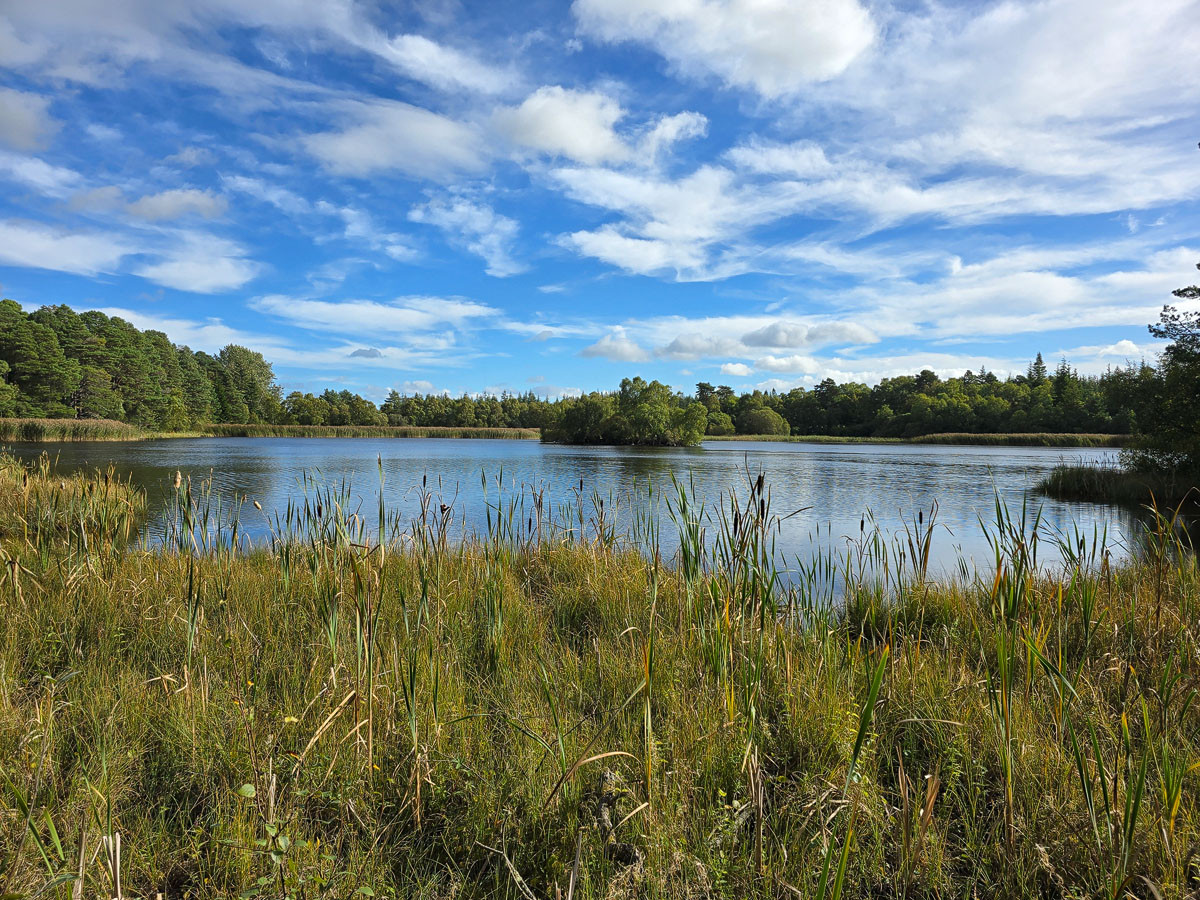
Tucked away in the woods of the Altyre Estate, just four miles south of Forres, Loch of Blairs is one of Moray’s quieter treasures. For years it was something of a secret, known mainly to local dog walkers, anglers and birdwatchers. Today, thanks to a dedicated band of volunteers, it has been transformed into a beautiful, family-friendly nature spot with woodland walks, wooden boardwalks, three waterside bird hides, picnic tables and a striking red Victorian boathouse that looks as though it has drifted over from Scandinavia.
Janette and I visited at the very end of September 2026 on a lovely, bright day. We had both been spending far too long in front of screens and really needed an escape into nature. Loch of Blairs turned out to be the ideal spot: peaceful, beautifully kept and full of little surprises, including dragonflies still darting over the water at the tail end of the season.

History of Loch of Blairs
A Man-Made Loch on the Altyre Estate
Although it looks completely natural today, Loch of Blairs is almost certainly man-made. The Altyre Estate has belonged to the Gordon Cumming family for centuries, and it seems that one of the lairds of Altyre decided to turn an area of boggy ground into an ornamental loch during the 19th century.
The evidence comes from old maps. When the renowned cartographer John Thomson published his map of the area in 1830, there was no sign of the loch, even though nearby Loch Dallas is clearly marked. By the time the Ordnance Survey carried out its first survey of the county in 1870, Loch of Blairs was there, complete with a drainage ditch to the Mannachy Burn and a boathouse in the same spot as the one you see today. So the loch was created at some point in those forty years.
It was probably formed from what is known in Scotland as a “stank”, an area of waterlogged ground with no obvious burn flowing in or out, possibly the site of old peat workings. When volunteers dredged the boat channel in 2018 they found a layer of clay beneath the reed roots. That may be natural, but it is quite possible the loch and its earthen dam were sealed using “puddled clay”, a technique widely used at the time to create ponds, lochans and canals.
The loch is very shallow. It covers around 11 hectares, with an average depth of just 0.8 metres and a maximum of about 1.5 metres. In 1904 it was surveyed by R. C. Marshall for the great Bathymetrical Survey of the Fresh-Water Lochs of Scotland led by Sir John Murray and Laurence Pullar. When two members of the Friends of Blairs Loch measured the depths again from a boat in 2018, their profile was remarkably close to Marshall’s.

Curling, a Boathouse and a Pencilled Signature
In the late Victorian era the loch was a popular spot for recreation. A wonderful old photograph shows a busy curling bonspiel on the frozen loch in 1891, a reminder of the days when outdoor curling on Scottish lochs was a much-loved winter pastime.
The boathouse and bothy that stand at the southern end of the loch today date from the 1890s. During restoration, one eagle-eyed volunteer spotted pencilled writing on the back of a piece of timber taken from above the bothy fireplace. It reads: “John Main Mason – Forres. Robert Murray Mason – Manachy Lodge Altyre. Built this fireplace in October 23rd 1896”. It is a lovely, very human piece of history, and I love the thought of those two craftsmen leaving their names behind for someone to find more than 120 years later.
This was the era of Sir William Gordon-Cumming, the 4th Baronet, who was laird of Altyre from 1866 until his death in 1930. He is best remembered for his role in the Royal Baccarat Scandal of 1890 to 1891, when he was accused of cheating at cards in a game involving the Prince of Wales and subsequently lost a famous libel case. After the scandal he spent much of his life away from London society on his Scottish estates.

A Trout Fishery and a Long Decline
In the early 1960s the dam was given major maintenance work, and it is thought this is when the concrete overspill that the footpath now crosses was built. In the late 1970s Moray Council took over the running of the loch as a trout fishery, and the Game Anglers’ Club of RAF Kinloss added a second boathouse. The loch was regularly stocked with rainbow trout and became a favourite with local fly fishers.
As budgets tightened, the council ended its involvement in the early 2000s, and boat hire stopped around 2005. Over the following years the loch slowly became overgrown. Phragmites reeds spread around more than 70% of the shoreline, invasive rhododendrons blocked around half of it, and nutrient run-off from surrounding farmland encouraged heavy weed growth in the water. The boathouse and bothy, unused since the late 1960s, fell into a sorry state with broken windows and a leaking roof.
The Friends of Blairs Loch
The loch’s fortunes changed in 2018 when a group of local volunteers formed the Friends of Blairs Loch, a Scottish Charitable Incorporated Organisation (SC048921). Their aim is simple: to create a beautiful place for recreation and education, for local people and visitors alike.
The results are remarkable. Volunteers have cleared huge quantities of rhododendron, improved the paths around the loch, built bridges and boardwalks, created viewpoints, a pond-dipping area and three waterside bird hides, and restored the boathouse and bothy. Where specialist skills were needed, local firms were brought in with the help of public donations and grant funding. The bothy restoration was finally completed in June 2020 after a delay caused by the COVID pandemic, and it now serves as a bright meeting and classroom space for groups of up to 18. Schools can use the facilities free of charge.
Fishing has returned too. Catch-and-release fly fishing is available from a hired boat, with all income going straight back into the loch. More recently the Friends have added a Squirrel Hide in the woods near the boathouse, complete with a livestream wildlife camera, where red squirrels, pine martens and the rare crested tit are regular visitors.

Our Visit to Loch of Blairs
Arriving at the North Car Park
We approached from Forres, following the A940 south towards Grantown-on-Spey before turning onto the single-track road that links it with Mannachie Road near Dallas Dhu. The north car park is a simple, free gravel area tucked into the trees, with plenty of space. There were only three other cars when we arrived, which set the tone for a wonderfully peaceful afternoon.

A clear path leads south from the car park into the woods, and almost straight away you come to an information board put up by the Friends of Blairs Loch. It has a handy map showing the paths, the three bird hides, the picnic area and the boathouse, along with a little donation slot. We were happy to drop in a few coins, as it is obvious how much work goes into keeping this place so lovely.


Into Blairs Wood
The walk from the car park to the loch is only around 500 metres, along a broad, easy path through a mix of Scots pine, birch, spruce and larch. At the end of September the bracken was just beginning to turn golden, and the low autumn sun was filtering through the trees. The paths are mostly firm earth carpeted with pine needles, although there are a few roots to watch for.


First Views of the Loch
When the loch first appears through the trees, it is a lovely moment. The water was sparkling in the sunshine, ringed by reedbeds and woodland, with a small wooded island sitting right in the middle. We followed the path anticlockwise along the northern and western shores, stopping every few minutes because there always seemed to be another view framed by birch branches.


It was such a calm, bright day that we simply had to stop for a selfie. This is exactly the kind of place we had been craving: no traffic noise, no notifications, just birdsong, rustling reeds and the occasional plop of something in the water.

The Otter Hide
Hand-carved wooden signs point the way to each of the hides. The Otter Hide sits in a small bay on the west side of the loch, a short detour through the trees from the main path. On the way we passed some magnificent old Scots pines, their bark crusted with lichen.


Inside, the hide is simple and sturdy, with a long shelf to lean on and wide viewing windows looking out over the reedmace towards the island. It is said to be particularly good in the evening, when the sun sets behind it. We sat for a while just watching the water, and it was here that we spotted dragonflies still active, zipping over the reeds and hovering above the surface. At this late stage of the season they were most likely common darters, which in Scotland can keep flying well into October on warm days.


Picnic Spots, Viewpoints and Fungi
One of the things that struck us most about Loch of Blairs is how family-friendly it is. Wooden picnic tables are dotted around the shore, and the volunteers have built rustic benches at several viewpoints. It would be a fantastic place to bring children, with plenty of space to explore, a pond-dipping area near the boathouse and enough wildlife to keep young eyes busy.


Keep an eye on the fallen trees too. We found a fine birch polypore growing on a mossy birch log. It is also known as the razor strop fungus, because barbers once used strips of it to sharpen their razors. Remarkably, Ötzi the Iceman was carrying pieces of birch polypore when he died in the Alps more than 5,000 years ago.

On the south-western side the path heads briefly through a darker, denser conifer plantation, with a soft carpet of needles underfoot and bright green moss on the woodland floor. It is a lovely contrast to the open views across the water.

The Red Boathouse and Bothy
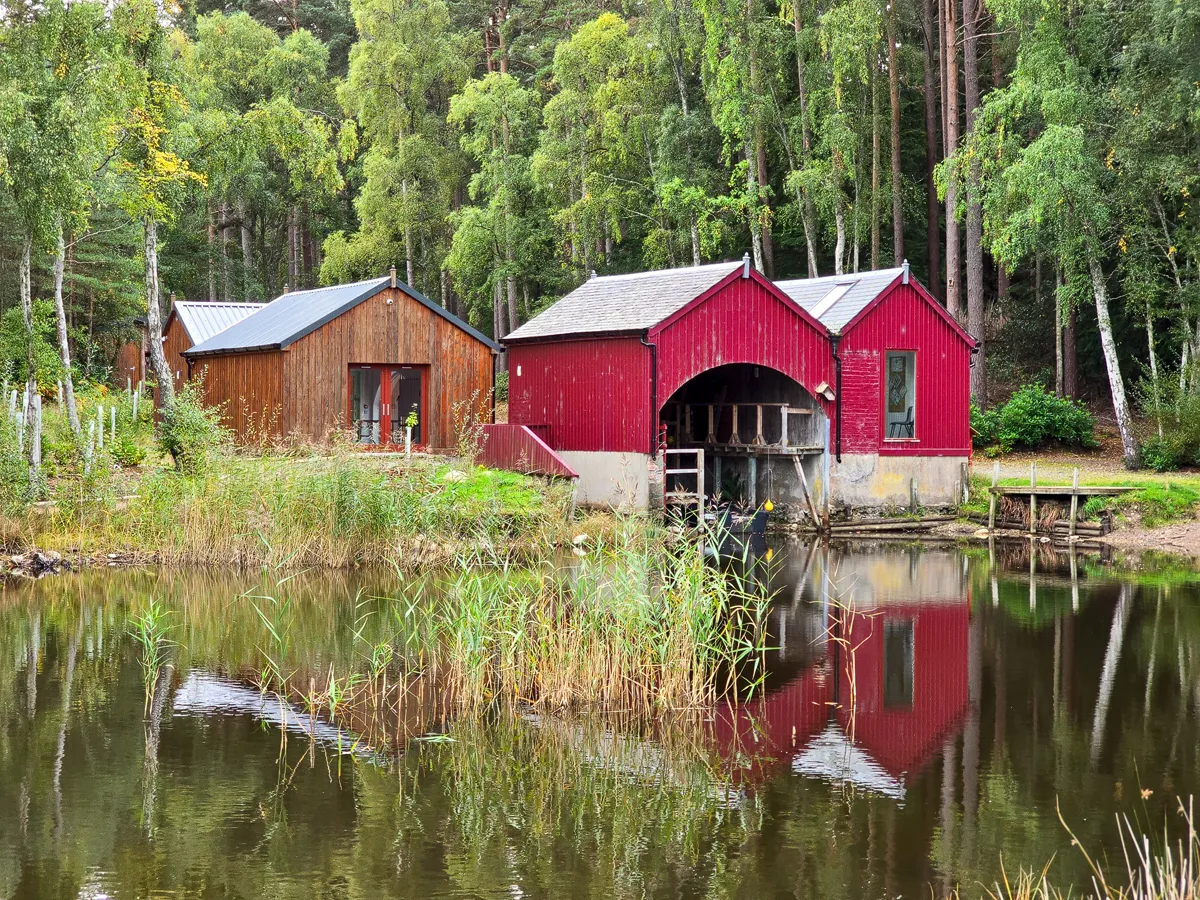
The highlight of the walk for me was the boathouse at the southern end of the loch. As you come along the path through the birches, the bright red timber suddenly appears through the trees, and it really is a striking sight.


The building combines the arched boathouse, with a hire boat moored inside, and the restored bothy where John Main and Robert Murray built their fireplace in 1896. The reflections in the still water of the boat channel are wonderful, and I spent quite a while trying to get the perfect shot. Beside it stands a newer timber-clad building, part of the Friends’ growing field study centre.


There is a picnic area on the peninsula beside the boathouse, and this would be the ideal spot to stop for lunch. A short wander from here, in the woods, is the Squirrel Hide, where the volunteers have built a natural-looking feeding area from storm-blown birch branches. If you have time, it is well worth a visit for the chance of seeing red squirrels and crested tits.
The Swan and Osprey Hides
From the boathouse area a sturdy wooden boardwalk with handrails leads out through the reeds and willow to the Swan Hide. This is the most accessible of the three hides, and the boardwalk is wide enough for wheelchairs and pushchairs. The bridge at the end of the boat channel is named the Jimmy Rooney Bridge, after the father of one of the Friends, who generously funded it.


The Swan Hide sits on a small wooded island at the southern end of the loch, with views stretching north across the water. Part of the bench lifts up so that a wheelchair can be wheeled right up to the window, which is a thoughtful touch.

Continuing up the eastern side, we took another detour out to the Osprey Hide. This is the largest of the three, with room for six to eight people, and it faces west so that the early morning sun rises behind it. The location was chosen with the local ospreys in mind, as they do most of their fishing in the morning. Look out for the lovely carved osprey plaque by the entrance.

Back to the Car Park
The final stretch follows a narrow path along the edge of a field on the eastern side before rejoining the woodland track back to the north car park. By now the sky had clouded over a little, but it remained dry and mild.

Our Route and Walk Time
Our full circuit from the north car park, including detours out to all three bird hides and the boathouse, came to a little over 2 miles (about 3.5 km). It took us just under 50 minutes at a relaxed pace of around 2.6 mph, with only about 100 feet of gentle ascent. It is easy walking with no steep sections, though some parts of the path can be soft and muddy after rain, so sturdy shoes or walking boots are a good idea.

After our walk we hopped back in the car and drove a short distance south to Logie Steading, which made a perfect end to a lovely afternoon.
Videos from Loch of Blairs
Frequently Asked Questions about Loch of Blairs
Is Loch of Blairs free to visit?
Yes. Loch of Blairs is free to visit and open all year round. The paths, hides and picnic areas are looked after by the volunteer charity Friends of Blairs Loch, and there is a donation slot at the information board by the north car park if you would like to support their work.
Where do you park for Loch of Blairs?
The main free car park is on the north side, just off the single-track road that links the A940 Forres to Grantown road with Mannachie Road at Dallas Dhu. The what3words address is putty.merchant.electrode. From there it is around 500 metres through the woods to the loch. There are also a few spaces near the boathouse at the southern end, reached by the track past the Altyre Estate Office.
How long does it take to walk around Loch of Blairs?
Our full circuit from the north car park, including detours to all three bird hides, was a little over 2 miles (about 3.5 km) and took just under 50 minutes at a gentle pace, with around 100 feet of ascent. Allow an hour or more if you want to linger in the hides or stop for a picnic.
Are dogs allowed at Loch of Blairs?
Yes, dogs are welcome. Please keep them under close control, especially around the hides, the water’s edge and the Squirrel Hide feeding area, and take any mess home with you.
Is Loch of Blairs wheelchair accessible?
Partly. The boardwalks around the boathouse lead to the picnic area and the Swan Hide, which has a wheelchair-friendly access path and a section of bench that lifts up to make room for a wheelchair. The rest of the circuit is on earth and woodland paths with roots and some soft, muddy sections after rain, so it is not suitable for wheelchairs all the way round.
Are there toilets or a café at Loch of Blairs?
No. There are no public toilets or café facilities at the loch. The toilets at the boathouse are only for groups hiring the Bothy or Stable Room. The nearest facilities are in Forres, about 4 miles away, or at Logie Steading, a short drive to the south.
What wildlife can you see at Loch of Blairs?
Red squirrels are seen regularly, and pine martens and otters occasionally. Resident birds include mallards, moorhens, coots, herons and little grebes, with swans, tufted ducks, mandarin ducks and ospreys visiting. Crested tits, woodpeckers, jays and crossbills come to the feeders at the Squirrel Hide, and dragonflies can be seen over the water well into autumn.
Key Information
- Location: Altyre Estate, about 4 miles south of Forres, Moray IV36 2SQ
- Grid Reference: NJ 0250 5615 (north car park); loch centre NJ 0218 5550
- what3words (car park): ///putty.merchant.electrode
- Managed by: Friends of Blairs Loch (SCIO SC048921), on land belonging to the Altyre Estate
- Entry: Free, open all year (donations welcome)
- Parking: Free north car park off the minor road between Dallas Dhu and the A940; a few spaces near the boathouse at the southern end
- Walk: Circuit of a little over 2 miles including the hides, around 50 minutes; about 100 feet of ascent
- Facilities: Three bird hides (Otter, Swan and Osprey), Squirrel Hide, picnic tables, viewpoints and benches, pond-dipping area. No public toilets or café
- Fishing: Catch-and-release fly fishing from a hired boat, £25 per session for up to 2 anglers; book via blairsloch@gmail.com
- Accessibility: Boardwalk and wheelchair-friendly Swan Hide near the boathouse; the rest of the circuit is on uneven woodland paths
- Dogs: Welcome, under close control
What Else is Nearby?
Logie Steading
Just a few miles south off the A940, Logie Steading is a beautifully converted farm courtyard with a café, independent shops and an art gallery, plus the lovely Logie House gardens and riverside walks along the Findhorn. It is where we headed after our walk, and it makes a great pairing with Loch of Blairs.
Randolph’s Leap
A short walk from Logie, Randolph’s Leap is a dramatic, narrow gorge on the River Findhorn with a fascinating legend and markers showing the height of the Muckle Spate of 1829. Take care near the edge, as the rocks are steep and the water is fast.
Sueno’s Stone
On the eastern edge of Forres, Sueno’s Stone is the tallest surviving Pictish carved stone in Scotland, standing more than six metres high in its protective glass enclosure. Its battle scenes are remarkable.
Nelson’s Tower
Crowning Cluny Hill above Forres, Nelson’s Tower was built in memory of Admiral Lord Nelson and offers wonderful views over the Moray Firth when it is open in summer.
Brodie Castle
Around 15 minutes’ drive away, Brodie Castle is a National Trust for Scotland property with fine interiors, a famous daffodil collection and the Playful Garden, which is brilliant for children.
Final Thoughts
Loch of Blairs was exactly what Janette and I needed: an hour of fresh air, gentle walking and genuine peace and quiet, without having to travel far from home. It is a wonderful example of what a dedicated group of volunteers can achieve. A neglected, overgrown loch has become a place that families, walkers, birdwatchers, photographers and anglers can all enjoy.
With its wooden walkways, picnic tables, bird hides and that gorgeous red boathouse, it is ideal for families and anyone wanting to slow down and reconnect with nature. If you are passing through Forres, or exploring Speyside and the Findhorn valley, I would thoroughly recommend setting aside an hour or two for a wander around this little gem.


Leave a comment below